
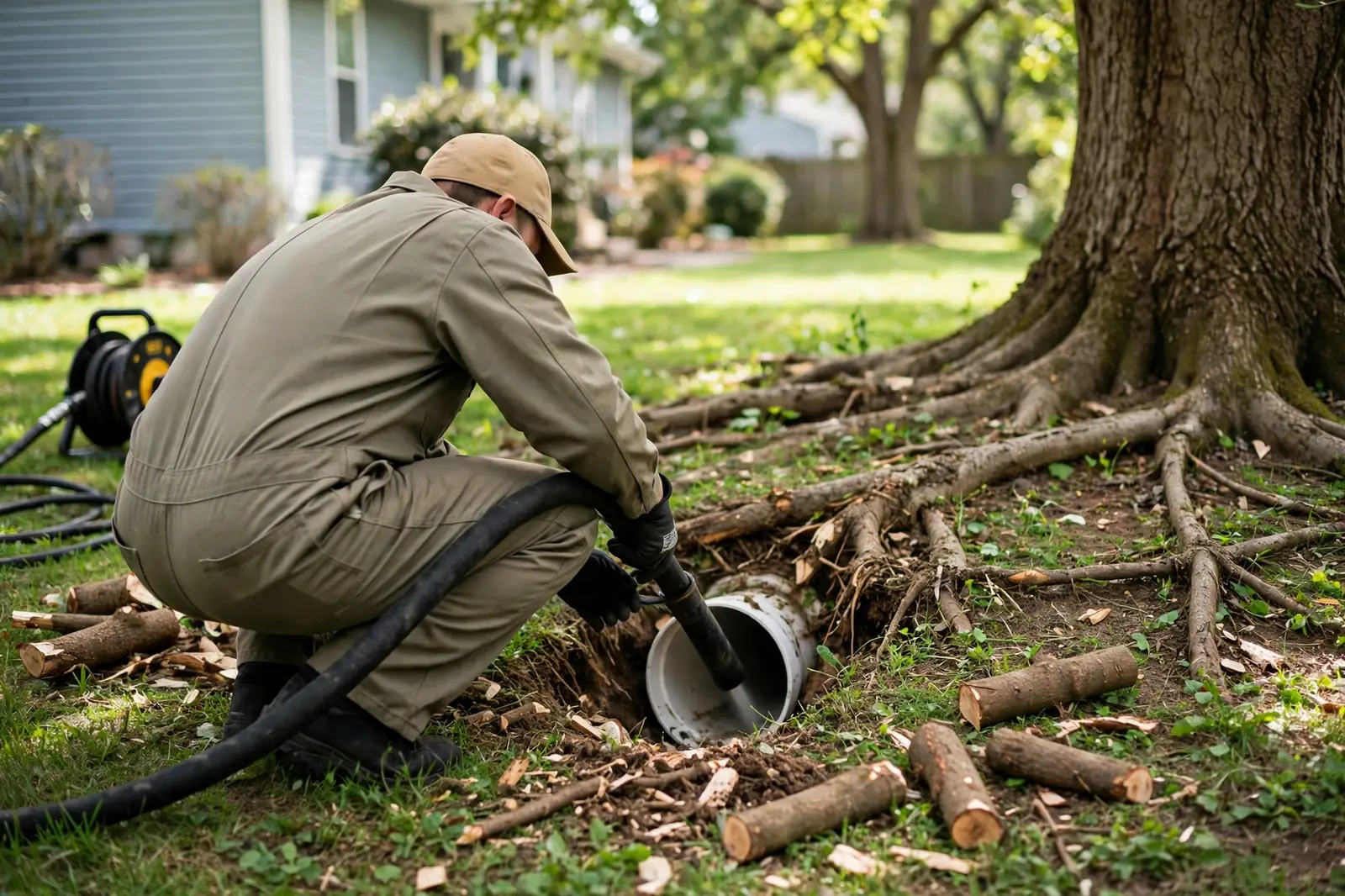
Hydro Jetting for Tree Roots
A tree in the yard and a sewer line under it are on a collision course that plays out slowly, underground, out of sight. This guide explains how roots get into a pipe, what the yard and the drains show while it happens, and how jetting cuts the roots out. Call (833) 878-1592 to book a camera survey.
Updated 2026-11-18. Prices shown are estimates only.
Why roots head for a sewer line
Roots grow toward moisture, and a sewer line is a steady source of it. Even a sound pipe gives off a little vapour through its joints, and a root tip nearby senses it and grows in that direction. The finest strand can pass through a gap no wider than a hair, and once it is inside, it finds water and nutrients in abundance, so it thickens quickly.
The tree above ground gives no warning. It looks healthy, it grows well — in part because its roots are drinking from the sewer — while below ground its roots are branching along the inside of the pipe. The first sign of trouble is rarely in the yard; it is in the drains, months or years after the first strand slipped in.
The joints that let roots in
Clay pipes are the most open to roots, because they are made of short sections joined together, and every joint is a gap. Older plastic and iron pipes have joints too, and soil movement over years can open them a little wider. A modern pipe with sealed joints and few connections is far harder for a root to enter, which is why a new line rarely has a root problem and an old clay line so often does.
Depth matters as well. A shallow line sits in the root zone of most trees, while a deep line is below the bulk of the roots. If you know your line is clay and shallow, and a large tree stands over it, the question is not whether roots will get in, but when — and a camera survey every year or two is the way to catch them early.
Yard clues: what to look for outside
The yard does give clues, if you know where to look. A patch of lawn over the line that grows faster and greener than the rest is fed by moisture leaking from a joint. A soggy patch that never dries, even in a dry spell, points the same way. A dip in the ground above the line can mean soil has washed into a cracked pipe.
Walk the line of the sewer — from the house to the street, roughly where the cleanout sits — and look for those patches. Note any large tree whose canopy reaches over that line, and how close its trunk stands. That walk, once a year, is the cheapest root survey there is, and it tells you when a camera look is worth booking.
Drain clues: what to look for inside
Inside, the signs are the familiar sewer ones, with a seasonal twist. Drains slow across the home, a toilet bubbles when the washing machine runs, and a blockage returns a few months after a clearing. The twist is timing: if the line blocks every spring or summer, when roots grow fastest, and stays clear through winter, roots are a likely cause.
A blockage that returns after a snake job is another pointer. A snake bores a hole through a root mat and leaves the mat behind, so the hole closes again. Jetting cuts the mat and washes it out, and the camera shows the joint the roots came through, so the cause is no longer a guess.
The cutting head: how roots are removed
A root job needs a different head from a fat job. The cutter spins as water drives it, and its blades shave through root strands while the hose moves forward a little at a time. The wash jets behind it carry the cut pieces on toward the street main. An operator who hurries the head risks jamming it in a dense mat, so the work is deliberately slow.
Once the bore is open, the lens goes back in for a last look. A clean cut leaves the walls visible and the pipe open, with only short root ends showing at the joint where they entered. If the mat is very dense, or the roots have pushed a joint out of place, the operator may clear what can be cleared safely and then show you the pictures, rather than forcing the head through a stretch that is no longer sound.
Why roots grow back, and how fast
Cutting takes the roots out of the pipe, but the gap they came through stays open. The tree is still overhead, the damp is still in the soil, and fresh strands will find the same opening again. The pace depends on the tree and the season, and a year or two is a common interval, with fast-growing trees over old clay lines returning sooner.
That is the plain limit of cutting: it treats the symptom, not the opening. Some owners settle for a regular cut while the pipe keeps its shape, and that works. Others decide to close the opening for good by replacing the weak stretch. The lens pictures are what let you weigh those two choices with facts in front of you, rather than guessing at the state of the pipe.
When a root line needs repair, not a cut
A cut is the right answer while the pipe is still round and sound. It stops being the right answer when roots have split a stretch, pushed a joint out of line, or filled the bore so thickly that cutting cannot open it again. In those cases the pictures tell the story, and the next step is a repair plan rather than another cut.
The simplest repair is to dig down and swap the damaged stretch for a modern pipe with sealed joints. Another choice is a sleeve fitted inside the old pipe, which seals the joints from within and suits a pipe that is still round but leaks at its joints. Which fits depends on the pictures, the depth of the line, and what sits above it in the yard.
Trees, planting and living with the line
When you plant, keep large trees well clear of the sewer run. You can find the run from the survey pictures and the position of the cleanout, and a tree planted clear of that line is a tree that will never trouble it. A small shrub over a line is a lesser risk than a large tree, but any planting over a shallow clay run deserves a second thought before the spade goes in.
For a tree that is already standing, do not reach for root-killing chemicals as a first step. They can harm the tree, the soil and the pipe, and they do nothing about a mat that has already formed. A mechanical cut clears the line, a survey shows whether the pipe needs a repair or only a regular check, and that order keeps both the yard and the line in better shape.

Which trees are the worst for sewers
Not every tree is an equal risk. Fast-growing, water-loving trees — willows, poplars, silver maples and elms among them — send out wide, thirsty root systems that find a sewer line quickly. Slow-growing trees with modest roots are a lesser risk, though any large tree over a shallow line deserves watching. The species matters less than the combination: a thirsty tree, a shallow line and old joints together are the risky case.
If you are choosing a tree for a yard with a sewer line, ask a local nursery or arborist which species suit the spot, and plant with the line in mind. The International Society of Arboriculture publishes plain guidance on planting the right tree in the right place, and a few minutes with it can save years of drain trouble.
How deep do roots go, and how deep is the line
Most tree roots live in the top few feet of soil, where the water and air are, and that is exactly where most sewer lines run. A line buried two or three feet down sits squarely in the root zone of a large tree. A deeper line, four feet or more, is below the bulk of the roots, though a thirsty tree can still reach it in a dry spell.
Depth is one reason a new line is usually buried deeper and bedded in gravel, which drains well and gives roots less reason to linger. If your line is shallow and old, the camera survey is the tool that tells you how much of a risk that is. The footage shows the joints, the gaps and the root ends, and that is a better guide than any guess about depth.
The camera survey: what the footage shows
The camera survey is the heart of a root job, because it turns a guess into a picture. The lens travels the line from the cleanout and shows the root mass, the joint it came through, and the distance along the run where it sits. It also shows the pipe itself: whether it is round, whether a joint has shifted, and whether the walls are sound enough to jet.
Ask the crew to talk through the footage as it plays, and ask for a copy to keep. The pictures show which joint is the entry point, how thick the mat is, and whether the pipe needs a cut, a repair or only a watch. A survey done in late summer, after the growth season, gives the clearest picture of the year. See sewer camera inspection for what the survey covers.
Root cutting vs chemical treatment
Foaming root killers and copper-based treatments are sold for sewer lines, and they do kill the roots they touch. But they do not remove a mat that has already formed, and they do not close the gap the roots came through. A dead mat left in the pipe still blocks the flow, and it still catches paper and grease.
There are also downsides: the chemicals can harm the tree, the soil life around it, and the pipe itself, and on a septic system they can disturb the tank. The safer order is mechanical first — cut the mat, wash it out, and look at the pipe — and only then discuss whether any treatment has a place. A treatment applied to a clean line, on professional advice, is a different matter from a chemical poured into a blocked one.
What happens if roots are ignored
Roots left alone do not stay a small problem. The mat thickens, the bore narrows, and the line blocks more often and more completely. Paper and grease catch on the mat, so each blockage is worse than the last. In time the roots can push a joint out of line or split a weak section, and soil can wash into the pipe through the gap, leaving a dip in the yard above.
The worst case is a backup into the house, usually at the lowest fixture, and a line that can no longer be cut open because the pipe itself has failed. None of that happens overnight, which is why a yearly walk of the yard and a survey every year or two are worth the effort. A root problem caught early is a small job; a root problem found by a backup is a large one.
The main line vs the branch: where roots strike
Roots usually strike the main line first, because it is the longest run, it carries the most water, and it passes under the yard where the trees are. The branch lines inside the house — the kitchen, the bathroom — are shorter, deeper under the building, and further from the trees, so they rarely see roots.
That distinction matters for diagnosis. If only the kitchen is slow, the cause is fat in the kitchen branch. If the whole house slows at once, and the lowest drain is the first to show it, the main is the likely site, and roots are a strong suspect where trees stand over the run. The camera look should travel the main, not just the branch, when the symptoms point that way.
Roots in a septic system
A septic system has its own root problem, and it sits in the drain field rather than the sewer line. The field is a network of shallow pipes in gravel, spread through soil that is kept damp by the treated water leaving the tank. Tree roots love that damp, gravelly ground, and they can fill the field pipes just as they fill a sewer.
The signs are a soggy field, slow drains across the house, and a tank that needs emptying more often than it should. Jetting can clean the house lines on a septic system, but the field itself needs a different approach, and a crew should be told about the septic system before they arrive. Keep large trees well clear of the field, and never plant over it.
Insurance and root damage
Whether insurance covers root damage depends on the policy, and the answer is rarely simple. Many policies treat gradual damage — roots growing into a pipe over years — differently from sudden damage, such as a pipe that bursts in one event. Some policies cover the water damage a backup causes but not the pipe repair itself. The only way to know is to read the policy and ask the insurer.
Whatever the policy says, the camera footage is the document that matters. It shows when the damage was found, what it looks like, and whether it is a sudden break or a slow invasion. Keep the footage and the dates together, and share them with the insurer before any repair is booked, so the claim is built on pictures rather than memory.
Replacing the weak stretch: the options
When a weak stretch must be replaced, there are usually two ways to do it. The open-cut method digs down to the pipe, removes the damaged section, and lays a modern pipe with sealed joints in its place. It is straightforward, it lets the crew see the whole run, and it suits a shallow line in open ground. The cost is the digging, and the yard above it.
The other way is a liner: a sleeve fitted inside the old pipe that seals the joints from within. It suits a pipe that is still round but leaks at its joints, and it needs little digging. It does not suit a pipe that has collapsed or shifted out of line. The camera footage decides which fits, along with the depth of the line and what sits above it in the yard.
Living with a big tree you love
A big tree you love is worth keeping, and in most cases it can stay. The deal is a regular cutting schedule: a survey every year or two, a cut while the strands are thin, and a watch on the pipe's shape. A sound pipe and a loved tree can live together for decades on that routine, and the cost of a scheduled cut is small against the cost of losing the tree.
A root barrier — a solid sheet sunk into the soil between the tree and the line — is another option, and it is worth discussing with an arborist before it is fitted. It can redirect roots away from the line, but it must be placed with care, because a barrier that cuts a tree's main roots can harm the tree. The arborist, not the plumber, is the right person to advise on that.
After the cut: the first year
The year after a root cut is the test of the schedule. In the first months the drains should run freely, and the seasonal pattern should ease: the line that blocked every summer should stay clear through the next one. If it blocks again within months, the mat was not fully removed, or the pipe itself is failing, and the crew should be called back to look.
Keep the footage from the cut and the date together, and book the next survey for late summer, after the growth season. If the new strands are thin, the schedule is working. If they are thick again after a single season, the interval is too long or the pipe needs a repair. That record, built year by year, is what turns root care from a guess into a routine.
A yearly routine for a root-prone line
Here is a routine for a home with trees near the line. Once a year, walk the line and look for green patches, soggy ground or dips. Every one to two years, book a camera survey, ideally in late summer after the growth season, and cut any strands while they are thin. Keep the footage and the dates on file.
That routine costs far less than a backup, and it keeps the decision in your hands: cut on schedule while the pipe is sound, or replace the weak section when the footage says the time has come. A root problem caught early is a small job; a root problem found by a backup is a large one. For the wider picture on timing, see how often to hydro jet.
Signs you may need hydro jetting
- A strip of lawn above the line grows greener than the grass around it.
- The ground stays damp over the sewer run long after rain.
- Drains run slowly through spring and summer, then ease in winter.
- A sewer blockage comes back a few months after it was cleared.
- A toilet gurgles when the washing machine empties.
- A tall tree stands with its canopy over the sewer line.
- A dip has appeared in the ground above the sewer run.
- The same line blocks every spring or summer.
How it works
- 1
First — Walk the yard
Once a year, walk from the house to the street along the sewer run and look for green strips, damp ground, dips and trees standing over it.
- 2
Next — Note the trees and the timing
Note which trees stand over the run and whether the blockages follow the growing season, since that pattern points to roots.
- 3
Then — Survey and cut
Book a lens survey, ideally in late summer, and have any root strands cut with a spinning head while they are still thin.
- 4
Last — File the pictures
Keep the footage and the dates together, so the next survey can be timed from what the pipe shows rather than from a guess.
What does it cost?
What root cutting usually runs to, by mat thickness and position along the run. Typical ranges, shown as estimates.
| Service | Typical range (estimate) | Notes |
|---|---|---|
| Root cutting with jetting | $400 – $900 | Root mat in the line |
| In-pipe camera survey | $150 – $350 | Often bundled in |
| Sewer line jetting | $350 – $900 | House to street main |
Prices are estimates only. The local company that does the work sets its own final pricing.