
How Often Should You Hydro Jet?
There is no single calendar answer to how often a home needs jetting. The right timing depends on the house, the trees, the kitchen, and what the camera shows. This guide works through each factor so you can set a timing that fits your home, not a generic schedule. Call (833) 878-1592 for a camera check.
Updated 2026-11-18. Prices shown are estimates only.
The honest answer: there is no set schedule
Most homes never need jetting on a fixed timetable. A home with new plastic pipe, no trees near the sewer line, and a kitchen that keeps fat out of the sink may go many years without a clean. A home with old clay pipe under a large tree and a busy kitchen may need attention every year or two. The difference is the load on the pipes, not the calendar.
That is why a guide that says jet every twelve months is misleading. The trigger should be evidence: drains that keep slowing, clogs that return, or a camera picture that shows heavy coating. Book when the evidence says so, and the money is spent on a real problem, not a date on a calendar.
Homes that need it more often
Three features push a home toward more frequent cleaning. The first is trees: a large tree over or near the sewer line sends roots into joints, and those roots grow back after every cut, so a survey every one to two years is sensible. The second is a busy kitchen: a household that cooks daily, fries often, and washes greasy pans will coat its kitchen line far faster than a household that eats out.
The third is old pipe. Clay pipe with many joints, and old cast iron with a rough, scaled interior, both narrow faster than smooth modern plastic. If your home has any of these three, do not wait for a backup: a camera look every year or two catches the buildup while it is still easy to clear.
Homes that need it rarely
At the other end are homes with smooth plastic pipe throughout, no trees within reach of the sewer line, and light kitchen use. Their drains may stay clear for years, and jetting them on a schedule would be money spent on a clean pipe. The same goes for a home that has just had a full clean and a closing camera picture showing clean walls: the clock restarts from that picture, not from the date of the last clean.
A single slow sink in such a home is usually a local problem — a trap, a hair clog, a small branch — and it does not mean the whole system needs jetting. Fix the local problem, watch the other fixtures, and only think about a full clean if several fixtures slow together.
Signs that the time has come
The signs are the same ones that point to jetting in the first place, and they matter more than any date. Drains that slow again within weeks of being cleared, several fixtures slowing at once, gurgling when a toilet flushes, and a smell that returns around a low drain — each of these says the pipe walls are coated again and a clean is due.
The most useful sign is the repeat. A clog that returns after a snake job is telling you the walls were never cleaned, and a second snake will leave the same coating behind. When the same drain blocks twice in a few months, stop clearing the plug and clean the walls: that is the point at which jetting earns its keep.
What the camera says about timing
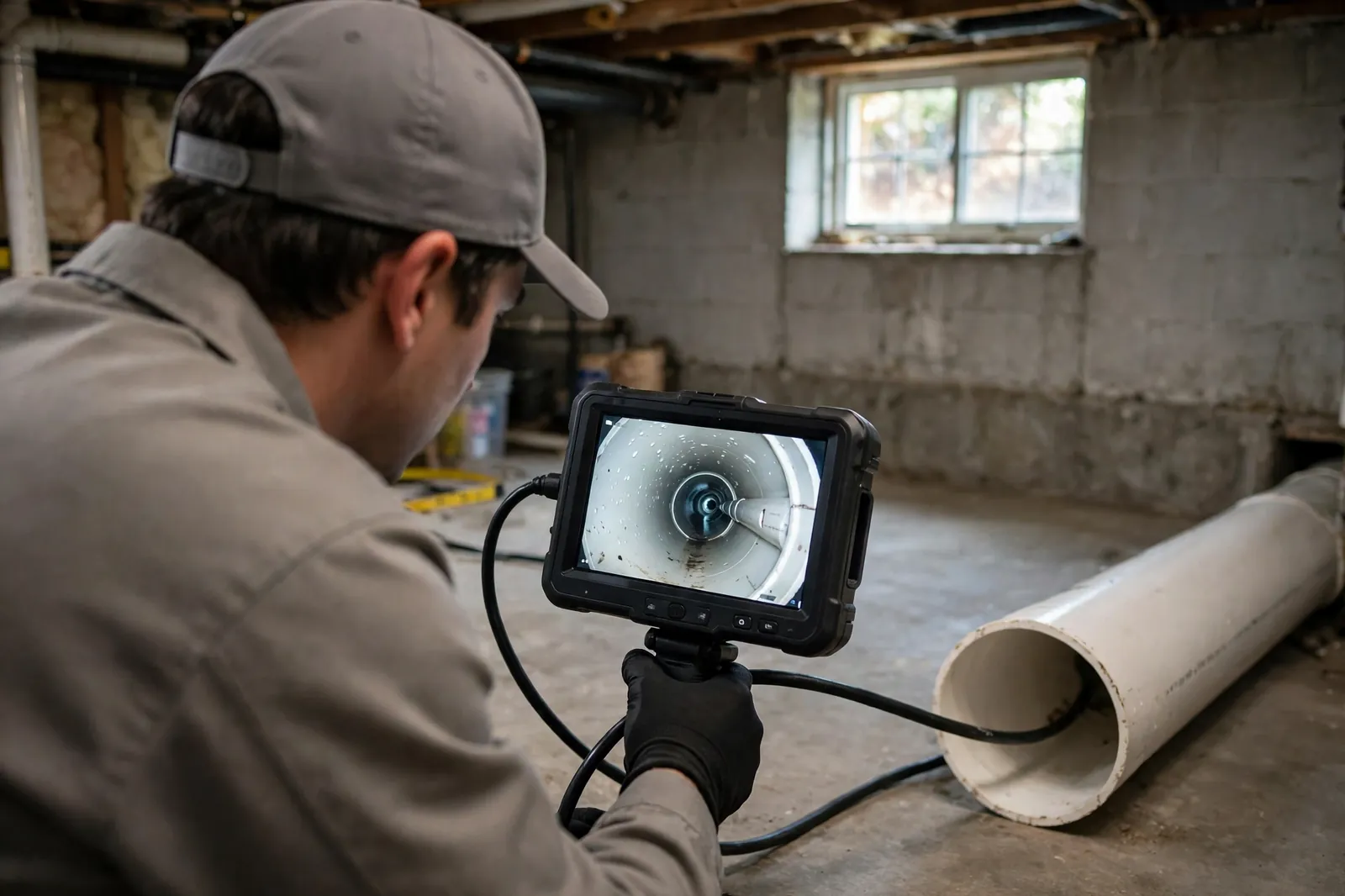
The camera is the best timing tool there is. After a clean, the closing picture shows the walls; a year later, another look shows how much coating has returned. If the walls are nearly clean after a year, the interval can stretch. If they are heavily coated after six months, it should shrink. Two or three such looks build a pattern for your home, and the pattern replaces guessing.
Ask the crew to date the footage and to note the worst stretch. Over time you will know which run loads up first — the kitchen line, the main, the stretch under the tree — and you can time the next clean to that run, rather than jetting the whole system every time.
Kitchens, trees and old pipe: three clocks
Think of it as three separate clocks. The kitchen clock runs on fat: the more cooking, the faster it ticks. The tree clock runs on seasons: roots grow fastest in spring and summer, so a survey in late summer catches the year's growth. The old-pipe clock runs on scale: mineral crust builds slowly and steadily, year after year, and it shows on the camera as a rough, narrowing bore.
Each clock has its own timing, and they rarely agree. A home may need its kitchen line yearly and its main line every three years. The camera lets you run them separately, cleaning the run that needs it and leaving the rest alone, which is cheaper and less disruptive than a whole-system clean on a single date.
Rentals, landlords and shared drains
Landlords face a different timing question, because they cannot see the drains day to day. A sensible approach is a camera look between tenancies, or when a tenant reports a repeat clog, rather than a fixed annual clean. A look between tenancies catches a coated line before the next tenant inherits it, and the footage is a record of the pipe's condition at handover.
Shared drains in flats or multi-unit buildings need a conversation with the other owners or the management company, because the shared main belongs to everyone it serves. If one flat's kitchen is coating the shared line, the cost and the timing should be agreed together, not left to whoever notices the backup first.
Seasonal timing: does the time of year matter
Any time of year works for jetting, because the job is done on demand when a drain needs it. There are two mild seasonal notes. First, roots grow fastest in the warm months, so a root-prone line is best checked in late summer or autumn, after the growth season. Second, a line that is going to block over the holidays, when the house is full and the kitchen is busy, is better cleaned before the holidays than during them.
Winter does not stop jetting: the water in the hose is under pressure and moving, so it does not sit still long enough to freeze, and indoor access points are unaffected by cold ground. A frozen ground surface can slow access to a buried outdoor cleanout, but that is a matter of digging, not of the jetting itself.
A simple plan for your home
Here is a plan that fits most homes. After a first clean, keep the closing camera footage and note the date. Watch the fixtures: if several slow together, or the same drain blocks twice, book a camera look. If a year passes with no symptoms, consider a look anyway if you have trees near the line or old clay pipe; otherwise, leave it.
That is the whole plan: clean on evidence, check on a pattern, and let the camera set the interval. It spends money only where the pipe shows a need, and it keeps a backup — the expensive, messy failure — from arriving unannounced.
The first clean: setting your baseline
The first jetting clean on a home is the most useful one, because it sets the baseline everything after it is measured against. Before the clean, the camera shows the state of the lines as they are: the coating, the scale, the roots, the joints. After the clean, the camera shows the same lines washed back to the pipe material. Those two pictures, filed with the date, are the record that makes every later decision easy. Without them, every visit starts from guesswork, and every quote is built on symptoms rather than evidence.
The baseline also tells you how fast your lines build up. A line that was heavily coated at the first clean and is coated again a year later builds fast, and it needs a shorter interval. A line that was lightly coated and is still clean two years later builds slowly, and it can wait longer. You cannot know which kind of home you have until the first clean is done and the second camera look is compared against it. Book the first clean with the camera before and after, keep the footage, and let the pictures — not a calendar — set the rhythm. The sewer camera inspection guide explains what a good inspection report contains, and the signs guide lists the symptoms that mean the time has come.
How the camera footage sets the next date
The camera footage is the only honest way to set the next cleaning date, because it shows the rate of buildup rather than a guess. A closing picture that shows bare pipe walls means the line is clean. A camera look a year later that shows a thin film means the line is building slowly. A look that shows thick coating or fresh root strands means the interval was too long. The footage turns a vague feeling — "the drains seem slower" — into a visible fact, and the interval is set from that fact.
The practical routine is simple. After a clean, note the date and file the closing footage. Twelve months later, run the camera again — not a full clean, just a look — and compare the two pictures side by side. If the walls are still mostly clean, push the next clean out by a year. If the coating is back, bring the next clean forward. Over two or three cycles, the right interval for your home reveals itself, and it will be based on your pipes rather than on a number from a brochure. A camera-only visit costs less than a full clean, and it saves you from paying for a clean a line does not yet need.
Homes with trees: the root calendar
Trees set their own calendar for drain cleaning, and it runs on the seasons rather than on the wall. Roots grow fastest in spring and early summer, when the tree is putting out new growth and seeking water. A fine root strand that enters a pipe joint in spring can become a thick mat by autumn, and a mat that was cut in winter can grow back through the same joint by the following summer. That is why a home with large trees near the sewer line often needs a shorter interval than a home with no trees at all — the roots do not wait for the calendar.
The camera is the tool that keeps the root calendar honest. A look in late summer shows how much the roots grew during the growing season, and a clean in autumn clears them before winter. A look in spring shows whether the winter cut held or whether new strands are already coming through. The long-term fix for roots is not cleaning but repair: a cracked joint or a broken section lets roots in, and the roots will keep coming until the pipe is fixed. Cleaning buys time, and the camera shows how much time you have. The root clearing page explains the options once the clean is done, and the main line jetting page covers the whole-home line where roots usually strike.
What happens if you wait too long
Waiting too long between cleans does not just mean slower drains — it changes the job itself. Grease that has been left for years hardens into a thick layer that needs more passes and a higher pressure to shift. Scale that has built up over a decade can narrow a cast iron pipe by a third, and the cleaning takes longer and costs more than it would have if the line had been cleaned on time. Roots left for several seasons grow into a dense mat that can block the line completely, and a blocked line can back sewage up into the lowest fixture in the house.
The cost of waiting shows up in the quote. A line cleaned every two years is a routine visit: camera, a few passes, closing footage, done. A line left for ten years is a project: a blocked line that has to be opened first, a mat that has to be cut, and a camera that may find a pipe damaged by the pressure of the buildup itself. The difference between the two is not the tool — it is the time. A regular interval, set by the camera and kept on the calendar, is the cheapest way to own a drain. It is also the calmest: a planned visit on a quiet Tuesday beats an emergency call on a Sunday night, in price and in stress.
A simple calendar for the first five years
If you are starting from scratch, here is a plain routine for the first five years. Year one: book the camera and the first clean, and file the before and after footage with the date. Year two: book a camera-only look and compare it with the closing footage from year one. If the walls are still mostly clean, wait. If the coating is back, book the clean. Year three: repeat the camera look, and let the two comparisons set your interval — one year, two years, or three. Year four and five: follow the interval the footage has shown you, and keep the file up to date with every visit.
Adjust the routine for your home. A house with big trees near the line gets a camera look every year rather than every two, because roots move faster than grease. A rental with changing tenants gets a look when the tenants change, because new habits can load a line fast. A home on a septic system gets a look before the tank is pumped, so the two jobs can be planned together. The routine is not a rule — it is a starting point, and the camera footage is what turns it into a plan for your pipes. Call (833) 878-1592 to book the first camera look and set the baseline for your home.
Signs you may need hydro jetting
- The same drain blocks twice within a few months.
- Several fixtures slow together after a period of clear running.
- A kitchen line slows again soon after a busy cooking period.
- A sewer line under a large tree has not been looked at in two years.
- Gurgling returns when a toilet flushes or a machine drains.
- The last camera picture showed heavy coating on the walls.
- A line that needed cleaning twice in one year.
- Roots found on two camera looks in a row.
- A kitchen line that slows every few months.
- A home with no clean in five years and trees overhead.
- A rental with repeat tenant complaints about drains.
- A line that clogs every holiday season.
How it works
- 1
Step 1 — Look at the last record
Find the date and the footage of the last clean, and note which run was worst and what the walls looked like afterwards.
- 2
Step 2 — Watch the fixtures
Note any repeat clog, any group of fixtures slowing together, and any gurgling or smell, since those are the triggers.
- 3
Step 3 — Let the camera set the date
Book a camera look when the signs say so, and set the next interval from what the new footage shows.
- 4
Step 4 — Put the next date on the calendar
When the crew leaves, put the next camera date on the calendar — twelve months out for most homes, sooner if the footage showed roots.
- 5
Step 5 — Re-check after a big change
Book a fresh camera look after a big change — new tenants, new trees planted, or a new appliance — because any of them can change how fast the line builds up.
What does it cost?
Timing is set by evidence, not by a calendar. Typical ranges for the work itself are shown as estimates below.
| Service | Typical range (estimate) | Notes |
|---|---|---|
| Branch line jetting | $250 – $550 | One sink or bath line |
| Main line hydro jetting | $350 – $900 | Whole-home line |
| Camera inspection with jetting | $150 – $350 | Often included |
Prices are estimates only. The local company that does the work sets its own final pricing.