
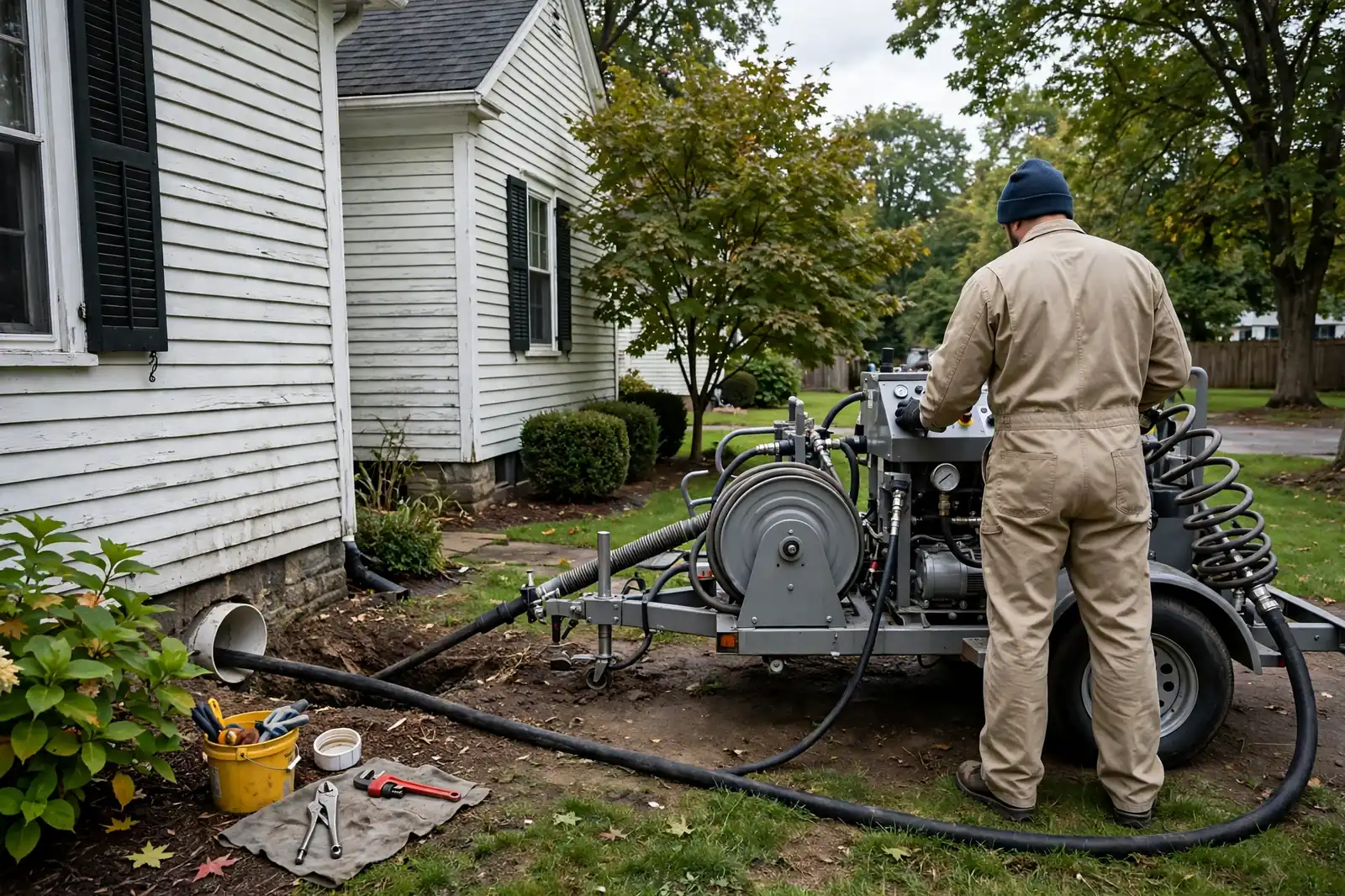
Sewer Jetting Services
A sewer line moves toilet waste and household wastewater from a building to the street main, and it blocks when grease, paper, wipes, scale and roots narrow it over years. Sewer jetting sends pressurised water through that line to cut the blockage away and wash it out. Phone (833) 878-1592 to arrange a survey and a clean.
Updated 2026-11-18. Prices shown are estimates only.
- $150–$900 Typical cost range
- 5 Steps in the visit
- 12 Questions answered
Before & after — sewer jetting
Before & after
Drag the slider to compare the same pipe before and after jetting.
Sewer Jetting
How a sewer line differs from an indoor drain
Indoor drains are short branches that serve one fixture. A sewer line is the long underground run that gathers them all and carries waste away from the building.
It runs under floors, yards and driveways, often at a shallow fall, so waste moves slowly and solids have time to settle. That slow fall is why sewer lines block more stubbornly than a kitchen sink: material sits, dries onto the walls, and builds into a crust.
Sewer lines are also the pipes most exposed to the outside world. Tree roots reach them through joints, soil movement shifts them, and ground water can seep in through cracks.
A problem here shows up across the whole building, not at one tap, and it needs a different kind of look — a long camera run from an outside entry point, not a glance down a sink.
Sewer Jetting
What blocks a sewer line most often
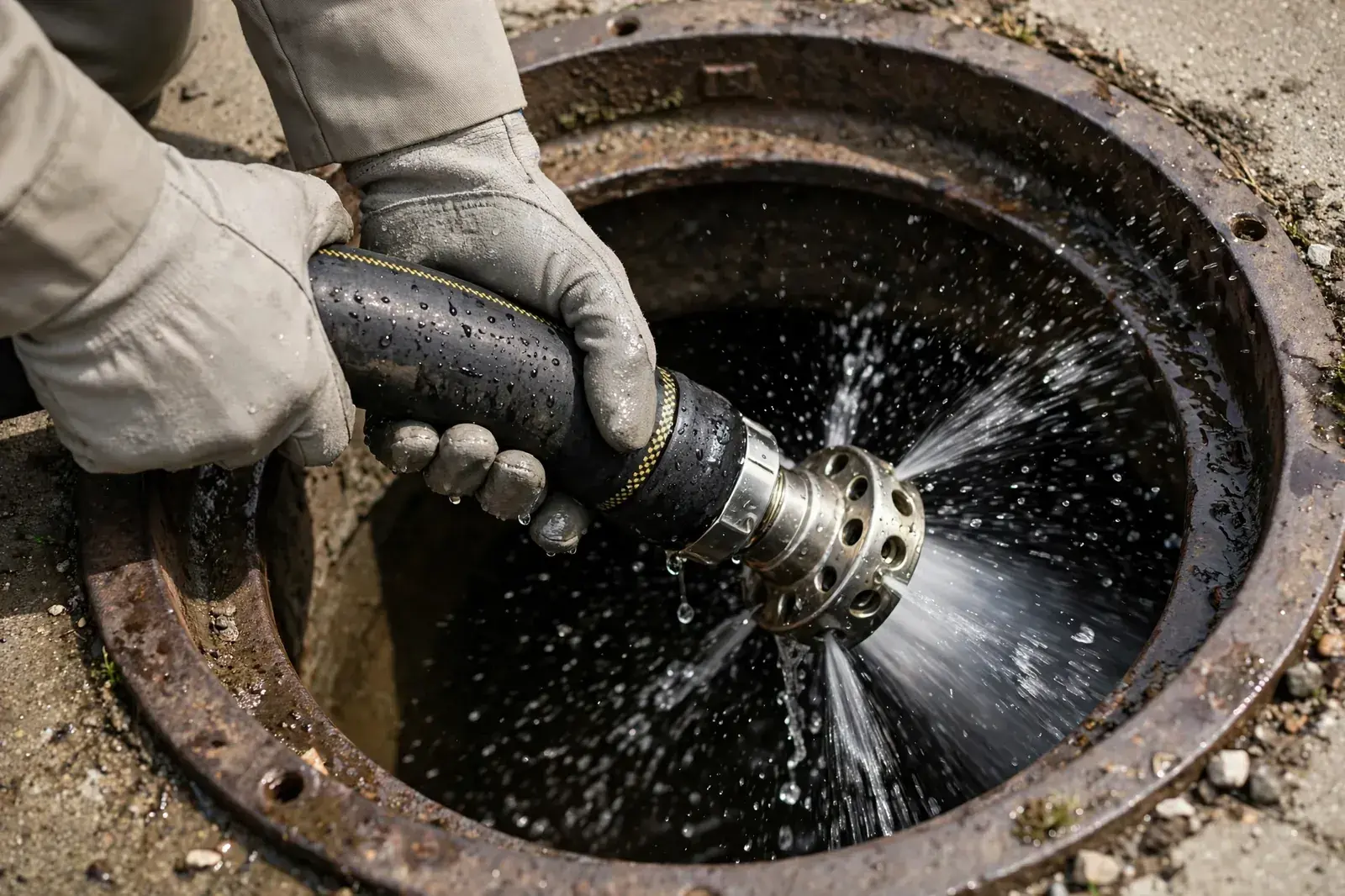
The usual mix is paper and wipes snagging on a rough patch, grease coating the upper walls, and mineral scale narrowing older metal pipe. Wipes are a frequent culprit even when the pack says they can be flushed: they do not break apart like toilet paper, they catch on joints and root strands, and they mat into a plug.
Feminine products, cotton buds and nappies do the same and should never go down a toilet.
Roots are the other big cause. A fine root strand enters through a joint, and the moisture inside the pipe feeds it until it thickens into a mat that traps paper.
Once that mat forms, ordinary flushing cannot shift it. A root-cutting nozzle on a jetting hose can slice the mat and wash the pieces out, but the joint that let the roots in stays open, so the line needs watching afterwards.
Sewer Jetting
Signs that the sewer line is the problem
The clearest sign is a backup at the lowest point in the building — a floor drain, a basement toilet or a ground-floor shower that fills when water runs elsewhere. Smell is another: a sewer odour that returns around low fixtures, especially after rain, points to waste sitting in a partly blocked line.
A toilet that flushes weakly in one bathroom while another works fine can mean a branch problem, but weak flushing everywhere points downstream.
Listen for gurgling too. When a washing machine drains and a nearby toilet bubbles, air is trapped by a blockage in the shared sewer run.
If several fixtures are affected at once, stop guessing at single drains and get the sewer line surveyed. A camera run shows the cause in minutes and stops a small blockage becoming a full backup.
Sewer Jetting
The survey that comes before any jetting
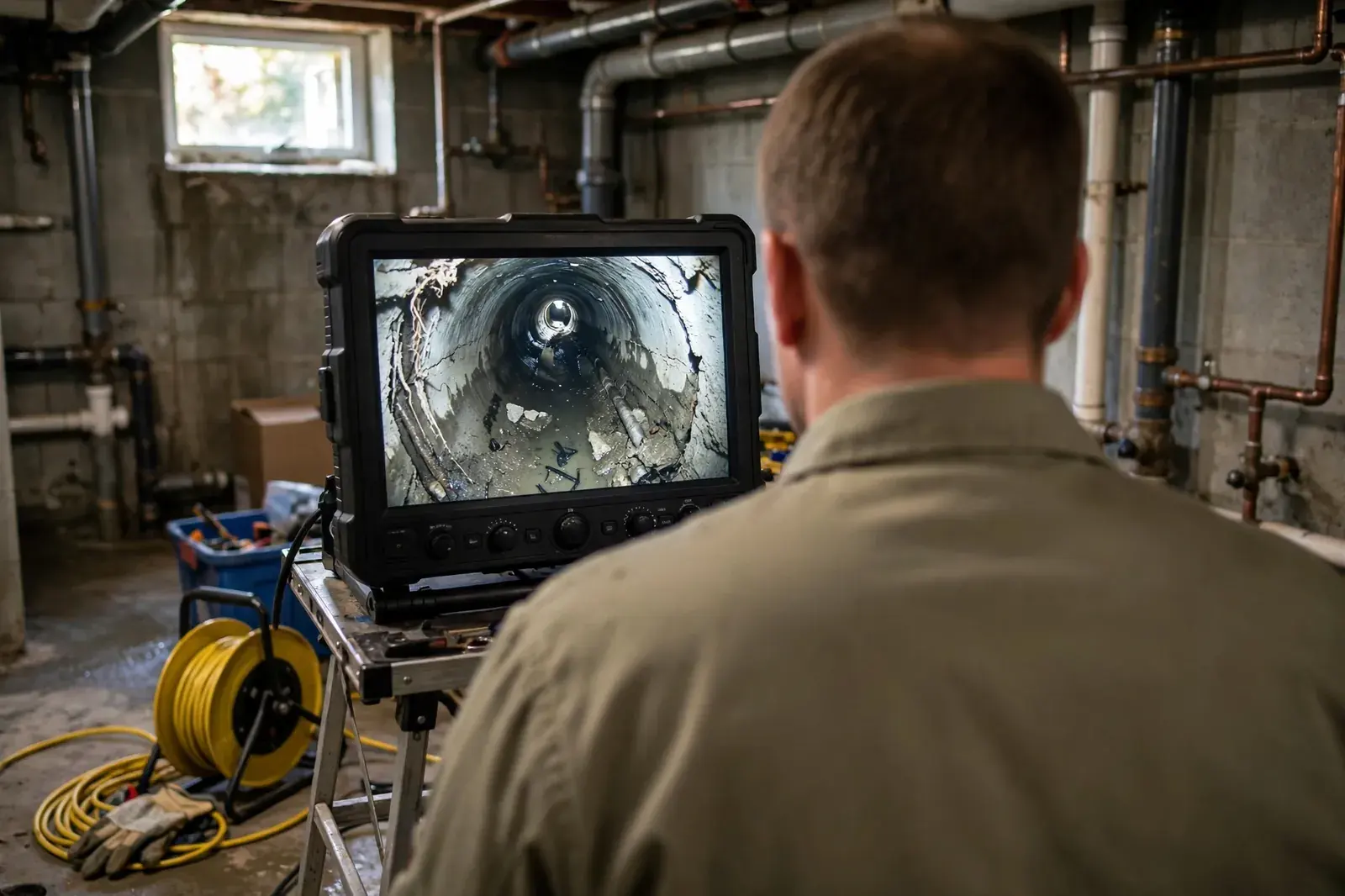
Every sewer job starts with an in-pipe camera survey. A waterproof camera on a flexible cable travels the line from a cleanout, and the operator watches the pipe interior on a monitor, calling out coating, roots, cracks, sags and standing water as the camera passes.
The footage is the basis for everything that follows: nozzle choice, pressure, and whether cleaning is even the right step.
A survey also finds damage that jetting cannot fix. A collapsed section, a pipe that has shifted out of line, or a joint that has opened wide will not be cured by water, however strong.
In that case the operator should stop, show you the footage, and talk about repair. Cleaning a broken sewer line at full pressure risks making the break worse and pushing waste into the surrounding soil.
Sewer Jetting
How the jetting pass works on a sewer run
With the survey done, the jetting hose goes in through the cleanout. The nozzle at its tip fires jets forward to cut through the plug and backwards to drag the hose along and flush debris toward the street main.
On a sewer run the operator works slowly, because the line is long and the worst buildup often sits far from the entry point, near the street connection.
Root mats get a spinning cutter head first, which slices the strands before the wash jets flush the pieces away. Grease gets hot water and repeated passes.
After the main pass, the camera goes back in to confirm the walls are clear and the water runs freely. That closing survey is the proof the job is done, and it is worth asking to see it.
Sewer Jetting
When a sewer line needs more than a clean
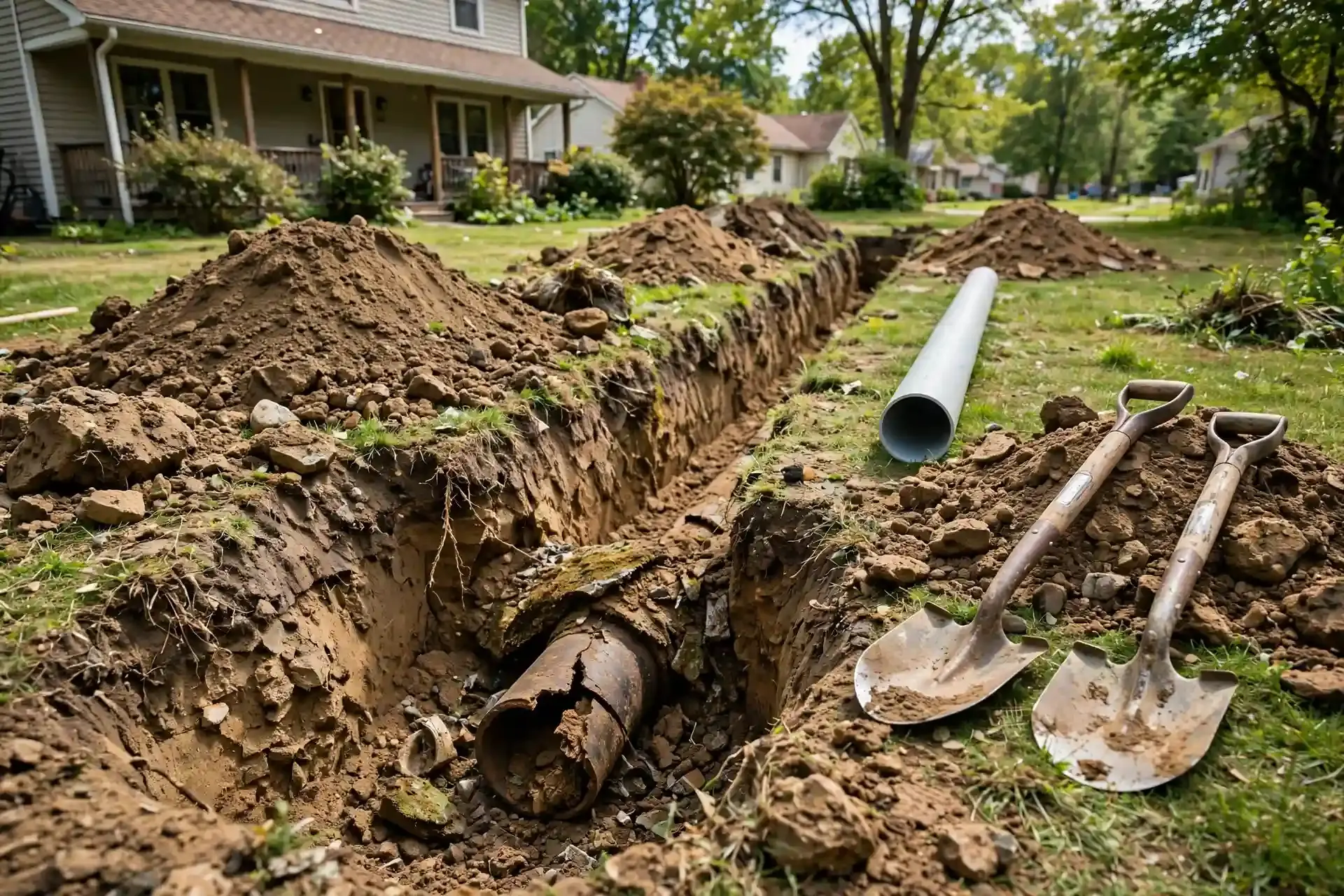
Jetting clears buildup, but it cannot fix shape. A pipe that sags in the middle holds standing water, and waste will settle there again within months.
A pipe with a wide-open joint will let roots back in. A cracked clay section will keep leaking and shifting.
In each case the survey footage tells the story, and the honest next step is a repair plan for that section, not another clean.
That does not make jetting wasted: clearing the line first is what lets a repair crew see the pipe properly and work in a clean line. It also buys time.
A cleared sewer line with a known weak section can often be managed with regular surveys until a repair is scheduled, rather than failing without warning on a busy weekend.
Sewer Jetting
How deep is a sewer line, and does depth matter?
A sewer lateral usually sits three to six feet below the surface, deep enough to stay below the frost line in cold climates and to keep a steady fall toward the street main. In warmer states it may sit shallower, and in hilly streets it can sit deeper where the ground drops away.
Depth matters when a repair is needed, because digging three feet down is a different job from digging eight feet down, and the cost rises with every extra foot of soil to move and shore up.
Depth does not change the jetting itself much, because the hose and camera travel down the pipe from the cleanout whatever the depth is. What depth does change is the entry point.
A shallow line often has a cleanout at ground level that is easy to find and open. A deep line may only be reachable from a basement cleanout or from the street end, and the crew may need a longer hose and a longer camera cable.
The depth also explains why a sewer problem is not a do-it-yourself job: the pipe is out of reach, out of sight, and the only way to see it is through a camera.
Sewer Jetting
What are the parts of a sewer lateral?
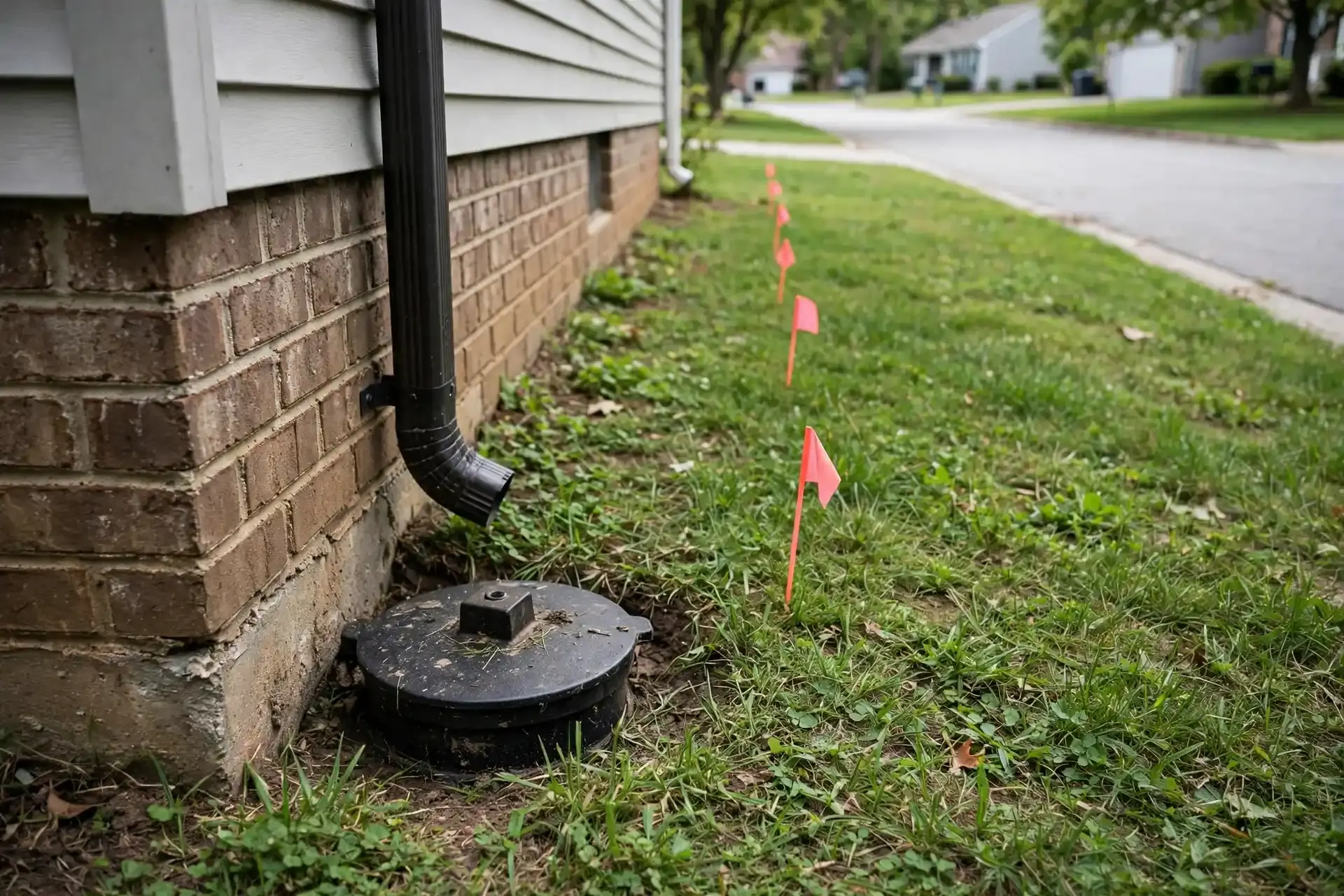
A sewer lateral has three parts, and each one can cause trouble in its own way. The first is the pipe under the house, where the branch drains join and the flow gathers.
The second is the run under the yard, the longest stretch, which carries the flow out to the property line. The third is the connection to the street main, a short section that joins the lateral to the big pipe under the road.
Blockages can form in any of the three, and the camera survey shows which one.
The joints between pipe sections are the weak points along the whole run. Older clay pipe comes in short lengths, so a fifty-foot lateral can have twenty joints, and each one is a place where the seal can fail and let roots in.
Plastic pipe comes in longer lengths with fewer joints, so it has fewer weak points, but its joints can still shift if the ground moves. The connection at the street is a common trouble spot too, because the street main is larger and the join can sit at an angle that catches paper.
Knowing the parts helps a homeowner follow the camera survey, because the crew can say which part the trouble sits in.
Sewer Jetting
How do wipes and paper cause a sewer blockage?
Toilet paper is made to fall apart in water. Within a minute of flushing it breaks into small fibres that flow easily through the pipe.
Wipes are made differently: they are woven to stay strong when wet, so they hold together through the whole run to the street. A single wipe usually passes, but wipes catch on any rough spot, a joint lip, a patch of scale, or a root strand, and each one that catches becomes an anchor for the next.
The mat that forms is a mix of wipes, paper, grease and hair, and it grows across the pipe until the flow slows and then stops. Grease makes it worse, because it coats the mat and glues it together.
The crew sees this on the camera as a pale, fibrous plug, and the jetting nozzle cuts it apart and washes it out in pieces. The fix is simple to say and harder to keep: flush only toilet paper, and put wipes, cotton pads and sanitary products in the bin.
A home that stops flushing wipes often sees its sewer problems stop with them.
Sewer Jetting
Can jetting damage a sewer line?
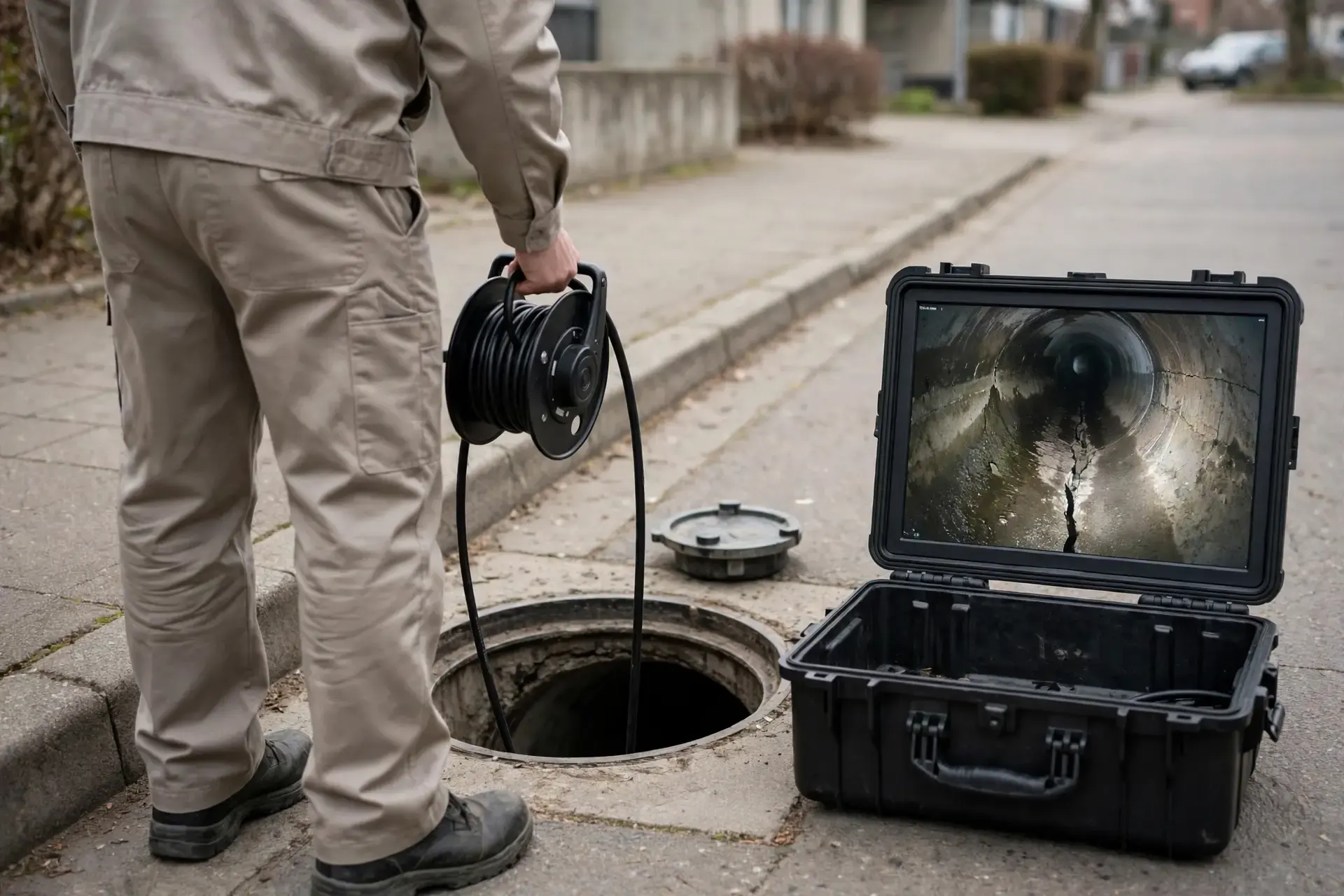
Jetting can damage a sewer line that is already in poor shape, which is why the camera survey always comes first. A sound pipe, whether plastic, cast iron or clay, handles jetting well when the pressure is set to suit it.
A pipe with a cracked section, a joint that has opened, or a wall thinned by age is a different case: high-pressure water on a weak spot can widen the crack or push soil into the line. The survey finds these weak spots before the water is turned up, and the crew lowers the pressure or skips jetting in favour of repair.
The pressure itself is not a single number. A typical residential sewer jetting job runs between about 1,500 and 4,000 pounds per square inch, with the lower end for older or thinner pipe and the higher end for a sound plastic or iron line with heavy scale.
The nozzle matters as much as the pressure: a spinning nozzle spreads the force across the wall, while a forward jet concentrates it on a plug. A crew that watches the camera while they work can see the pipe responding and ease off the moment the wall looks clean.
Sewer Jetting
What happens to the waste that jetting washes out?
The waste that jetting strips from the pipe walls does not stay in the yard or in the house. It is carried by the water flow down the lateral and into the street sewer, and from there to the treatment plant, exactly like the wastewater the line carries every day.
Grease, scale flakes, paper fibres and root shreds all travel the same way. The crew works from the house end toward the street, so the flow pushes the loosened material away from the home, not back into it.
That direction matters. If the hose were fed from the street end toward the house, the loosened material would pile up against the flow and could back up into the lowest fixture.
Working with the flow keeps the line clear as it is cleaned, and the final camera look shows a pipe with clean walls and clear water moving through it. The water used is ordinary water from the jetting machine's tank or a garden hose connection, and the volume is modest: a typical sewer jetting job uses less water than a long shower, spread across the whole visit.
Sewer Jetting
How does weather affect a sewer line?
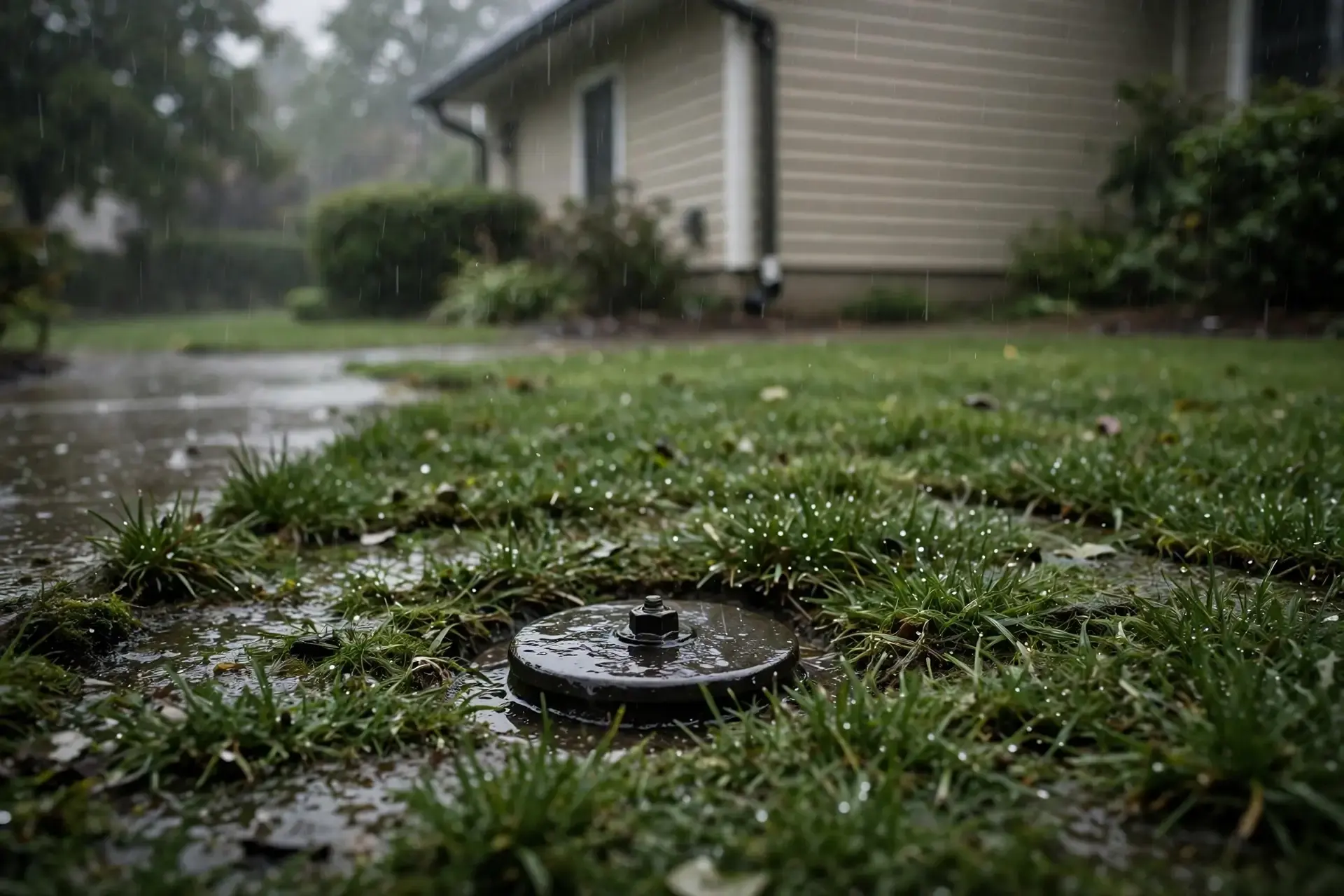
Heavy rain is the hardest weather on a sewer line. A downpour fills the street sewer faster than it can drain, and the water level in the main rises.
When it rises above the level of a home's lateral, wastewater can push back toward the house, and the lowest fixture is where it shows up first. A line that is already narrowed by grease or roots has less spare capacity, so it backs up sooner in a storm than a clean line would.
Jetting before the rainy season gives the line its full width back, which is the best defence a homeowner has.
Cold weather brings a different problem. A shallow lateral in a freezing climate can ice up where the flow is slow, and a partial blockage makes the icing worse, because still water freezes faster than moving water.
Hot, dry weather dries the soil around the pipe, and the ground shrinks and shifts, which can open a joint or crack a clay section. Tree roots also grow fastest in warm, dry weather, when they chase the moisture leaking from a joint.
None of these can be controlled, but a line that is clean and surveyed is far less likely to fail when the weather turns.
Signs you may need sewer jetting
- A floor drain or basement toilet backs up when water runs upstairs.
- A sewer smell returns around low fixtures, worse after rain.
- Every toilet in the building flushes weakly or needs a second flush.
- A toilet bubbles when the washing machine or dishwasher drains.
- Wastewater appears in a ground-floor shower after a flush.
- The same sewer blockage returns within months of a clearing.
- A sewage smell appears in the yard, strongest near the line that runs to the street.
- The grass grows greener and faster in a strip across the yard, fed by a leak from the lateral.
- Toilets on different floors of the house back up on the same day.
- Water drains from the tub, then comes back up through the shower drain.
- A gurgling sound comes from the floor drain when the dishwasher runs.
- The sewer line has backed up once before, and the same slow drains are returning a year later.
How it works
- 1
Step 1 — Listen to the whole house
The crew asks which fixtures are affected and whether the trouble is worse after rain, because a sewer lateral problem shows up across the whole house and often follows the weather.
- 2
Step 2 — Survey the lateral first
A camera is run into the sewer line from the cleanout, showing the blockage, the pipe material, the joints, and any cracks, with distances measured from the house.
- 3
Step 3 — Choose the nozzle for the blockage
Grease gets a spinning scouring nozzle, a fibrous plug gets a forward cutting jet, and roots get a cutting head. The nozzle is picked for what the camera showed, not by habit.
- 4
Step 4 — Jet with the flow, toward the street
The hose cleans the lateral in passes from the house toward the street main, so the loosened waste washes out of the line instead of piling up behind the nozzle.
- 5
Step 5 — Final survey and a clear picture
A last camera pass shows the clean walls and the free flow. The crew caps the cleanout, tidies up, and explains what was found and whether any joint or section needs watching.
Sewer Jetting cost
What does it cost?
Sewer work is priced by the length of the run, the entry point and what is blocking it. Typical ranges, shown as estimates, not quotes. A sewer lateral is longer than any indoor drain, so its length is the first driver: a short run to a near street main costs less than a long run across a deep lot. The entry point is next — an outdoor cleanout is quick to open, while a line reached through a basement cleanout or a pulled toilet takes longer. The third driver is the blockage itself: a soft grease plug clears in one pass, while a root mat or a fibrous wipe plug needs a cutting head, several passes and more time on site. A camera survey may be priced on its own at $150 to $350 or bundled with the jetting, so ask which it is. The written quote should list the survey, the jetting and the tidy-up as separate lines, and a planned visit in working hours costs less than an urgent call.
| Service | Typical range (estimate) | Notes |
|---|---|---|
| Sewer line jetting | $350 – $900 | House to street main |
| In-pipe camera survey | $150 – $350 | Often bundled in |
| Root cutting with jetting | $400 – $900 | Root mat in the line |
Prices are estimates only. The local company that does the work sets its own final pricing.
Questions about sewer jetting