
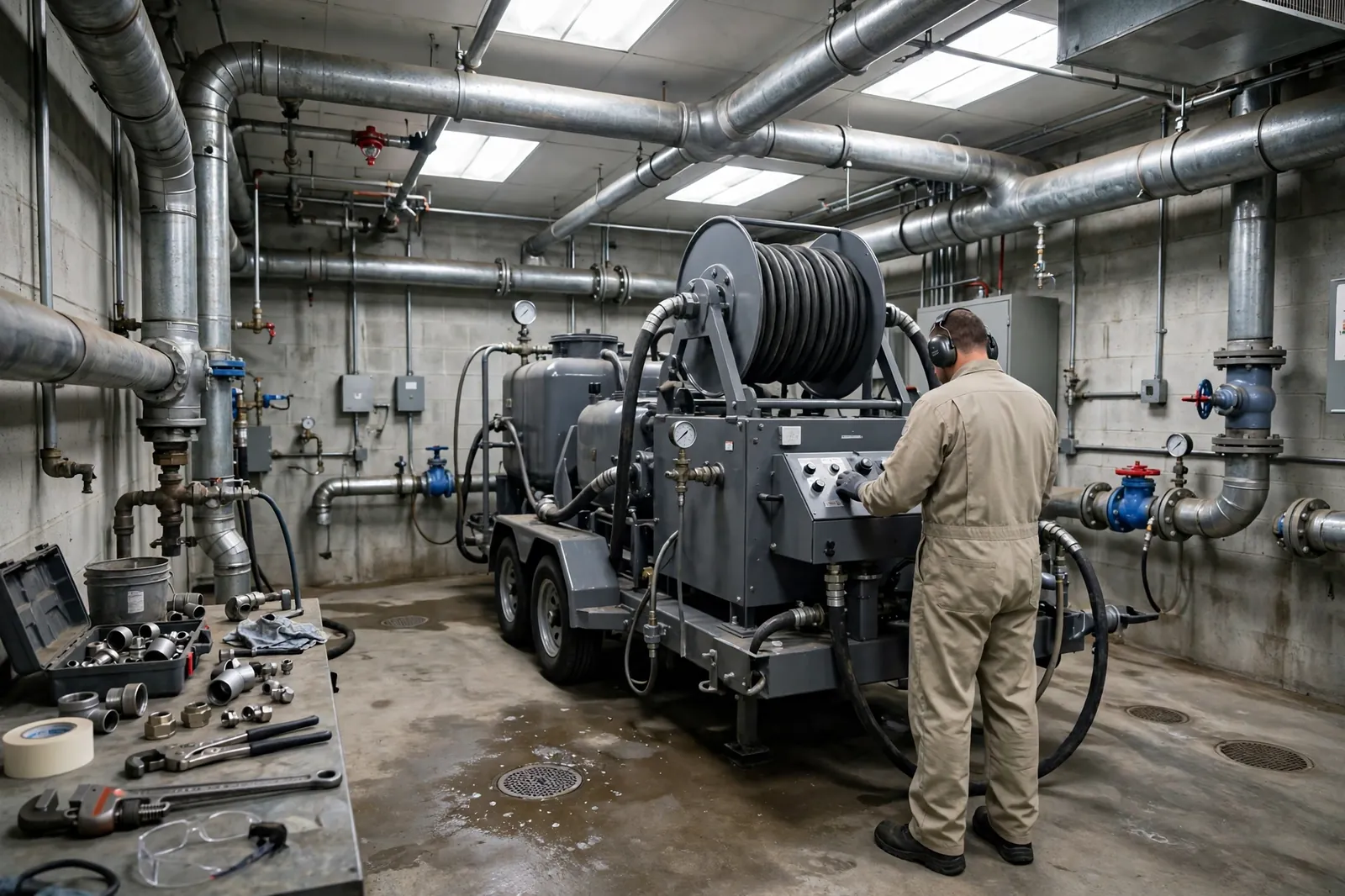
Commercial Hydro Jetting
A blocked drain in a business does more than slow a sink: it closes a restroom, stops a kitchen, and sends customers elsewhere. Commercial jetting cleans the long, wide drains of shops, offices, restaurants and hotels with high-pressure water, usually outside opening hours. Call (833) 878-1592 to plan a clean around your trading day.
Updated 2026-11-18. Prices shown are estimates only.
- $200–$1,500 Typical cost range
- 5 Steps in the visit
- 12 Questions answered
Before & after — commercial hydro jetting
Before & after
Drag the slider to compare the same pipe before and after jetting.
Commercial Hydro Jetting
Why business drains block differently
Business drains carry far more volume than a home drain, and they carry it in bursts: a lunch rush, a shift change, a full hotel floor checking in. Kitchen lines in a restaurant collect fat and food all day, restroom lines in an office collect paper in waves, and floor drains in a warehouse collect grit and silt.
The pipes are often wider and longer, running under car parks and across basements, and a blockage can sit far from the fixture that shows the symptom.
Because the stakes are higher, the approach is different too. A home job can wait a day; a business job often cannot.
The crew needs to know the building layout, where the cleanouts are, and which fixtures must stay open, before they start. That planning is part of the service, not an extra.
Commercial Hydro Jetting
Buildings and drains this service covers
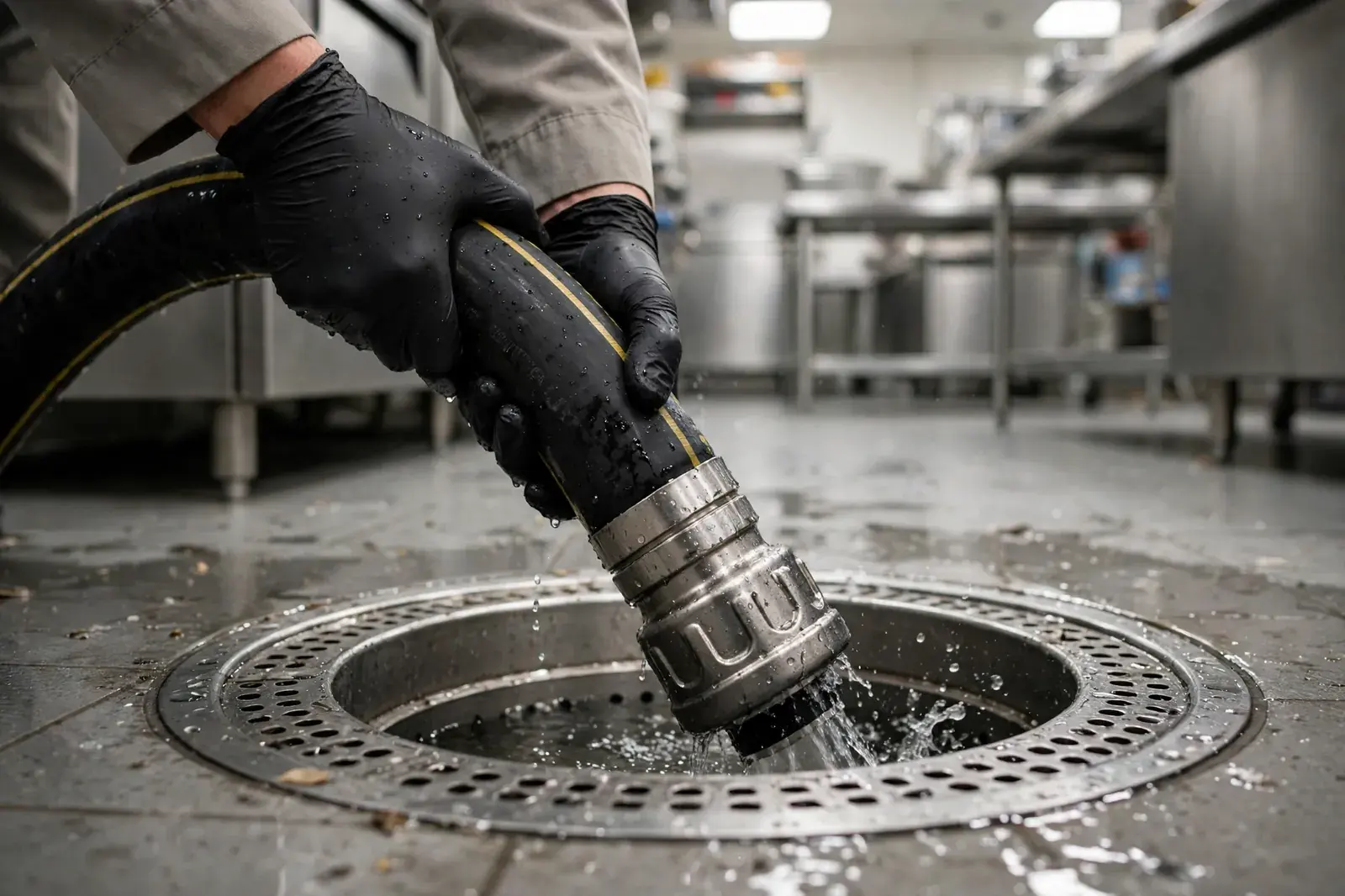
Restaurants and cafes are the most frequent call, because their kitchen lines coat with fat daily and their grease traps need the lines beyond them kept clear. Hotels follow, with long restroom runs, laundry lines and kitchen lines all feeding shared mains.
Offices and shops bring restroom and pantry lines, while warehouses and workshops bring floor drains and silt.
Each building has its own pattern. A restaurant blocks at the kitchen line; a hotel blocks where many restroom branches join a main; an office blocks at a single busy restroom floor.
The crew maps the pattern from the symptoms and the camera footage, then cleans the runs that cause the trouble, rather than jetting every pipe in the building.
Commercial Hydro Jetting
Working around opening hours
Most commercial jetting is booked outside opening hours — early morning, late evening, or a quiet weekday — so customers and staff are not stepping around hoses. The crew arrives with the layout already discussed, sets up at the agreed entry point, and works through the planned runs in order.
A restaurant kitchen can often be cleaned between close and open, and an office restroom floor can be done over a weekend.
Timing needs a clear conversation first. The person booking should say which fixtures must stay open, when the building is quietest, and where the cleanouts are.
A written quote given after a camera look should list the runs to be cleaned, the time window, and the tidy-up, so the manager knows what will be done and when the building is back to normal.
Commercial Hydro Jetting
The camera look in a commercial building
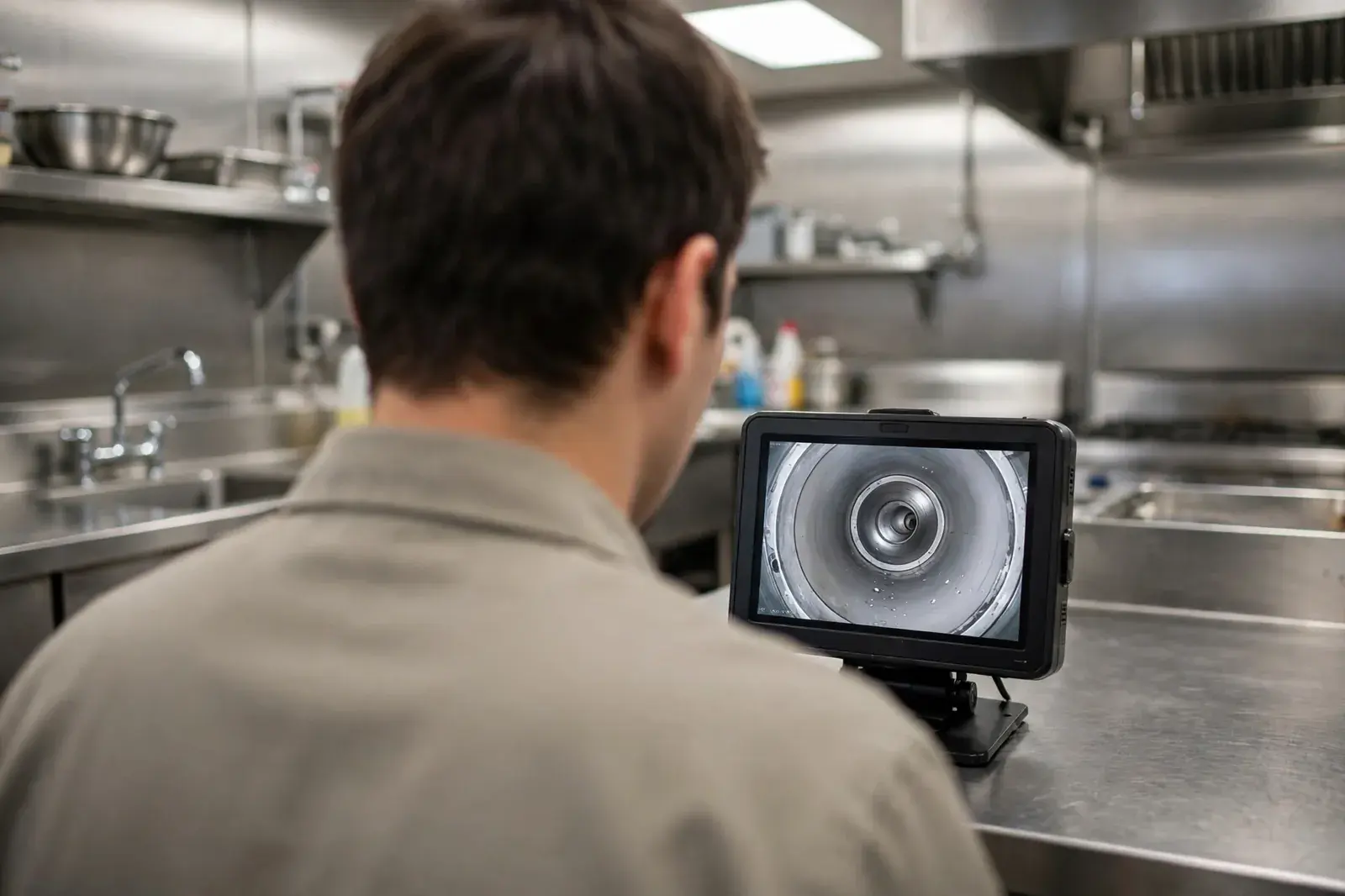
A video inspection is the starting point for commercial work, because the runs are long and the blockage may sit far from the symptom. The camera travels from a cleanout and shows coating, root entry, scale and any damage on a monitor, and the operator notes the distance along the run so the crew knows exactly where to work.
That record matters for a building manager: it is the basis for the quote and for any later discussion about repair.
Commercial camera work also finds the surprises that a home job rarely has: a floor drain that was capped and forgotten, a branch that was added during a refit and never drawn on a plan, or a section where a previous repair changed the pipe size. Finding those before jetting starts avoids a wasted visit and a wrong price.
Commercial Hydro Jetting
Repeat cleaning and keeping records
Many businesses clean on a repeat basis, because their drains load up on a predictable cycle. A busy restaurant kitchen may need its lines cleaned every few months, while an office restroom main may go a year or more.
The right interval comes from what the camera shows after each clean, not from a fixed calendar: if the walls are still coated after three months, the interval is too long; if they are nearly clean, it can stretch.
Keeping the camera footage and the dates of each clean builds a useful record. It shows which runs block first, whether a weak section is getting worse, and when a repair would cost less than repeated cleaning.
A manager who can show that record to a landlord or a contractor is in a far stronger position than one who relies on memory.
Commercial Hydro Jetting
What a manager should ask before booking
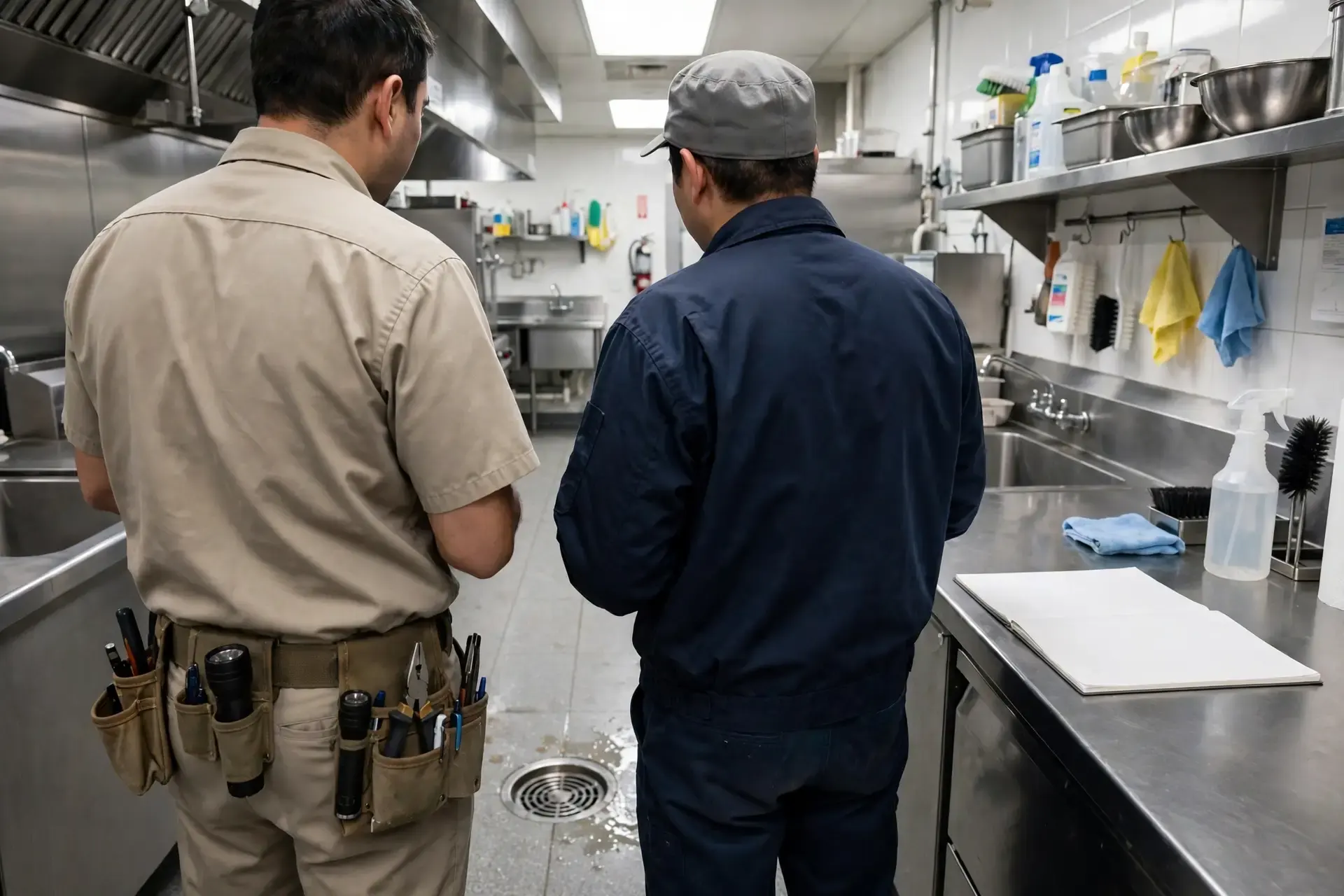
Ask what the quote covers: the camera look, the runs to be cleaned, the time window, and the tidy-up. Ask how the crew will protect floors and stock near indoor entry points, and what happens if the camera finds a broken section — will they stop and report, or carry on?
A clear answer to those questions before work starts avoids a dispute after it.
Also ask about access. The crew needs a clear path to the cleanout, a water supply for the jetter, and somewhere for the hose to run without crossing a customer area.
If the building has a basement plant room or a service yard, say so when booking: it changes the setup and the time. The more the crew knows in advance, the less the visit disrupts the working day.
Commercial Hydro Jetting
Which businesses block their drains fastest?
Restaurants block their drains fastest, because a commercial kitchen puts more fat, food and hot water down its lines in a day than a home puts down in a month. The grease line from the kitchen to the main drain coats quickly, and the floor drains in the kitchen collect food scraps with every wash-down.
A busy restaurant can need its kitchen line jetted every three to six months, and a kitchen that fries food all day may need it more often.
Hotels are next, because a hotel has dozens of bathrooms feeding into shared stacks, and the load is spread across the whole building. Hair, soap and paper from a hundred rooms add up, and a blockage in a shared stack affects several rooms at once.
Offices block more slowly, because the load is mostly restrooms and a small kitchen, but a large office with a cafeteria behaves like a small restaurant. Shops, salons and gyms have their own patterns: a hair salon fills its lines with hair and dye, and a gym fills its shower drains with hair and soap.
The pattern of the business decides the schedule, not the size of the building alone.
Commercial Hydro Jetting
How does a commercial kitchen line differ from a home kitchen line?
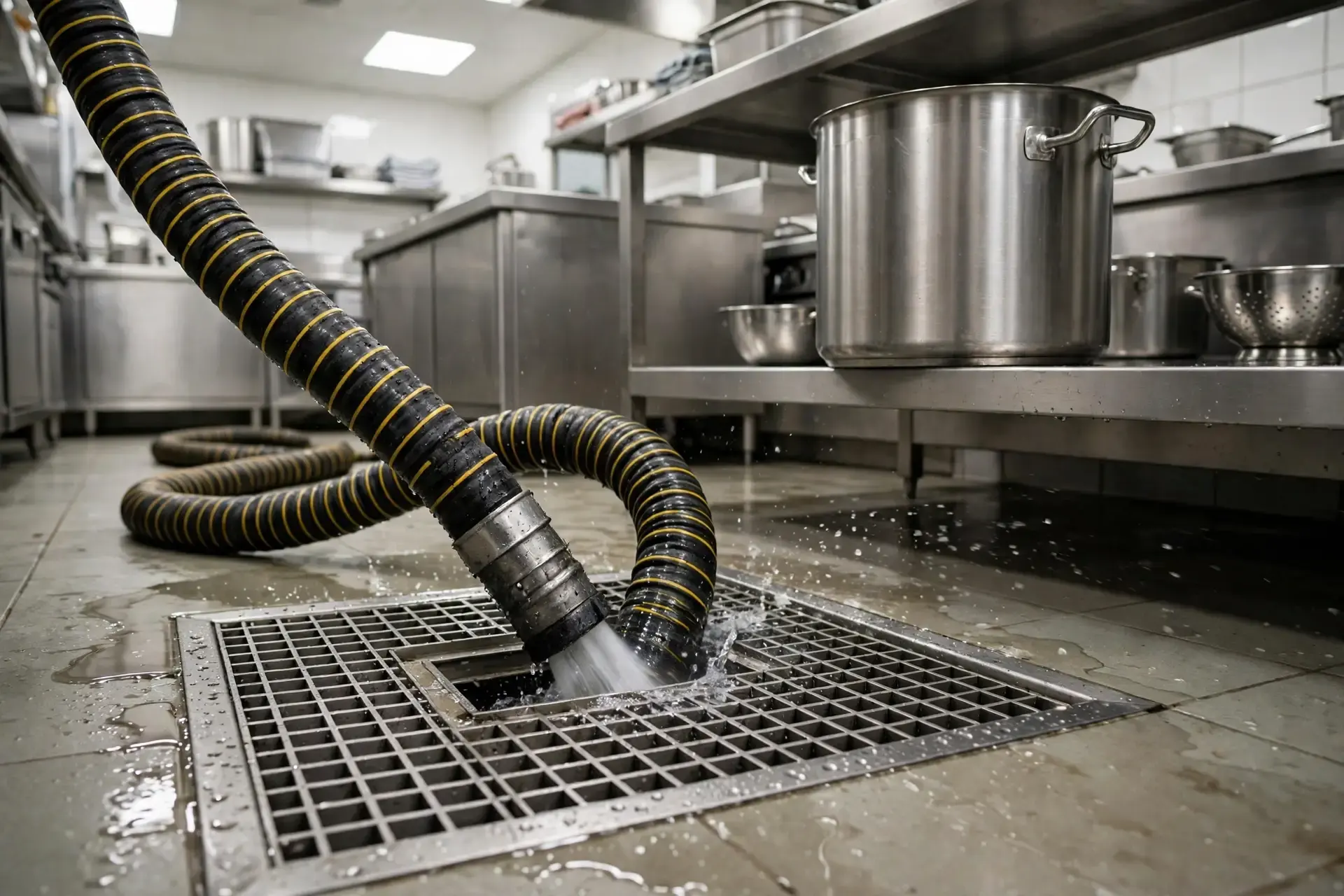
A commercial kitchen line is wider, longer and hotter than a home kitchen line. The pipe is often four inches across instead of two, it runs further to reach the main drain, and it carries water that is far hotter, from dish machines that run at high temperatures all day.
The grease load is heavier too: a commercial kitchen fries, grills and roasts in volume, and the fat that goes down the drain is measured in gallons per week, not spoonfuls.
The line also has more in it than a home line. A grease trap, often a large underground tank, sits in the line before the main drain, and it needs pumping on a schedule.
Floor drains, prep sinks, dish machines and hand sinks all feed into the same run, so a blockage anywhere in it affects the whole kitchen. The jetting machine for a commercial line is bigger, with a longer hose and a higher flow, and the crew may work from a roof vent or a basement cleanout rather than a sink trap.
The principle is the same as at home, but the scale is larger and the cost of a blocked line, a kitchen that cannot serve food, is higher.
Commercial Hydro Jetting
What should staff do when a drain backs up during service?
The first step is to stop using the affected drain and to tell the manager at once. A kitchen hand who keeps running water into a backing-up sink will flood the floor within minutes, and a flooded kitchen floor is a slip hazard as well as a hygiene problem.
The manager should close the affected sink or restroom, put up a sign, and move staff and customers away from the water. If the backup is sewage, the area should be closed off entirely, because sewage carries bacteria that should not be walked through a kitchen or a dining room.
The second step is to call for help and to give the crew clear information: which drain backed up, when it started, and whether it has happened before. The crew will ask whether the grease trap was pumped recently, because a full trap is a common cause.
While waiting, staff should not pour chemical cleaners down the drain, because the crew will be working in that line and the chemicals are a hazard to them. Mopping up is fine, but the water should be treated as dirty, and hands should be washed after handling it.
A short written note of what happened, with the time, helps the manager keep a record for the next visit.
Commercial Hydro Jetting
How are commercial drains cleaned without closing the business?
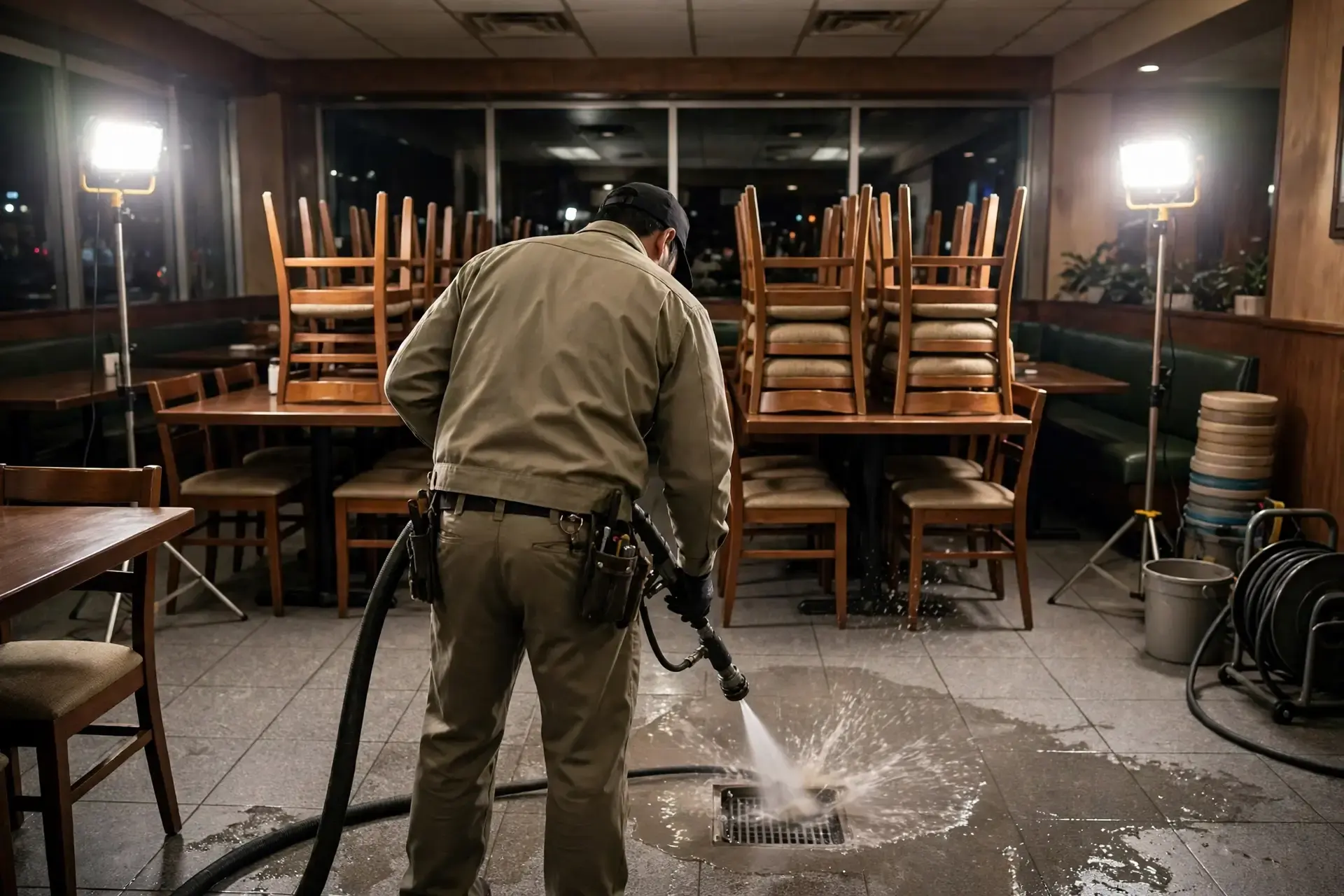
Most commercial jetting is scheduled outside opening hours: early in the morning before the kitchen opens, late at night after the last service, or on a closed day. The crew works from a cleanout or a roof vent, so the dining room and the kitchen can stay untouched, and the noise of the machine is kept outside the building where possible.
A restaurant that opens at eleven can often have its kitchen line jetted between six and nine in the morning, with the kitchen ready for service by opening time.
When the work cannot wait for closing time, the crew works in sections, closing one restroom or one sink at a time while the rest of the building stays open. A hotel can close one floor's stack while the other floors keep running.
An office can close one restroom block and direct staff to another. The key is planning: the manager and the crew agree in advance which drains will be out of use, for how long, and what signs will be put up.
A job that is planned this way rarely needs the business to close, and the crew will tidy each section as they finish it, so the building is ready for use again straight away.
Commercial Hydro Jetting
What records should a business keep after each clean?
A business should keep a simple record for every drain clean: the date, which line was cleaned, what was found, and when the next clean is due. The camera recording, or at least the crew's written notes, should be filed with it.
Over a year or two, that file becomes the most useful thing the manager has, because it shows the pattern: the kitchen line needs cleaning every four months, the restroom stack every eighteen, the floor drain in the loading bay every year.
The record also matters for compliance. A restaurant's grease trap pumping needs a paper trail for the health inspector, and a record of regular jetting shows that the drains are being maintained rather than left to block.
An insurance claim after a backup goes more smoothly when the business can show that the drains were cleaned on a schedule and that the trap was pumped. The record does not need to be fancy: a folder, a spreadsheet, or a page in the maintenance log, kept in one place and updated after every visit, is enough.
Commercial Hydro Jetting
How does jetting fit a restaurant grease trap schedule?
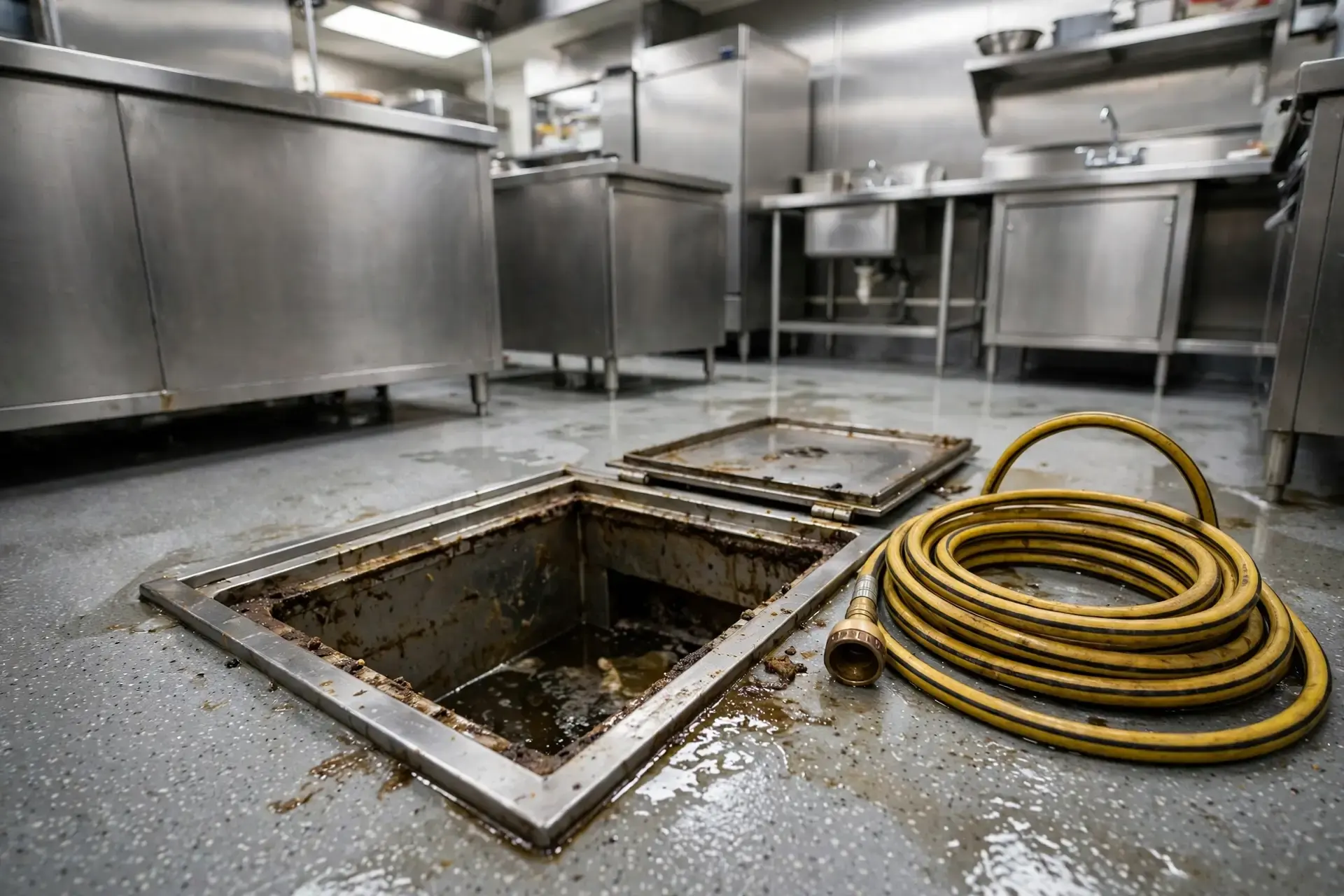
A grease trap and a jetting schedule work together, and neither replaces the other. The trap catches the fat before it reaches the line, and it needs pumping when it is a quarter full of fat and solids, which for a busy restaurant is often every one to three months.
Jetting cleans the line beyond the trap, where the fat that slipped through has coated the walls. If the trap is pumped on time, the line stays cleaner for longer, and the jetting interval stretches.
If the trap is left full, fat flows straight through it, and the line blocks again within weeks of a jetting visit.
The practical routine is to pump the trap first, then jet the line, so the clean line starts with an empty trap behind it. The crew can check the trap during the visit and tell the manager whether it is due for pumping.
Some restaurants put both jobs on the same schedule, with the trap pumped every month and the line jetted every four months, and they keep a single record for both. A health inspector will ask about the trap, and a blocked kitchen will ask about the line, so keeping both on a schedule is the cheapest way to avoid either problem.
Signs you may need commercial hydro jetting
- A restroom closes because its drains back up during busy hours.
- A kitchen line slows every lunch rush and recovers overnight.
- Floor drains in a warehouse or workshop hold standing water.
- Several restrooms on one floor drain slowly at the same time.
- A drain smell returns in a dining room or a reception area.
- The same commercial line blocks again within a few months.
- A restroom on one floor backs up while the restrooms on other floors still run, pointing to a shared stack.
- The kitchen floor drain overflows during the lunch rush, when the line is carrying its heaviest load.
- Customers mention a drain smell in a restroom that the cleaning staff cannot shift.
- A floor drain in the loading bay drains slowly after rain, because the line also takes the yard water.
- The grease trap was pumped last month, but the kitchen line is already slowing again.
- Several sinks in different parts of the building slow down on the same day.
How it works
- 1
Step 1 — Walk the building with the manager
The crew walks the drains with the manager, noting which lines serve the kitchen, the restrooms and the floor drains, and which fixtures have given trouble, so the visit starts at the right line.
- 2
Step 2 — Camera look at the commercial run
A camera is run into the line from the cleanout or the roof vent, showing the coating, the blockage and the pipe condition, with distances measured so the crew can find the trouble again.
- 3
Step 3 — Jetting around the business hours
The work is scheduled before opening, after closing or in sections, so the business keeps trading. The hose cleans the run in passes, and the loosened waste washes out toward the street main.
- 4
Step 4 — Check the trap and the stacks
The grease trap is checked, and the shared stacks are looked at, because a commercial blockage is often a trap that is full or a stack that serves several floors.
- 5
Step 5 — Records and the next date
A final camera look confirms the line is clear. The crew leaves a written note of what was found and suggests the next cleaning date, so the manager can keep the drains on a schedule.
Commercial Hydro Jetting cost
What does it cost?
Commercial work is priced by the size of the building, the length of the runs and the time window. Typical ranges, shown as estimates, not quotes. A small shop with one restroom and a short kitchen line costs less than a hotel with dozens of bathrooms and long shared stacks. The length of the runs is the first driver, because a commercial line can run a hundred feet or more through a building. The time window is the second: work done before opening or after closing often costs more than work done in normal hours, because the crew is working outside their usual day. The third driver is what is inside the pipe: a thin grease film clears in one pass, while a thick coating in a restaurant kitchen line needs several passes and more time on site. A camera survey may be priced on its own or bundled with the jetting, so ask which it is. The written quote should list the survey, the jetting, the trap check and the tidy-up as separate lines.
| Service | Typical range (estimate) | Notes |
|---|---|---|
| Commercial drain jetting | $500 – $1,500 | Per visit, per building |
| Video inspection | $200 – $500 | Long commercial runs |
| Restaurant kitchen line jetting | $400 – $1,000 | Kitchen to main |
Prices are estimates only. The local company that does the work sets its own final pricing.
Questions about commercial hydro jetting