
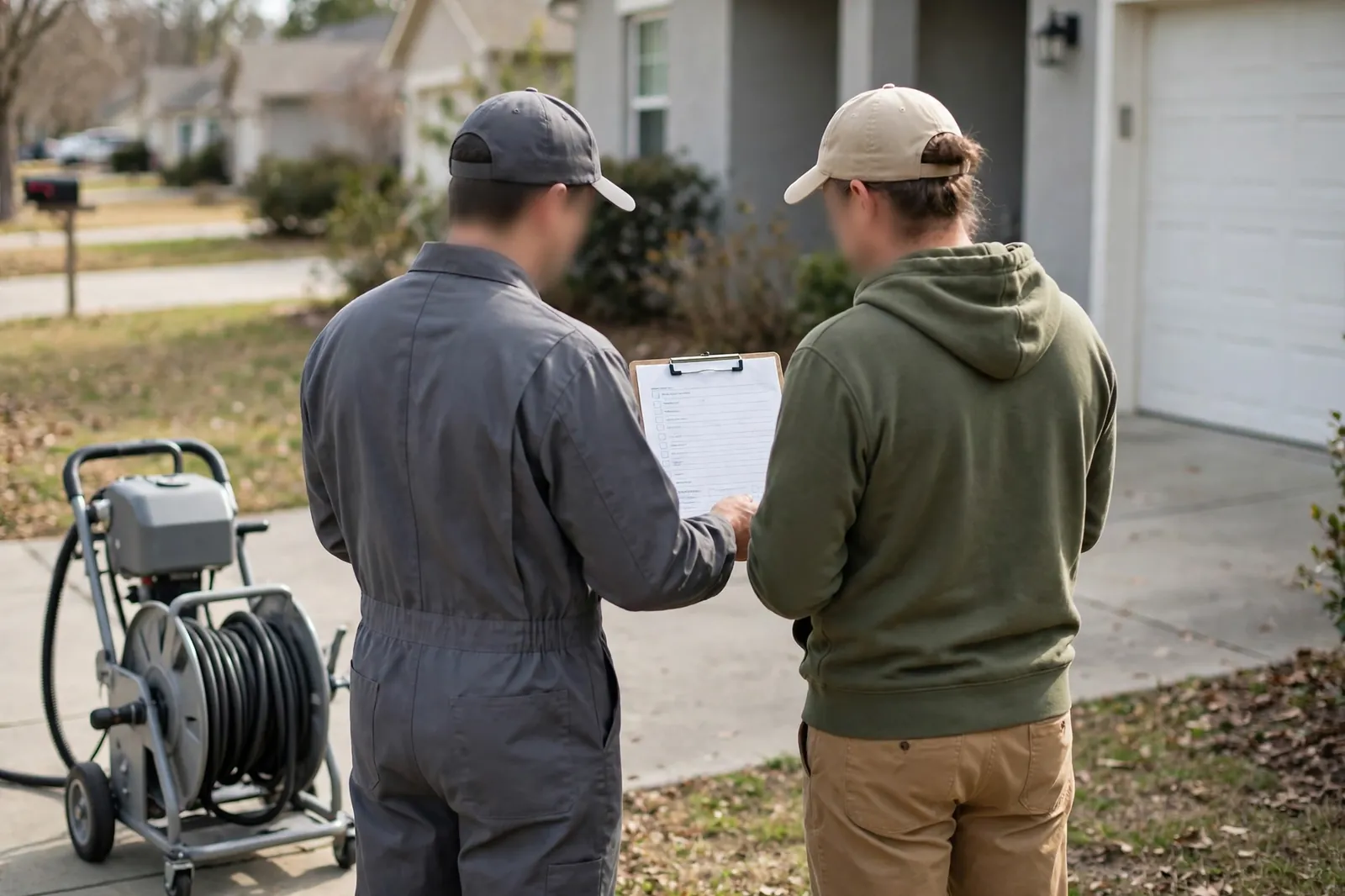
Hydro Jetting Cost Guide
This guide is about money: what hydro jetting usually costs, what moves the price up or down, and how to compare two quotes without being misled by the headline figure. Every figure here is a typical national range, labelled as an estimate. Call (833) 878-1592 for a written quote for your line.
Updated 2026-11-18. Prices shown are estimates only.
The typical ranges, in one place
Home hydro jetting usually costs $300 to $900. A short branch line — one sink or bath — sits at the lower end, around $250 to $550. A main line, the trunk that carries the whole home, runs $350 to $900. A camera inspection on its own runs $150 to $350, and it is often bundled into the jetting price. Grease lines run $300 to $700, root cutting $400 to $900, and commercial work $500 to $1,500 per visit.
Those are typical ranges, not quotes. Two homes with the same job can pay different amounts, because the length of the line, the entry point, and what the camera finds are never identical. The ranges are useful for one thing: spotting a quote that is far outside them, in either direction, and asking why.
Line length: the biggest price driver
Length is the first thing that moves a price. A hose that travels ten feet does less work than a hose that travels eighty, and the operator's time, the water used, and the wear on the gear all grow with the run. A small home with a short main to the street will pay less than a large home with a long run across a big lot, even if the blockage is the same.
Length also decides how many passes are needed. A long line with coating along its whole length needs the operator to work every foot of it, while a short line with a single plug needs only the plug cleared. When a quote seems high, ask how long the run is: the answer usually explains the figure.
Access: the hidden cost in many quotes
Access is the second driver, and it is the one homeowners most often overlook. A clear yard cleanout — a capped pipe at ground level — is the cheapest entry point: the crew opens it, feeds the hose in, and starts work. A buried cleanout that has to be dug out adds time. A line reached through a roof vent adds time and risk. A toilet that has to be pulled to reach the line adds time and a refit.
If your home has no accessible cleanout, say so when you book, and ask whether fitting one is worth doing. A cleanout costs money to fit, but it makes every future clean cheaper, because the crew can reach the line in minutes instead of spending an hour getting to it.
Buildup type: grease, scale and roots
What is blocking the line changes the price too. Soft grease washes out fast with hot water, so a grease job is often at the lower end of its range. Mineral scale is harder: it needs a spinning nozzle, slower passes, and more time. Roots are hardest of all: a thick mat needs a cutting head, slow feeding, and often a second camera look to confirm the bore is open.
The camera look is what tells the crew which type they are dealing with, and it is why a quote given before the camera has been in is only a rough figure. A quote given after the camera look, listing the buildup type and the runs to be cleaned, is the one to rely on.
What a written quote should list
A good written quote lists each part separately: the camera inspection, the jetting itself, and the tidy-up. It names the runs to be cleaned — kitchen branch, main line, sewer run — and it says what happens if the camera finds a broken pipe: does the price change, and by how much? It also says whether a second pass is included if the first pass leaves buildup behind.
Compare quotes by what they include, not by the total alone. A quote that includes the camera, the jetting and the tidy-up is worth more than a lower quote that leaves the camera out and adds it later as an extra. Ask the three questions — camera, second pass, broken pipe — and a vague quote will reveal itself quickly.
When jetting is worth the money
Jetting is worth the money when the problem is buildup along a run of pipe: repeat clogs, several slow fixtures, a camera picture showing heavy coating. In those cases one clean that washes the walls can keep the line open far longer than a snake job, and the higher price pays for itself in the time before the next blockage.
It is less worth it for a single slow sink with a local clog, where a plunger or a small snake will do the job for far less. It is also the wrong spend when the camera shows a collapsed pipe: no amount of cleaning fixes a broken line, and the money is better put toward the repair. The camera look before you book settles which case you are in.
Costs that catch people out
Three costs catch people out. The first is the camera fee charged separately after a quote that seemed to include it. The second is the repair that follows a clean: the camera finds a broken section, and the job changes from cleaning to repair, with a new price. The third is the return visit: the first clean leaves buildup in one stretch, and a second visit is needed to finish it.
All three are avoidable with questions asked before work starts. Ask whether the camera is included. Ask what happens if a break is found. Ask whether a second pass is included. A crew that answers clearly before starting is a crew that is unlikely to surprise you with the bill afterwards.
Commercial and restaurant pricing
Commercial pricing follows the same drivers, at a larger scale. A restaurant kitchen line runs $400 to $1,000, a full commercial visit $500 to $1,500, and a video inspection of long commercial runs $200 to $500. The number of runs, the length of each, and the time window — outside opening hours costs more than a quiet weekday — all move the figure.
For a business, the comparison is not just the quote but the cost of disruption: a restroom closed at lunch, a kitchen stopped during service. A quote that includes a quiet window and a tidy-up is worth more than a cheaper quote that leaves the building unusable at peak time. That is a cost, too, and it belongs in the comparison.
How to keep the next clean cheaper
The cheapest clean is the one you do not need yet. Keep cooking fat out of the sink, use screens to catch hair and food, and keep wipes out of the toilet, and the coating builds far slower. A camera look every year or two on a line with trees nearby catches root strands while they are thin, and a thin strand is a cheaper cut than a thick mat.
Keep the record, too: the closing footage, the date, and the quote. A crew that starts with that record does not need to re-learn your line, and a quote built on a known pipe is a more accurate quote. Over years, that record is worth more than any single discount.
What the price includes — and what is extra
A hydro jetting price is rarely one single charge. It is a bundle of smaller jobs, and knowing which parts are inside the figure is the only way to compare two quotes honestly. The visit itself is the first part: the crew drives out, sets up the machine, and runs the hose. The camera inspection is the second part, and it may be listed on its own line or folded into the total. The jetting itself is the third part, priced by the length of the run and the number of passes. Then there is the tidy-up: the crew flushes the line, checks the fixtures, and leaves the entry point as they found it.
What sits outside the figure matters just as much. A cleanout that has to be dug out can be an extra charge. A toilet that has to be pulled and refitted can be an extra charge. A repair found by the camera — a cracked section, a joint that has shifted — is a separate job with a separate price, and it should be quoted on its own rather than folded silently into the clean. Water used on the job is normally part of the price, not a separate line. If a quote lists a water charge, ask about it. The cost report page lists the same typical ranges in one table, and the main line jetting page explains what a whole-home clean covers, so you can check whether the runs on your quote match the runs on your home.
Why the same job costs more in some parts of the country
Two homes with the same blockage can pay different amounts, and the gap often comes down to where the home sits. Labour rates run higher in large cities and in areas where the cost of living is high, and drain work is labour-heavy: the crew, the truck, and the hours on site are most of what you are paying for. A job in a dense city can also cost more because parking, access, and working around other trades all take time. None of this is a mark-up trick; it is the local cost of doing the work.
The age of the local housing stock matters too. Neighbourhoods built before the 1970s often have cast iron or clay pipe, and those materials need slower passes and lower pressure, which stretches the visit. Areas with hard water see more mineral scale, which needs a spinning nozzle and extra time. Homes on large lots have longer runs to the street, and a long run costs more than a short one. When a quote seems high, ask the crew to walk through the drivers for your street: the length of the run, the pipe material, and the access point. A crew that can name the three will usually have priced the job fairly, and the answer tells you whether the figure reflects your home or a flat rate that ignores it.
How to read a low quote — and a high one
A quote far below the typical range should raise the same questions as one far above it. A low figure may leave out the camera inspection, and the camera fee then appears as an extra once the crew is on site. It may cover a single pass only, with a second pass charged separately if the first leaves coating behind. It may be for a short branch only, while the main line — the part that actually needs the work — is priced apart. None of these are wrong on their own, but they make a low total look cheaper than it is. Ask what the figure covers, in writing, before you book.
A high quote deserves the same treatment rather than an instant refusal. It may include the camera, two passes, and a written record of the footage, which a cheaper quote leaves out. It may reflect a long run, a buried cleanout, or root cutting that a lower quote has not allowed for. The test is the same in both directions: does the quote list the runs, the camera, the number of passes, and what happens if a break is found? A quote that answers those four points is a quote you can compare. A quote that answers none of them is a guess, and a guess is not a bargain at any price. Call (833) 878-1592 and ask for the four points in writing before you decide.
Paying for the job: deposits, timing and the paper trail
Most home jetting jobs are paid after the work is done, once the closing camera footage shows the line is clear. A small deposit to hold the visit is normal in some areas, but a demand for the full amount before any work starts is not. Be wary of any price that only holds if you book on the spot: a real quote for a real pipe does not expire in an hour. Ask for the quote in writing, with the date on it, and ask how long the figure holds — a week or two is common, and it gives you time to compare without pressure.
Keep the paper trail after the job. The written quote, the paid invoice, and the closing camera footage are the record of what was cleaned, when, and for how much. That record is worth money at the next visit: a crew that starts with the last footage does not need to re-learn your line, and a quote built on a known pipe is a more accurate quote. It is also the evidence you need if a problem returns soon after the clean — the footage shows what the pipe looked like when the crew left. File the three items together, with the date, and bring them out again the next time a drain slows. Over the years, that folder is worth more than any single discount, and it costs nothing to keep.
Seasonal demand: when prices move during the year
Drain work has busy seasons, and the price can move with them. Cold snaps bring frozen and burst pipes, holiday cooking loads kitchen lines with fat, and heavy rain pushes groundwater into older sewer runs. When every crew in town is booked out, a quote can sit at the top of its range, and a short-notice visit can cost more than a visit booked a week ahead. None of this is a surprise charge if it is stated on the quote — it is demand, and it is the same reason a hotel room costs more on a holiday weekend.
The practical answer is timing. If the problem is a slow drain rather than a backup, book ahead and pick a quiet week: the crew has more time on site, the quote is easier to compare, and you are not paying for urgency you do not need. If the problem is a backup, speed matters more than price, and the emergency hydro jetting page explains what an urgent visit covers. Either way, ask the same four questions — camera, runs, second pass, broken pipe — and get the answers in writing. A quote that is clear about what it covers is fair at any time of year, and a quote that hides the extras is not a bargain in any season.
Signs you may need hydro jetting
- A quote that lists only a total, with no breakdown.
- A camera fee added after a quote that seemed to include it.
- A second visit needed because one stretch was left coated.
- A repair bill that follows a clean because a break was found.
- A price far outside the typical ranges, in either direction.
- A clean quoted before any camera look at the line.
- A quote that changes on the day, once the crew is already on site.
- A deposit demanded in full before any work starts.
- A price that only applies if you book on the spot.
- No written record of what was cleaned, or of the closing footage.
- A charge for water used, added after the job is done.
- A quote with no company name, address, or phone number on it.
How it works
- 1
Step 1 — Get the camera look
Book a camera inspection first, so the quote is built on what the pipe actually shows, not on a guess from the symptoms.
- 2
Step 2 — Compare like with like
Ask each quote to list the camera, the runs, the second pass and the broken-pipe rule, then compare the lists, not just the totals.
- 3
Step 3 — Agree in writing
Agree the written quote before work starts, and keep it with the closing camera footage for the next visit.
- 4
Step 4 — Check the closing footage
Before you pay, watch the closing camera run with the crew and check that the walls look clean along the full run, not just near the entry point.
- 5
Step 5 — File the quote and the footage
Keep the written quote, the paid invoice, and the closing footage together with the date, so the next visit starts from a known pipe.
What does it cost?
Every figure on this page is a typical national range, labelled as an estimate. The written quote for your line is the figure that counts.
| Service | Typical range (estimate) | Notes |
|---|---|---|
| Branch line jetting | $250 – $550 | One sink or bath line |
| Main line hydro jetting | $350 – $900 | Whole-home line |
| Camera inspection | $150 – $350 | Often bundled in |
| Grease line jetting | $300 – $700 | Kitchen line |
| Root cutting with jetting | $400 – $900 | Root mat in the line |
| Commercial drain jetting | $500 – $1,500 | Per visit, per building |
Prices are estimates only. The local company that does the work sets its own final pricing.