
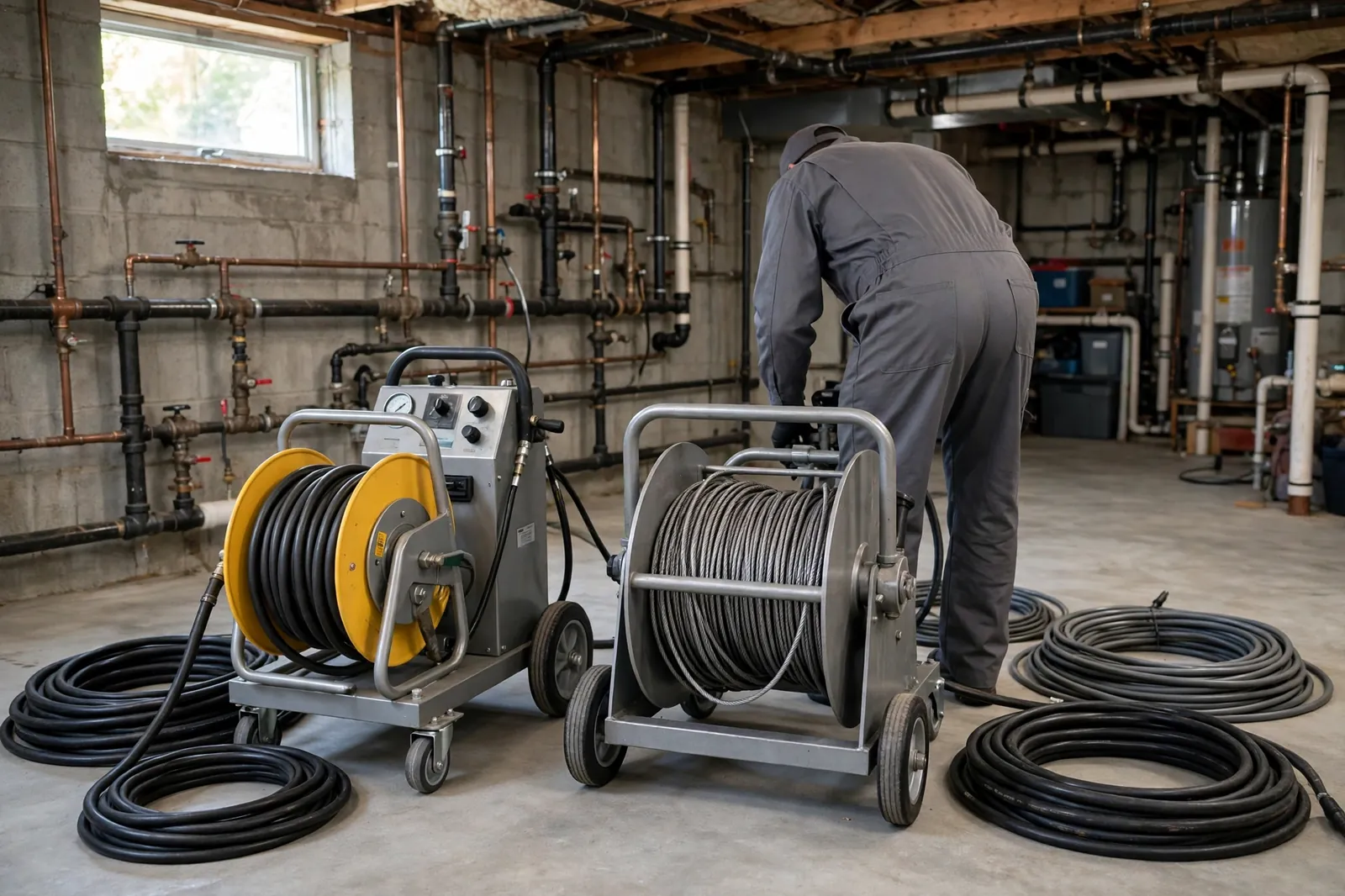
Hydro Jetting vs Snaking
A snake and a jetter are the two tools every drain crew carries, and they do different jobs. One bores a hole; the other washes the pipe. This guide compares them side by side: how they work, what they clear, what they cost, and when each one is the right call. Call (833) 878-1592 for advice.
Updated 2026-11-18. Prices shown are estimates only.
What snaking does, in plain terms
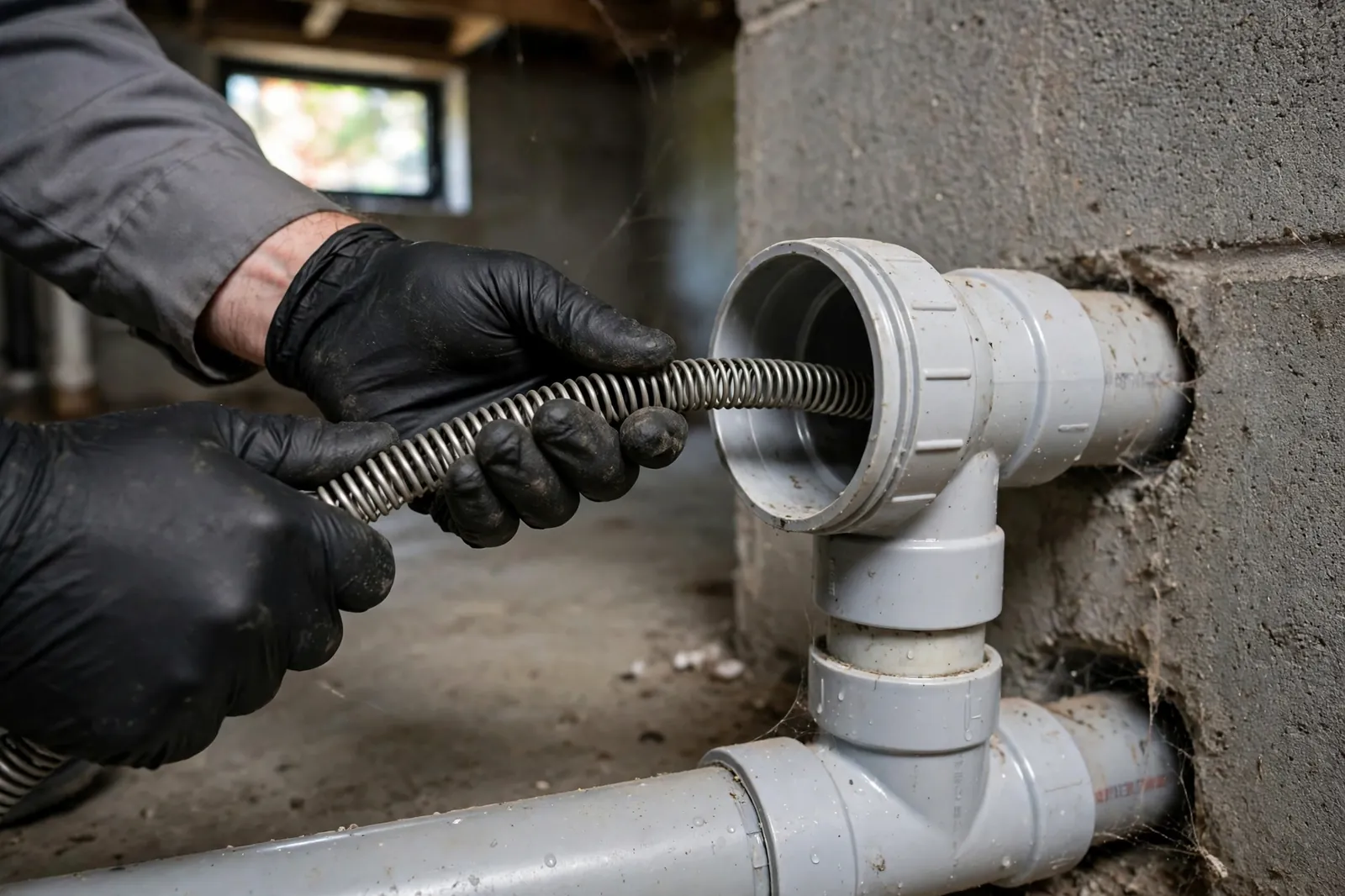
Snaking — also called cabling or rodding — pushes a flexible steel cable with a cutting head into the drain and rotates it. The head bores through the blockage, breaking it up so water can pass, and the operator pulls the cable back, dragging pieces of the blockage out with it. It is a mechanical tool, and it is good at one thing: opening a path through a plug.
Snaking is quick, it needs little water, and it can reach a local clog through a trap or a small access point. For a single hair clog in a shower, a wad of paper in a toilet line, or a plug near the surface, it is often the fastest and cheapest answer, and a good crew will say so rather than selling a bigger job.
What jetting does, in plain terms
Jetting does not bore a hole; it washes the pipe. A hose with a nozzle fires water in several directions, cutting coating from the walls and flushing it out. The result is not a path through the blockage but a clean pipe along the whole run that was jetted, with the bore restored to near its original width.
That difference is the whole comparison. A snake leaves the walls coated, so the pipe narrows again quickly. Jetting removes the coating, so the pipe stays open longer. A snake is a hole; jetting is a clean. The two are not rivals so much as tools for different problems, and a crew that carries both will use each where it fits.
Side by side: speed, cost and result
Snaking is usually quicker and cheaper: a local clog can be cleared in under an hour, and the price is lower than a jetting visit, because the gear is simpler and no camera is always needed. Jetting takes longer — one to three hours for a home — and costs more, typically $300 to $900 for a home job, because the machine, the water, and the camera look are all part of the visit.
The result reverses the comparison. A snake job on a coated line often needs repeating within weeks, so the cheap visit is paid for twice or three times. A jetting job on the same line can last a year or more. The fair comparison is not one visit against one visit, but the cost over a year, and on a coated line jetting usually wins that comparison.
When snaking is the right call
Snaking is the right call for a single, local, first-time clog: a hairball in a shower drain, a paper plug in a toilet line, a small blockage near a trap that has never happened before. It is also the right call when the pipe is fragile — a very old or damaged line that a camera shows cannot take high-pressure water — because a cable can clear a path without the force of a jet.
It is the right call, too, as a first step when the cause is unknown. A snake can open a line enough for a camera to pass, and the camera then shows whether the walls need jetting or the pipe needs repair. A crew that snakes first and looks second is not cutting corners; it is sequencing the tools.
When jetting is the right call
Jetting is the right call when the problem is buildup, not a single plug: repeat clogs, several slow fixtures, a camera picture showing heavy coating, a grease line that blocks every few months, or a root mat in the sewer. In those cases a snake can only bore a hole that closes again, and the homeowner pays for the same visit twice.
It is also the right call when the line has been snaked before and blocked again. A repeat blockage after snaking is evidence that the walls were never cleaned, and a second snake will leave the same coating behind. At that point the question is not snake or jet, but when to jet, because the snake has already had its chance.
Can the two tools be used together?
Yes, and good crews often do. A snake can break through a hard plug so the jetting hose can pass, and jetting can then wash the walls clean behind it. A root mat can be cut with a cable head first and flushed with water after. The sequence depends on the blockage, and the camera look decides it.
The combination is also the answer when a line is too fragile for full-pressure jetting but too coated for a snake alone. A gentle jet at low pressure, after a cable pass, can clean the walls without risking the pipe. A crew that carries both tools and a camera can tune the job to the pipe in front of them, rather than forcing one tool to do everything.
Pipe safety: which tool risks what
A snake can damage a pipe if it is pushed hard through a bend or a weak joint: the cable can catch, kink, or punch through a thin wall. An operator who feels the cable catch should stop, not force it, and a camera look after a snake job can show whether the pipe was harmed.
Jetting can damage a pipe that is already broken, if the pressure is set too high for its condition. That risk is controlled by the camera look first, which finds the cracks and weak joints before the water is turned up. Neither tool is risk-free; both are safe in trained hands, and both are risky when the operator works blind.
What to ask the crew before they start
Ask which tool they plan to use, and why. A crew that can explain — a local plug, so a snake; a coated line, so jetting; a root mat, so a cutter then a wash — is a crew that has looked at your problem, not one that sells the same tool to everyone.
Ask whether a camera look is included, and whether the price covers a second pass if the first leaves buildup behind. Ask what happens if the camera finds a broken pipe. Those three questions, asked before work starts, will tell you more about the crew than any advertisement, and they will keep the bill free of surprises.
The one-minute decision
Here is the decision in one minute. One clog, one fixture, first time, near the surface: snake it. Same clog again, several fixtures slow, a camera showing coating, grease or roots: jet it. A fragile pipe that cannot take pressure: snake it, and look with a camera after. A hard plug that a snake cannot pass: jet it, or snake then jet.
If you are still unsure, book a camera look first. The picture will show the blockage, the coating, and the pipe condition, and the tool choice will make itself. A decision made from a picture is always better than a decision made from a guess, and the camera is the cheapest way to get that picture.
What does a snake leave behind?
A snake clears a path, not a pipe. The cable bores a hole through the clog and the water starts moving again, but the coating on the walls stays where it is: grease smeared along a kitchen line, scale roughing up a cast iron run, soap and hair lining a bath drain. The drain works, so the job feels done, yet the pipe is still narrowed, and the same material that caught the clog is still there to catch the next one. That is why a snake job can be followed by the same slow drain a few weeks later, with the same symptoms and the same call.
The camera shows the difference plainly. After a snake, the footage shows a hole through the blockage and dirty walls around it. After a jetting clean, the footage shows the wall itself, washed back to the pipe material. Neither result is wrong — they are different jobs for different problems. A single local clog, like a wad of paper caught at a bend, is a snake job: the hole is the fix. A line that clogs again and again, or several fixtures slowing together, is a coating problem, and a coating problem needs the walls washed. Ask to see the footage after the work, whichever tool was used: it is the only honest record of what was actually cleared.
How long does each fix last?
The honest answer is that it depends on what is in the pipe, not on which tool was used. A snake that clears a one-off clog — a toy, a lump of paper, a single wad of wipes — can last for years, because nothing is left to grow back. A snake that bores through grease leaves the grease behind, and grease catches more grease, so the same drain can slow again within weeks. A jetting clean that washes the walls bare gives the line a fresh start, and the time before the next problem is set by what goes down the drain next, not by the tool.
That is the right way to compare the two: not by the price on the day, but by how long the fix holds. If you have had the same drain snaked three times in a year, the three cheap visits have already cost more than one jetting clean, and the line is still coated. If you have had one snake visit in five years, the cheap tool was the right tool. Keep a note of the date and the tool each time a drain is cleared, and the pattern will tell you which one your home actually needs. The how often hydro jetting guide explains how to set a cleaning rhythm from that record, and the signs guide lists the symptoms that point to coating rather than a single clog.
Which tool for which pipe material?
Pipe material changes the choice. PVC and ABS plastic are smooth and tough, and both tools work well on them, though a jetter at full pressure still needs an operator who checks the fittings first. Cast iron is the pipe where the difference shows most: old cast iron builds up rough scale inside, and a snake scrapes a path through it while a jetter with a spinning nozzle can wash the scale off the walls. Clay pipe, common in older sewer runs, is brittle at the joints, and a snake cable can catch a lip at a joint while a jetter needs a careful hand on the pressure. Orangeburg — a tar-paper pipe used in some mid-century homes — is soft and fragile, and neither tool should be used hard on it without a camera look first.
The camera look is what settles the question. It shows the material, the joints, and any weak spots before either tool goes in, and it lets the operator pick the pressure and the nozzle for the pipe in front of them rather than guessing. A crew that starts with the camera is a crew that is thinking about your pipe, not just their tool. If a crew wants to snake or jet without looking first, ask why — the camera takes minutes, and it is the difference between a clean and a cracked pipe. The main line jetting page covers the materials found in whole-home lines in more detail.
The cost over five years: one clean vs repeated snakes
On the day, a snake is cheaper: a snake visit often runs $100 to $250, while a home jetting job usually runs $300 to $900. The comparison that matters is the cost over time. A line with heavy grease that needs a snake every three months costs $400 to $1,000 a year in snake visits, and the line is never clean between them. One jetting clean at $300 to $900 can hold that same line for a year or more, because the walls are washed rather than pierced. Over five years, the repeated cheap tool can cost several times the price of the one thorough clean.
The maths flips for a line with no coating problem. A home that needs a snake once every few years for a one-off clog should keep using the snake: the cheap tool is the right tool, and paying for a jetter would be wasted money. The deciding factor is the record, not the sales pitch. Count the snake visits in the last two years and what they cost in total. If the total is already above the price of one jetting clean, and the same drain keeps slowing, the jetter is the cheaper choice over the next five years. If the snake visits are rare and the problem is always a single clog, stay with the snake and spend the difference on screens for the sinks.
What the crew should tell you before they start
A good crew explains the choice before the tool goes in, not after the bill arrives. They should say which tool they plan to use and why, what they expect to find, and what they will do if the first tool does not work. They should say whether a camera look is included, and whether the price covers a second pass if the first one leaves coating behind. If they plan to jet, they should say what pressure they will use and whether your pipe material suits it. If they plan to snake, they should say what the snake will leave behind and how soon the problem may return.
You can help by telling them the history: how many times the drain has been cleared, what tool was used, and how long each fix lasted. A crew that hears "snaked three times this year" knows the line is coated before they open the cleanout. A crew that hears "first clog in five years" knows the snake is probably enough. The conversation takes two minutes and it is the difference between a tool chosen for your pipe and a tool chosen from habit. Call (833) 878-1592 and describe the history when you book — the right tool is usually clear from the pattern before anyone arrives.
Signs you may need hydro jetting
- The same drain clogs again within weeks of a snake job.
- Several fixtures slow at once, not just one sink.
- A camera picture shows coating along a run of pipe.
- A grease line blocks every few months despite snaking.
- A root mat is visible inside the sewer line.
- A single local clog has never happened before.
- A clog that returns within weeks of a snake visit.
- Several fixtures slow at once, not just one.
- A snake that passes through but the drain stays slow.
- A camera picture showing coating on the pipe walls.
- Grease coming back up the sink after a snake.
- A line that needs a snake every few months.
How it works
- 1
Step 1 — Name the pattern
Note whether the problem is one local clog or a repeat, multi-fixture problem, since that decides whether a hole or a clean is needed.
- 2
Step 2 — Book the camera look
A camera inspection shows the coating, the blockage and the pipe condition, so the tool choice is made from a picture, not a guess.
- 3
Step 3 — Pick the tool, then check
Snake a local plug, jet a coated line, and ask to see the closing camera picture before the crew leaves.
- 4
Step 4 — Ask for the camera before and after
Ask the crew to run the camera before the work and again after it, so you can see what the tool cleared and what it left behind.
- 5
Step 5 — Decide by the footage, not the tool
Let the camera picture decide: a single clog points to the snake, and coating along the walls points to the jetter.
What does it cost?
Snake and jet prices differ. Typical ranges for jetting work are shown as estimates below.
| Service | Typical range (estimate) | Notes |
|---|---|---|
| Branch line jetting | $250 – $550 | One sink or bath line |
| Main line hydro jetting | $350 – $900 | Whole-home line |
| Camera inspection with jetting | $150 – $350 | Often included |
Prices are estimates only. The local company that does the work sets its own final pricing.