
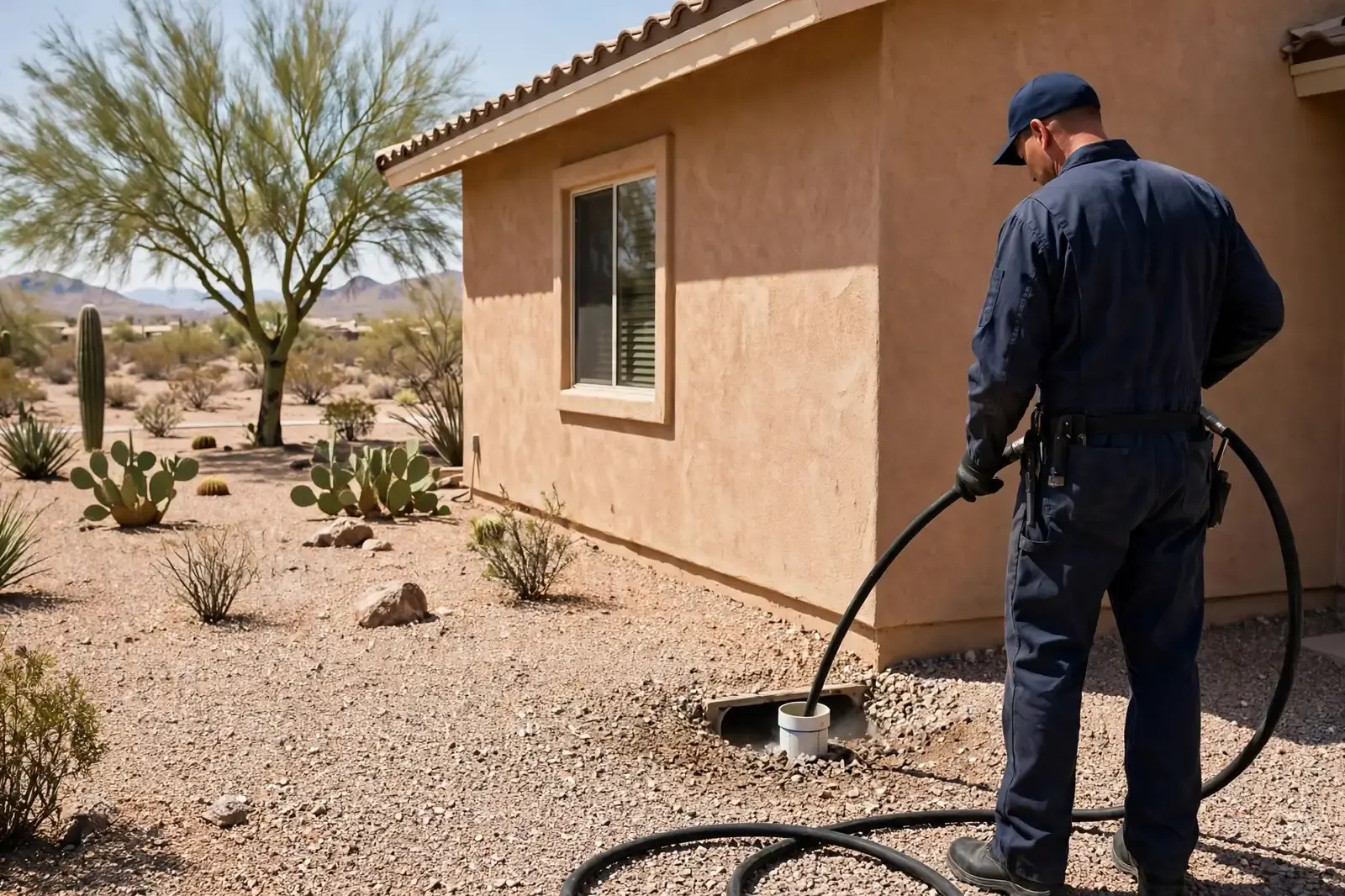
Hydro Jetting in Phoenix, AZ
Phoenix drains clog with mineral scale. The water here is very hard, and the minerals settle inside hot-water lines year after year until the bore narrows. Hydro jetting scours that crust off with high-pressure water, after a camera look shows what the line holds. Call (833) 878-1592 to book a visit in Phoenix.
Updated 2026-11-18. Phoenix, AZ · Maricopa County · Population 1,673,164. Prices shown are estimates only.
- 1,673,164 Population
- Maricopa County
- 76 ZIP codes served
- Arcadia Neighbourhood
Before & after in Phoenix
Before & after
Drag the slider to compare the same pipe before and after jetting.
Hydro jetting in Phoenix
Why is Phoenix water so hard on drains?
Look at your kettle. Look at the shower head.
The white crust you see there is the same crust growing inside your drains. Phoenix water runs through desert rivers and aquifers full of limestone and minerals, and it arrives at your tap carrying a heavy load of calcium and magnesium.
City of Phoenix Water Services delivers it across the city, and every drop leaves a little behind.
Heat speeds the process up. When hard water is heated, minerals fall out of it and stick to the pipe wall.
A hot-water line grows a crust year after year. The bore shrinks.
The surface roughens, so soap and hair catch on it. A kitchen branch that carries hot water for the dishwasher scales faster than a cold line.
Give it a decade and a scaled main can lose a real share of its opening. When a Phoenix shower keeps slowing down, scale is the first suspect, not hair.
The fix is a scouring head on the jetter, not a poke through the middle. It strips the crust off the wall, and the camera afterward shows bare pipe or pitted pipe underneath.
Scale never stops forming while the supply stays hard. A softener on the incoming line slows it down, and that conversation is worth having if your fixtures crust over within months of a cleaning.
Without one, a camera look every year or two for hot-water lines is the rhythm that works.
Watch the kettle for a week after a cleaning. If the white film returns fast, the scale inside your pipes is returning just as fast.
That is the honest measure of how hard your water is, and it is worth more than any number on a report. A home with a softener will see the film return slowly, or not at all.
A home without one will see it within days, and the drains follow the same clock.
Hydro jetting in Phoenix
How much does hydro jetting cost in Phoenix?
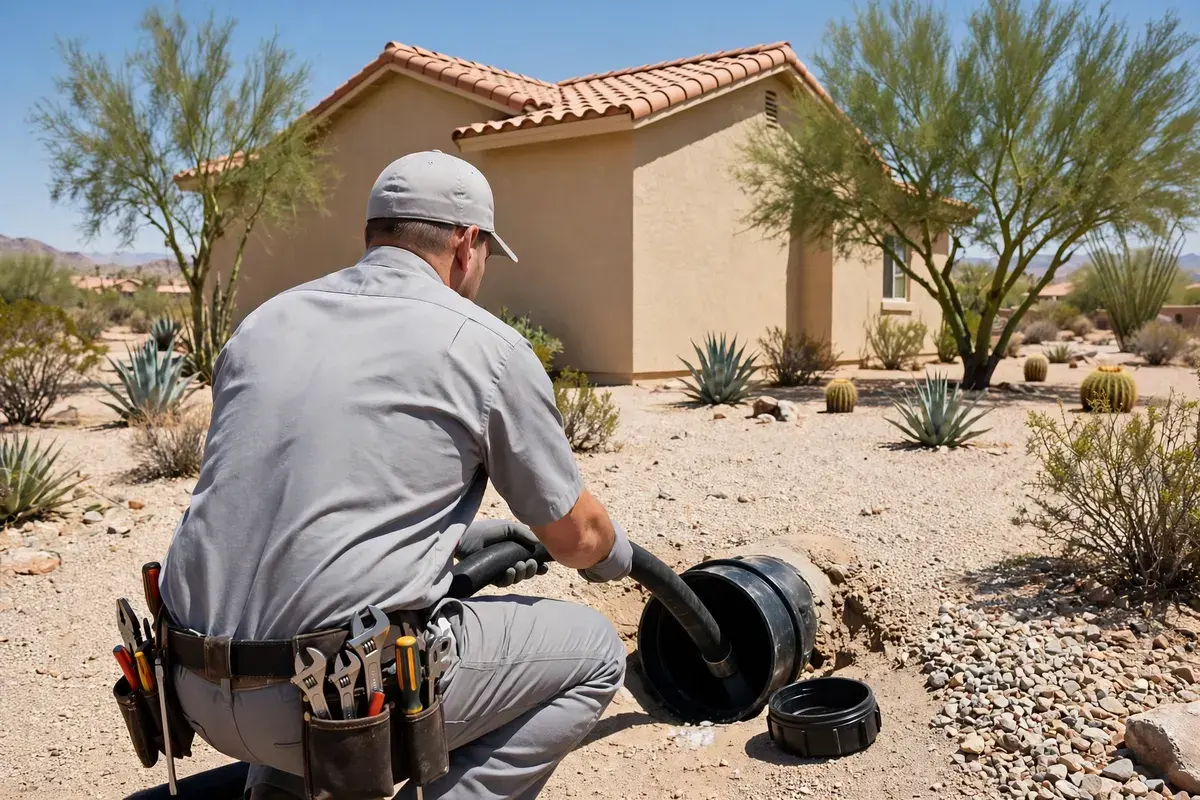
Three things set the bill in Phoenix. First, length: a short kitchen branch is quick, a main running through a long desert yard to the street is not.
Second, scale: a light grease coat clears in a pass or two, a mineral crust laid down over years needs slow passes and a different head, and the crew charges for the time the crust takes. Third, access: a cleanout sitting open in the yard keeps the visit short, while one buried under gravel or a patio adds a search before the cleaning starts.
Most Phoenix homes are single-story stucco ranches on slabs, so the cleanout is outside and easy to reach. That helps the price.
The exception is the older house where a patio or a driveway extension went over the cleanout. If you know where yours is, say so when you book.
If you do not, the crew will hunt for it first, and that hunt is part of the visit.
Get the camera look before anyone quotes. The picture shows the scale, the joints, and the length, and it turns the ranges in the table below into a firm number for your house.
Ask what the visit includes: a camera run before and after, the jetting passes, and a flow test at the slow fixtures. That package is what you compare between companies, not the headline figure.
Hydro jetting in Phoenix
Arcadia's ranch homes and their pipes
Arcadia's lots are big, and that changes the job. The mid-century ranch homes there sit on wide parcels shaded by citrus trees and palo verdes, and a lateral can run a long way from the house to the street.
A long run takes more time to clean and more camera footage to map. The trees add to it: citrus roots spread wide hunting for moisture, and a clay joint is the easiest water in the yard.
The camera often finds root hairs at the joints nearest the trees, thin at first, then thick enough to snag paper.
Inside, the plumbing tells the age of the house. Many Arcadia ranches went up in the 1950s and 1960s with cast iron or galvanized steel, and later work added other materials in ways that made sense at the time.
A mixed line like that needs the camera more than a new PVC line does, because the crew has to see which stretches are scaled, which joints have roots, and whether any section has settled.
Under the topsoil sits caliche, a hard cement-like layer that makes digging slow and costly. A repair that needs excavation costs more here than in soft ground.
That is one more reason to catch trouble with a camera while it is still a cleaning job. Buying in the area?
Ask for the camera footage, and read the pipe material in each stretch, not just the note that the drains run.
Hydro jetting in Phoenix
What does a camera inspection find in Phoenix drains?
The picture tells the story in minutes. Near the house, the camera shows scale on the hot-water walls, a pale rough crust, and grease in the kitchen branch laid down in layers.
Mid-run, the scale is thickest, because the water has travelled furthest and dropped the most minerals. Near the street, roots show up at the clay joints closest to the trees.
Some of what the camera finds, jetting cannot fix. A joint that has separated shows as a step in the pipe where waste catches.
A low stretch where water stands still is a belly, often where the ground settled under a driveway. A crack or a collapse shows as a break with soil pressing in.
In the desert, the camera sometimes catches a pipe that shifted at a joint as the ground dried and shrank, leaving a gap the roots exploit. None of these is a cleaning problem, and washing them will not hold.
Have the technician talk through the footage as it plays, and note how far each fault sits from the cleanout. A root mat forty feet out by the citrus trees is a different job from a scale coat ten feet out under the kitchen.
Keep the video or the written notes. Next time the drain slows, new footage against old footage shows at once whether the trouble is fresh buildup or the same joint failing again.
Hydro jetting in Phoenix
Desert heat, monsoon rain, and your drains
Summer in Phoenix does two things to a drain. First, the ground bakes.
Grease in a kitchen line softens in the heat, moves further down the pipe, and sets again in a thicker coat where the line cools. Second, the dry soil shrinks, and a pipe can shift at a joint, opening a gap for roots.
A line that ran well in spring can start to drag by autumn, because the summer moved the ground around it.
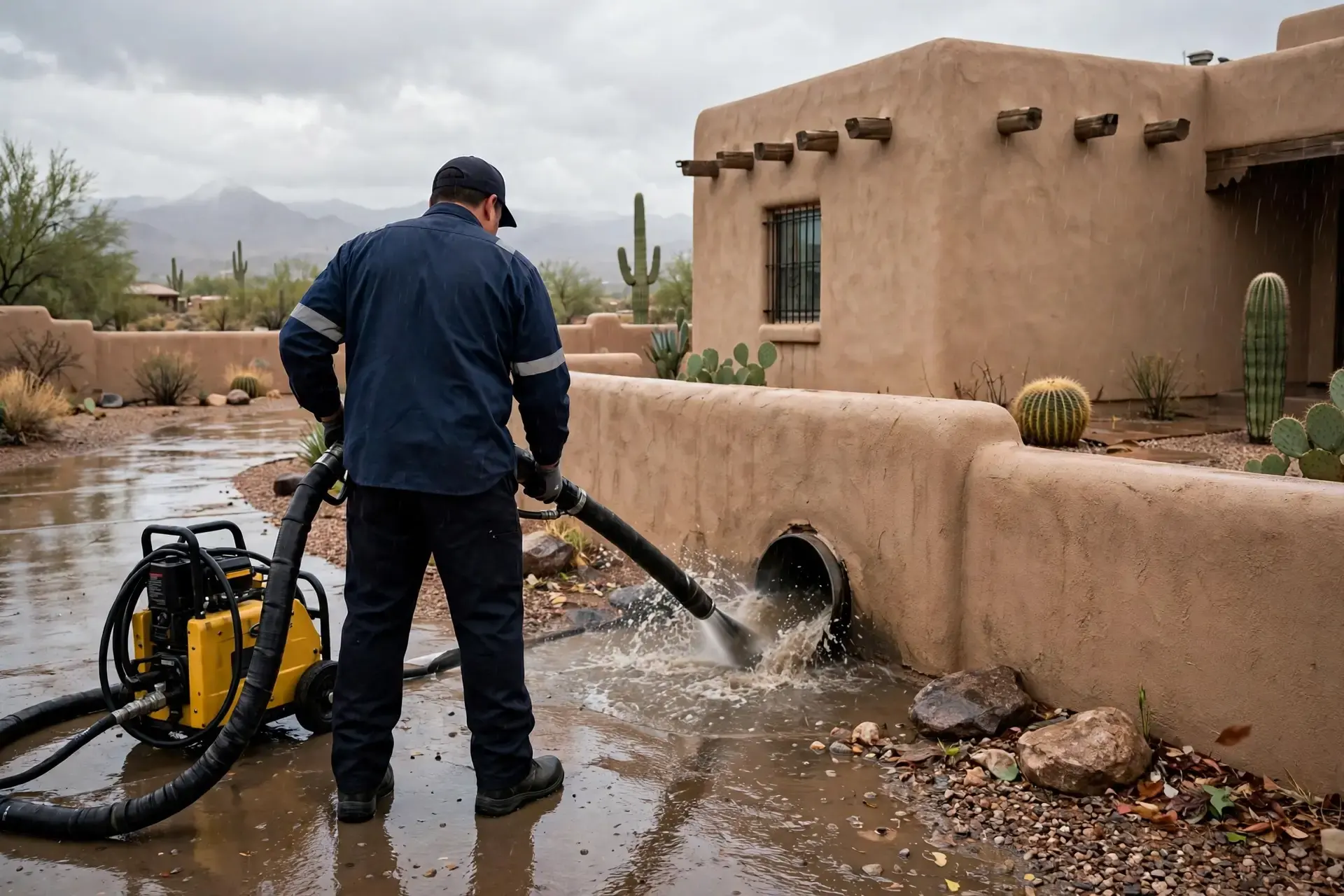
Then the monsoon comes, usually July into September, and the rain arrives all at once. A single storm can drop a large amount of water in an hour, and the street sewers fill just as fast.
A lateral that already drains slowly backs up first, at the lowest fixture in the house. A clean lateral with its full opening moves your wastewater out faster and gives the line more room before it fills.
A coated lateral, half closed by scale, fills twice as fast.
Your fixtures warn you before the drains do. A crusted shower head or a slow aerator means the same minerals are coating the inside of your pipes.
Clean the aerators when you see the crust. When a drain slows at the same time, book a camera look instead of reaching for a chemical cleaner, which does nothing for scale and can damage older pipes.
Hydro jetting in Phoenix
Roots in the desert: citrus, palo verde, and clay joints
Desert trees are built to find water, and a sewer lateral is the most reliable water in the neighbourhood. A citrus tree in an Arcadia yard spreads its roots wide in search of moisture.
A palo verde or a mesquite does the same, far beyond its canopy. When those roots reach a clay lateral, they test every joint.
A hair slips through a gap, grows toward the water inside, and thickens into a mat that snags paper and waste.
On the camera screen, early growth looks like a thin thread. A mature mat looks like a dark tangle closing the pipe to a slit.
Jetting cuts both, the first easily, the second with repeated passes and a cutting head. Neither pass closes the joint.
The tree is still there, the joint is still open, and the roots come back, usually within a year or two.
So treat it as upkeep, not a cure. A camera look once a year and jetting when the picture shows growth returning is the rhythm for a Phoenix home with clay laterals and big trees.
When the same joint fills up thick within a year, the lasting answer is a repair at that joint, and the camera footage is what the plumber prices from. Planting something new?
Keep it well away from the line between your house and the street, and find out where the lateral runs before you dig.
A new planting deserves a thought about the lateral. A young citrus tree goes in small and grows wide, and its roots will travel further than the canopy ever reaches.
Ask where the line runs before you plant, and give the tree room on the far side of the yard. The cost of moving a planting is nothing next to the cost of digging up a lateral, and the camera will show you exactly where the line sits.
Hydro jetting in Phoenix
A Phoenix visit, from the first call to the clean pipe
Book it by phone, and start with the slow fixtures: which ones, how long, whether anything has backed up. That tells the crew whether they face one branch or the main, and what gear to bring.
Clear a path to the yard cleanout, keep pets inside, and in summer leave a shaded spot to work in. Desert sun is hard on workers and equipment alike.
The camera goes in first. You watch the inside of your own pipe on a small screen while the lens travels: crust, grease, roots, breaks.
The picture sets the pressure and picks the nozzle. A scaled cast iron line takes a different setting from a sound PVC one.
Then the hose feeds through the cleanout and the head works toward the street in passes, each one a little further, flushing the loosened material to the sewer. The crew watches the slow fixtures as the flow comes back.
Proof ends the visit. The camera runs again and should show bare walls.
Then the crew opens the slow fixtures together and checks them under a real load. Ask to keep the after footage.
In Phoenix, where a lateral runs a long way through a desert yard and the scale grows back every year, that recording shows what was clean and how fast the crust is returning.
Hydro jetting in Phoenix
Does a Phoenix drain ever freeze?
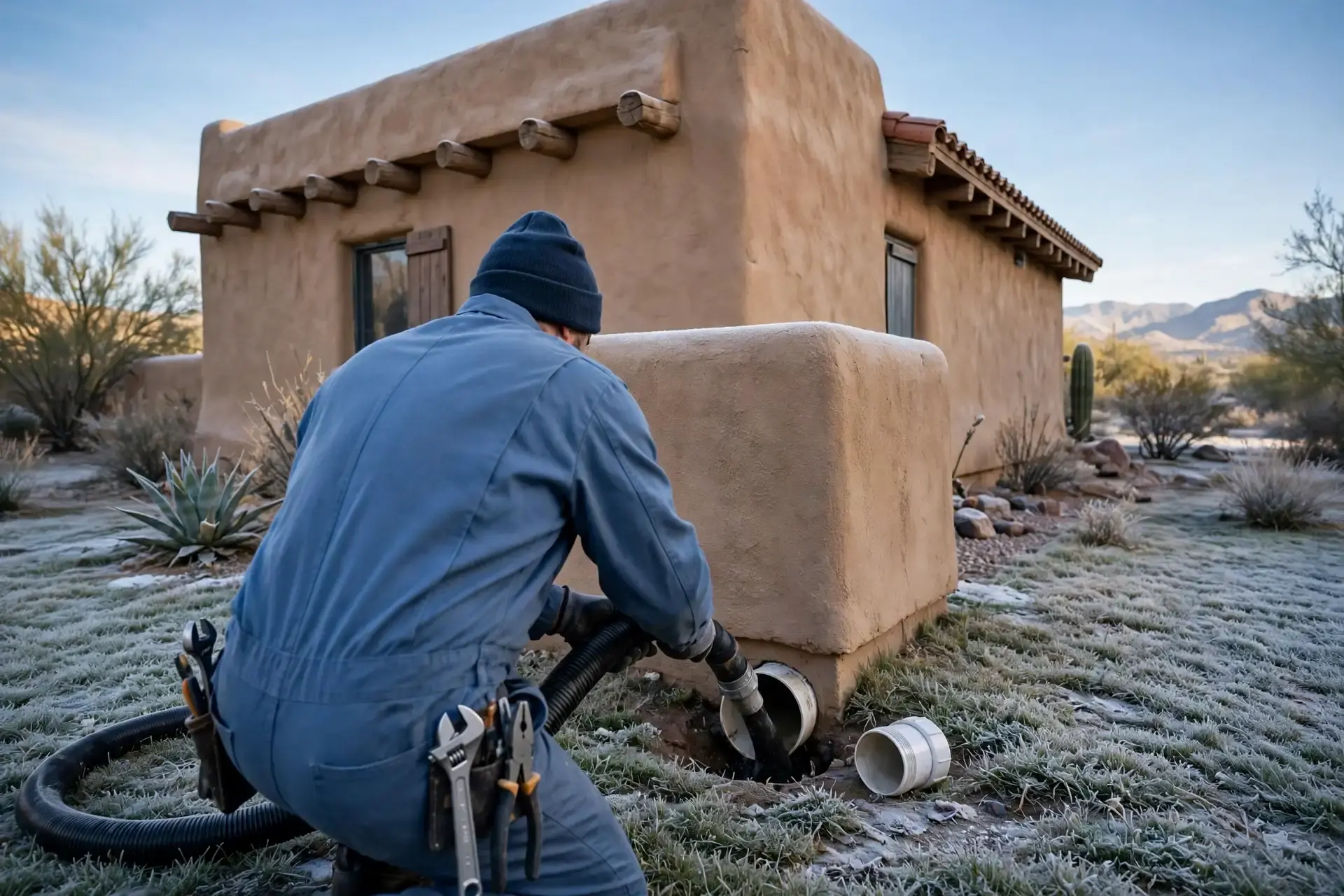
Practically never. Night temperatures in the city rarely fall below freezing, and the soil around a buried lateral stays warm all year.
A Phoenix drain needs none of the winter protection a Chicago or New York line needs, and there is no frost season to plan around.
The one exception sits in the higher desert around the city, where the coldest nights of the year can bring a light frost. An exposed pipe on an outside wall, or a trap in an unheated garage, can freeze in those conditions.
The fix is simple: wrap any exposed pipe you can see, and let a slow trickle run from a tap on the coldest nights if a pipe is exposed.
With no freeze to plan around, the calendar is yours. Book a jetting visit when the camera shows buildup, or after the monsoon season, when storm water has pushed debris into the lines and the scale has had the summer to harden.
The footage decides the timing, not the season.
Hydro jetting in Phoenix
When should you call, and when can it wait?
Call today when wastewater comes back up. Water rising in a tub while a toilet flushes, a toilet that will not flush at all, sewage smells strong enough to notice from another room, water pooling on a floor near a drain: any of these means the line has stopped moving, and the next flush pushes water into the lowest fixture in the house.
A single slow sink can wait for a booked visit, as long as nothing backs up and no other fixture is affected. Pull the stopper and take the hair out, run hot water for a minute after cooking, and watch the pattern through the day.
A shower that drags in the morning and runs well by evening often carries a scale coat: minerals build fastest in hot-water lines, and a Phoenix shower is a scale problem before it is a hair problem. That is a cleaning job, not an emergency.
Watch for spread. One slow fixture is a branch.
Two slowing together is the main, and the main will not clear itself. A drain snaked twice in a year that slows again within weeks has only had a hole bored through its coating.
Book before the next monsoon season, not after the first backup of the summer, and ask to see the footage so the cause, scale, grease, or roots, is named.
Hydro jetting in Phoenix
Do you need a permit for hydro jetting in Phoenix?
No permit is needed for jetting alone. The work is cleaning: the crew inspects with a camera, washes the line, and leaves the pipework as it was.
Nothing is filed, and no inspector visits. Permits only matter when the camera finds damage that cleaning cannot fix.
Then the job changes. Cutting out a section of lateral, digging a yard to reach a broken pipe, or breaking through a slab to reach a failed line all alter the plumbing system, and the city wants that work filed and inspected when it is done.
In Phoenix the digging is the slow part: caliche, the hard cement-like layer under the topsoil, makes excavation costly. A plumber who finds such a fault should explain the filing before the digging starts and say who handles it.
Before the visit, find the cleanout and check whether the house has open permits from earlier work. Where the home sits on a slab, ask the crew to show you on the camera picture exactly where a fault sits before any digging is discussed.
A repair under a slab is a far bigger job than the same repair in a yard. Ask for a written note of the camera findings at the end: if a filed repair follows, that note is where the next plumber starts.
Hydro jetting in Phoenix
How does jetting in Phoenix compare with Mesa and Scottsdale?
Every city in the Valley drinks the same hard water, but the houses change the job. Mesa, to the east, mixes older homes near its centre with newer tracts further out, so its laterals carry the same scale and root growth in different proportions by age.
Scottsdale, to the northeast, has many newer homes with PVC laterals, so jetting there is more often a grease job in the kitchen branch than a scale job in the main.
Glendale and Chandler sit between the two: older homes with cast iron and clay near their centres, newer tracts further out, all on the same hard supply. Tempe and Gilbert are newer still, with longer laterals and more PVC, so their lines scale less and root less, but a long run from the house to the street takes more time to clean, and the camera often finds a belly where the desert ground has settled under a long driveway.
A price from one of those towns will not carry over to Phoenix, because the cost table on this page is written for Phoenix housing and access. What carries over is the method: camera first, jetting passes, camera after.
If you own homes in more than one of these places, judge them by the camera footage, which shows the state of each line, rather than by the bills, which mostly show how long the crew spent reaching the pipe.
The Valley shares one more trait: the ground itself. Caliche sits under the topsoil everywhere here, so any repair that needs digging is slow work in every one of these cities.
That shared ground is another reason the camera matters so much. A cleaning job stays a cleaning job only while the pipe is sound, and the footage is what proves it.
Signs you may need hydro jetting
- A shower head crusts over within weeks of being cleaned.
- A kitchen sink in an Arcadia ranch drains slowly after dinner.
- A toilet needs two flushes before the bowl clears.
- A drain that was snaked in spring is slow again by summer.
- Two fixtures on different floors slow down in the same week.
- A sewage smell drifts up from a yard cleanout on a hot afternoon.
- A citrus root has cracked a section of driveway near the lateral.
- A bathroom drain gurgles when the washing machine empties.
- Water climbs in a tub when a toilet flushes on another floor.
- Dark grit shows in the water at a low drain while the washer is running.
- Several fixtures slow down together on a monsoon evening.
How it works
- 1
Step 1 — Look down the line first
The camera goes in from the yard cleanout, and the technician reads the screen as it travels: mineral crust, grease, roots, breaks. Pressure and nozzle follow from that picture.
- 2
Step 2 — Pick the head for the crust
Scale needs a scouring head, grease needs a cutting spray, a root mat needs a cutting head at a slow feed. The jetter is set to the pipe the camera showed.
- 3
Step 3 — Scour toward the street
Pass by pass, the hose strips the crust and coating from the walls and pushes it out to the sewer. At thick scale and root joints, the crew slows down and lets the head work.
- 4
Step 4 — Look again and test the flow
The camera runs a second time and should show bare walls. The crew opens the slow fixtures together to check the drain under a real load before the cap goes back on.
Hydro jetting cost in Phoenix
What does it cost?
Phoenix prices follow the pipe, and the table below gives countrywide ranges to work from. Length comes first: a short branch is quick, a main through a long desert yard is not. Scale comes second, and here it is the number that surprises people. A mineral crust laid down over years takes slow passes and a different head, and the crew bills the time the crust takes. Access comes third: an open yard cleanout keeps the visit short, a buried one adds a search. Get the camera look before anyone quotes, because the picture turns the range into a firm number for your house. Compare whole visits, camera before and after, jetting passes, and a flow test, not headline figures.
| Service | Typical range (estimate) | Notes |
|---|---|---|
| Main line jetting | $350 – $650 | Standard home main line |
| Single fixture line clean | $250 – $500 | Just one branch line |
| Bad blockage and commercial lines | $600 – $1,200 | Long runs and heavy buildup |
Prices are estimates only. The local company that does the work sets its own final pricing.
Questions about hydro jetting in Phoenix