
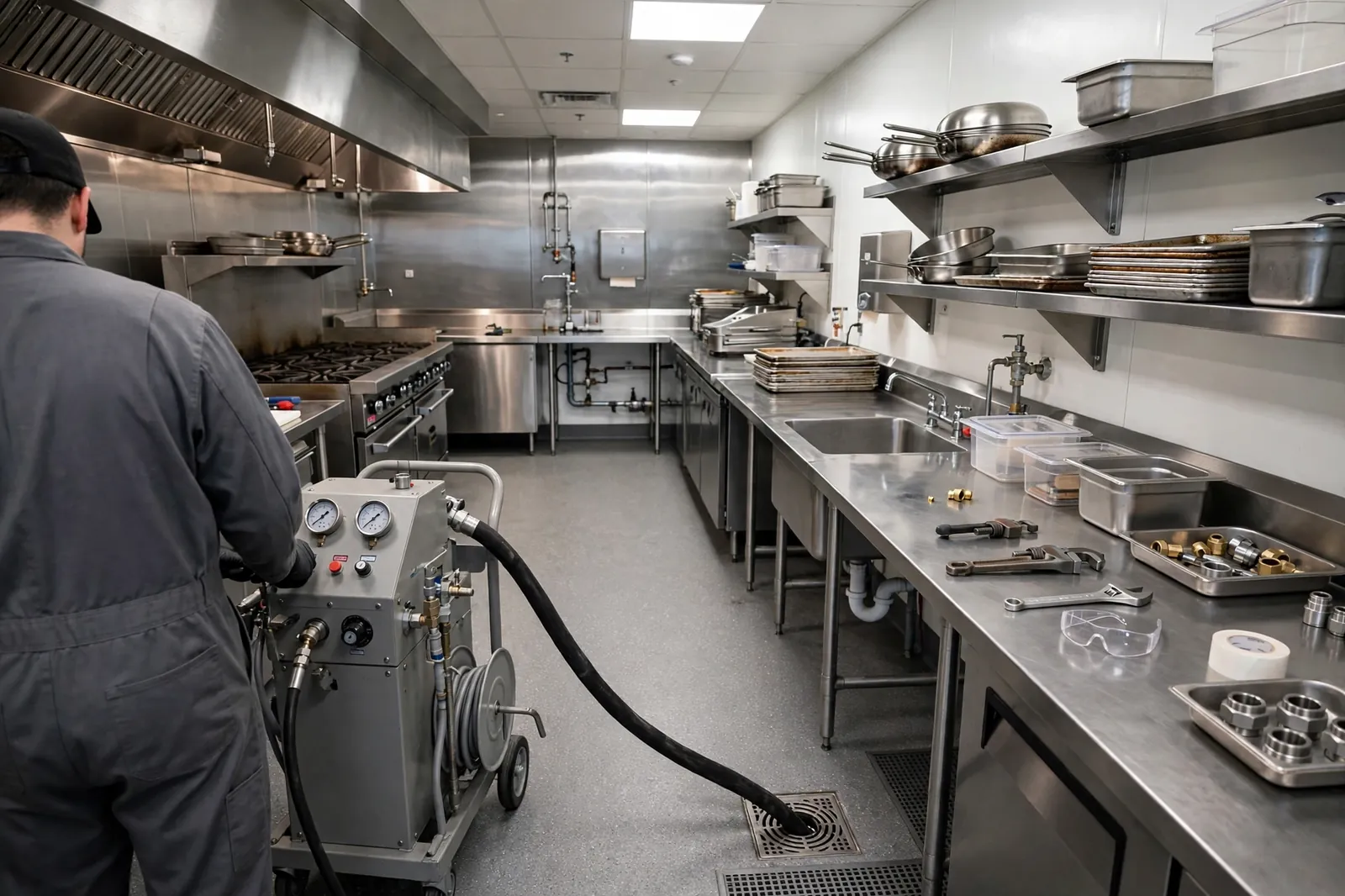
Grease Line Jetting
Cooking fat poured down a sink cools, hardens and sticks to the pipe walls, and each wash adds another layer until the kitchen line narrows to a trickle. Grease line jetting runs hot, high-pressure water through that line to melt the fat, strip it from the walls and flush it away. Call (833) 878-1592 to book a kitchen line clean.
Updated 2026-11-18. Prices shown are estimates only.
- $150–$900 Typical cost range
- 5 Steps in the visit
- 12 Questions answered
Before & after — grease line jetting
Before & after
Drag the slider to compare the same pipe before and after jetting.
Grease Line Jetting
How cooking fat turns into a blockage
Hot fat looks like water when it leaves the pan, so it slips down the drain without a second thought. Inside the pipe it cools within seconds and sets into a pale, waxy coating.
Dishwater, food scraps and soap stick to that coating, and the next wash adds a fresh layer on top. Over weeks the bore shrinks, water drains slower, and the line starts to smell as food rots in the fat.
This is a slow process, which is why a kitchen drain often seems fine until it suddenly is not. A snake can punch a hole through the fat, but the coating stays on the walls and the hole closes again.
Hot water is the only thing that shifts the coating itself, which is why jetting suits grease better than any cable tool.
Grease Line Jetting
Kitchen signs that point to grease
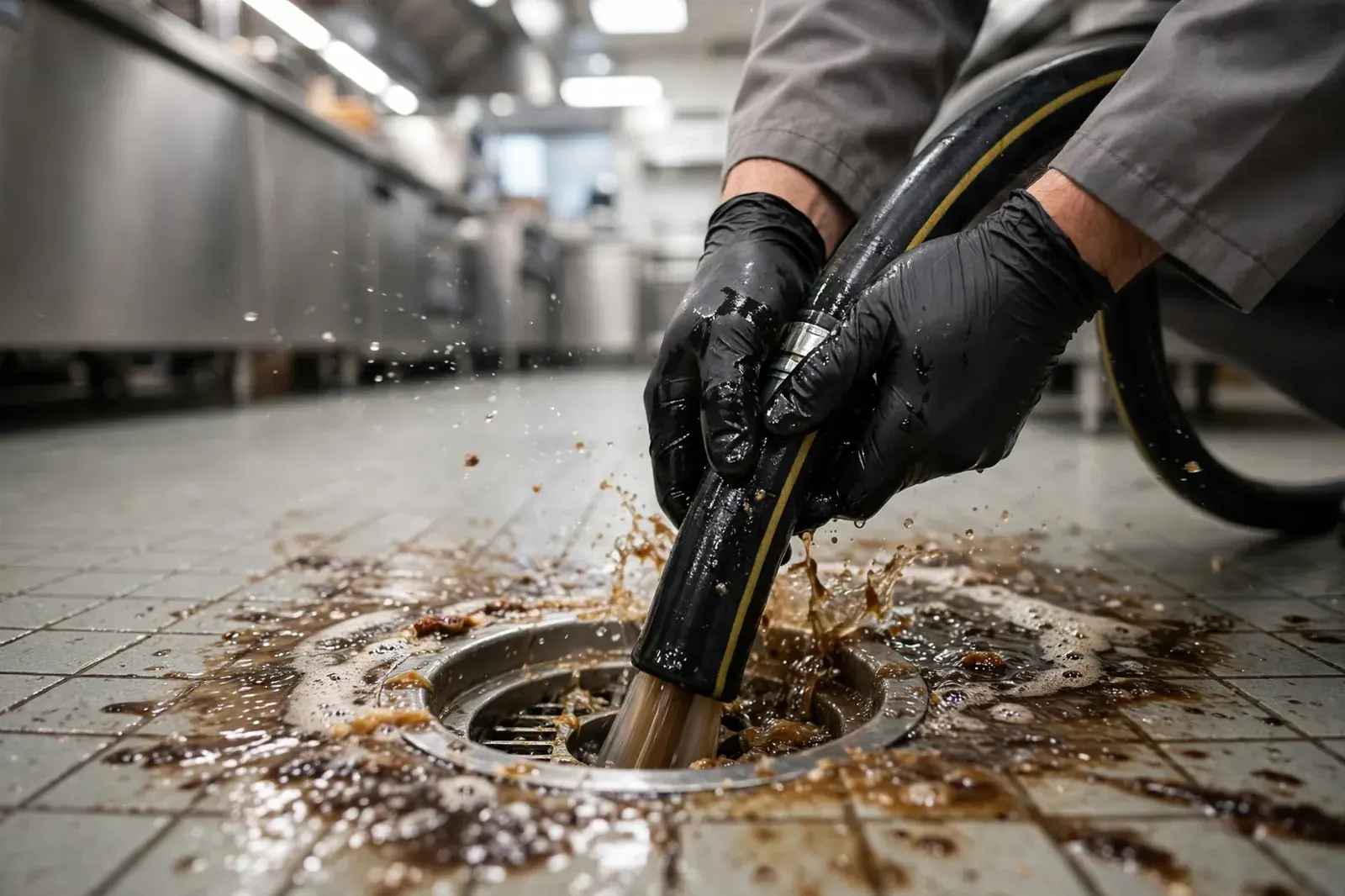
The first sign is a sink that drains slower than it did a month ago, even though the trap has been emptied and the plunger has been tried. Next comes gurgling when the dishwasher runs, because air is trapped behind a fat plug downstream.
Then the smell: a stale, rancid odour from the sink that returns after cleaning the basin, because the source is inside the pipe, not on the surface.
In a busy household the dishwasher may start leaving water in its base, or the sink may fill when the disposal runs. If the bathroom drains are fine and only the kitchen is slow, the problem is almost certainly the kitchen line, and it is worth treating the fat rather than the fixtures.
Grease Line Jetting
Hot water, pressure and passes: how it is done
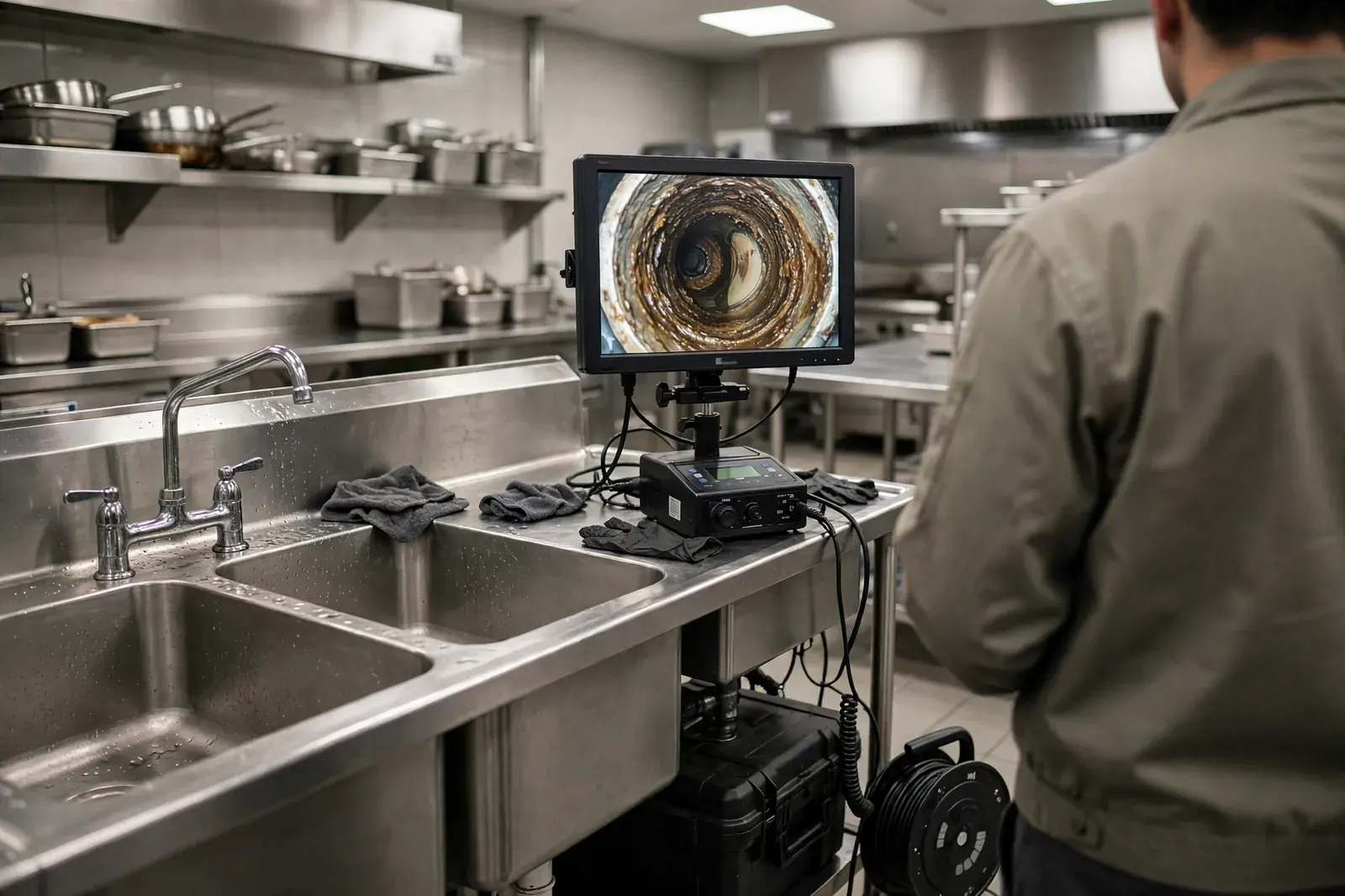
A grease job starts with a camera look inside the line, so the crew can see how far the fat runs and whether the pipe is sound. Then the jetting hose goes in through a cleanout or a pulled trap, and hot water at high pressure is run through the line in slow passes.
The heat softens the fat, the jets strip it from the walls, and the flow carries it out to the main drain.
The operator works the hose back and forth over the worst stretches, because a single fast pass leaves a film behind. A second camera look at the end shows clean walls, and the crew can point out any section where the fat has returned before, which is often a sag or a rough joint that catches debris.
Grease Line Jetting
Traps, disposals and the line beyond them
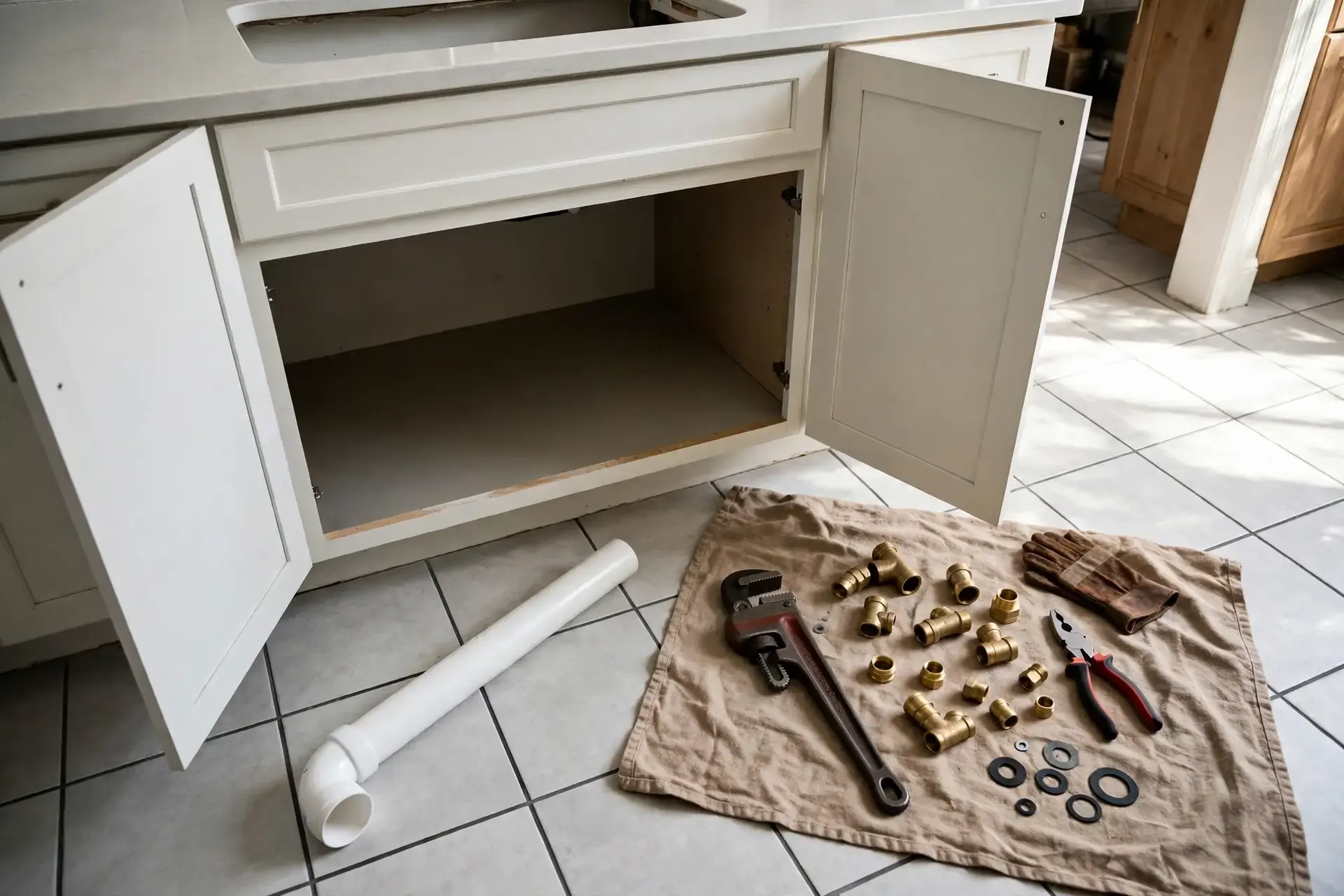
The trap under a sink holds water to block smells, and it also catches fat and food. It is easy to remove and clean, and it is often the first thing a homeowner tries.
But the trap is only the first few inches: the fat that matters sits further down the line, where the pipe runs through the wall and under the floor, and no trap cleaning reaches it.
A garbage disposal adds to the load. It chops food fine, but fine food still sticks to fat-coated walls, and starchy foods such as rice and pasta swell in the pipe.
Jetting cleans the line past the disposal, not the disposal itself. If the disposal is old and its blades are blunt, replacing it can help, but it will not cure a fat-coated line on its own.
Grease Line Jetting
Keeping a kitchen line clear after jetting
The habit that matters most is keeping fat out of the sink in the first place. Wipe pans with a paper towel before washing, and pour cooled oil into a sealed container for the rubbish.
Even small amounts add up: a tablespoon a day is enough to recoat a line within months. A mesh screen in the sink catches food scraps that would otherwise stick to the walls.
Run hot water for a short while after washing greasy pans, so any fat that does enter stays liquid until it reaches the main drain. Avoid pouring chemical cleaners down a fat line: they can sit on the fat, give off fumes, and create a hazard for the crew who later opens the line.
Hot water and a screen do more, for less money.
Grease Line Jetting
When a kitchen line needs a different answer
Jetting clears fat, but it cannot fix a line that has the wrong fall, a sag where water sits, or a section that has cracked. If the camera shows standing water in one stretch, fat will settle there again soon after cleaning, and the honest fix is to correct that section.
A line that has been jetted twice in a year and keeps blocking is telling you something about its shape, not its cleanliness.
Old steel pipe is another case. Years of fat and corrosion can leave the inside so rough that no wash restores a smooth bore, and the pipe may need replacing.
The camera look is what separates these cases from a plain fat problem, and a crew that shows you the footage is giving you the facts to decide, not just selling another clean.
Grease Line Jetting
Which foods and fats cause the worst buildup?
Not all fats behave the same way in a drain. Animal fats, the fat from meat, bacon and butter, set hard as they cool, and they form a firm, waxy layer that grips the pipe wall.
That layer is the one that builds fastest and hardest to shift. Vegetable oils stay liquid longer, so they travel further down the line before they set, which means they coat a longer stretch of pipe.
Mayonnaise, salad dressing and sauces carry oil in a form that separates in the drain, leaving the oil behind while the water runs on.
Food scraps add to the problem. Coffee grounds do not dissolve; they settle into the fat layer and give it a rough surface that catches more debris.
Rice and pasta swell in water and clump together in a fat-coated pipe. Flour paste from baking sets like glue.
Even dishwater carries a load: the hot, soapy water from washing up holds fat in suspension while it is hot, then drops it as a film when it cools a few feet down the line. The kitchen line is the hardest-working drain in the house, and the mix of fat and food that passes through it is the reason it blocks more often than any other.
Grease Line Jetting
Does hot water down the sink prevent grease clogs?
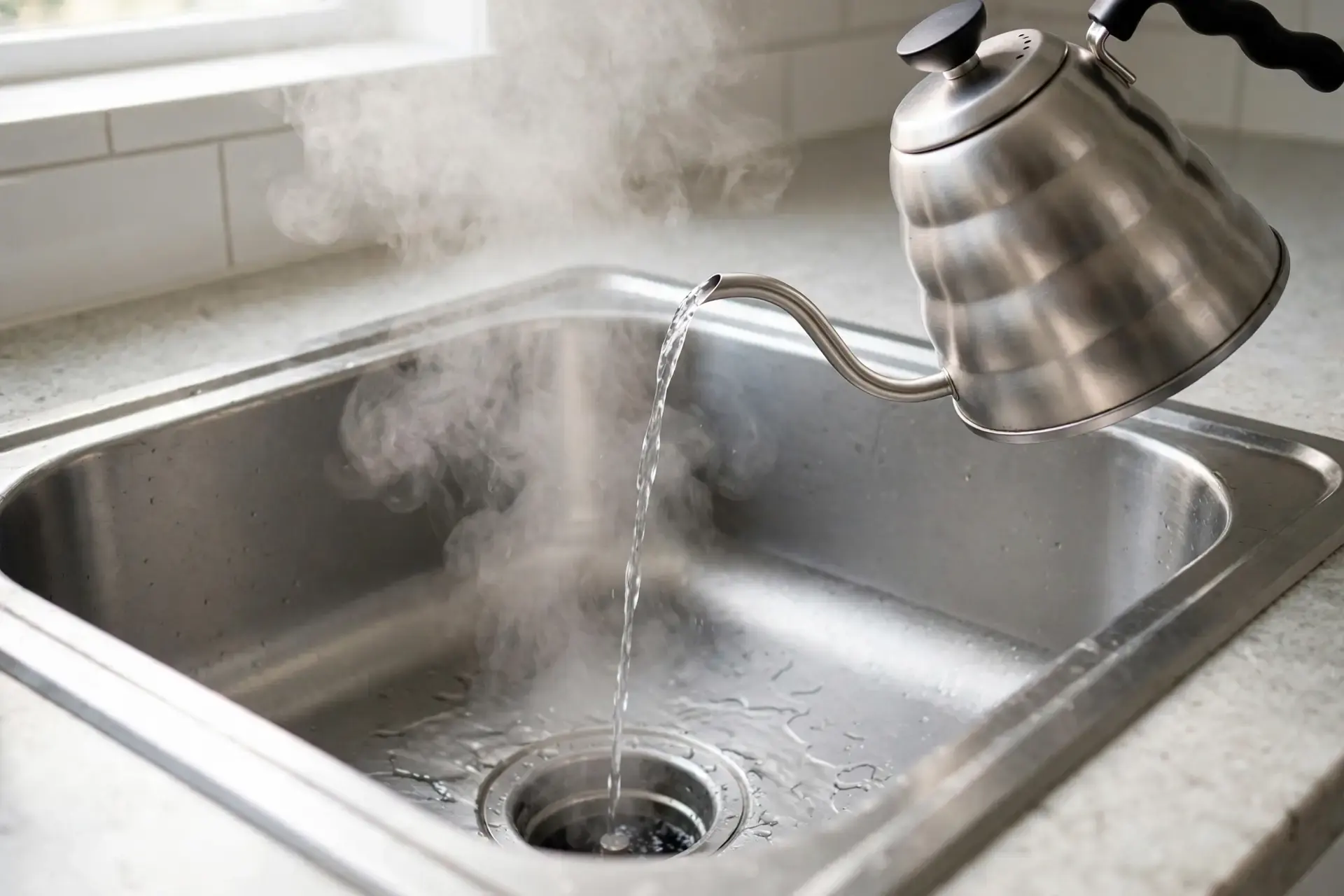
Hot water helps a little, and it is worth doing, but it is not a cure. Running the hot tap for a minute after washing up melts the surface of the fat film and carries some of it further down the line.
The catch is that hot water cools quickly inside a pipe: within a few feet the water has lost its heat, and the fat sets again, just further from the sink. The clog moves rather than disappearing, and a line that is flushed with hot water every day still builds a coating, only more slowly and further along.
Boiling water from a kettle is stronger than tap-hot water, and a kettle poured slowly down the drain can clear a fresh, thin film. It will not shift a thick, set layer, and it should never be poured into a sink with a porcelain basin that is already full of cold water, because the sudden change in temperature can crack the basin.
The habit that actually prevents grease clogs is keeping fat out of the sink in the first place: scrape plates into the bin, wipe pans with a paper towel, and pour cooking fat into a jar to set and throw away.
Grease Line Jetting
How does a grease trap work, and when does it fail?
A grease trap is a small tank fitted in the kitchen drain line, usually under the sink in a home or in the floor of a restaurant kitchen. Wastewater flows in, slows down, and the fat floats to the top while the heavier food scraps sink to the bottom.
The clear water in the middle flows out to the drain. The trap holds the fat back, so the line beyond it stays cleaner for longer.
A home trap is small and needs emptying by hand; a restaurant trap is larger and needs a pump-out by a specialist.
A trap fails when it is not emptied. The fat layer grows until it reaches the outlet, and from then on fat flows straight through the trap and into the line as if the trap were not there.
A trap also fails when hot water is poured through it in a rush, because the hot water melts the floating fat and carries it out the outlet. The signs are a kitchen line that blocks again soon after jetting, and a smell of old fat around the sink.
If a home has a trap, the crew should check it during the visit, and the trap should be emptied on a regular schedule, not only when the drain slows.
Grease Line Jetting
Can a garbage disposal make grease problems worse?
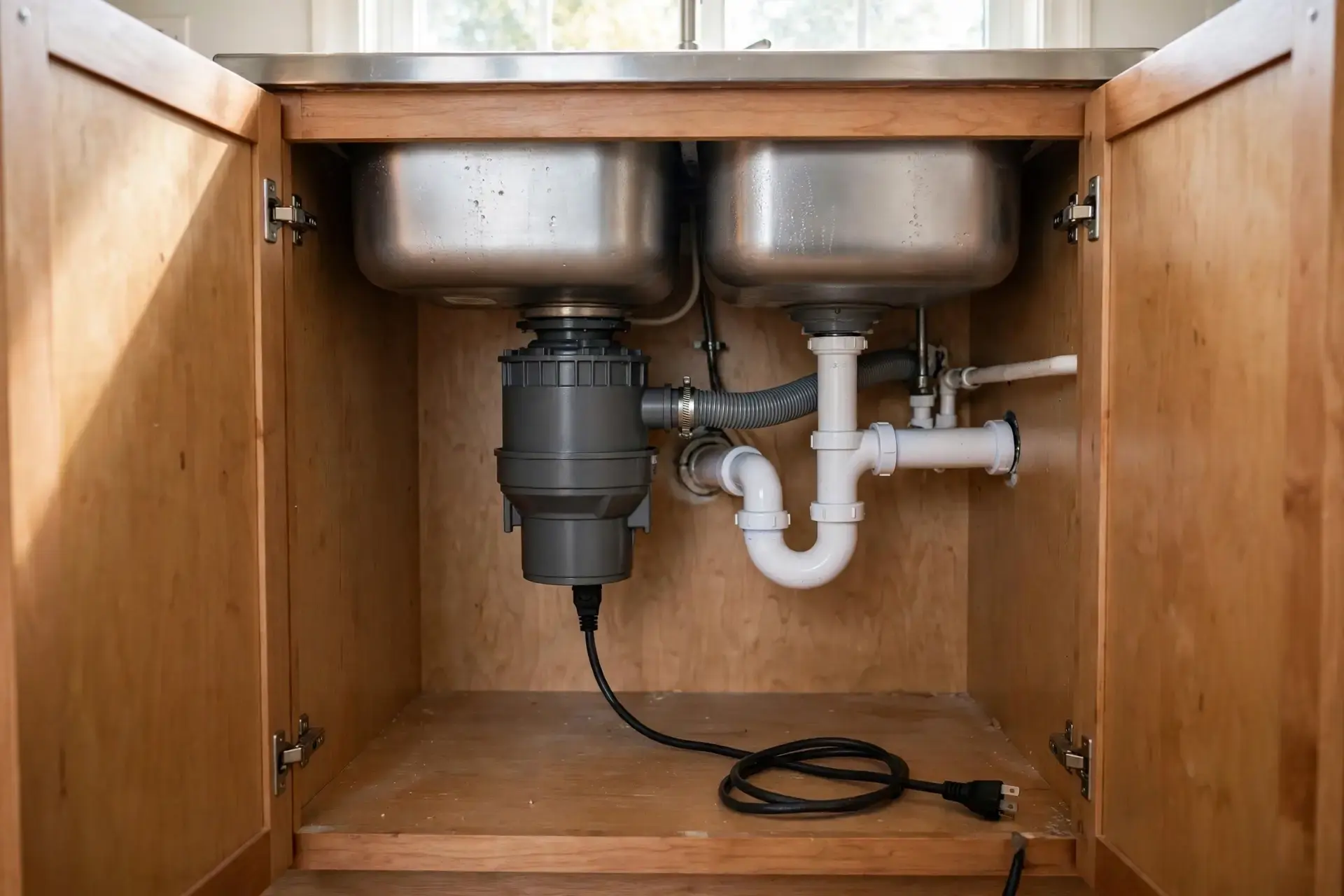
A garbage disposal grinds food scraps into small pieces so they can flow down the drain, and it does that job well. What it does not do is remove fat.
Ground-up food mixed with fat makes a paste that coats the pipe more evenly than either one alone, and the paste sets hard as it cools. A disposal also encourages a habit that hurts the line: because the food disappears down the sink, it feels safe to put more down, including starchy foods that swell and fibrous foods that tangle.
The worst loads for a disposal-fed line are rice, pasta, potato peel and coffee grounds, all of which the disposal grinds fine enough to pass the trap but which then settle in the fat film further down. Cold water should run while the disposal is on, because it keeps the fat solid so the ground pieces carry it along, but the fat still sets further down the line.
A home with a disposal should jet its kitchen line more often than a home without one, and should still scrape plates into the bin first. The disposal is a helper for small scraps, not a replacement for the bin.
Grease Line Jetting
What does the crew see on the camera in a grease line?
A grease-coated pipe looks unmistakable on a camera screen. The walls are pale yellow or cream, smooth and waxy, and the bore of the pipe is narrowed to a small channel in the middle.
The water in the channel runs slowly, and the surface of the grease has a rippled look where the flow has worn it. In a line that has been coated for years, the grease can be an inch thick, and the channel through it may be no wider than a finger.
The camera also shows where the grease stops. In a kitchen line the coating is thickest near the sink and thins as the line runs toward the main drain, because the water cools and the fat sets early.
That pattern tells the crew where to spend their passes. The final camera look after jetting shows a different pipe: the walls are the colour of the pipe material again, the bore is open to its full width, and the water runs clear and fast.
The before and after pictures are the clearest proof of what the visit achieved, and they are worth asking to see.
Grease Line Jetting
How often should a busy home kitchen be jetted?
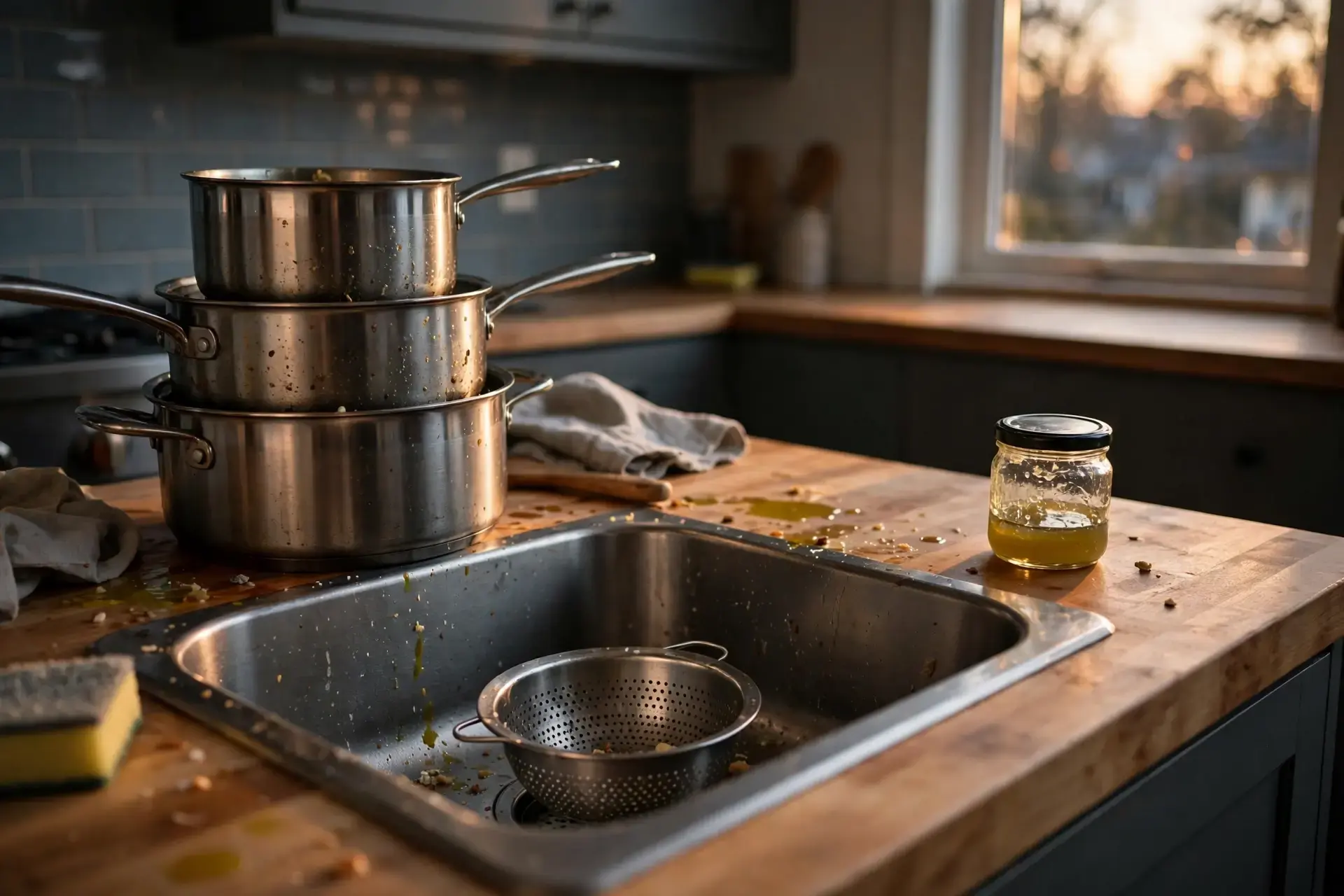
A household that cooks most meals at home, fries food often, and washes up by hand puts the heaviest load on its kitchen line, and a jetting visit every twelve to eighteen months is a sensible rhythm for it. A household that eats out often, uses a dishwasher, and keeps fat out of the sink can go two or three years between cleans.
The honest measure is the drain itself: if the sink slows within a year of a clean, the interval is too long, and if it runs clear for three years, the interval can stretch.
A restaurant kitchen is a different case, and its line may need jetting every three to six months, because the volume of fat and food is far higher and the line is longer. Many restaurants schedule the work in the quiet hours and keep a record of each visit, so the interval can be tuned to the kitchen's own history.
For a home, the simplest plan is to book a clean when the sink first slows, note the date, and book the next one when it slows again. Two dates give an interval, and the interval is the schedule.
Signs you may need grease line jetting
- The kitchen sink drains slower each week, though the trap is empty.
- A rancid smell comes from the sink even after the basin is cleaned.
- The sink gurgles when the dishwasher runs a cycle.
- Water stands in the dishwasher base after it finishes.
- The sink fills when the garbage disposal is switched on.
- Bathroom drains are fine while only the kitchen line is slow.
- The kitchen sink fills with water while the dishwasher runs, because the shared line cannot take both at once.
- A smell of old cooking fat rises from the sink, strongest in warm weather.
- Water drains from the sink in a slow swirl instead of a straight drop.
- The sink backs up when a large pot of water is tipped down it all at once.
- A white, waxy film appears around the plughole, which is grease setting at the surface.
- The disposal runs and the water level in the sink rises instead of falling.
How it works
- 1
Step 1 — Find where the fat sits
The crew asks what is cooked, how often, and when the sink first slowed, because the pattern of use tells them how far along the line the grease has set.
- 2
Step 2 — Camera look at the kitchen line
A camera goes into the line from the sink trap or the cleanout, showing the thickness of the grease coating and where it starts and ends.
- 3
Step 3 — Hot water and jetting passes
Hot water softens the surface of the fat, and the jetting nozzle scours the walls in slow passes, washing the loosened grease out toward the main drain.
- 4
Step 4 — Check the trap and the disposal
The crew checks the grease trap, if the home has one, and the disposal, because a full trap or a worn disposal will undo a clean line within weeks.
- 5
Step 5 — Final look and kitchen habits
A last camera look shows the clean pipe walls. The crew tidies up and explains the small habits, scraping plates and jarring fat, that keep the line clear longest.
Grease Line Jetting cost
What does it cost?
Kitchen grease work is priced by the length of the line and how thick the fat is. Typical ranges, shown as estimates. A short kitchen branch that runs a few feet to the stack costs less than a long line that runs across the house to the main drain. The thickness of the grease is the second driver: a thin, fresh film clears in one pass, while a thick, set layer that has built up over years needs hot water, several passes and more time on site. The entry point matters too — a line reached through the sink trap or an outdoor cleanout is quick to open, while a line that needs the trap dismantled or a toilet pulled takes longer. A camera look may be priced on its own at $150 to $350 or bundled with the jetting, so ask which it is. The written quote should list the camera look, the jetting and the tidy-up as separate lines, and a planned visit in working hours costs less than an urgent call.
| Service | Typical range (estimate) | Notes |
|---|---|---|
| Kitchen grease line jetting | $300 – $700 | Sink to main drain |
| Camera look with jetting | $150 – $350 | Often bundled in |
| Main drain jetting | $350 – $900 | Whole-home line |
Prices are estimates only. The local company that does the work sets its own final pricing.
Questions about grease line jetting