
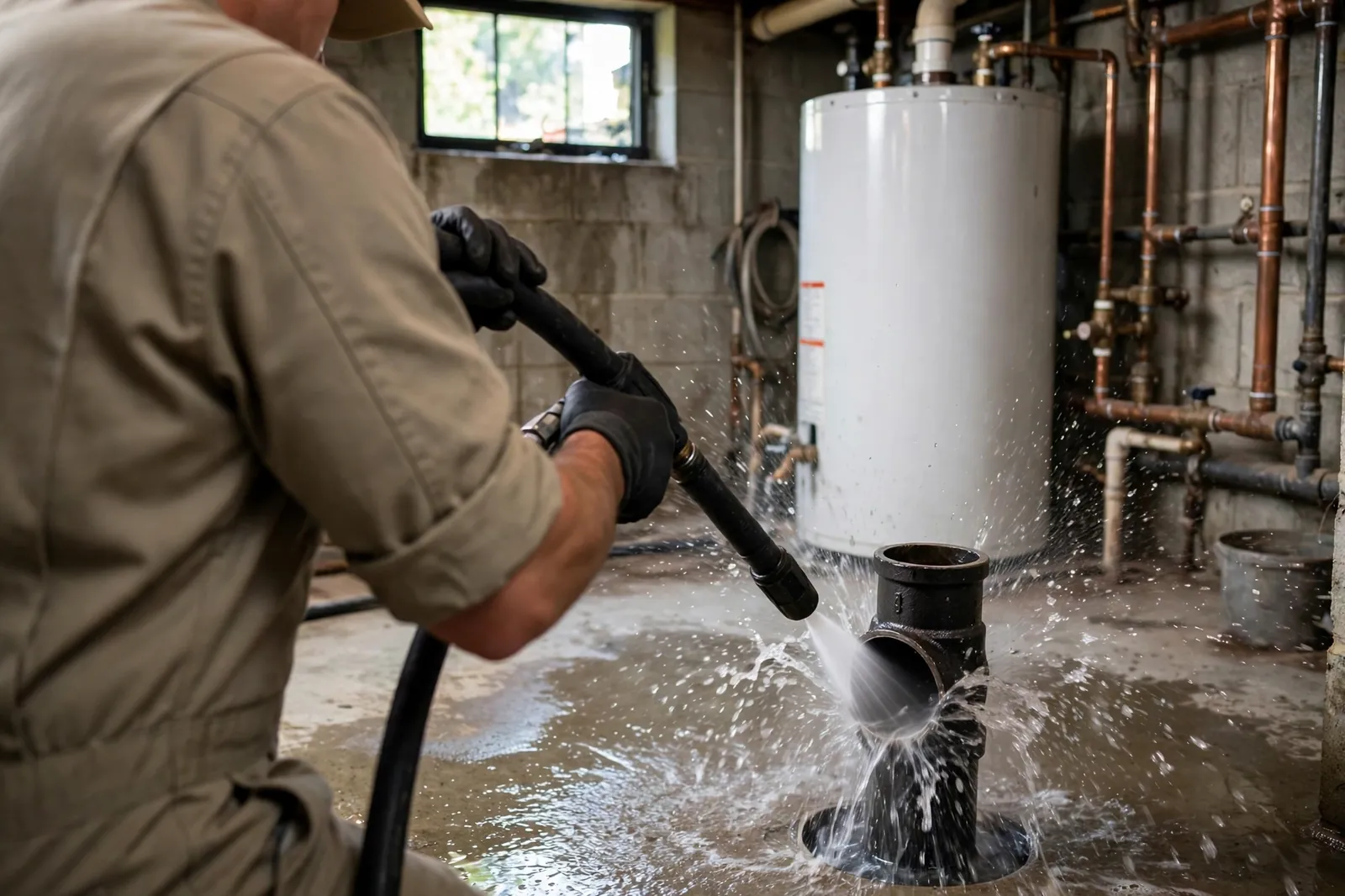
How Hydro Jetting Works
This guide takes the machine apart in plain English: the pump that makes the pressure, the hose that carries it, the nozzle that shapes the water, and the camera that checks the result. No jargon, no sales talk — just the sequence a crew follows on a real job. Call (833) 878-1592 to book a visit.
Updated 2026-11-18. Prices shown are estimates only.
The pump: where the pressure comes from
Everything starts at the pump, usually a petrol or diesel unit on a trailer or in a van. It draws water from a tank or a mains connection and pushes it through a hose at pressures a household tap never approaches — commonly 1,500 to 4,000 PSI for home work, higher for large commercial lines. Pressure on its own is not the point; it is pressure plus flow, the volume of water moving through the hose each minute, that does the cleaning.
The operator controls both from the machine. Too little flow and the debris stays put; too much pressure on a weak pipe and the pipe suffers. A trained operator reads the pipe first — its material, its age, what the camera showed — and then sets the machine to match, rather than running it flat out on every job.
The hose and how it moves through a pipe
The jetting hose is a tough, flexible line, thinner than a garden hose in some setups, thicker in others, and it can be tens of metres long. It is fed into the drain through a cleanout, and the water itself helps it travel: jets at the back of the nozzle fire backwards, and their thrust pulls the hose forward along the pipe, a bit like a small rocket.
The operator feeds the hose in slowly and pulls it back slowly, because the cleaning happens on the pull-back. Each stretch of pipe gets several seconds of jetting as the nozzle passes, and the operator can feel through the hose when it meets a blockage, a bend, or a rough patch. That feel, built over many jobs, is as much a tool as the pressure gauge.
Nozzles: the part that shapes the water
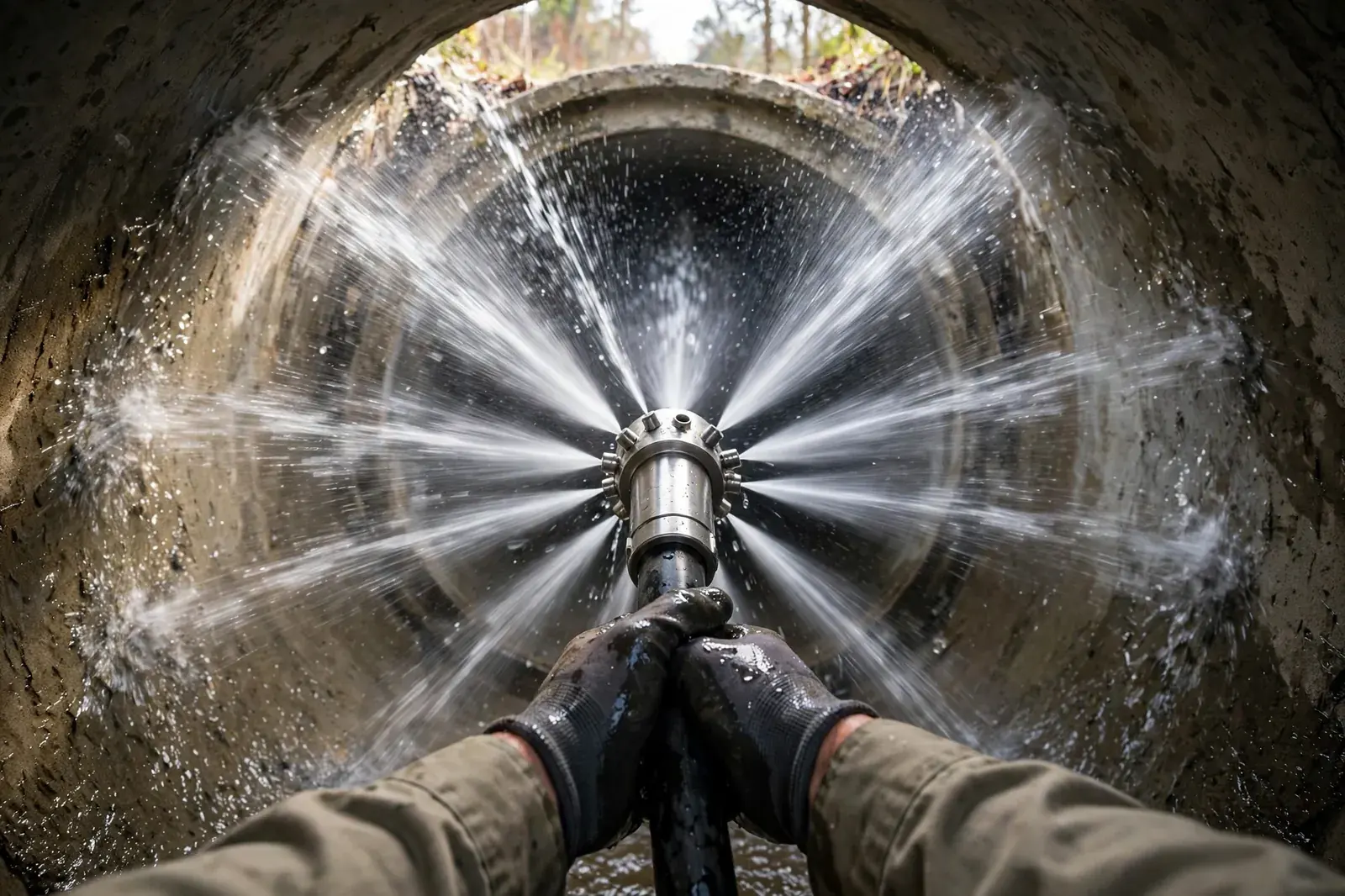
The nozzle is the small metal head at the end of the hose, and different nozzles do different jobs. A penetrating nozzle fires a strong forward jet to cut through a plug. A flushing nozzle fires backwards to wash debris out behind it. A spinning nozzle rotates as it works, scouring the walls in a circle, and a root-cutting nozzle carries blades that slice through root strands.
Choosing the nozzle is the operator's key decision. Grease wants heat and a scouring pattern; scale wants a spinning head and time; roots want the cutter. A nozzle that is right for one blockage is wrong for another, which is why the camera look comes first: it shows what the blockage is made of, and the nozzle is picked to match.
The camera: the eyes of the job
A sewer camera is a small waterproof lens on a flexible cable, pushed into the pipe ahead of the jetting hose. It sends a live picture to a monitor above ground, and the operator watches the pipe interior as the camera travels: the coating on the walls, the blockage, the joints, the cracks, the standing water in a sag.
The camera is used twice. Before jetting, it decides the nozzle, the pressure, and whether cleaning is safe at all. After jetting, it proves the result: clean walls, open bore, water running freely. Without it, a crew is working blind, and a homeowner is taking the result on trust. With it, both sides can see the same picture.
The sequence on a real job
First comes the talk: which fixtures are slow, when it started, what has been tried. Then the camera goes in and the operator maps the line — blockage type, worst stretch, pipe condition. Then the hose follows, and the operator works the line in passes, pulling back slowly, repeating the worst stretches, and watching the flow.
Finally the camera goes back in. If the walls are clean and the water runs, the job is done. If one stretch still shows coating, the operator makes another pass while the gear is set up, rather than booking a second visit. The whole sequence, for a home, usually takes one to three hours.
Water, flow and where the debris goes
A home jetting job uses roughly 100 to 300 gallons of water, depending on the length of the line and how much cleaning it needs. That water does not pool in the garden: it flows through the pipe and out to the sewer, carrying the loosened grease, scale and root pieces with it. The debris is the same material that was already in the drain, just moved along.
Because the water moves, the job is contained. The hose enters through a cleanout, the water leaves through the sewer, and the only mess is around the entry point, where the crew lays protection. That is why a jetting visit leaves a home tidier than most people expect, and why the tidy-up at the end is a short job.
Pressure and pipe safety
High pressure sounds dangerous to a pipe, and on a broken pipe it is. On a sound pipe it is not, because the pressure is set to the pipe. Plastic pipe, cast iron and clay each take a different setting, and the operator lowers it for old or thin-walled pipe. The camera look is what makes this safe: it finds the cracks and weak joints before the water is turned up.
If the camera shows a collapsed section, a wide-open joint or a pipe that has shifted, the operator should not jet at full pressure. The honest step is to stop, show the footage, and talk about repair. A crew that jets a broken pipe anyway is not cleaning it — it is making the break worse.
What the operator watches while working
An experienced operator watches three things at once: the pressure gauge, the flow coming back out of the line, and the feel of the hose. A sudden change in flow means the nozzle has broken through a plug. A hose that stops advancing means it has met a bend, a root mat or a collapsed section. A gauge that climbs means the nozzle is blocked or the line is full.
Those signals decide the next move: ease off, change nozzle, pull back and try again, or stop and run the camera. Jetting is not a matter of switching the machine on and waiting. It is a hands-on job, and the difference between a good clean and a damaged pipe is often the operator's attention in a single minute.
After the job: the record that matters
The most useful thing a homeowner gets from a jetting visit, after the clear drain, is the record: the closing camera footage and a short note of what was found and cleared. That record tells the next plumber what the pipe looks like inside, where the weak section is, and when a recheck is worth doing.
Ask for it. Ask to see the closing footage on the monitor before the crew leaves, and ask what the operator would watch for next. A crew that shows its work is giving you the facts to decide, and a homeowner with that record is in a far better position the next time a drain slows.
The water supply: where the machine gets its water
A jetting machine needs a steady supply of water, and the crew brings it in one of two ways. Most truck-mounted machines carry their own tank, filled before the visit, which holds enough water for a normal home job. Smaller portable machines connect to an outdoor tap with a hose and draw water as they work. Either way, the supply is plain water — no chemicals are added to the tank, and nothing but water goes into your pipes. The crew checks the water level before they start, because a machine that runs dry mid-pass can lose pressure and leave a stretch half-cleaned.
The amount of water used is less than most homeowners expect. A home jetting job typically uses tens of gallons rather than hundreds, because the machine works at high pressure and low flow: a thin stream moving very fast does the cutting, and the water that follows it carries the debris away. The water that leaves the line goes down the sewer, as it would from any tap, and it carries the loosened grease and scale with it to the treatment plant. If your home is on a septic system, tell the crew: the extra water is small, but a septic tank that is already full should be pumped before a jetting visit rather than after.
How the operator controls pressure and flow
The operator controls two things: pressure, measured in pounds per square inch, and flow, measured in gallons per minute. Pressure is what cuts through grease and scale. Flow is what carries the loosened debris back out of the pipe. A home job usually runs at 1,500 to 4,000 PSI with a flow of a few gallons per minute, and the operator sets both from the camera picture: soft grease needs less pressure, hard scale needs more, and a weak pipe needs less of both. The machine has gauges the operator can read at a glance, and a foot pedal or a remote control that starts and stops the water without the operator leaving the cleanout.
The skill is in the balance. Too little pressure and the coating stays. Too much pressure on a weak pipe and the pipe can be damaged. Too little flow and the debris settles back into the line instead of washing out. A good operator starts low, watches the camera, and raises the pressure only as far as the pipe allows — and a good operator is happy to show you the gauge and explain the setting. If a crew cannot say what pressure they are using, or why, that is a reason to ask questions before they start. The pressure is not a secret; it is a setting, and it should match the pipe in front of them.
The different nozzle heads and what each one does
The nozzle is the small head at the end of the hose, and it shapes the water into the pattern that does the work. A penetrating nozzle fires jets forward to bore a hole through a solid blockage, and it is usually the first head in on a blocked line. A flushing nozzle fires jets backward, which pulls the hose forward through the pipe and washes debris back toward the entry point. A spinning or rotary nozzle fires jets at an angle while it turns, and the spinning water scrubs the walls — this is the head that clears scale from cast iron and grease from a long kitchen run. A root-cutting head uses a chain or a blade that spins with the water pressure to shred root mats.
The operator swaps heads during the job as the camera picture changes. A blocked line starts with a penetrating head, moves to a flushing head once the water runs, and finishes with a spinning head to wash the walls. A line full of roots gets the cutting head, then a flushing head to carry the shreds out. Each swap takes a minute, and each head is chosen for the material in front of it rather than from habit. Ask the operator which heads they plan to use and why — the answer tells you whether they have looked at the camera picture or are working blind. A crew with a full set of heads and a reason for each one is a crew that will finish the job properly.
What happens to the debris after the clean
The debris loosened by the jetter does not vanish: it has to go somewhere, and the answer is the sewer. The backward jets on the nozzle push the loosened grease, scale, hair, and root shreds back toward the entry point, and the flow of water carries them down the line and out to the street sewer. The crew watches the water coming back at the cleanout: when it runs clear, the line is clean. When it still carries grit and grease, another pass is needed. That is the honest test of a finished job — clear water, not a clock.
Larger pieces need more care. A thick root mat cut into shreds can settle in a low spot if the flow is not strong enough to carry it out, which is why the operator flushes the line after the cutting head and checks the camera again. Grease that has been melted by hot water can re-set further down a cold line, so the operator keeps the water moving until the grease has left the property. The crew should leave the entry point tidy: the cleanout cap back on, the area hosed down, and no debris left in the yard or the bathroom. If the job was done through a toilet or an indoor drain, the fixtures should be checked and flushed before the crew leaves, and the closing camera run should show clean walls along the full length.
The machine itself: what is on the truck
A jetting rig is a compact set of parts, and knowing what they are helps you judge the crew that arrives. The pump is the heart: an engine or an electric motor drives a high-pressure pump that turns tap water into a cutting stream. The hose reel holds the hose — a tough, flexible line that can be hundreds of feet long on a truck machine, and shorter on a portable unit. The hose is rated for the pressure the pump makes, and a worn hose is a safety risk, so a good crew inspects it before every job. The control panel carries the pressure gauge, the flow control, and the on-off valve, and the operator works from it throughout the visit.
The camera is a separate unit: a reel of cable with a small lens and a light on the end, feeding a picture to a screen the operator watches. The locator is a hand-held device that finds the camera head underground, so the crew can mark where a break or a joint sits. The rest of the truck is support gear: spare nozzles, gloves, eye protection, a wet vacuum for any spill, and a water tank. A crew that arrives with a tidy truck, a clean hose, and a working camera is a crew that takes the work seriously. A crew that arrives with a tangled hose and no camera has already told you how the job will go.
Signs you may need hydro jetting
- The pump unit sits outside and feeds a long hose into the line.
- The nozzle at the hose end shapes the water into cutting jets.
- A camera travels the pipe before and after the cleaning.
- The operator pulls the hose back slowly to scour each stretch.
- Loosened debris flows out through the sewer with the water.
- The closing camera picture is the proof the job is done.
- A crew that starts without a camera look.
- A nozzle forced through a bend in the pipe.
- Water coming back out of the entry point in volume.
- A job finished with no closing camera footage.
- A machine with no pressure gauge the operator can show you.
- Debris left around the cleanout after the crew leaves.
How it works
- 1
Step 1 — Camera first
A waterproof camera travels the line and shows the blockage, the pipe material and any damage, so the nozzle and pressure can be set to match.
- 2
Step 2 — Jet in passes
The hose works the line in slow passes, cutting the blockage and washing the walls, with the operator watching flow and feel.
- 3
Step 3 — Camera again and record
A closing camera run confirms clean walls, and the crew notes what was found for the next visit.
- 4
Step 4 — Watch the closing camera run
Stand with the operator for the closing camera run and check that the walls look clean along the full run before the crew packs up.
- 5
Step 5 — Keep the footage with the date
File the before and after footage with the date and the pressure used, so the next visit starts from a known pipe.
What does it cost?
This guide is about the method, not the price. Typical ranges for the work are shown as estimates below.
| Service | Typical range (estimate) | Notes |
|---|---|---|
| Branch line jetting | $250 – $550 | One sink or bath line |
| Main line hydro jetting | $350 – $900 | Whole-home line |
| Camera inspection with jetting | $150 – $350 | Often included |
Prices are estimates only. The local company that does the work sets its own final pricing.