
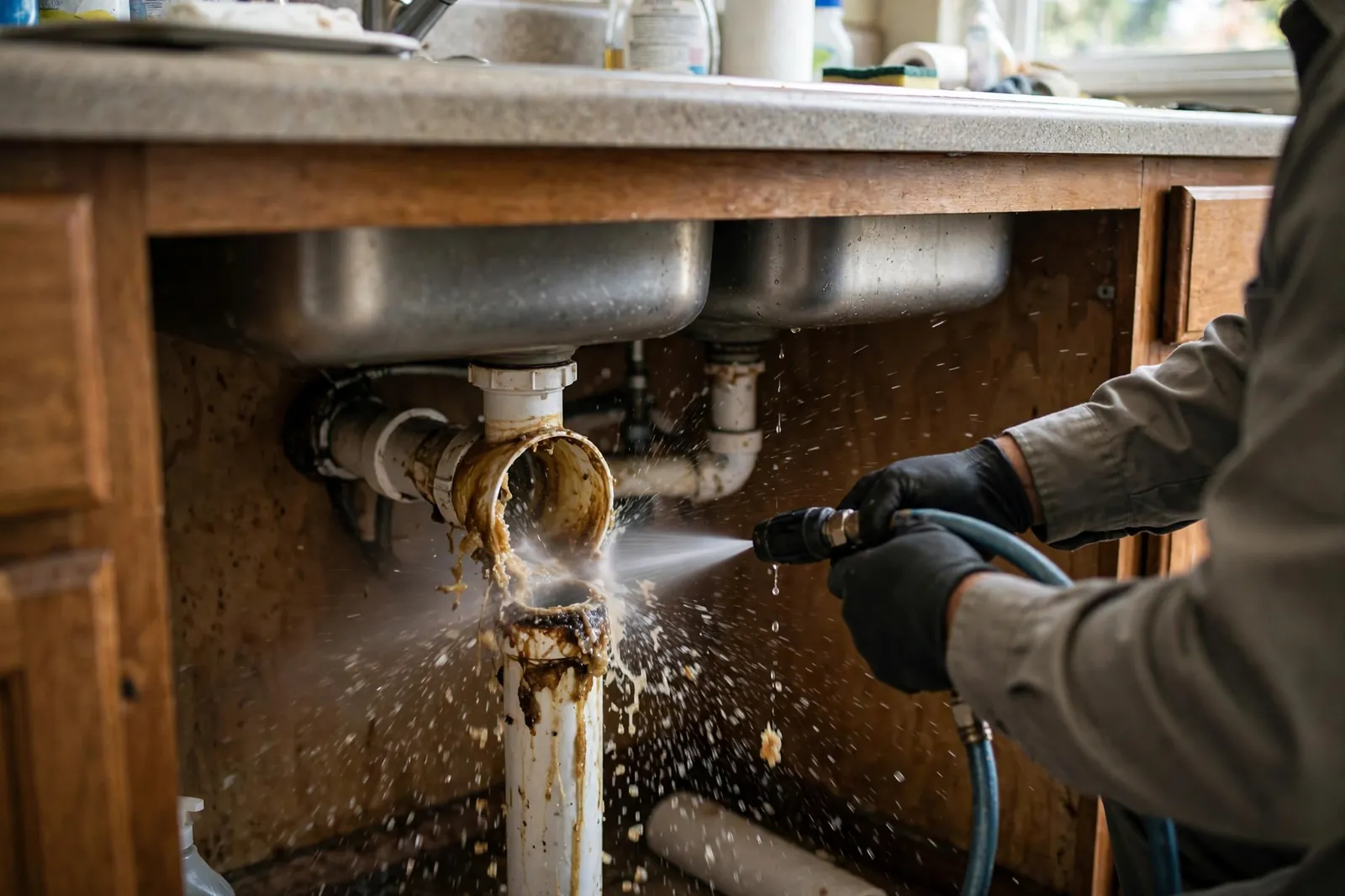
Hydro Jetting for Grease
Grease is the kitchen's own blockage: cooking fat that leaves the pan as a liquid, cools in the pipe, and hardens into a coating that catches everything else. This guide explains how that coating forms, how hot-water jetting removes it, and how to keep it from coming back. Call (833) 878-1592 to book a kitchen line clean.
Updated 2026-11-18. Prices shown are estimates only.
Where kitchen grease comes from
Everyday cooking makes grease, even in a careful kitchen. Frying leaves oil in the pan. Roasting leaves fat in the tray. Butter, cheese, cream and meat drippings all add fat to the washing-up water, and that water goes down the sink. A single wash may carry only a spoonful, but a spoonful a day, week after week, is enough to coat a line.
The sink is not the only source. A dishwasher sends greasy water down the same line, and a garbage disposal chops food fine without removing its fat content. The line that serves the kitchen carries the heaviest fat load in the house, which is why it blocks first and most often. Even a household that never fries can build up fat, because roasting, baking and washing greasy plates all add their share.
How fat hardens inside a pipe
Hot fat is a liquid, and it behaves like one while it is hot. The moment it meets the cooler water and pipe walls inside a drain, it begins to set. Within a few feet of the sink it has cooled enough to form a pale, waxy film on the pipe wall. The next wash adds another film on top of the first, and food scraps, soap and coffee grounds stick to the growing layer.
Over months the bore narrows. Water that once ran freely now lingers, and the line starts to smell as trapped food rots in the fat. The process is slow and silent, which is why a kitchen drain often seems fine until it suddenly drains at a trickle. By then the coating is thick, and only heat and pressure will shift it. The film is thinnest near the sink and thickest where the pipe runs flat, because slow water drops its fat there first.
Why a snake rarely fixes a grease line
A snake is a cable with a cutting head, and it works by boring a hole through a blockage. On a grease line it bores a hole through the fat, water passes for a while, and the hole closes again as the fat settles back. The coating on the walls — the real problem — is untouched, because a cable head touches only the centre of the pipe.
That is why a grease clog returns after a snake job, often within weeks. The homeowner pays for a clear drain and gets a temporary hole. Jetting is different because it treats the walls: hot water melts the fat, jets strip it from the full width of the pipe, and the flow carries it away. The drain is not just open; it is clean. If you want the comparison in full, see hydro jetting vs snaking.
Hot water and jetting: the cleaning itself
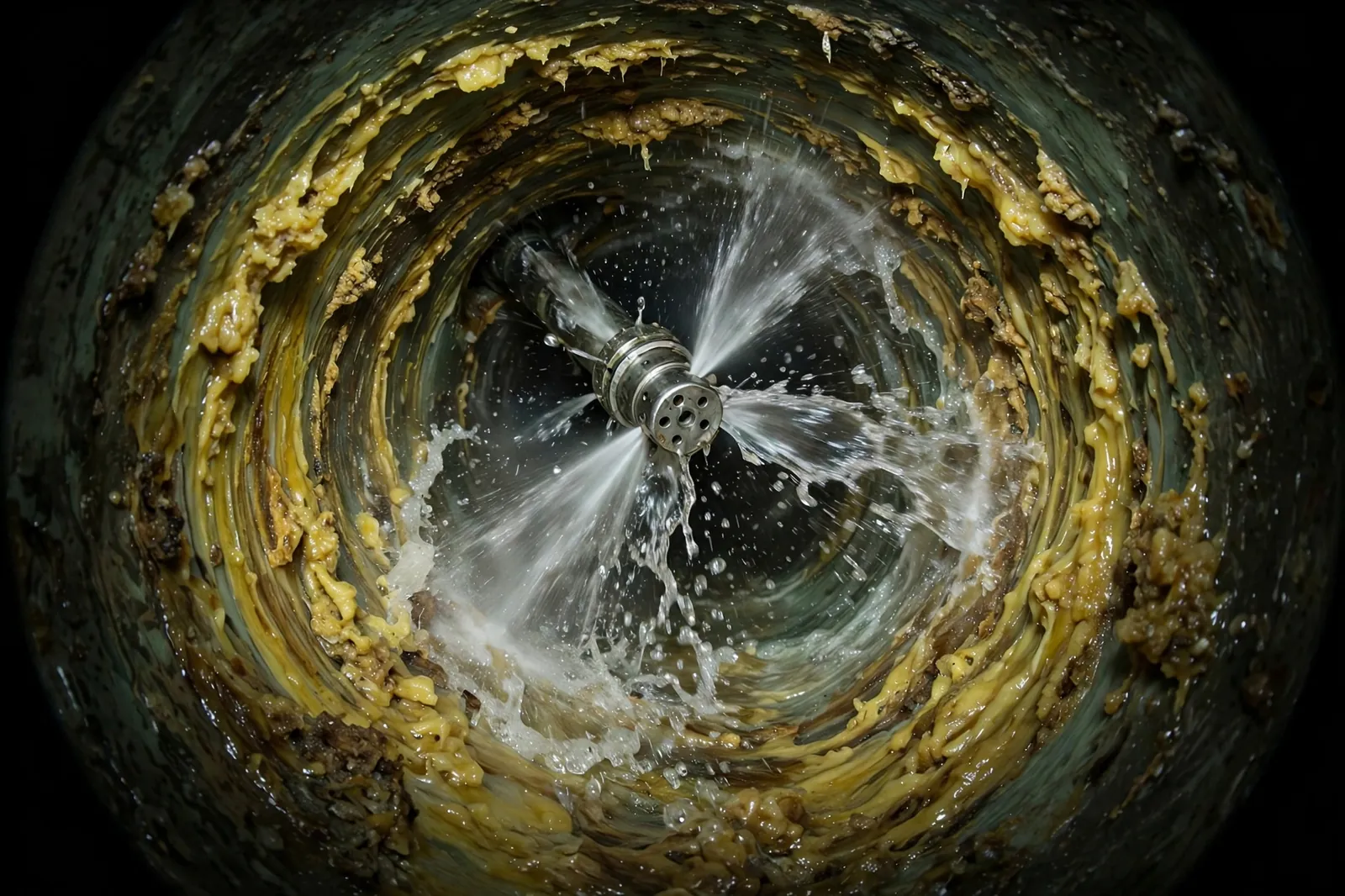
On a grease call, the crew begins by looking down the line with a small video lens, so they can see how far the pale coating reaches and whether the pipe underneath is still sound. The hose then goes in at the sink end or at an outside cap, and heated water is driven through in unhurried passes. Heat loosens the waxy layer, the jets peel it away, and the flow carries the softened material on toward the main drain.
The operator does not rush the hose. Each stretch gets several passes, because one quick run leaves a thin film that hardens again within weeks. When the water runs freely, the lens goes back in for a last look, and the crew can show you the difference on the monitor: grey, coated walls before, and a clear bore after. That pair of pictures is the proof the kitchen line is clean, and it is worth asking to see.
The trap, the disposal and the line beyond
Under every kitchen sink sits a U-bend that holds water to keep smells out, and it is the first place fat settles. It unscrews easily and can be emptied by hand, which is why most people start there. But the bend is only the opening stretch of a pipe that runs for many feet behind the wall and beneath the floor, and no amount of cleaning at the sink reaches the coating further along.
A disposal unit adds its own load. It minces food into fine pieces, and those pieces cling to fat-coated walls more readily than large scraps do. Rice and pasta swell once they are wet and add to the narrowing. The wash cleans the pipe past the unit, where the real blockage sits — the unit itself is left alone, because the problem is downstream of it, not inside it. If the disposal itself smells, the cause is usually food caught in its chamber, not the drain beyond.
Signs your kitchen line is coated with grease
The earliest sign is a sink that drains a little slower each week, even though the trap is empty and the plunger has been tried. Then comes the smell: a stale, rancid odour from the sink that returns after the basin is scrubbed, because the source is inside the pipe. Then the gurgling, when the dishwasher runs and air is trapped behind a fat plug downstream.
Later signs are harder to ignore: water standing in the dishwasher base, the sink filling when the disposal runs, and a kitchen line that blocks every few months. If the bathroom drains are fine and only the kitchen is slow, the problem is fat in the kitchen line, and it is worth treating the fat rather than the fixtures. A line that blocks on the same stretch again and again is telling you the coating was never fully removed.
Keeping fat out of the sink
Prevention in a kitchen is mostly about the bin, not the drain. Scrape plates before rinsing, wipe a frying pan with paper before it goes in the water, and let cooking oil cool into a jar for the rubbish instead of tipping it down the sink. Those three moves keep most fat out of the pipe, and they cost nothing but a few seconds.
A fine mesh over the plughole catches scraps that would otherwise stick to the walls, and a kettle of hot water after a greasy wash keeps any fat that does slip through liquid until it is past the kitchen run. Chemical bottles are best left on the shelf for this job: they can sit on the fat, release fumes, and make the line unsafe for the crew who opens it next. The EPA's septic guidance also warns that grease harms septic systems, where it forms a scum layer that can block the drain field.
When grease is not the whole story
Sometimes a kitchen line blocks for a reason that is not fat. A sag in the pipe holds standing water, and fat settles there again soon after cleaning. A cracked section lets soil in and narrows the bore. Old steel pipe can be so rough inside that no wash restores a smooth surface, and the pipe needs replacing.
The camera look is what separates these cases from a plain fat problem. If the footage shows standing water in one stretch, or a rough, pitted wall, the crew should say so and talk about the fix, rather than selling another clean. A line jetted twice in a year that keeps blocking is telling you about its shape, not its cleanliness. That is the point at which a repair quote, not a third clean, is the honest next step.
Where the fat goes after it leaves your pipe
The fat washed out of your kitchen line does not vanish. It travels to the main sewer, where it joins the fat from every other kitchen on the street, and in city sewers that shared fat can harden into huge masses known as fatbergs. London's sewers have produced fatbergs weighing over a hundred tonnes, and water companies in the US report the same problem in their own networks. Your sink is one small source of a very large shared blockage.
That is one more reason to keep oil in a container instead of the drain: the fat you stop at the sink never reaches the main. Many cities run collection points for used cooking oil, and some turn it into fuel. A jar by the stove, emptied into the bin or a collection point, costs nothing and keeps both your line and the street main clearer for longer.
Grease in older homes and older pipes
Older kitchens carry a heavier grease problem, because their pipes are rougher inside. Cast iron and galvanised steel corrode over decades into a pitted, uneven surface, and fat grips that surface far better than it grips smooth plastic. A kitchen line in a 1960s home can coat up in half the time of the same line in a new build, and it needs cleaning more often.
Age also changes the cleaning itself. The camera look matters more on an old line, because the operator must see how thin the walls have become before choosing the pressure. Sound old pipe can still be jetted, but at a lower setting and with more passes. Pipe that is flaking or paper-thin needs a different plan — often a repair or a replacement — and the footage is what shows which case yours is.
How often should a kitchen line be jetted?
There is no fixed schedule for a kitchen line, because the interval depends on how the kitchen is used. A household that cooks most nights and washes greasy pans daily may need a clean once a year. A light-use kitchen that wipes pans and uses screens may go two or three years between cleans. The camera sets the interval, not the calendar.
After a clean, ask the crew what the walls looked like before the wash and what the closing picture shows. If the coating was thick, book the next look sooner. If the walls were nearly clean after a year, the interval can stretch. Keep the dates and the footage together, and over two or three visits a pattern will emerge for your kitchen. That pattern is the schedule, and it is built from your own pipe, not from a guess.
The dishwasher's part in the problem
A dishwasher is a quiet contributor to a grease line. It sends hot, greasy water down the same pipe as the sink, and it does so in bursts: a full load of greasy plates, a hot wash, then a drain cycle that pushes the water through in one go. That burst carries fat further down the line than a slow sink trickle would, and the fat sets where the pipe runs flat beyond the kitchen.
The dishwasher also hides the problem. Its base can hold standing water without anyone noticing, and a slow drain in the dishwasher is often blamed on the machine rather than the pipe. If the dishwasher leaves a puddle after a cycle, or the sink fills when the dishwasher runs, the shared line is the likely cause. A jetting visit that cleans the kitchen run should include the dishwasher branch, and the camera look should cover it too.
When grease reaches the main line
A kitchen line joins the main drain that serves the whole house, and grease that gets past the kitchen run coats the main as well. The signs change at that point: the problem stops being a kitchen problem and becomes a house problem. Several fixtures slow at once, a low bath or shower backs up when the kitchen sink runs, and the lowest drain in the house is the first to show it.
That is the stage at which a kitchen clean alone is not enough. The crew should jet the main line from the kitchen run to the street, not just the branch behind the sink, and the camera should travel the whole way. A main coated with grease can block the entire house in a single evening, and a clean that stops at the kitchen leaves the real risk in place. See main line hydro jetting for how the main is cleaned.
What to ask before you book a grease clean
A grease job is worth a few questions before you book. Ask whether the crew will run a camera look first, and whether the closing look is included in the price. Ask whether they use heated water, since heat is what melts a fat coating and a cold wash leaves a film behind. Ask for the quote in writing, with the camera work and the runs to be cleaned listed separately, so you can compare it with another quote fairly.
Also ask what the crew will do if the camera shows damage rather than fat. A good answer is that they will stop, show you the footage, and talk about repair before jetting further. A crew that promises to jet whatever it finds, sight unseen, is a crew to avoid. The questions take two minutes on the phone, and they separate a careful job from a rushed one.
Grease in a rented kitchen: who books and who pays
In a rented home, a blocked kitchen line is usually the landlord's responsibility, because the pipe belongs to the property. A tenant who finds a slow sink should report it in writing, with the date and the symptoms, and keep a copy. The landlord then arranges the camera look and the clean, and the tenant gives access on the day.
The exception is grease caused by the tenant's own habits, and some tenancy agreements say the tenant pays where the blockage comes from misuse. That is one more reason to keep oil out of the sink and to keep the jar habit: a tenant who can show they kept fat out of the drain is in a far stronger position if the bill is disputed. Whatever the agreement says, a tenant should not book a repair that involves digging without the landlord's agreement.
Grease, soap and the laundry line
The kitchen is not the only place fat and soap meet. A laundry line carries detergent, fabric softener and body oils, and over years those build a soft, grey coating of their own. It forms more slowly than kitchen fat, but it catches lint and hair just as readily, and a laundry line that drains slowly is often blamed on the washing machine when the pipe is the problem.
The fix is the same: a camera look, then a wash that strips the coating from the walls. The habits differ, though. A laundry line benefits from the right amount of detergent — too much leaves more residue — and from a hot wash now and then, which keeps the residue soft. A line that is jetted and then fed a measured dose of detergent will stay clear far longer than one that is jetted and then overloaded again.
After the clean: the first month
The month after a grease clean is the test of whether the habits have changed. In the first week, the sink should drain at its normal pace and the smell should be gone. If the smell returns within days, something is still feeding the line — a disposal that needs cleaning, a dishwasher branch that was not washed, or fat still going down the sink.
Watch the lowest fixture in the house as well as the kitchen sink, because a main that was coated will show itself at the lowest drain first. If the drains stay quick for a month, the routine is working, and the next clean can be timed from the camera pictures rather than from a guess. If they slow again within weeks, call the crew back and ask them to look again, because a fast return means the coating was never fully removed or the pipe itself is the problem.
A kitchen routine that keeps drains clear
Put the routine together and it is short. Wipe pans, scrape plates, use a screen, run hot water after greasy washing, and keep oil in a container, not the sink. Do that daily, and a kitchen line that was jetted clean can stay clear for a year or more. Skip it, and the fat returns within months, however good the clean was.
If the line does slow again, do not reach for a chemical cleaner or a snake first. Book a camera look and a jetting visit, and ask the crew to show you the walls before and after. A clean kitchen line, seen on a screen, is the proof that the routine is working — and the warning, if it is not. For the wider picture on timing, see how often to hydro jet.
Signs you may need hydro jetting
- Pans leave a greasy film in the sink even after rinsing.
- The plughole smells stale although the basin is spotless.
- Washing-up water drains away more slowly than last month.
- The dishwasher leaves a puddle in its base after a cycle.
- Running the disposal makes the sink water rise.
- Only the kitchen is slow; the bathroom drains run fine.
- The same kitchen line blocks again within a few months.
- Gurgling sounds come from the sink when the dishwasher runs.
How it works
- 1
First — Look down the kitchen run
A video lens travels the line from the sink and shows how far the pale coating reaches and whether the pipe is sound.
- 2
Next — Heated passes through the line
The hose runs heated water through in slow passes, loosening the waxy layer, peeling it from the walls and carrying it out.
- 3
Then — Check the trap and disposal
The crew checks the trap and the run past the disposal, since fat settles in the bend and the minced food from the unit clings to coated walls.
- 4
Last — Check the bore and set habits
A final lens look confirms a clear bore, and the crew notes the kitchen habits that will keep fat out of the sink.
What does it cost?
What a kitchen fat clean usually runs to, by line length and coating thickness. Typical ranges, shown as estimates.
| Service | Typical range (estimate) | Notes |
|---|---|---|
| Kitchen grease line jetting | $300 – $700 | Sink to main drain |
| Camera look with jetting | $150 – $350 | Often bundled in |
| Main drain jetting | $350 – $900 | Whole-home line |
Prices are estimates only. The local company that does the work sets its own final pricing.