
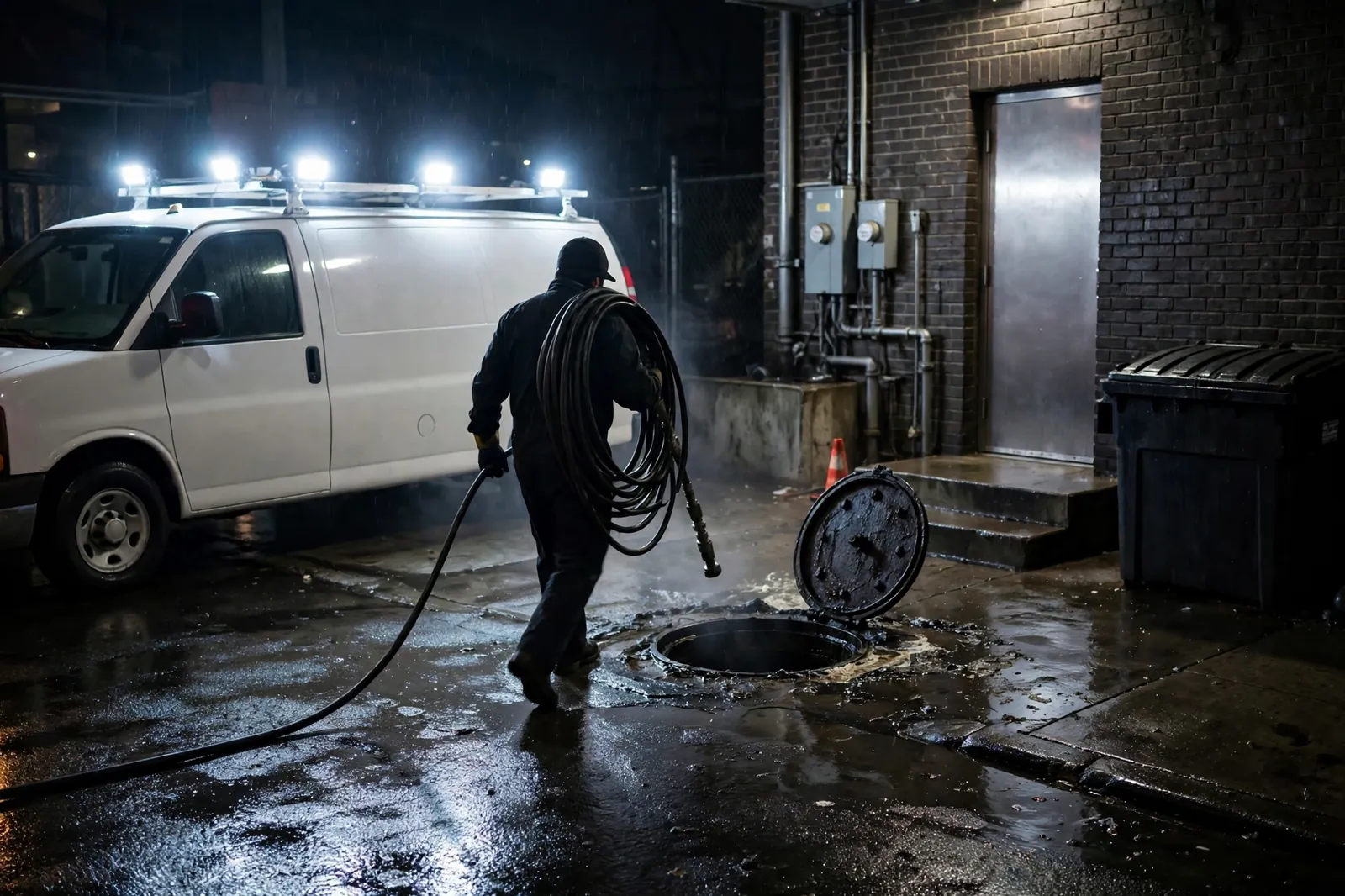
Emergency Grease Line Jetting
A grease emergency is a kitchen line blocked solid with fat, so sinks back up and the kitchen cannot be used. Stop running water, do not pour in cleaner, and phone (833) 878-1592. The crew melts the grease out with hot, high-pressure water, checks the line on camera, and gets the kitchen working again.
Updated 2026-11-18. Prices shown are estimates only.
- $150–$900 Typical cost range
- 5 Steps in the visit
- 12 Questions answered
Before & after — emergency grease line jetting
Before & after
Drag the slider to compare the same pipe before and after jetting.
Emergency Grease Line Jetting
How does a grease clog turn into an emergency?
Grease builds up slowly. A thin coat from each wash sticks to the walls, catches food bits, and narrows the line a little more every week.
The sink drains a touch slower, then needs a second rinse, then one evening the water simply stops going down and starts coming back up. In a home kitchen that is an annoyance; in a restaurant it stops service.
The line often blocks all at once because the last bit of build-up closes the gap that was left. Hot water from a tap will not melt a blockage that has set along a long run, and a plunger only pushes at it.
Once the sink backs up, the kitchen is out of use until the line is jetted.
Emergency Grease Line Jetting
What should you do when the kitchen line backs up?
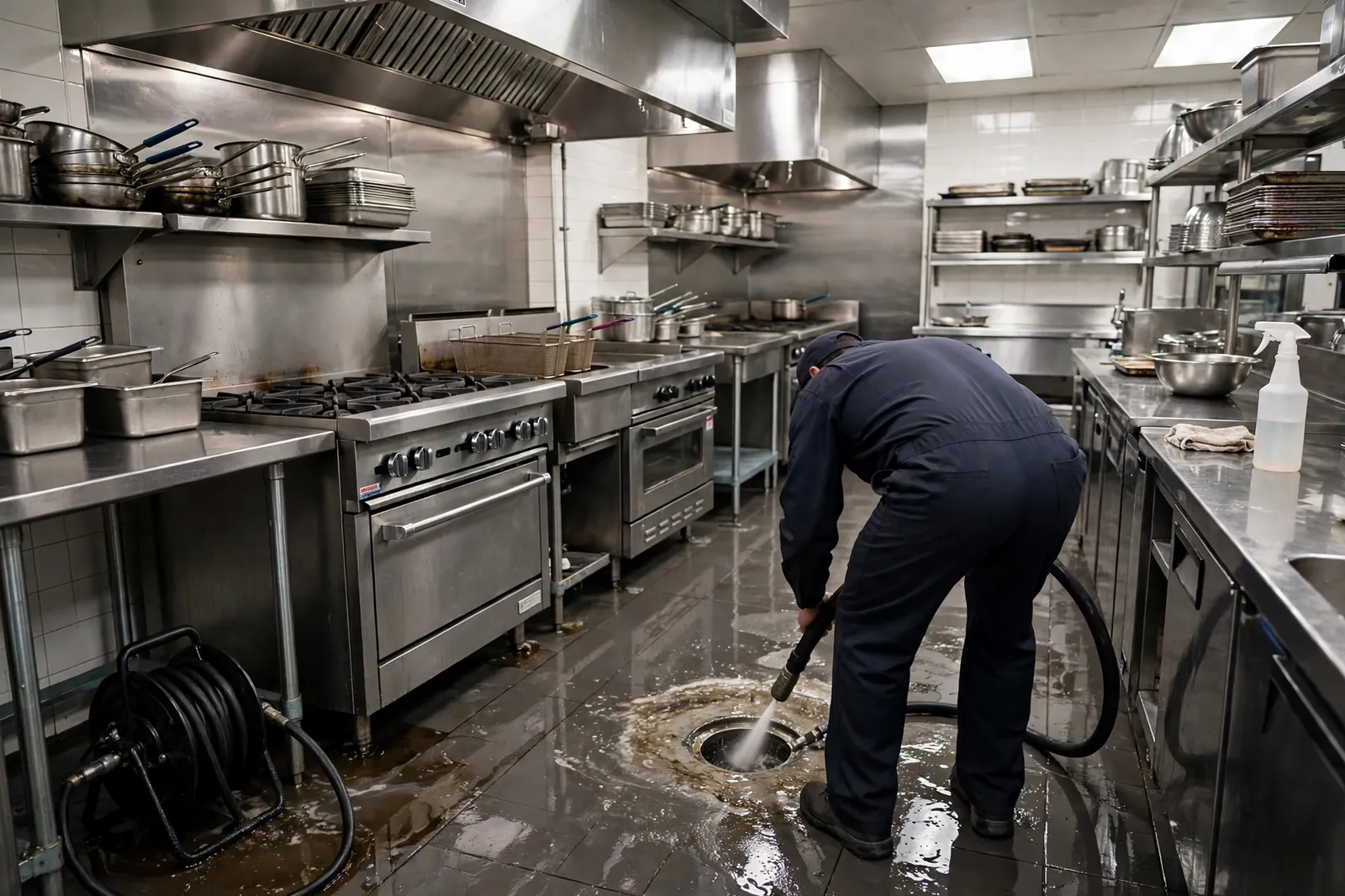
Stop running water into the sink and the dishwasher straight away. If the sink is full of greasy water, do not bail it into another sink — that moves the grease to a second line.
Keep the dishwasher off, since a cycle sends a large amount of water into the blocked line. Wipe up any spill on the floor so nobody slips, and move food, boards, and cloths away from the wet area.
Phone (833) 878-1592 and say it is a kitchen grease line, which sinks are affected, and whether the dishwasher or a second sink is backing up too. That tells the crew which line to open first.
Emergency Grease Line Jetting
What must you never pour down a blocked grease line?
Never pour chemical cleaner into a grease blockage. The cleaner sits on top of the fat, gives off fumes, and does nothing to the clog — and it turns the line into a hazard for the crew.
Never pour boiling water down the sink in large amounts either: it can soften the top of the clog and push hot greasy water back up through the drain. Never add more fat, oil, or food waste while the line is blocked, and never run the garbage disposal to clear it — the disposal only chops waste and sends it further into the same blocked line.
Leave the line alone until the crew arrives with hot water and the right nozzle.
Emergency Grease Line Jetting
How does the crew clear a grease line?
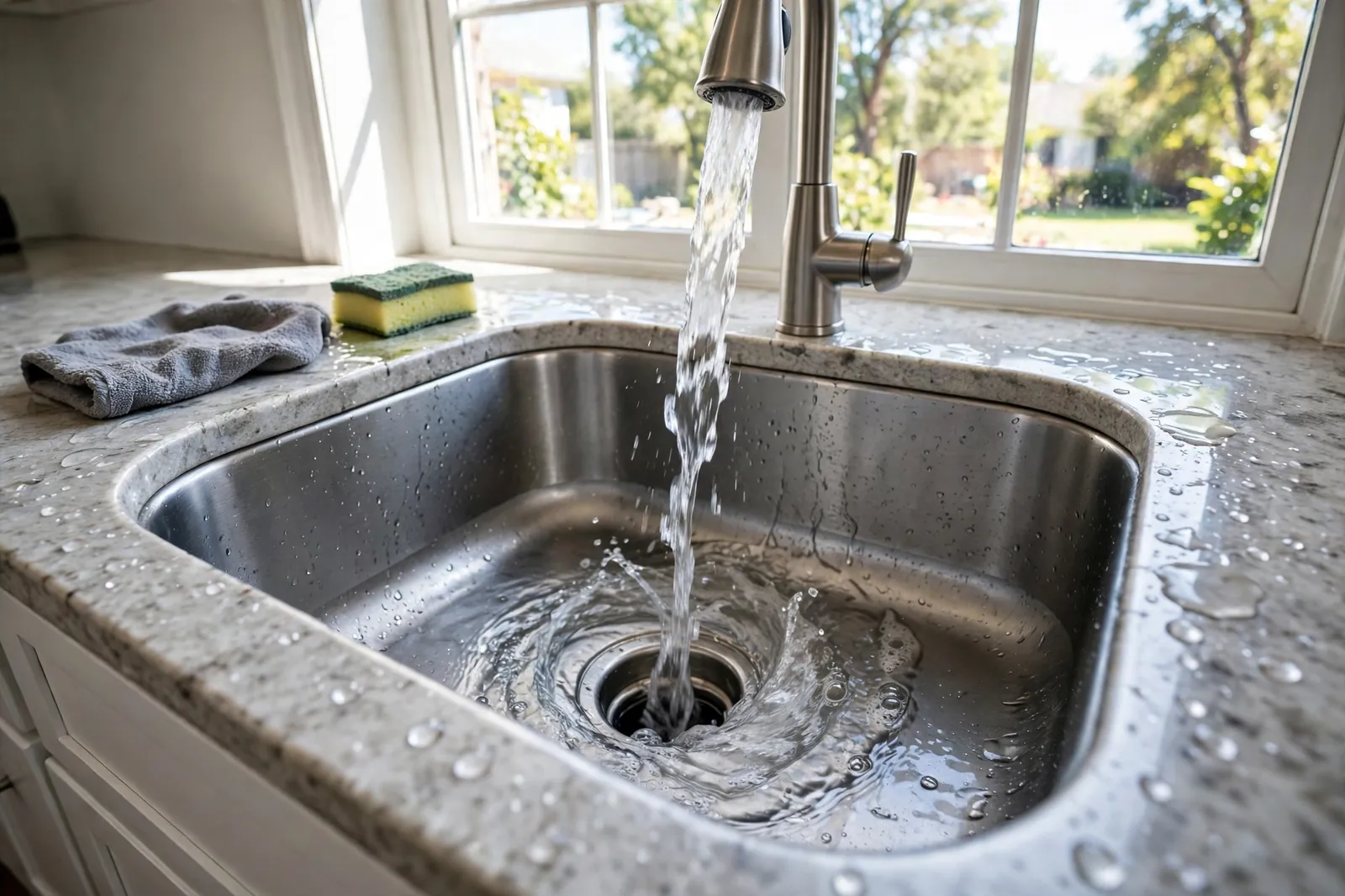
The crew finds the access point for the kitchen run, often a cleanout under the sink or outside the wall, and runs a camera in to see how far the grease reaches and whether the line is clear past it. Then the jetting hose goes in with a nozzle that sprays hot, high-pressure water forward and back, melting the fat off the walls and flushing it out toward the main.
The crew makes several passes, since grease coats the line along its length rather than sitting in one lump. A last camera pass shows whether the walls are clean, and the crew runs the tap to prove the sink drains at full speed.
Emergency Grease Line Jetting
What if the grease trap is part of the problem?
In a restaurant, the grease trap sits between the kitchen and the sewer, and a full trap can push grease into the lines past it. If the trap has not been pumped on schedule, the crew may find grease all the way down the run.
They will say so plainly and may advise a trap pump-out before or after the jetting, since jetting the line without emptying a full trap leaves the cause in place. In a home there is no trap, but the same idea holds: if fat has been going down the sink for years, the whole run may need several passes.
Ask the crew what they found and what to change so the clog does not come back in weeks.
Emergency Grease Line Jetting
How do you keep a grease line open after jetting?
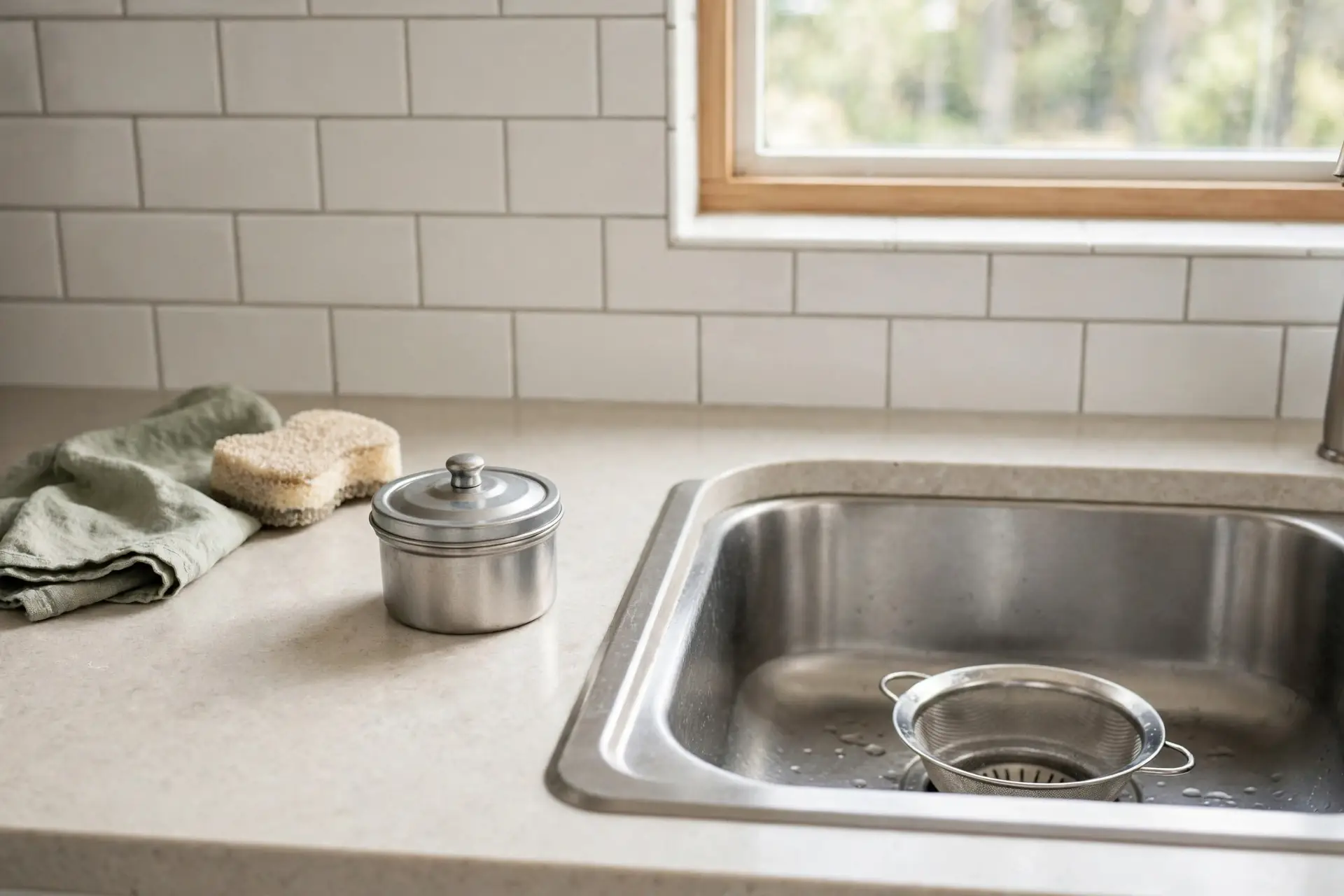
Wipe pans with a paper towel before washing them, and pour cooled fat into a jar instead of the sink. Scrape plates into the bin rather than rinsing food down the drain, and use a sink strainer to catch bits.
In a restaurant, keep the grease trap on its pumping schedule and log each pump-out, so the trap never fills enough to pass grease downstream. Run hot water for a short while after washing greasy pans, but do not rely on it to melt a clog that has already set.
A camera check a year after jetting shows whether the line is staying clean or coating up again.
Emergency Grease Line Jetting
What should you do with a sink full of greasy water?
A sink full of greasy water should be left alone until the crew arrives. Bailing it out with a jug and tipping it down another drain only moves the fat into a different line, where it sets again and starts a second blockage.
Tipping it outside is no better: the fat coats the ground, draws pests, and can run into a storm drain that leads to a waterway. The water in the sink is not going anywhere on its own, and the safest place for it is in the sink.
If the water is rising toward the edge of the sink, put towels on the floor around the base of the cabinet and move anything stored under the sink to higher ground, because the cabinet floor is usually the first thing the water reaches if the sink overflows. Do not run the disposal: a disposal in a blocked line churns the water and can spray greasy water out of the sink.
Do not pour in hot water from a kettle to melt the fat, because the water cools within a few feet of pipe and the fat sets again further down the line, moving the blockage to a harder place to reach. Leave the water where it is, and let the crew deal with it from the cleanout.
Emergency Grease Line Jetting
Can a grease backup flood a kitchen during a dinner service?
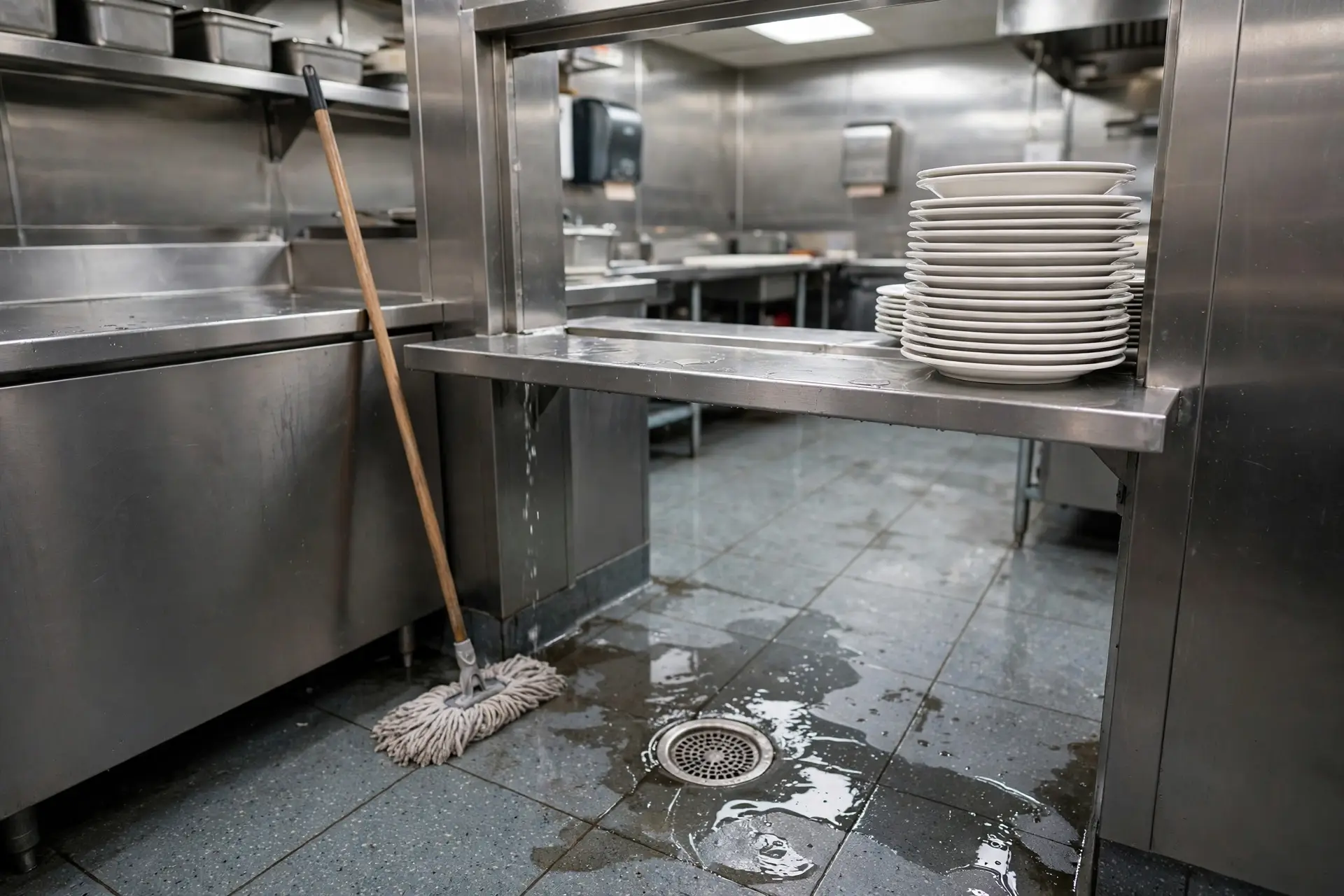
Yes, and it is one of the fastest ways a restaurant kitchen can be stopped. A kitchen line that has been narrowing for weeks can block completely in the middle of service, when the dish machine, the prep sinks and the hand sinks are all running at once.
The floor drains back up first, then the sinks, and within minutes the kitchen floor is covered in greasy water. A kitchen in that state cannot serve food: the floor is a slip hazard, the water is a hygiene risk, and the dish machine cannot run.
The response is to stop the water at once, close the affected sinks, and move staff away from the wet floor. The manager should call for help and say that the kitchen is in service, because the crew will treat it as urgent and bring the equipment to clear the line fast.
While waiting, the kitchen can sometimes keep serving from a limited menu using the sinks that still drain, but only if the water is contained and the floor is safe to walk on. After the line is open, the floor needs washing with hot water and a degreaser, and the health inspector may need to be told if food was affected.
A kitchen that has blocked once during service should be put on a regular jetting schedule, because a second blockage during service costs far more than a planned clean.
Emergency Grease Line Jetting
What should a restaurant do when the kitchen line blocks mid-service?
The first step is to protect the food. Move any food that is near the backed-up water, cover what cannot be moved, and throw away anything the water has touched.
A health inspector will ask about this, and the answer should be that nothing that touched the water was served. The second step is to stop the water: turn off the dish machine, close the prep sinks, and tell the staff to use the hand sinks that still drain, if any do.
The third step is to call for help and to give the crew the facts: which line blocked, when it started, when the grease trap was last pumped, and whether the kitchen can stay open. The crew will ask about the trap, because a full trap is the most common cause of a mid-service blockage.
While waiting, the manager should keep a written note of the time the blockage started, what was thrown away, and when the crew arrived. That note is useful for the insurer and for the health inspector.
After the line is open, the floor and the affected sinks need washing with hot water and a degreaser before service resumes, and the trap should be pumped if it is full.
Emergency Grease Line Jetting
Is a grease backup a health risk?
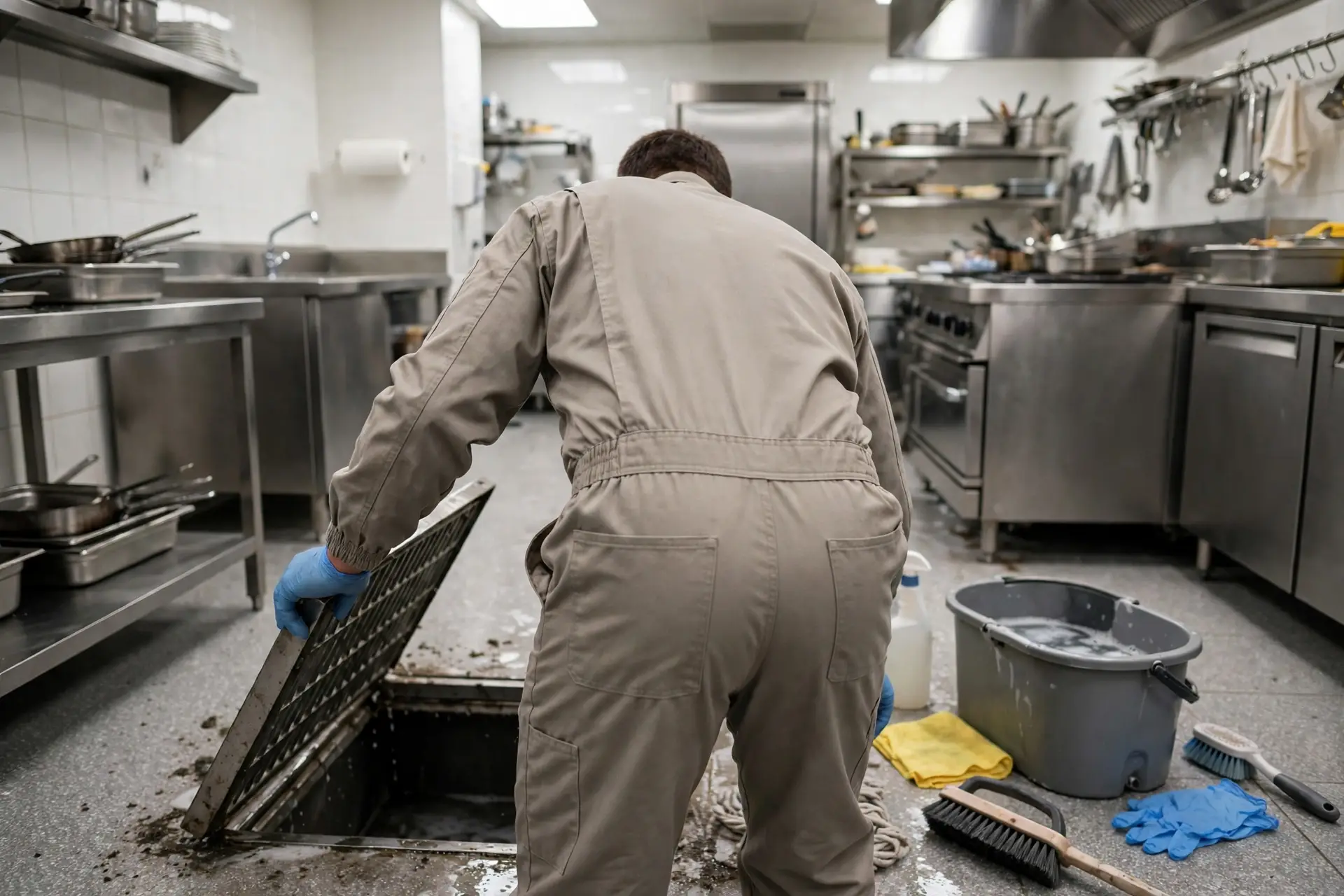
A grease backup is a health risk, though a smaller one than a sewage backup, because the water in a kitchen line is grey water, not toilet waste. It still carries bacteria: food scraps, grease and soap residue sit in the warm water and feed bacteria, and the water that backs up onto a kitchen floor can carry those bacteria onto surfaces where food is prepared.
A floor that has had greasy water on it should be washed with hot water and a degreaser, then a household disinfectant, before food preparation resumes.
The risk is higher in a restaurant, because the volume of water is larger and the food is served to the public. A health inspector will want to know that any food the water touched was thrown away, and that the floor and the sinks were cleaned before service resumed.
In a home, the risk is smaller, but the same rule applies: wash the surfaces, wash your hands after handling the water, and do not prepare food on a surface that has not been cleaned. The crew will tell you how to clean the affected area, and they will treat the water as dirty while they work.
Emergency Grease Line Jetting
What if the grease has set solid in the line?
Grease that has set solid is the hardest kind of kitchen blockage, because it fills the pipe like a plug and a snake simply bores a small hole through it. The crew deals with it in two stages.
First, hot water is run through the line to soften the surface of the plug, which loosens the outer layer and gives the nozzle something to grip. Then a jetting nozzle with a forward cutting jet breaks the plug apart, and the water flow carries the pieces out toward the main drain.
The camera look in between passes shows how much of the plug is left.
A solid plug can take longer than a soft one, and the crew may need to work from both ends of the line, feeding the hose from the sink end and then from the cleanout, so the plug is attacked from both sides. The line may also need a second visit if the plug is very long, because a plug that runs for ten feet cannot be cleared in a single pass.
The final camera look shows the pipe walls again, and the crew will tell you how thick the plug was and how long the line is likely to stay clear. The lesson is the same as always: fat belongs in a jar, not in the sink.
Emergency Grease Line Jetting
How do you tell a grease emergency from a main line emergency?
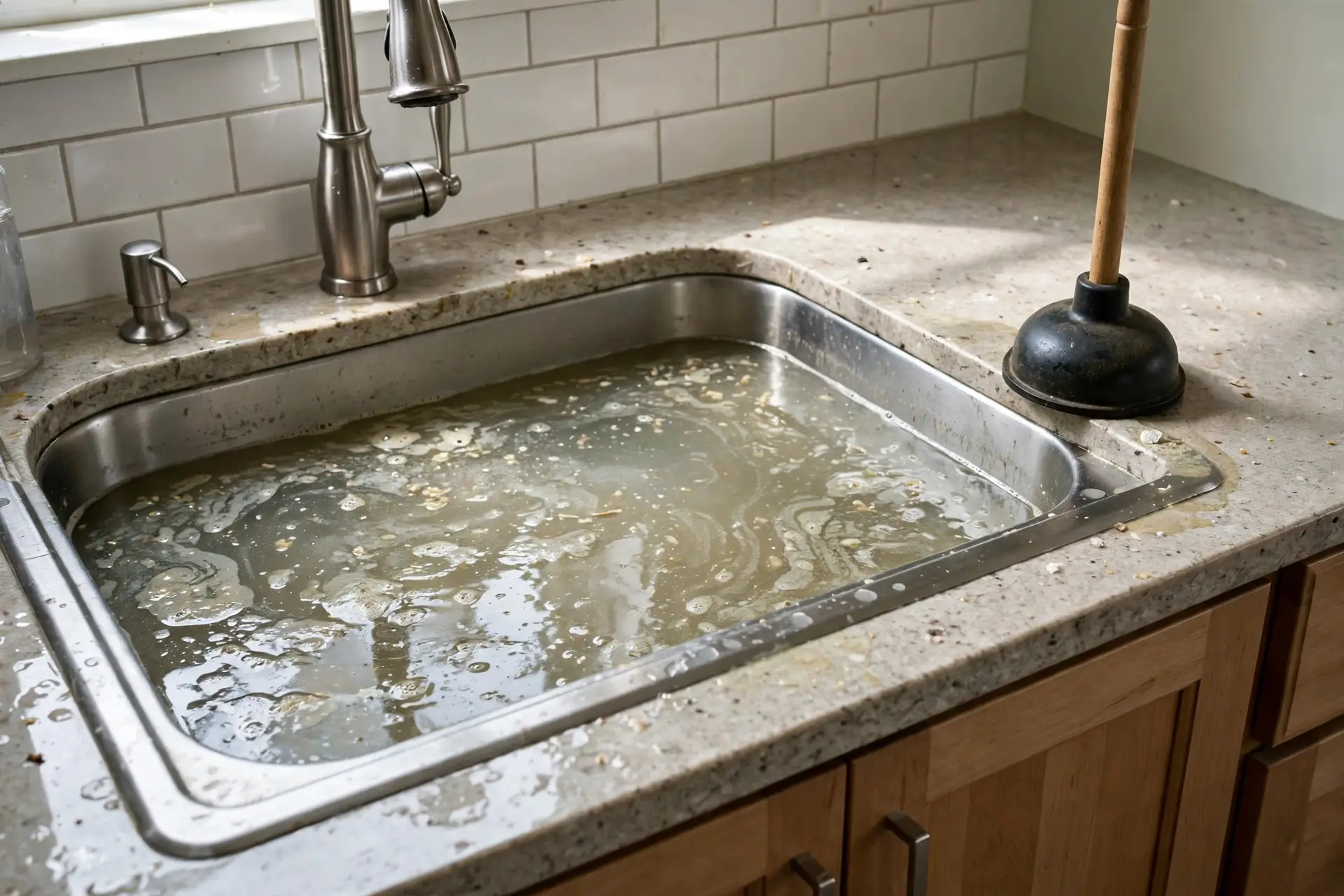
The pattern gives it away. A grease emergency affects the kitchen first: the kitchen sink backs up, the dishwasher cannot drain, and the floor drain in the kitchen bubbles.
The bathroom fixtures keep working, because the blockage sits in the kitchen line before it joins the main drain. A main line emergency affects the whole house: several fixtures back up at the same time, the lowest fixture floods first, and flushing one toilet affects another fixture.
The kitchen may be involved in a main line emergency too, but only as one of many fixtures, not as the only one.
The distinction matters because it decides what the crew brings and where they start. A grease emergency needs a jetting nozzle that cuts fat, hot water to soften the plug, and a look at the grease trap.
A main line emergency needs a longer hose, a camera survey of the full run, and sometimes a cutting head for roots. If you are not sure which it is, tell the crew exactly which fixtures are affected and in what order they slowed: the crew can tell from the pattern, and the camera survey will settle it for certain once they arrive.
Signs you may need emergency grease line jetting
- The kitchen sink fills and drains only a trickle, then stops.
- Greasy water backs up into a second sink or the dishwasher.
- The sink smells of old fat even when it looks clean.
- Hot water drains slower than cold water in the same sink.
- The garbage disposal drains fine, but the sink past it does not.
- The kitchen line clogs again within weeks of a snake visit.
- The kitchen sink is full of greasy water that will not drain at all, even after an hour.
- Water from the dishwasher comes up through the kitchen sink instead of draining away.
- The kitchen floor drain bubbles when the sink is used, and the smell of old fat fills the room.
- A restaurant kitchen line blocks in the middle of service, with the dish machine running.
- The sink drains, then fills again within minutes, because the plug is further down the line.
- Hot water poured down the sink makes the smell worse instead of clearing the drain.
How it works
- 1
Step 1 — Stop the kitchen water
Turn off the taps, stop the dishwasher, and do not run the disposal. Every litre that goes into a blocked kitchen line comes back out of the sink or the floor drain.
- 2
Step 2 — Leave the water in the sink
Do not bail the greasy water into another drain or tip it outside: the fat will set again in the next line it reaches. Leave it in the sink and let the crew deal with it from the cleanout.
- 3
Step 3 — Phone with the kitchen facts ready
Call (833) 878-1592 and say which fixtures are affected, when the sink first slowed, when the grease trap was last emptied, and whether the kitchen is in service. A restaurant in service is treated as urgent.
- 4
Step 4 — Hot water, cutting jet, camera check
The crew softens the plug with hot water, breaks it apart with a cutting jet, and washes the line clean in passes toward the main drain, checking the camera between passes.
- 5
Step 5 — Trap check and kitchen habits
A final camera look shows the clean pipe walls. The crew checks the grease trap, tidies up, and explains the habits that keep the line open: scraping plates, jarring fat, and emptying the trap on a schedule.
Emergency Grease Line Jetting cost
What does it cost?
Typical ranges only — estimates, not quotes. Grease coats a line along its length, so the price rests on how far the coating reaches and how thick it has set. A short kitchen branch costs less than a long line that runs across the house to the main drain. A late-night or weekend call often carries a call-out fee on top of the normal price, and the crew should say what that fee is when you phone, before they set out. A thin, fresh film clears in one pass, while a thick, set plug needs hot water, several passes and more time on site. A camera look may be priced on its own at $150 to $350 or bundled with the jetting, so ask which it is. The written quote should list the call-out fee, the camera look, the jetting and the tidy-up as separate lines.
| Service | Typical range (estimate) | Notes |
|---|---|---|
| Grease line hydro jetting | $300 – $700 | Kitchen and food lines |
| Camera inspection with jetting | $150 – $350 | Often included |
| Single drain line jetting | $250 – $550 | One branch line |
| Repeat or heavy buildup cleaning | $400 – $900 | Extra passes needed |
Prices are estimates only. The local company that does the work sets its own final pricing.
Questions about emergency grease line jetting