
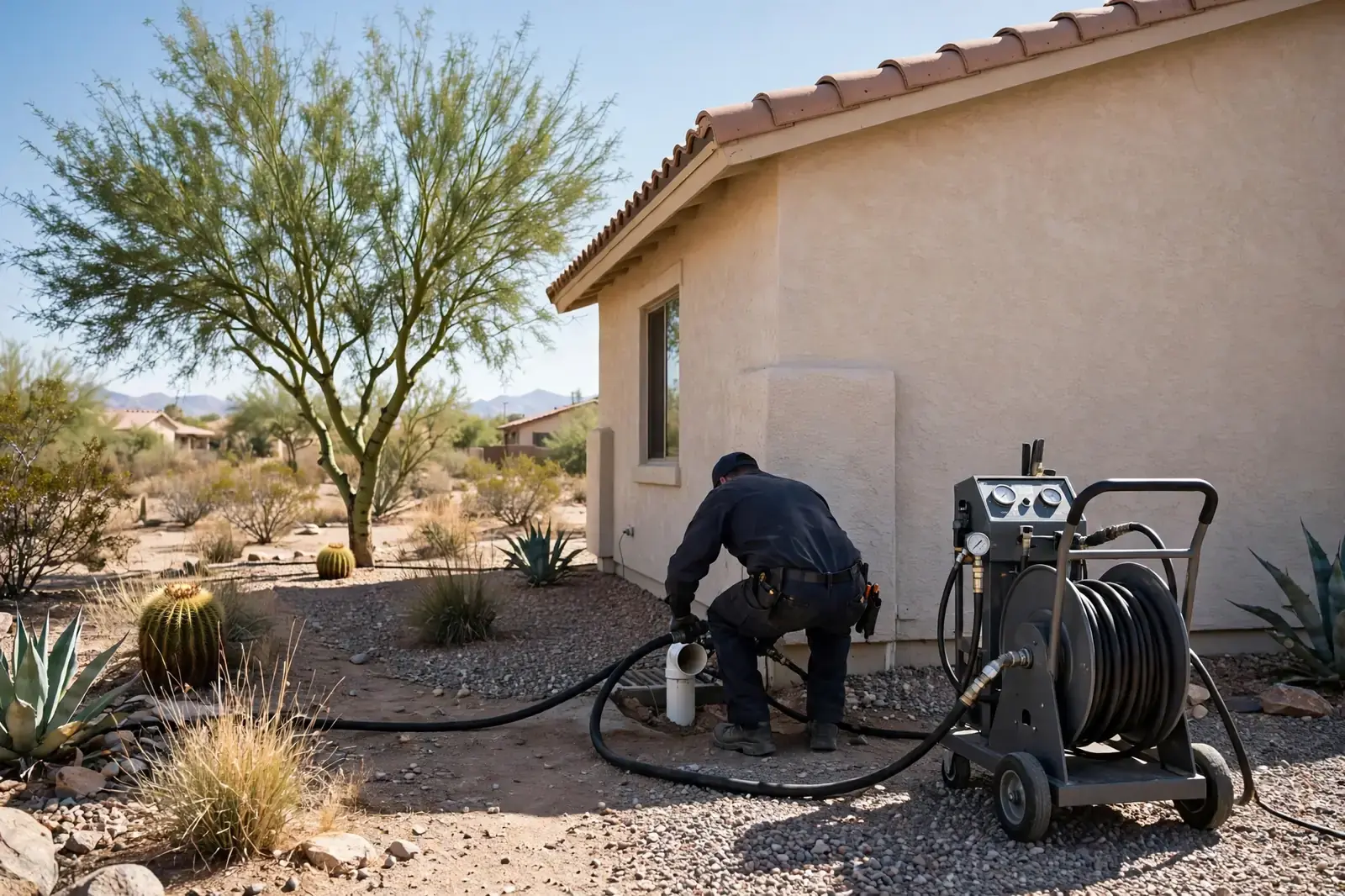
Hydro Jetting in Mesa, AZ
A Mesa sewer or drain line coated with fat, soap, and mineral limescale will not stay clear after a fast clearing. Hydro jetting scours the interior with water at force and washes the loosened coating away. Inspection comes before any water is pushed through. Call (833) 878-1592 to book a visit.
Updated 2026-11-18. Mesa, AZ · Maricopa County · Population 517,151. Prices shown are estimates only.
- 517,151 Population
- Maricopa County
- 19 ZIP codes served
- Dobson Ranch Neighbourhood
Before & after in Mesa
Before & after
Drag the slider to compare the same pipe before and after jetting.
Hydro jetting in Mesa
What $250 buys versus what $1,200 buys in Mesa
At the low end of the table below sits a branch wash: one kitchen or bathroom line, one clog, a short run, smooth walls. The crew is in and out in about an hour, and the figure lands near $250.
At the high end sits a main line under a mature desert yard: a long lateral, a root mat under a palo verde, a thick mineral crust inside old cast iron, and a cleanout that is hard to reach. That job takes most of a morning, a cutting head, several slow passes, and a careful camera run after — and the figure lands near $1,200.
Most Mesa jobs sit between the two. The difference is the pipe, not the postcode: its length, its material, its coating, and its access.
A price given before anyone has seen inside the pipe is a guess. Ask the crew to explain what the camera showed, and the number will make sense.
The figure should cover the camera before and after as well as the wash itself. When a quote leaves the camera out, ask where it went — the pictures are the proof the line is clean, not just open.
Hydro jetting in Mesa
Heat, depth, and roots: the Mesa price triangle
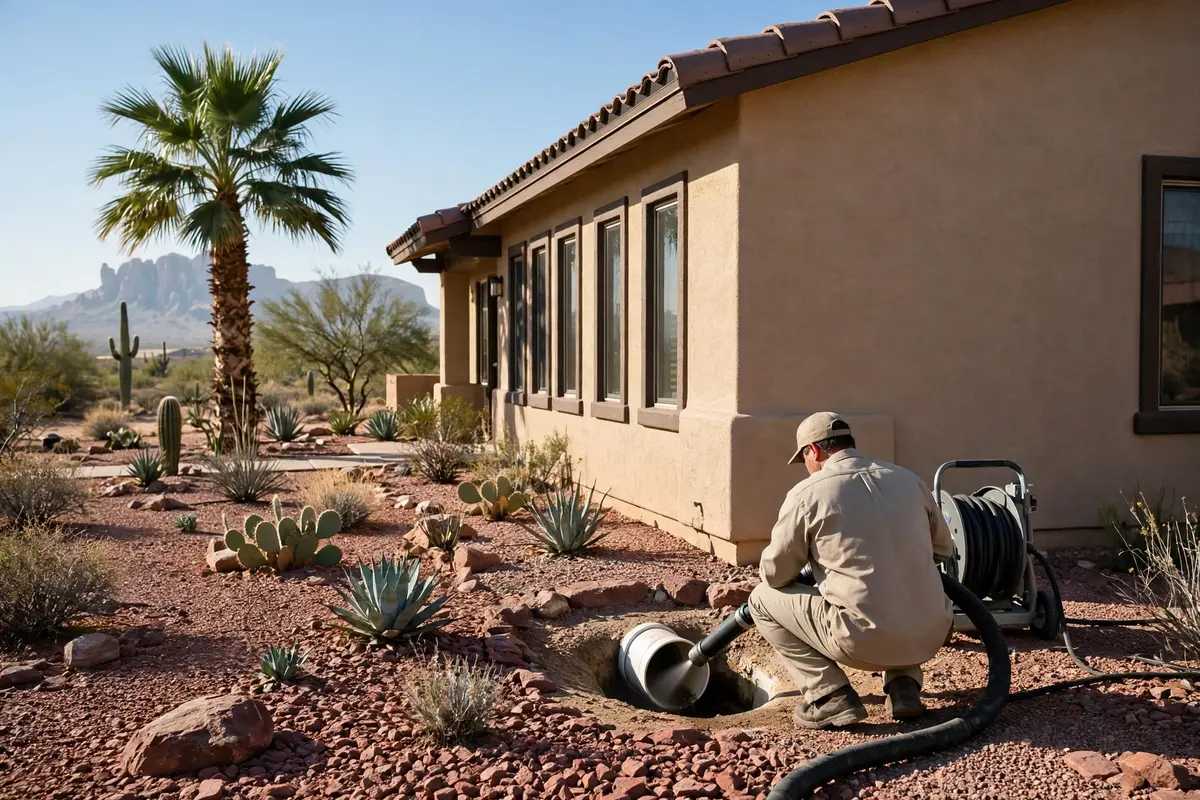
Three things set a Mesa jetting price, and they pull against each other. Heat: Mesa summers are long and hot, and crews start early to beat the worst of it.
A morning visit runs smoother than a midday one when the ground is baking and the yard is too hot to work in. Depth: a lateral buried deep under a walled courtyard or a gravel drive takes more time to work through than a shallow run, and a deep cleanout means a longer hose run and more passes.
Roots: desert trees send roots a long way in search of water, and a palo verde or olive root mat needs a cutting head before the wash head, which takes time. Put the three together and you get the range in the table below.
A shallow PVC lateral with no trees near it sits low. A deep clay tile lateral under a mature palo verde in July sits high.
None of this should catch you off guard. The camera run that opens the visit shows the depth, the roots, and the coating — and the price follows what the camera shows.
Book the morning, not the afternoon: an early start means a cooler yard and a calmer job.
Hydro jetting in Mesa
Hard water in Mesa: the crust inside your pipes
Mesa water is hard — Colorado River water and groundwater, carrying dissolved minerals that settle inside pipes as a hard, pale crust called scale. Scale builds a little at a time.
Each year the layer gets a fraction thicker, the pipe a fraction narrower, and the rough surface gives fat something to hold onto. Smooth new plastic sheds fat; scaled iron holds it.
So a 1970s Mesa kitchen drain can slow again weeks after a cable clearing. The cable opened a gap in the middle of the clog.
The scale stayed on the walls, and the fat rebuilt on the same rough surface. The scouring strips both layers at once, leaving the pipe as smooth as its age allows.
A softener slows new scale on fixtures and appliances, but it cannot lift the scale already in the drain. Faucet spots and slow drains: one cause, one fix — the same scouring.
Hydro jetting in Mesa
Desert trees and the Mesa lateral
Mesa's yards are planted with palo verde, mesquite, olive, and palm, and their roots spread wide in the desert soil. A lateral is a steady source of water and nutrients, and a root will grow toward the smallest opening: a hairline crack, a loose old clay joint, a gap at the house connection.
Inside the pipe, the root thickens into a nest that snags paper, grease, and waste until the line slows or backs up. The first warning is often a toilet that flushes weakly after a long dry spell — roots have been growing toward the line for months by then.
Mesa's long, hot summers make the problem worse: with little rain, roots grow harder toward the only steady water source around. A spinning root cutter takes the nest out and cleans the joint it grew through.
The opening stays open — the scouring does not seal it — so roots can return. Houses with a large palo verde, mesquite, or olive near the lateral should plan on a wash every year or two.
Ask the crew to note on the inspection scope exactly which joint the roots entered through — that spot is the one to seal or replace when the time comes.
Hydro jetting in Mesa
What the camera finds in a Mesa sewer line
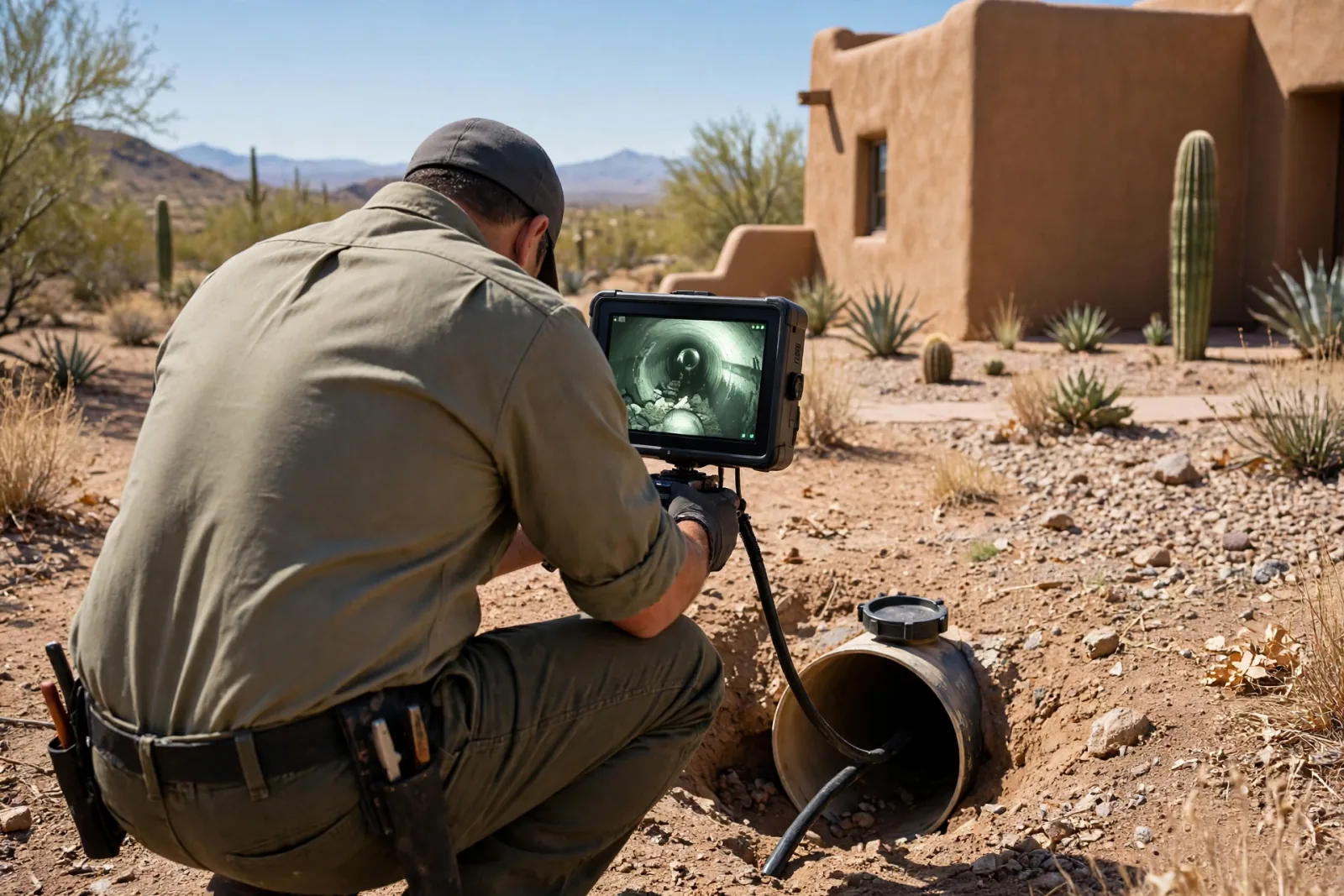
From the curb, the inspection scope goes in, and the screen shows what the yard hides. The lower half of the pipe usually carries a chalky crust, pale and hard, laid down by Mesa's hard water year after year, with a fat buildup layer on top of it in the kitchen branch.
At the joints, the scope may find a root nest, a pale mass growing thicker toward the street, worst under a palo verde. In a sagging length, the pipe may hold standing water — a low run that the scouring can clean but cannot straighten.
Sometimes the scope finds a break, a cracked old clay pipe or a collapsed stretch, and that stops the job. Water at force belongs in a sound pipe, not a broken one, so the visit turns into a repair talk.
Sometimes it finds a single blockage, wipes or a clump of fat buildup, and that is quick work. The picture decides the head, the pressure, and the passes.
Look first, wash second — that order is what keeps a routine cleaning routine.
Hydro jetting in Mesa
From Dobson Ranch to the east valley: pipes by era
Mesa housing runs from 1970s ranch houses in Dobson Ranch to mid-century homes in the central neighbourhoods and newer stucco homes in the east valley. Each decade left its own pipe.
The oldest houses usually carry iron inside and old clay outside. Iron rusts inside and narrows as chalky crust builds; old clay joints let roots in.
From the 1980s on, plastic is standard — smooth walls that take the scouring well. A few mid-century laterals are Orangeburg, a tar-paper pipe that softens and sags as it ages — a poor match for the scouring.
With that spread, the inspection scope look is not optional here. A crew that scours blind on Orangeburg or a badly cracked clay line can turn a wash into a collapse.
On the inspection scope, the crew sees the material, the joints, and any sagging length, and the crew matches the force and the head to what it shows. The older central streets show it best: iron inside, old clay outside, and a palo verde in the front yard whose roots have spent decades hunting the joints.
If your house went up before 1980 and the lateral has never had an inspection scope in it, book that look first — the picture tells you the material, the joints, and whether the line can take the scouring.
Hydro jetting in Mesa
Mesa Water Resources, the city main, and your lateral
The City of Mesa Water Resources Department supplies drinking water and runs the sewer system for the city, drawing on Colorado River water and groundwater. The line from your house to the street main is yours, and the scouring cleans it.
The street main belongs to the city. When the inspection scope shows the blockage past your property line, the fix is a call to the utility, not a jetting visit.
The inspection scope picture marks the distance from the cleanout, so the crew knows which side of the line the trouble sits on. Mesa's hard water leaves a chalky crust inside pipes, so the coating that narrows a line here is often mineral rather than grease.
A softener can slow new crust from forming, but it will not lift the crust already in the drain. On a septic system outside the city service area, the rules change: the scouring still works on the house lines, but the tank and drain field need their own care, and the crew should know you are on septic before they start.
Hydro jetting in Mesa
Monsoon season in the east valley
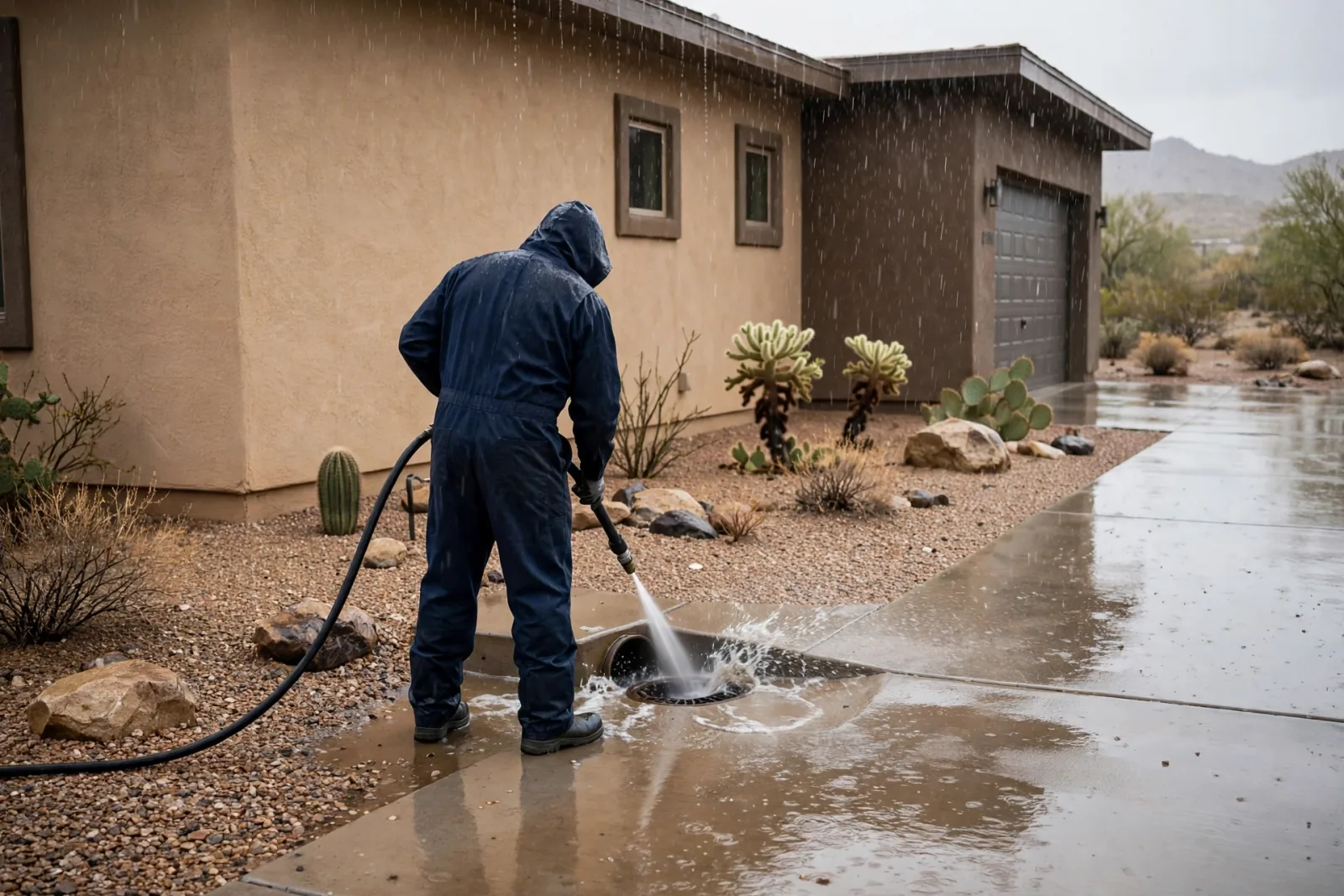
The east valley's monsoon runs roughly July through September, and the storms arrive fast — a lot of water in a short time. A lateral narrowed by chalky crust or a root nest cannot pass that surge, so the backup comes up through the lowest drain in the house, usually a shower or a floor drain.
The heat does its own damage before the rain arrives: it dries the soil out and shrinks it around a shallow lateral, and the pipe can shift and open a joint, giving roots a new way in. The dry months have one more effect — with almost no rain, roots push harder toward the only steady water around, which is your sewer line.
Underground the pipe stays far cooler than the air above it, so fat poured down a kitchen drain in July still cools and sets in the line — the same as in winter. A scouring visit in late spring, before the monsoon, gets the line ready.
It clears the crust and the roots while the yard is still workable, and it leaves the line at full width for the storms.
Hydro jetting in Mesa
Dobson Ranch: the first master plan, now mature trees
Dobson Ranch, on Mesa's west side, was one of Arizona's first master-planned communities, built in the 1970s around a golf course and a network of lakes. The houses are mostly 1970s ranch houses, and the neighbourhood's trees — palo verde, olive, and palm — have had fifty years to grow.
That maturity is the drain story here: a lateral that runs under a fifty-year-old palo verde has had decades of root growth to contend with, and the joints in a 1970s clay tile lateral are exactly where those roots enter. Many Dobson Ranch houses have also been added onto over the decades, which means the drain layout is not always what the original plans suggest; the camera is the only way to know where the line actually runs.
A house with a guest house or a casita on the same lateral builds grease faster than a single-family house, because two kitchens share one pipe. When you live in Dobson Ranch and your drains have started slowing down, a camera inspection and a jetting visit will tell you more about your house in one morning than years of guessing.
The work is usually done from a yard cleanout, and the neighbourhood's mature trees are the reason to keep the line on a regular schedule.
Hydro jetting in Mesa
The casita problem: when an addition shares your lateral
Mesa has a lot of casitas — small guest houses built beside the main house — and most of them share the main house's lateral. That sharing is the drain problem.
Two kitchens, two bathrooms, and twice the grease all run through one pipe, and the pipe was sized for one house, not two. The casita's kitchen is often the first place trouble shows: its drain runs a long way to join the main lateral, and grease settles in that long, flat run.
A casita that sits empty for months has a different problem: the traps dry out, sewer gas comes up through the drains, and the first guest to use the shower gets a smell instead of a welcome. A camera inspection and a jetting visit between tenants is the cheapest insurance a casita owner can buy.
It shows the pipe material, the root entry points, and the scale, and it resets the line before the next guest arrives. When a casita tenant reports a slow drain, treat it as a main-line question, not a single-fixture question: ask whether more than one fixture is slow, and whether the lowest drain in the house has burped.
Those answers tell the crew where to look before they arrive.
Hydro jetting in Mesa
From the curb to the kitchen: a Mesa jetting visit
A Mesa jetting visit moves through the property in a shape you can follow. It starts at the curb, where the crew checks the street main and the cleanout location.
It moves to the truck, where the nozzle is matched to what the camera showed — a wide spray head for grease and scale, a spinning cutter for a root mat, a piercing head for a hard clog. It moves to the cleanout, where the hose goes in and the wash works its way down in slow passes, spraying backwards so debris is carried toward the street main.
It moves back to the screen, where the camera goes in again along the whole washed length and every fixture that was slow gets tested. It ends at the kitchen sink, where the crew tells you the findings in plain words — pipe material, any belly or weak joint, and how soon roots or scale are likely to return.
The whole visit takes two to four hours for most homes. What changes the shape is what the camera finds: a long lateral, a thick scale layer, or a belly that holds water can stretch the morning.
Book the morning, not the afternoon: the crew starts early to beat the heat.
Hydro jetting in Mesa
After the wash: keeping a Mesa drain clear
After the scouring, the line is open — and the habits that keep it open are small ones. In the kitchen, scrape plates into the trash and wipe pans with a paper towel before they hit the sink; the fat that never goes down the drain never coats the pipe.
Run hot water for half a minute after washing up, which carries grease past the trap before it sets. In the yard, keep an eye on the trees: a palo verde or mesquite that has grown since the last visit is sending roots toward the line, and a wash every year or two is cheaper than a backup.
Do not plant new trees near the lateral — the roots will find it. Once a year, have the crew run the inspection scope through the line; five minutes of footage tells you whether the chalky crust is building again or the roots are back.
The wash resets the pipe. What you do after it decides how long the reset lasts.
Signs you may need hydro jetting
- In a Mesa house, the kitchen sink slows again a few weeks after a cable clearing, the coating still on the walls.
- In a Mesa house, the toilet flushes weakly after a long dry spell, desert roots reaching for the line.
- In a Mesa house, a bathroom fixture gurgles while the washing machine runs, air trapped behind a partial blockage.
- In a Mesa house, the shower starts pooling around your feet halfway through, the branch narrowing.
- In a Mesa house, white mineral crust on the taps shows up beside slow drains, one hard-water cause.
- In a Mesa house, a sewer smell by a floor drain stays put after the trap is refilled, the main line restricted.
- In a Mesa house, water comes up in a shower or floor drain in a monsoon downpour, the lateral unable to pass the surge.
- In a Mesa house, tiny drain flies circle a sink that gets used every day, coating inside the pipe feeding them.
- In a Mesa house, a laundry tub fills back up when the washer empties, the shared line restricted.
- In a Mesa house, toilet paper drifts slowly in a bowl that once flushed hard, the pipe narrowed.
- In a Mesa house, a drain glugs once the water has gone, air caught behind a partial blockage.
- In a Mesa house, all the fixtures slow on the same day, which means the main line.
How it works
- 1
From the curb: the story, then the scope
From the curb, the crew asks which drains are slow and how long it has been going on. Then the inspection scope goes in from the cleanout. On screen you see the pipe material, the chalky crust, the joints, and the blockage itself. The answers shape where the crew looks.
- 2
At the truck: the head is picked
At the truck, the crew picks the head from the inspection scope picture: wide spray for fat buildup and chalky crust, spinning cutter for a root nest, piercing head for a hard clog. Old clay gets gentle pressure; plastic takes more.
- 3
At the cleanout: the wash begins
At the cleanout, the hose goes in and the nozzle works its way down. It sprays backwards, carrying loosened debris toward the street main. A heavy stretch gets another pass. The crew watches the flow at the fixtures while the hose moves.
- 4
Back at the screen: the proof
The inspection scope goes back in. The second run covers the entire washed length. Chalky crust, fat buildup, and root hairs should be gone, and the pipe should be clear to its full width. Each slow fixture gets tested for flow, and you can watch the monitor yourself.
- 5
Before the crew leaves: the note
Before leaving, the crew tells you what they found in plain words — pipe material, any sagging length or weak joint, and how soon roots or chalky crust are likely to return — so you know whether this was a one-off wash or the start of a routine.
Hydro jetting cost in Mesa
What does it cost?
Treat these figures as national ranges for 2026, not a fixed cost. In Mesa, a short branch line sits low and a long main line with roots sits high. The camera look before work sets the final figure.
| Service | Typical range (estimate) | Notes |
|---|---|---|
| Full main line wash | $350 – $650 | Typical for a house |
| Branch line jetting | $250 – $500 | A single drain run |
| Commercial and severe jobs | $600 – $1,200 | Bad roots or grease, long lines |
Prices are estimates only. The local company that does the work sets its own final pricing.
Questions about hydro jetting in Mesa