
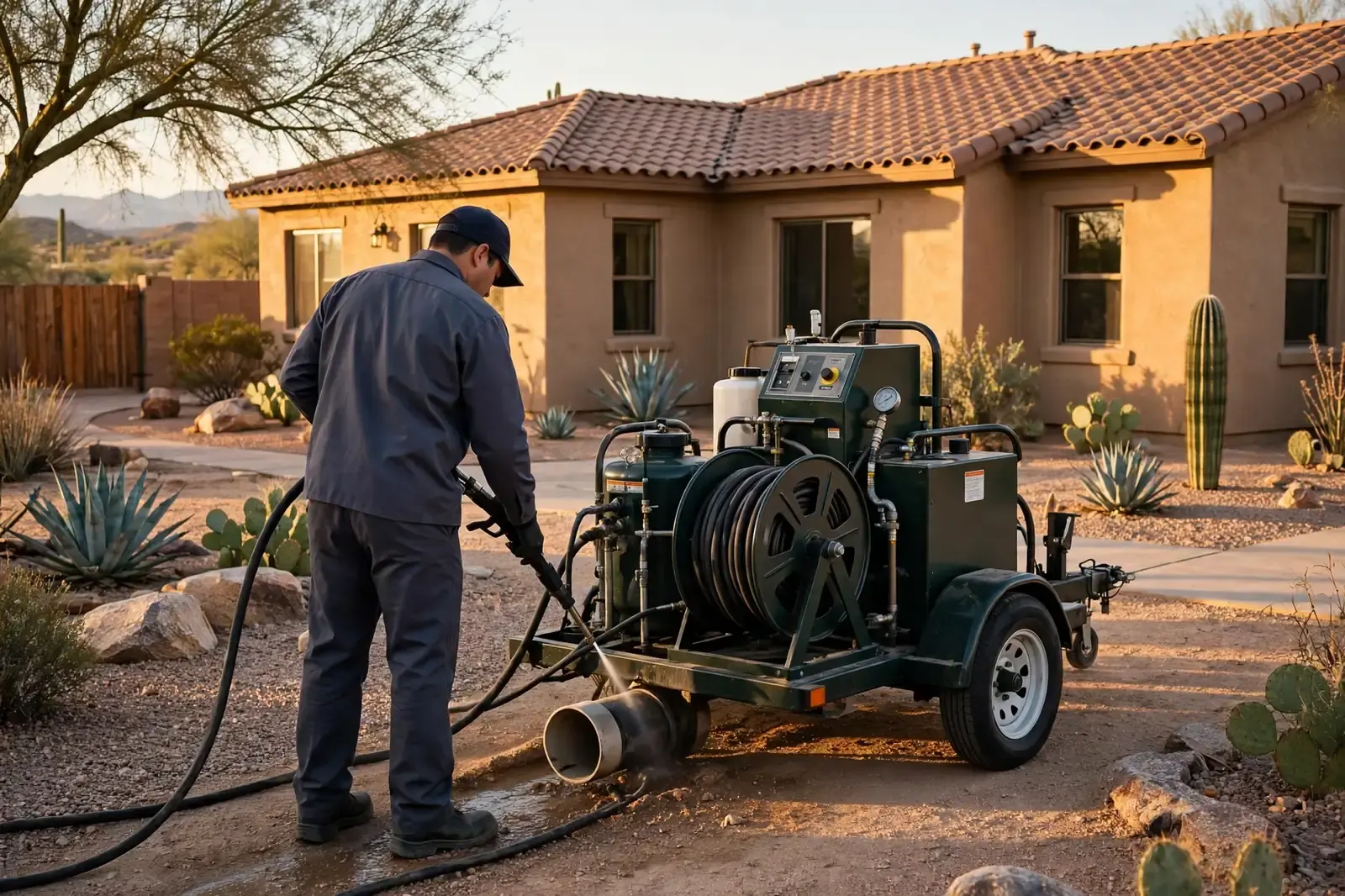
Hydro Jetting in Glendale, AZ
Hydro jetting in Glendale, AZ clears a coated or clogged drain by sending a high-pressure stream of water through the line, washing grease, scale, and fine roots off the full inside wall instead of just poking a hole through the blockage. Call (833) 878-1592 to book a visit in Glendale.
Updated 2026-11-18. Glendale, AZ · Maricopa County · Population 258,143. Prices shown are estimates only.
- 258,143 Population
- Maricopa County
- 12 ZIP codes served
- Arrowhead Ranch Neighbourhood
Before & after in Glendale
Before & after
Drag the slider to compare the same pipe before and after jetting.
Hydro jetting in Glendale
How much does hydro jetting cost in Glendale, AZ?
Most Glendale homeowners pay between $350 and $650 for a main drain jetting, with a single branch line running $250 to $500 and heavy work reaching $600 to $1,200. Those figures come from the cost table below, and they cover the usual home job: one main line, one visit, and a camera look before and after.
A short kitchen branch with a light grease coat sits at the low end, while a long main line packed with roots and scale sits at the high end.
Three things move the price most in Glendale. First is access: a cleanout in the front yard keeps the job quick, while a line that can only be reached through a roof vent or by pulling a toilet adds time and care.
Second is length and condition: a 40-foot run to the street costs less to wash than a 120-foot run under a large lot, and a line with a sag or a cracked joint needs a gentler pass. Third is what the camera finds: a simple grease coat is one pass, but a root mass may need a cutting head first, then the jet.
Ask for the price in writing before work starts, with the camera inspection listed as its own line. A written figure protects both sides, and it lets you compare like with like if you get a second quote.
The cheapest quote is not always the best one: a job that skips the camera check can miss a broken pipe, and a job that skips the after-look leaves you guessing whether the line is truly clean.
Hydro jetting in Glendale
What does a camera inspection find in Glendale drains?
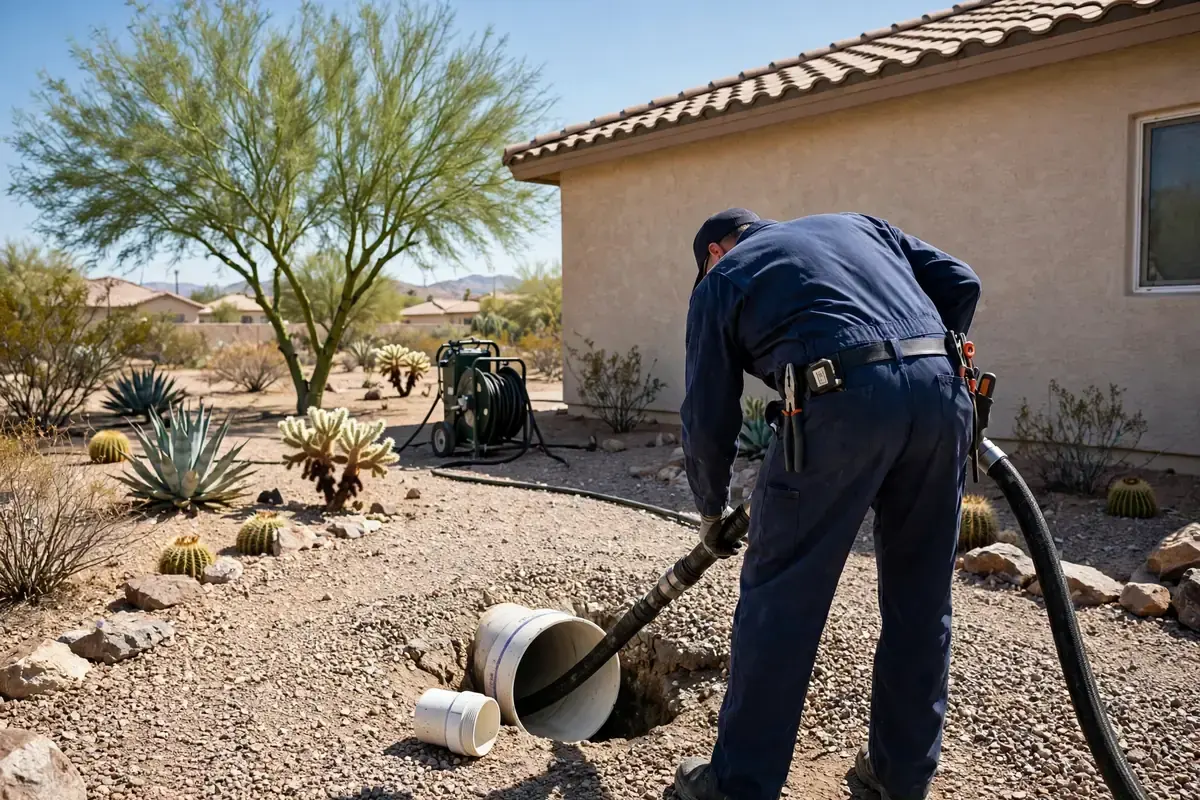
A camera is the part of the job that replaces guessing with seeing, and in Glendale the picture is usually dominated by mineral crust. The lens moves slowly down the line, and the first thing it shows is often a pale, rough ring of scale on the wall, thickest where hot water runs.
Grease sits on top of that crust as a waxy yellow layer, and where the two have built together, the bore can be a third narrower than the pipe that was installed. Roots show up differently: thin white threads at a joint, or a brown mat that sways in the flow when it has had years to grow.
The second thing the camera does is judge whether the pipe can take the jet at all. A Glendale line from the 1960s may be cast iron with a wall that has thinned to a flake, and the screen shows that as a pitted surface with pieces missing.
Clay tile from the same era shows a small step where one section has dropped below the next, and paper catches on that step every time. Either finding changes the plan: the pressure comes down, the nozzle changes, or the job becomes a repair instead of a cleaning.
Ask the technician to talk through the screen while the camera is moving, and ask for the distance of anything that looks wrong. A note that says 'root thread at 62 feet' is useful a year later, when the same joint can be checked again and the growth measured.
A recording or a set of stills is worth keeping for the same reason: it turns a one-off visit into a record of the line, and a record is what lets a homeowner decide between another cleaning and a repair.
Hydro jetting in Glendale
Why Glendale's hard water coats pipes so fast
The water that reaches a Glendale tap has travelled a long way and picked up a heavy load of calcium and magnesium on the journey. You can see the load without any test: it dries white on a glass, it crusts a shower head, and it shortens the life of a water heater.
In a drain, the same minerals come out of solution when the water cools or evaporates, and they settle on the pipe wall as a hard, pale crust. Warm water leaves the crust faster, which is why the kitchen branch, the dishwasher line, and the hot side of a bathroom drain are always the first to narrow.
A scaled wall is a rough wall, and roughness is the real problem. Grease that would slide down a smooth PVC pipe sticks to a scaled one, and soap film does the same.
Each layer gives the next layer something to grip, so a line that was only lightly coated in January can be noticeably slow by June. A cable run through that line drills a hole in the middle and leaves the crust where it is, which is why the drain is slow again within weeks.
The water jet is the tool that fits this problem, because it peels the crust off the whole circumference instead of boring through it. After a jetting, the wall is smooth again, and grease has little to hold on to.
The habit that pays off in Glendale is a camera look once a year and a cleaning while the crust is still thin. It is a shorter visit, a lower bill, and a drain that stays open, rather than a thick crust that needs several passes and a bigger bill.
For the background on why desert water carries so much mineral, the U.S. Geological Survey explains water hardness in plain language.
Hydro jetting in Glendale
Desert soil, caliche, and roots around Arrowhead Ranch
Digging in Glendale is hard work, and the reason is a layer called caliche that sits under much of the Valley. Rainwater carrying dissolved calcium carbonate dries out in the soil and leaves the mineral behind as a cement-like sheet, sometimes only a foot down, sometimes several feet.
A sewer line bedded in that ground does not shift much, which is a genuine advantage: a pipe in stable soil keeps its slope and its joints longer than a pipe in soft, moving ground. The price of that stability shows up only when a repair is needed, because breaking through caliche to reach a buried line is slow, loud, and expensive.
Roots are the counterweight to that stability. In a dry climate, a tree sends its roots a long way to find water, and a sewer line is the most reliable water source in the yard.
Palo verde and mesquite, the two trees that define a Glendale landscape, both grow wide, searching root systems, and a eucalyptus will do the same. A hairline crack or a loose joint is all a fine root needs, and once it is inside, the damp flow feeds it fast.
A line under a lawn or near a large tree should be looked at with a camera every year or two.
Arrowhead Ranch, in the north of the city, is where these two facts meet. Its homes were built from the late 1970s onward on wide lots, with golf-course edges and mature landscaping that has had decades to grow.
The runs from house to street are long, the trees are full-grown, and the caliche is as hard as anywhere in the Valley. A homeowner there gets the most from a camera map that lists every joint and its condition, so a cleaning can be booked before a root mat blocks the line, and so a repair, if one is ever needed, can be planned with the digging cost in mind.
Hydro jetting in Glendale
Signs of trouble by home age and pipe material in Glendale
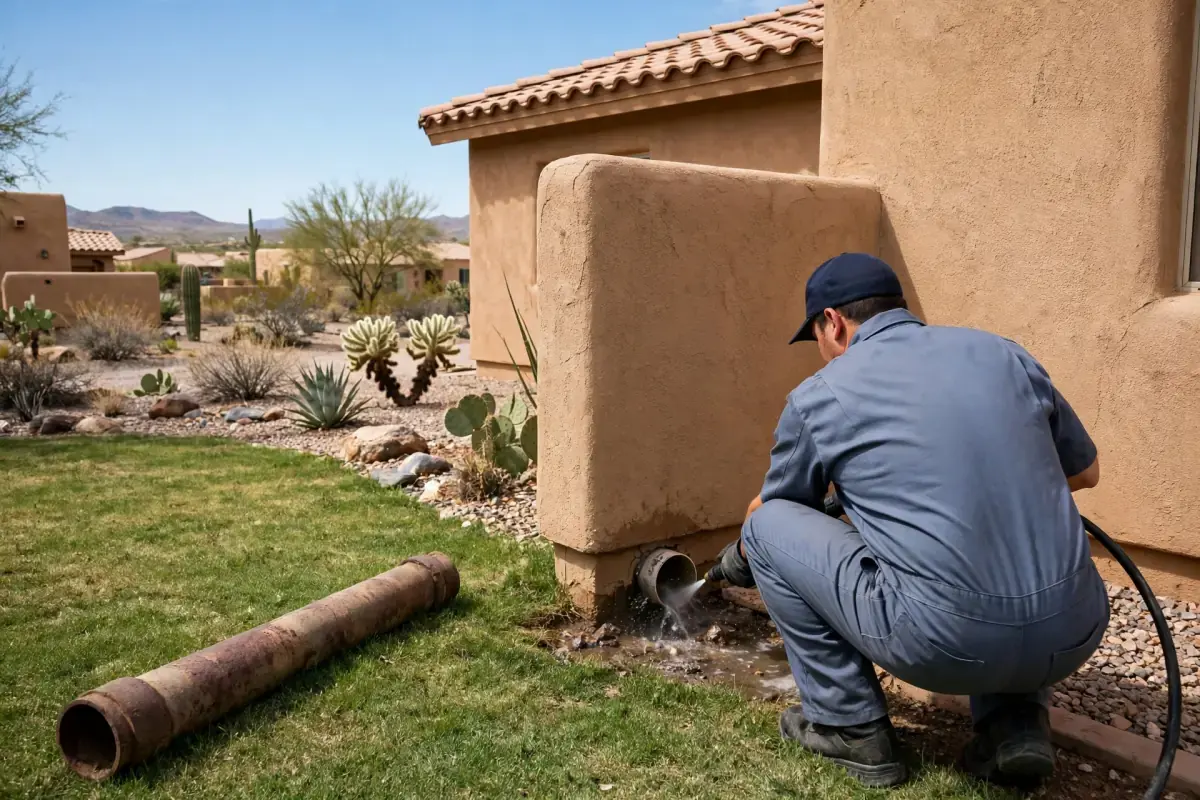
A Glendale home built before the 1970s may still have cast iron or clay tile drains, and those materials age in ways that jetting can reveal but not fix. Cast iron corrodes from the inside, so the bore narrows and the wall thins at the same time; a camera shows a rough, pitted surface and sometimes a flake that has broken loose.
Clay tile holds up well until a joint shifts, and then roots enter at exactly that spot. Either way, a slow drain in an older home is a reason to look with a camera before choosing a cleaning method.
Homes from the 1980s and 1990s usually have ABS or PVC, which resist corrosion but are not immune to trouble. A PVC line can sag where the bedding settled, and a sag collects solids until the drain gurgles.
ABS joints can loosen over decades of heat cycles from hot water. In these homes, the most common story is a grease and scale coat rather than a failing pipe, and jetting is usually the right answer.
Newer Glendale homes, built in the last twenty years, often have PVC throughout and fewer material problems, but they are not trouble-free. A long run to the street, a low spot left by the builder, or a kitchen that cooks with a lot of oil can still produce a slow drain within a few years.
The sign to watch is the same at any age: more than one fixture slowing at once. A single slow sink is usually a local clog; a slow tub, a slow toilet, and a gurgling kitchen sink together point to the main line, and that is where jetting earns its keep.
Hydro jetting in Glendale
What a Glendale jetting visit looks like, from the first knock to the final test
The visit opens at the door with a short conversation: which fixtures are slow, how long the trouble has lasted, and whether anything has backed up. The technician then walks the yard to find the cleanout, a capped pipe that is usually near the front of the house or in the side yard, and sends a camera in toward the street.
The monitor shows the inside of the line as the camera travels, and the technician points out scale, grease, roots, or a shifted joint as each one appears, with the distance from the cleanout noted.
With that map in hand, the technician picks the nozzle and the pressure. A root-cutting head goes first if a root mat is blocking the way; a wide spray head follows to wash the walls.
The hose enters through the cleanout, and each pass carries it a little further down the line, while the loosened coating is flushed out by the same water that lifted it. The work is noisy and wet at the cleanout, so splash protection goes down and the yard is left as it was found.
The closing part of the visit is the proof. A second camera run should show clean walls along the whole jetted length, and each sink, tub, toilet, and laundry drain is run and timed.
Before leaving, the technician explains what was found, what the line looks like now, and when to have it looked at again. If a cracked joint or a sag turned up, the explanation will be plain, with the camera distance noted so that any repair quote can be exact.
Hydro jetting in Glendale
Do you need a permit for hydro jetting in Glendale?
A jetting visit is cleaning, not construction, and cleaning a drain does not usually need a permit in Glendale. The technician uses water and a cleanout that already exists, changes nothing about the pipe or the house, and makes no new connection to the city sewer.
The visit is a single appointment, and the invoice is the only document it produces.
Permits belong to a different kind of job. When the camera finds a broken section, a collapsed joint, or a line that has to be replaced, the work becomes construction: digging in the yard, cutting a section out, and joining a new one in.
The City of Glendale generally requires a permit for that work, and the usual path is an application with a description of the job, a plan showing where the line runs, and an inspection once the work is finished.
The person to ask is the plumber doing the work, because whether a permit applies depends on the exact repair and where it sits. If a repair is needed, ask for the permit to be named on the quote and for the inspection to be part of the job, so the finished work has a record.
A repair done without a permit that was required can cause trouble at sale time, when a buyer asks for records. Jetting itself never reaches that question: no permit, no digging, and no change to the line.
Hydro jetting in Glendale
Arrowhead Ranch and the north Glendale neighbourhoods
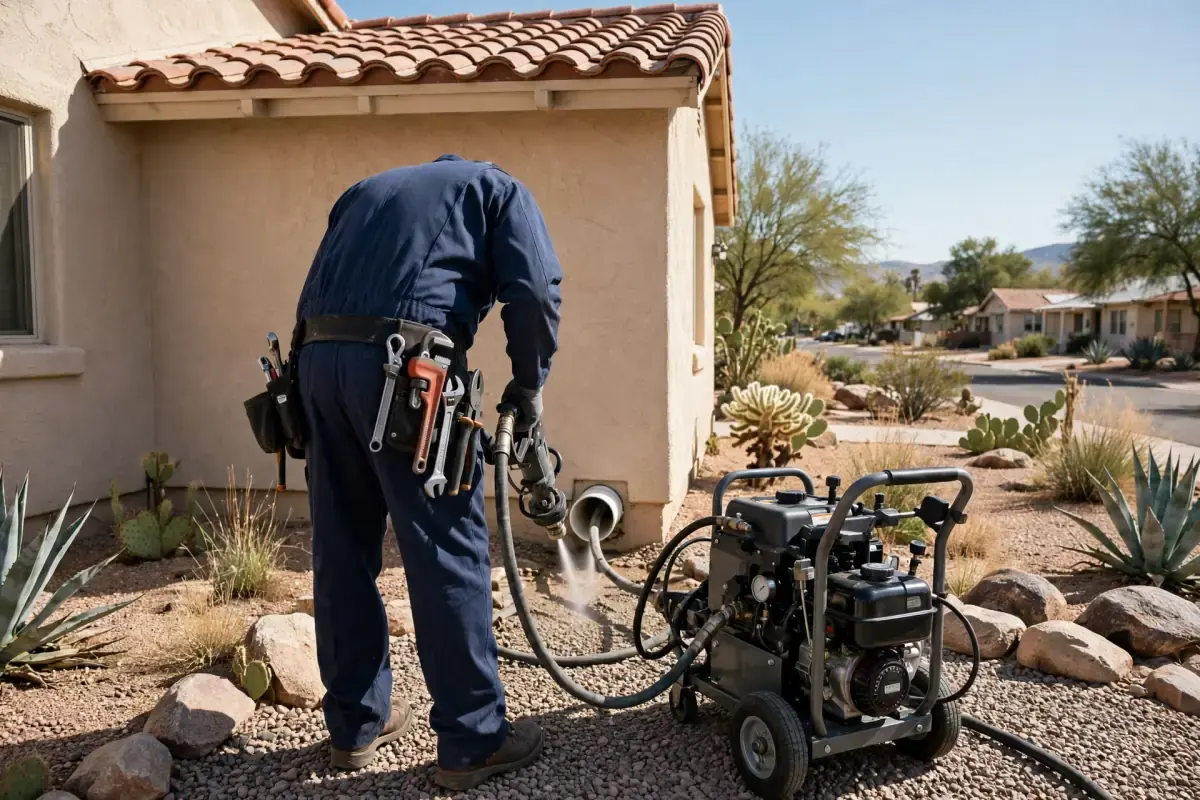
Arrowhead Ranch anchors north Glendale, a wide area of planned communities, golf courses, and larger lots that grew up from the late 1970s onward. Many of its homes have long sewer runs, mature trees, and landscaping that was planted when the houses were new, which means the root systems are now full-grown and well placed to find a sewer joint.
A homeowner here benefits from a camera look every couple of years, even when the drains seem fine, because a root thread caught early is a short job.
South of Arrowhead, the older parts of Glendale near the downtown and the historic districts have a different mix: smaller lots, older cast iron and clay lines, and homes that have been extended or remodelled over the decades. A remodel that added a bathroom or moved a kitchen can leave a drain with an awkward slope or a long flat run, and those runs collect solids.
In these neighbourhoods, a jetting that follows a camera inspection often reveals the one stretch that causes all the trouble.
West Glendale, toward the newer subdivisions near the Loop 101 corridor, has mostly newer PVC lines, but the same desert water flows through them, so scale builds at the same pace. Newer does not mean immune.
Whatever part of Glendale you live in, the pattern is the same: hard water coats, roots search, and a camera check turns a guess into a fact. The neighbourhood changes which cause is most likely, not whether the line needs looking after.
Hydro jetting in Glendale
When to call now in Glendale, and when you can watch it for a week
Some drain trouble is an emergency, and the test is simple: is water coming back up, or is it about to? A tub that fills when the toilet flushes, a shower that will not drain, or a floor drain that overflows means the main line is close to fully blocked.
Every flush and every shower adds water with nowhere to go, so stop using water, do not keep flushing to test the problem, and call (833) 878-1592 the same day. A sewage smell that is strong and getting stronger belongs in the same group, especially if it comes with a wet patch in the yard over the sewer line.
A single slow fixture is a different matter, and it can usually wait a few days while you watch it. A bathroom sink that drains slowly on its own is often hair and soap near the trap, and a plunger or a careful hand cleaning may clear it.
The thing to watch while you wait is the rest of the house: if the tub starts slowing too, or the toilet gurgles when the washer runs, the problem has moved from one fixture to the main line, and the time to book has arrived.
The case in between is the drain that was cleared a month ago and is slow again. That repeat pattern is the clearest sign of a coating or a root mass that a cable only partly removed, and it deserves a booking even though nothing has backed up.
Waiting turns a planned cleaning into an emergency visit, and emergency visits cost more and happen at worse hours. A camera look and a jetting now is the cheaper path, and it leaves you with a record of what the line actually holds.
Hydro jetting in Glendale
How Glendale compares with Scottsdale, Peoria, and Tempe
Glendale, Scottsdale, Peoria, and Tempe share the same desert water, so scale is a common thread across all four cities. The differences are in the homes and the ground.
Scottsdale has many hillside and desert-lot homes with long runs and a lot of mature landscaping, so root intrusion shows up there as often as in north Glendale. Peoria, like Glendale, has a mix of older homes near its historic core and newer subdivisions to the north, and the older homes carry the same cast iron and clay questions.
Tempe is older on average, with many homes built in the 1960s and 1970s around the university, and its lines have had more decades to corrode and shift. A Tempe drain is more likely to show a thinned cast iron wall or a shifted clay joint than a newer Glendale line.
Mesa, the other large neighbour, has a similar spread of ages and the same hard water, so its jetting jobs look much like Glendale's.
For a Glendale homeowner, the comparison matters when a plumber quotes a price or a schedule. A job in a newer Peoria subdivision and a job in an older Tempe street are not the same job, even if the symptom sounds identical.
The camera check is what makes the quote honest: it shows the material, the length, and the coating, so the price follows the pipe rather than the city name. If you are choosing between plumbers, ask each one what the camera showed and compare those answers, not just the totals.
Signs you may need hydro jetting
- A kitchen sink that holds water after the dishes are done, even with a clean trap.
- A shower that leaves you standing in water before you have finished washing.
- A toilet that gurgles when the washing machine drains.
- Two bathrooms slowing down on the same day.
- A drain that was cleared a month ago and is already sluggish again.
- A sour smell coming from a floor drain that gets used every day.
- Water rising in the tub when the toilet is flushed.
- A laundry drain that spills over during the spin cycle.
- A damp, sunken patch in the yard above the sewer line.
- Paper that needs two flushes where one used to be enough.
- A gurgling sound after every shower in the house.
How it works
- 1
First — look inside the line
The technician finds the cleanout and sends a camera toward the street, marking grease, scale, roots, and any break or sag by distance. You see the screen too, so the problem is visible before any cleaning starts, and the distances give every finding a location.
- 2
Second — choose the nozzle and the pressure
A root head goes first if a root mat is in the way; a wide spray head follows to wash the walls. The pressure is set from the camera findings, lower for older cast iron or clay, higher for sound PVC, so the cleaning is strong without stressing a weak line.
- 3
Third — wash the line through, pass by pass
The hose moves a little further on each pass, and the water lifts the coating off the full circumference and carries it downstream. The technician watches the return flow and repeats a stretch when the water still runs dirty.
- 4
Fourth — look again and test every fixture
A second camera run should show clean walls along the whole jetted length. Then each sink, tub, toilet, and laundry drain is run and timed, so you leave knowing the line is open rather than hoping it is.
Hydro jetting cost in Glendale
What does it cost?
The numbers below are the ranges already set for Glendale homes, and they describe the usual job: camera, cleaning, and a second look. A main line wash sits in the middle range; a single branch is cheaper because the run is shorter; heavy work costs more because it can need a root head first and several passes. The camera look before work is what fixes the final figure, since it shows the length, the material, and how thick the coating is. In Glendale, access, length, and the camera findings move the price most: a cleanout in the yard keeps it simple, a roof-vent entry adds time, a long Arrowhead Ranch run costs more than a short one, and a root mat or a heavy scale crust adds passes. Ask for the total in writing before the hose goes in, and check that the after-look is included.
| Service | Typical range (estimate) | Notes |
|---|---|---|
| Full main line wash | $350 – $650 | Typical for a house |
| Branch line jetting | $250 – $500 | One sink or tub line |
| Severe or commercial jetting | $600 – $1,200 | Bad roots or grease, long lines |
Prices are estimates only. The local company that does the work sets its own final pricing.
Questions about hydro jetting in Glendale