
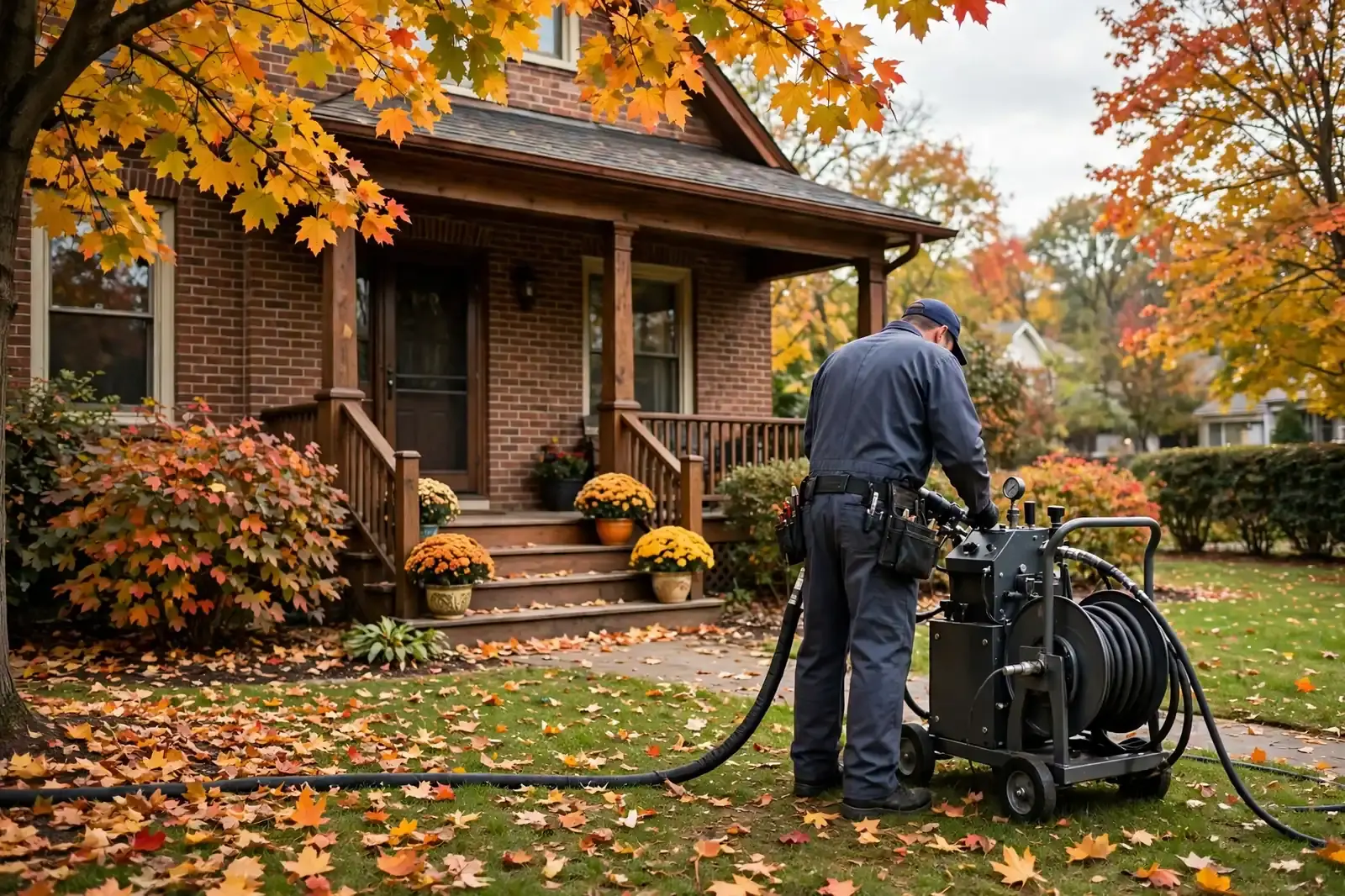
Hydro Jetting in Madison, WI
Madison is a city on an isthmus between two lakes, with deep winters and hard well water: the water table runs high, the frost runs deep, and the mineral film builds fast. Hydro jetting sends high-pressure water through the line and scours the whole inner wall clean. Call (833) 878-1592 to arrange a visit.
Updated 2026-11-18. Madison, WI · Dane County · Population 285,300. Prices shown are estimates only.
- 285,300 Population
- Dane County
- 13 ZIP codes served
- Willy Street Neighbourhood
Before & after in Madison
Before & after
Drag the slider to compare the same pipe before and after jetting.
Hydro jetting in Madison
What does hydro jetting cost in Madison?
Compare the two ends of the table and you will see the range. A branch line to one sink is the cheapest job in the table.
A full main line to the street costs more. A line packed with roots or a heavy mineral film costs more again.
Unlike a warm-climate city, where the price is mostly about the run, Madison adds two costs of its own. Depth is the first.
Wisconsin frost runs deep, so laterals sit deep, and a deep cleanout takes longer to reach and longer to work from. The season is the second.
A winter job can cost more than the same job in summer, because the crew has to clear snow and sometimes thaw a shallow section before they can start. The run matters too: lots on the west side are generous, and a lateral can run a long way from the house to the street.
Get the figure in writing after the scope look, with the inspection, the jetting, and the second look shown as separate lines. Hydro jetting cost guide explains how the ranges are put together.
Hydro jetting in Madison
Why do Madison drains clog the way they do?
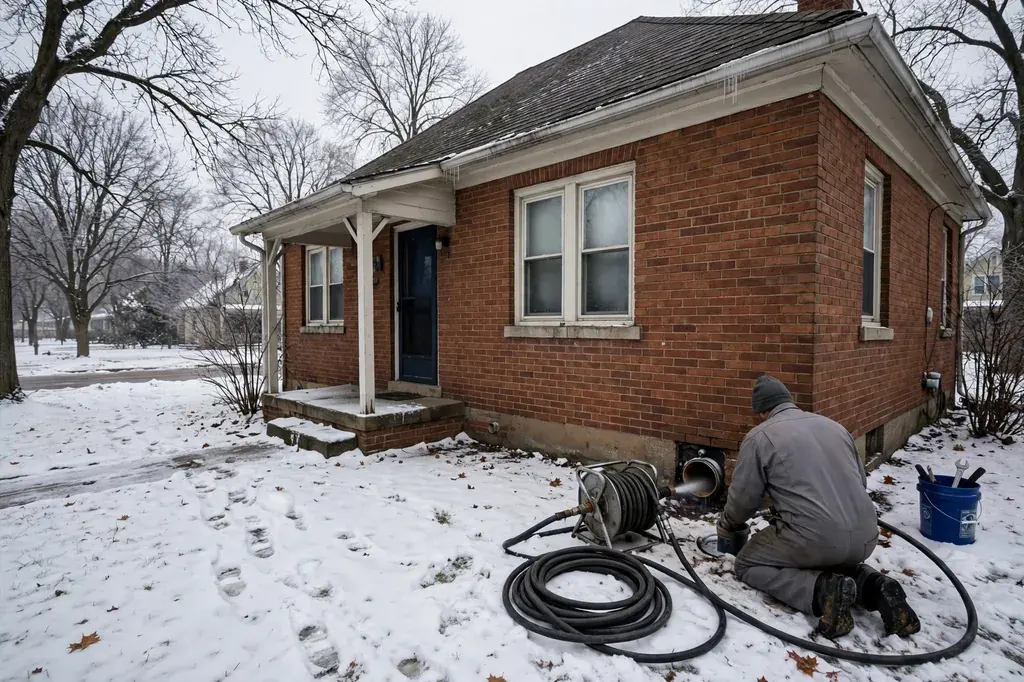
Unlike a cable visit, which treats the blockage as a single thing, a Madison drain usually has three things wrong at once. The first is the water.
Madison Water Utility draws on deep wells, and the supply is very hard, so a mineral film builds fast on the pipe wall, and the film roughens the surface until it catches grease and hair. The second is grease.
Wisconsin kitchens cook a lot of fried food, and fat cools and sticks to the filmed wall, layer on layer, until the bore narrows. The third is the trees.
Maples and oaks send roots a long way through the soil, and a sewer lateral is the most reliable water in the yard, and a clay joint that frost has opened a fraction is all a root needs. Where a cable bores a hole through the blockage and leaves the film on the walls, jetting strips the film off the wall and leaves the pipe bare.
The scope look tells you which of the three is doing the damage before any tool is chosen, and in this city it usually finds film first, grease second, and roots third.
Hydro jetting in Madison
What does a camera inspection find in Madison?
Where a guess would stop, the sewer scope keeps going. The technician opens the cleanout, in a Madison home often in the basement or out in the yard, and feeds a sewer scope down the line.
The run passes each bend and joint, and in Madison the picture often shows a hard-water film coating the pipe wall, a thick grease layer in the kitchen branch, and root strands nosing through a clay joint that frost has opened. The screen will also show you what water cannot fix.
A low stretch where the soft isthmus soil has let the pipe dip holds standing water, and sludge gathers in it. A joint that has shifted can catch a cleaning head, so the crew maps it before they start.
The pipe can change material halfway along, where an old repair left new pipe in one stretch and the rest original, and in an older home the original pipe may be clay, roughened by decades of hard water. After the jetting, the scope runs the line a second time from end to end.
Bare walls on the screen are the proof the wash held, and the recording is a record of the pipe for the next slow drain. Sewer camera inspection guide covers what to expect.
Hydro jetting in Madison
Willy Street and the isthmus: what changes by neighbourhood?
Willy Street, on the near east side, is one of the oldest parts of the city. Homes from the 1900s through the 1940s line its streets, and some still run clay or cast iron underground.
Their laterals have been through decades of freeze and thaw, so separated joints and root entry turn up more often there than in the newer districts. The isthmus itself, between Lake Mendota and Lake Monona, sits low, and the water table runs high there, so a cracked lateral can let groundwater in, and a line that already drains slowly will back up sooner when the ground is soaked.
The west side tells a different story. Homes from the 1960s onward stand there, on higher ground, with longer laterals running across big lots, and their troubles are usually one kitchen line or a laundry stack.
One supply reaches every street, so film is a city-wide problem, not a neighbourhood one. Homes built after 2000 are nearly all PVC, and jetting is a straightforward job.
A home from before 1960 deserves a scope look first, because the pipe may be clay and the frost may have moved it more than you think.
Hydro jetting in Madison
Do Madison winters put drains at risk?
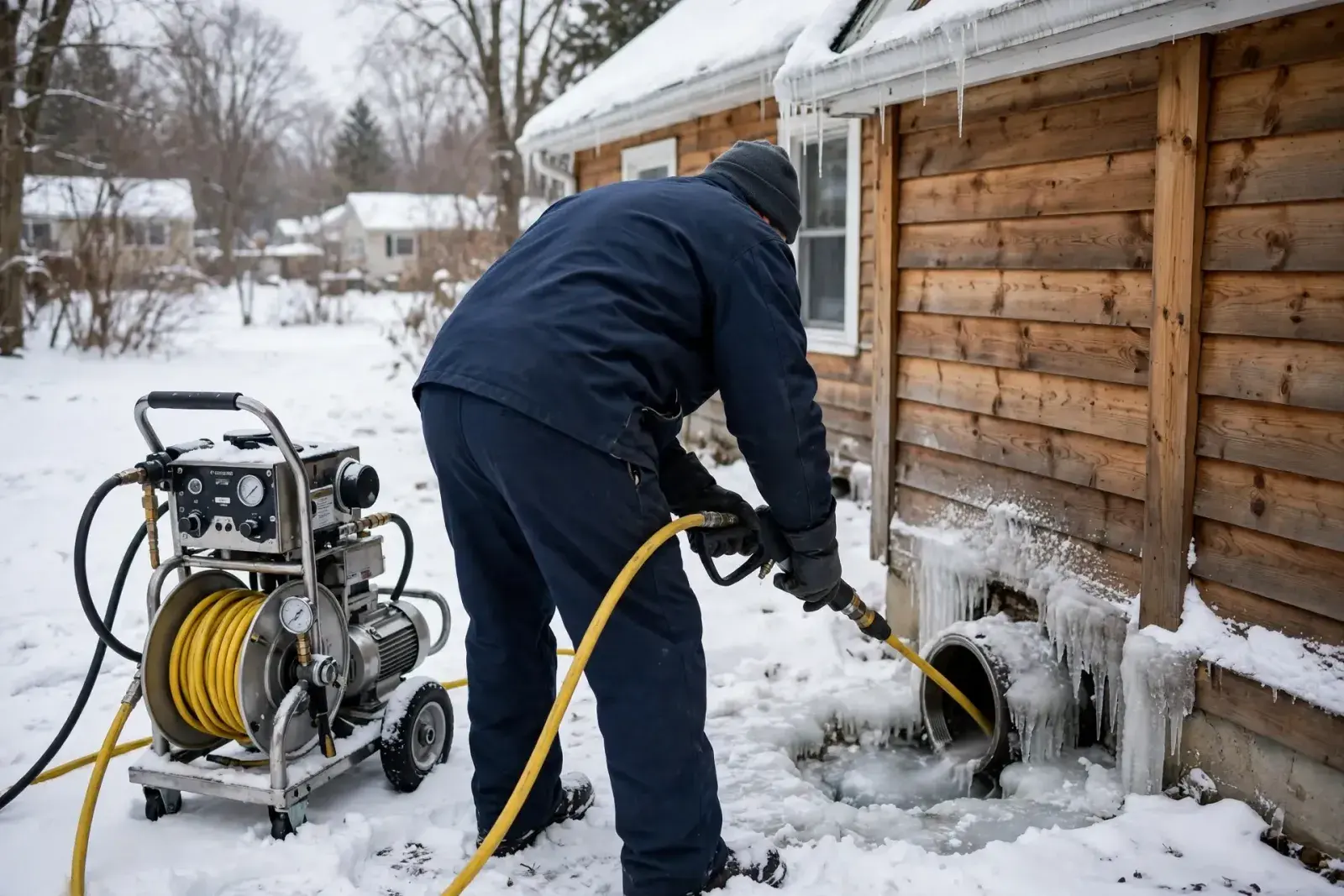
A Madison winter works on a drain from above and below at once: the frost from above, the water table from below. The first trouble is a frozen shallow run.
A section that sits close to an outside wall, or a line that runs through an unheated part of the house, can turn to ice in a January cold snap, and a line full of ice cannot be jetted until it is thawed, because the ice blocks the hose and the pressure has nowhere to go. The crew melts the ice out with hot water before the jetter is rigged.
The second trouble is the ground moving. The soil lifts as it freezes and settles as it thaws, and a pipe that has been lifted and settled a dozen times can dip and hold a belly of standing water, and sludge gathers in the belly.
An empty house is the worst case: no warm water runs through the line, the traps dry out, and the whole run can freeze through. The wash takes the grease and the roots out, but it cannot raise a dipped section or keep a shallow run from icing again.
A line that backs up every January, with the scope showing the same low spot each time, needs a fix at that low spot, not another wash. Tell the crew when it blocks and in which month: a January pattern means frost, not grease.
Hydro jetting in Madison
How hard is Madison water, and does scale matter?
Unlike a soft-water city, where scale is an afterthought, Madison water makes scale the first thing to check. Madison Water Utility draws on deep wells, and the supply is very hard, so a mineral film builds fast on the pipe wall, and the film narrows the bore a little each year.
In a clay line, the film is often the main reason a rough pipe starts to catch grease and hair, and in a PVC line it is the reason a smooth pipe starts to catch them too. Jetting takes the film off.
The scope afterwards shows whether the wall came clean or whether the film has built into a thick ridge. Heavy film may call for extra passes with a different cleaning head, which adds time to the visit.
A softener slows new film from forming but cannot remove what is already there. The signs are easy to spot: white crust on a faucet, spots on glassware, a showerhead that clogs.
All of them say the pipes are carrying film too. Say so when you book, and the crew will bring the right heads.
The Madison Water Utility publishes water quality information for the city supply.
Hydro jetting in Madison
Does the lake isthmus affect Madison drains?
Compared with a city on high ground, Madison's isthmus changes the drain picture in two ways. The first is the water table.
The city sits on a narrow strip of land between Lake Mendota and Lake Monona, and the ground there is low, and the water table runs high, so a cracked lateral can let groundwater in, and a line that already drains slowly will back up sooner when the ground is soaked. That groundwater carries silt into the low spots, and the silt adds to the blockage.
The second is the soil. The isthmus ground is soft in places, and a pipe laid in soft ground can dip over time, and a dip holds a belly of standing water, and sludge gathers in the belly.
Jetting clears the silt and the grease, but it cannot mend a cracked pipe that keeps letting water in, and it cannot lift a dipped section back into line. If your drains back up only after a heavy rain, tell the crew, because that points toward water getting in from outside rather than a simple grease clog.
Some homes have a sump pump that keeps the basement dry, and if its discharge ties into the sewer line, the crew should know, because a pump that runs constantly can push water back into a slow line. Clear the line and check the pump together.
Hydro jetting in Madison
When should you call, and when can you wait in Madison?
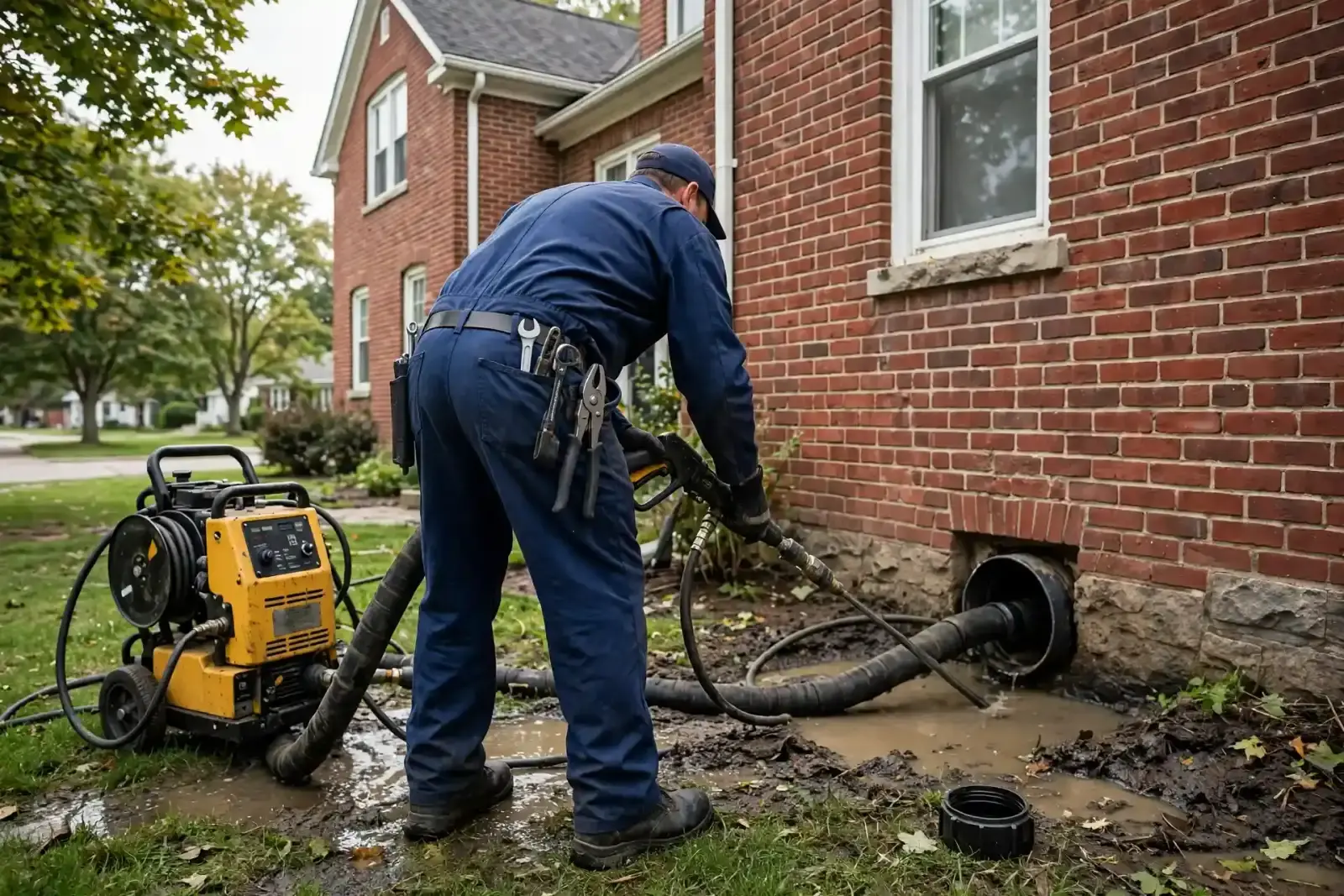
A January backup and a July backup are two different emergencies. Sewage coming up in a tub, a shower, or a floor drain is a same-day call, whatever the month.
So is more than one fixture backing up at once. Both mean the main line, and the longer you wait the further the water spreads, and in January it can freeze where it stands.
Turn off the water at the fixtures that are backing up, keep everyone away from the standing water, and call (833) 878-1592. A single slow sink, with no smell and no water coming back up anywhere else, can wait a day or two; in summer it can wait longer.
Do not pour drain cleaner down it while you wait. It seldom moves a grease film, it makes the pipe unsafe for the crew to open, and in a frozen line it does nothing at all.
Watch for the early signs: the toilet bubbling when the shower runs, the kitchen sink dragging after dinner, a faint sewer smell near a floor drain. Each one means the film is thickening, and a scope look now costs less than a backup later.
Late autumn is the time to book, before the ground freezes. A drain that drags in November will drag harder when the first cold snap comes.
Hydro jetting in Madison
Do you need a permit for hydro jetting in Madison?
The city's rule is short: washing needs no paper, digging does. Jetting is cleaning, and no permit covers cleaning.
The paperwork starts only when the work turns into repair. If the scope finds a broken lateral and the fix means digging up a yard, a driveway, or a stretch of street, the city wants a permit and an inspection, and the contractor files it.
A new cleanout set into a yard or cut through a basement wall can also need approval. Digging through frozen ground often calls for heavier equipment, and the permit covers the street and sidewalk work that follows.
The plumber files the form and waits for the city's go-ahead before the digging starts. What it costs and how long it takes depends on the size of the work, so no figure is given here.
Ask before the shovels come out: does this job need a permit, and who files it? A contractor willing to dig without one is a reason to walk away.
A careful crew will say outright when the work has moved from cleaning into repair.
Hydro jetting in Madison
What does a hydro jetting visit look like in Madison?
Unlike a cable visit, which is over in half an hour, a jetting visit runs in four parts, and you will watch most of it. Part one is questions: which fixtures are slow, when it started, and whether a cold snap or cooking makes it worse.
Part two is the scope: the crew opens the cleanout, in a Madison home often in the basement or out in the yard, and runs the scope down while you watch the screen. Part three is the jetter: the machine stays by the truck and only the hose comes to the cleanout, and the cleaning head works the pipe in slow passes while the crew runs water through the fixtures.
Part four is the proof: the scope goes down a second time to show clean walls, and each slow fixture is run at full flow to prove it drains. A home line usually takes an hour or two, and a line that needs thawing first takes longer.
Before they leave, ask what the scope found, whether any stretch needs a fix rather than a wash, and when the line should be checked again. File the written note with your house papers.
Hydro jetting in Madison
How does Madison compare with nearby cities for drain problems?
Compared with Milwaukee, Madison is smaller and its water is harder. Milwaukee sits on Lake Michigan, and its water is softer, so its lines carry less film, though its housing is older on average and shows more cast iron.
Green Bay, further north, is colder, and its lines face more frost risk, and its water is hard too. Kenosha and Racine, on the lake to the southeast, have softer water and older housing, so their pattern runs closer to Milwaukee's.
Appleton, to the northeast, sits on the Fox River, with hard water and deep winters, so its pattern runs close to Madison's. Waukesha, just west of Milwaukee, has hard well water like Madison, and its lines carry the same film.
What marks Madison out is the combination: very hard well water on top of an isthmus with a high water table, in a city with deep winters. A line that blocks here is more often a film and grease problem made worse by frost and groundwater than an age problem, and the fix is usually a straightforward jetting.
Hydro jetting in Milwaukee, WI covers the closest comparison.
Hydro jetting in Madison
What if the home has a finished basement with no visible cleanout in Madison?
Unlike a slab home, where the cleanout sits in the yard, a Madison home with a finished basement can hide its cleanout behind a wall, under a floor, or behind a stack of boxes. The crew starts by looking for it: behind the laundry area, near the floor drain, or where the main stack meets the floor.
If no cleanout can be found, the crew can run the scope through a toilet, or through a roof vent, though neither is as good as a cleanout, because the bends are tighter and the hose has further to travel. A finished basement also changes the risk.
A backup in a finished basement damages flooring and furniture, so the stakes are higher, and a slow drain is worth a scope look sooner rather than later. Jetting from a toilet or a vent takes longer, and the crew will lay down protection for the floors.
Tell the crew when you book that the basement is finished and the cleanout is hidden, because they will bring the right equipment and plan the visit around it.
Hydro jetting in Madison
What if the home has a sump pump?
Compared with a home on high ground, a Madison home with a sump pump lives with the water table every day. The isthmus sits low between two lakes, and the water table runs high, and a sump pump keeps the basement dry by lifting groundwater out of a pit and sending it outside.
The pump matters to the drains in two ways. The first is the discharge.
A pump that discharges into the sewer line adds water to a line that may already be slow, and a line that already drains slowly will back up sooner when the pump runs. The second is the pit itself.
A pit that collects silt can send grit into the line, and the grit settles in the low spots and adds to the blockage. Unlike a cable, which only tells you where it stops, the scope shows where the pump ties in and whether the tie-in is clear.
Jetting clears the silt and the grease, but it cannot fix a pump that discharges into a line too small for it. If the pump runs constantly in spring, tell the crew, because that points toward groundwater getting in from outside rather than a simple grease clog.
Clear the line and check the pump together.
Signs you may need hydro jetting
- Unlike a summer slowdown, every fixture in the house slows on the same day in the coldest week of winter.
- The tub fills when the toilet flushes, and the water runs cold.
- A floor drain backs up after a heavy rain, when the water table is high.
- A wall pipe gurgles after a shower, and the gurgle gets worse as the weather turns cold.
- The kitchen sink drags after every meal, because the fat hardens fast in a cold pipe.
- A sewer smell hangs by a floor drain in a finished basement.
- Two bathrooms flush weakly at once, though each toilet works fine alone.
- Water gathers around the laundry standpipe while the washer runs.
- A drain cleared with a cable slows again within a few weeks.
- White crust on the faucets and a showerhead that keeps clogging, with slow drains, point to hard-water film.
How it works
- 1
Scope the line before any water runs
Unlike a cable, which only tells you where it stops, the sewer scope shows the whole run. The technician opens the cleanout, in the basement or out in the yard, and feeds the scope down the line, reading the run on a monitor as it travels past each bend and joint. The screen shows how far the trouble sits, what the pipe is made of, and where it dips, shifts, or lets roots in. A hard-water film gets a close look, because it can look like a blockage on its own. The picture that comes back picks the cleaning head and the pressure, and it proves the pipe can take the water.
- 2
Rig the jetter to the line
The machine stays by the truck; only the hose comes to the cleanout. A spinning head takes grease and film off the walls. A penetrating head takes a hard blockage. A cutting head takes maple roots grown through a joint. Set the pressure to the pipe: low for old clay, higher for sound PVC.
- 3
Wash the walls in slow passes
Push the hose from the cleanout toward the street, working in slow passes. The head strips grease, breaks film free, and slices fine roots, then carries the loosened material downstream. Ease the hose back slowly, so nothing settles further down the line. A heavily filmed pipe may need several passes before the wall runs clean.
- 4
Prove it with a second scope pass
Run the scope down a last time, along the full washed length, and turn on every tap that was slow to watch it drain. A cracked stretch or a dip holding water gets flagged, with an explanation of the repair it needs, rather than a claim that cleaning fixed a structural problem.
Hydro jetting cost in Madison
What does it cost?
Use the table as a budget guide for 2026, not a quote. A Madison price is set only after the sewer scope look, and a deep lateral under a frozen yard, a long run across a big lot, or a root mass from maples and oaks can push it toward the top of the range.
| Service | Typical range (estimate) | Notes |
|---|---|---|
| Main line clean-out | $350 – $650 | What most houses need |
| One-line jetting | $250 – $500 | One sink, tub, or laundry line |
| Bad blockage and commercial lines | $600 – $1,200 | Long runs and heavy buildup |
Prices are estimates only. The local company that does the work sets its own final pricing.
Questions about hydro jetting in Madison