
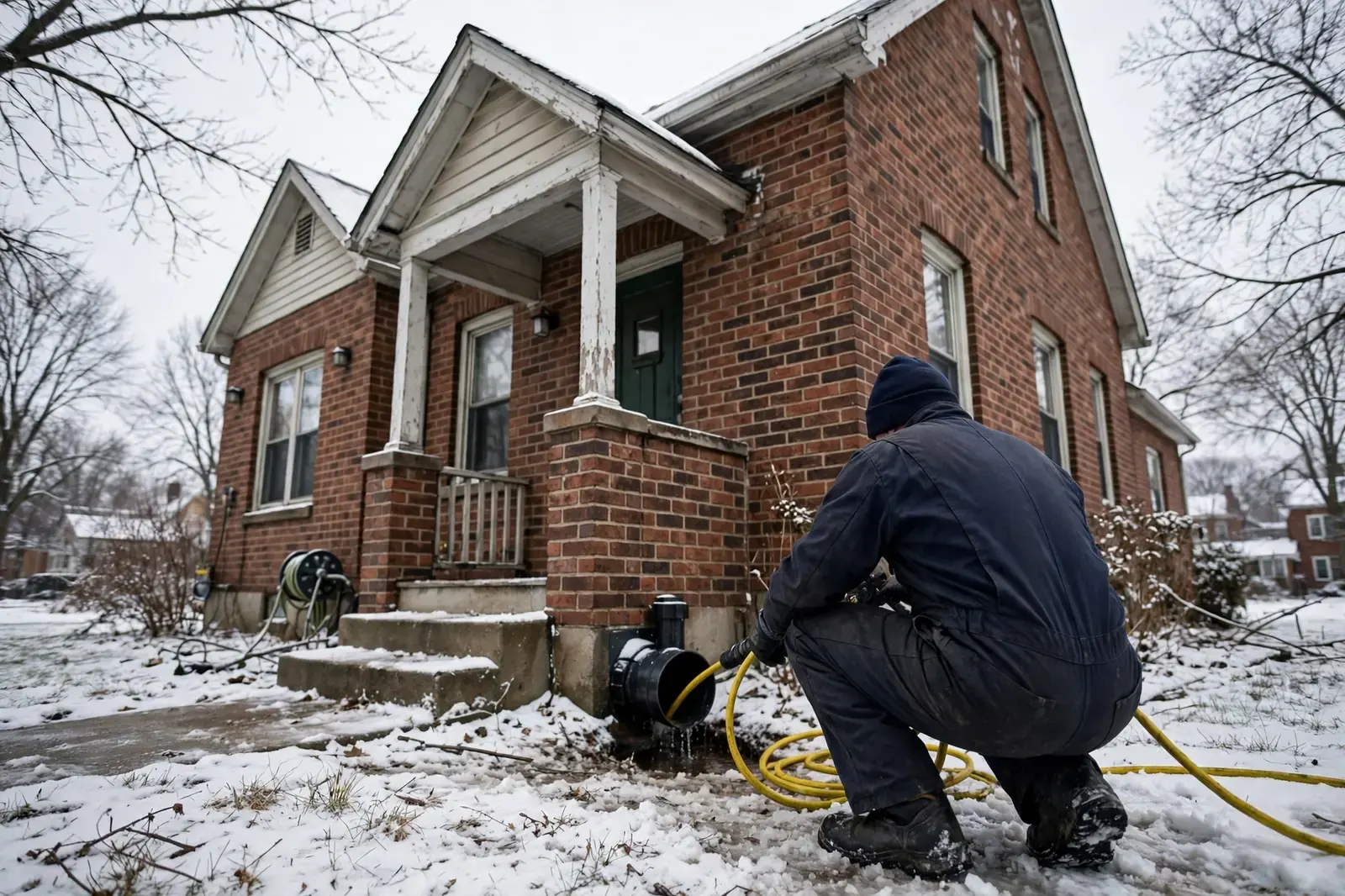
Hydro Jetting in Milwaukee, WI
For a Milwaukee house, hydro jetting means running a hose with a spray head through a drain line so water at high force peels grease, rust scale, soap film, and fine roots off the inside walls. Choose it when a cable clearing stops holding. The camera goes in first. Call (833) 878-1592 to set up a visit.
Updated 2026-11-18. Milwaukee, WI · Milwaukee County · Population 563,531. Prices shown are estimates only.
- 563,531 Population
- Milwaukee County
- 41 ZIP codes served
- Bay View Neighbourhood
Before & after in Milwaukee
Before & after
Drag the slider to compare the same pipe before and after jetting.
Hydro jetting in Milwaukee
Two Milwaukee houses, two very different jetting bills
Take two houses on the same Milwaukee block and the bills can sit at opposite ends of the table below. The first is a newer brick home in the suburbs with plastic pipe and a cleanout standing at grade in the front yard.
The monitor shows a short run, smooth walls, and a grease plug near the kitchen sink. One branch wash, about an hour, low end of the range.
The second is a 1920s duplex in Bay View with cast iron inside, clay tile outside, a long run under a maple-shaded yard, and a thick mineral coat inside the iron. That job wants a root-cutting head, several slow passes, and a careful camera run after — high end of the range, and most of a morning.
Same block, same service, different bill. The pipe decides, not the postcode.
That spread is why the table shows a band rather than a single number, and why the camera run matters more than any figure given over the phone. A number quoted before anyone has looked inside the pipe is a guess, and it usually guesses low.
Ask the crew to walk you through what the camera showed, and the figure stops looking random. Make sure the figure includes both camera runs as well as the wash — the footage is the proof the line is clean, not just open.
Hydro jetting in Milwaukee
Reading the estimate, line by line
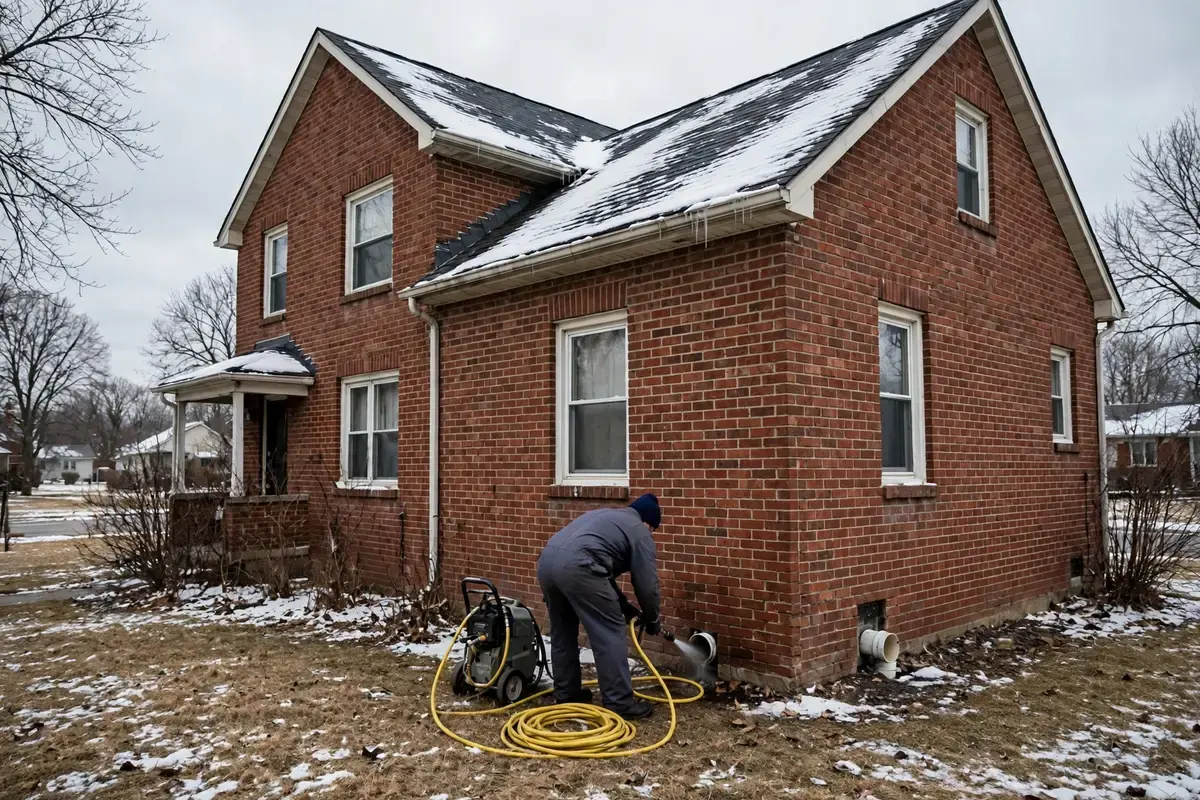
A jetting estimate has a few parts, and each one answers a question about your house. The crust: how thick is the mineral layer?
Lake Michigan water leaves scale behind, and a line that has carried it for decades can hold a thick coat that takes several slow passes to strip. The roots: is there a mat?
A maple root mat wants a cutting head before the wash head, and that takes time. The run: how long is the lateral, and how deep?
A pipe running a long way to the street, or one buried deep under a concrete drive, takes more time to work through. The entry: where does the hose go in?
A yard cleanout is quick; a basement cleanout behind a finished wall is slower. The surprises: what else did the camera find?
A belly that holds water, a separated joint, or a cracked stretch turns a cleaning into a repair talk, and a good crew stops and discusses it before pushing water through a damaged pipe. Winter adds a practical wrinkle: a frozen yard in January makes outdoor access harder, and a morning visit runs smoother than a midday one when the ground is hard.
None of this should catch you off guard. The camera finds it first, and the price follows what the camera shows.
Hydro jetting in Milwaukee
Why Milwaukee drains get worse in winter
Cold is Milwaukee's drain season. When the ground freezes, the soil around a shallow lateral contracts and shifts, and that movement can open a joint or press on a weak stretch of pipe.
Fats poured down a kitchen drain set faster in a cold pipe, so a grease layer that stayed soft in September turns hard by January. Holiday cooking adds to it: Thanksgiving and Christmas send more fat, more food, and more guests down the same drains, and the line that coped in summer gives up in December.
The basement floor drain is where winter trouble shows first, because it sits lowest in the house. A backup there in February is almost never a single-fixture problem — it means the main line is restricted and the house has nowhere else to send the water.
A jetting visit in late fall, before the ground freezes, is the practical move. It clears the autumn's grease and root growth while the yard is still workable, and it leaves the line at full width for the coldest months.
When your house has backed up in a previous winter, the pattern will repeat until the pipe walls are clean.
Hydro jetting in Milwaukee
Read your house's age off its pipes
Milwaukee housing runs from 1890s brick duplexes in Bay View to mid-century ranch houses and newer homes on the far northwest side, and the pipe under each house matches its decade. The oldest houses usually run iron inside and clay pipe outside.
Iron rusts from the inside and narrows as crust builds; clay pipe joints let roots in. Houses from the 1970s onward usually have plastic pipe, which stays smooth and takes the wash well.
A few mid-century laterals are Orangeburg, a tar-paper pipe that softens and sags with age — a poor match for high-pressure water. With that spread of materials, the scope look is not optional here.
Washing blind on Orangeburg or a badly cracked clay line can turn a cleaning into a collapse. On the monitor the crew can see the material, the joints, and any dip, and they set the force and the head to match what they see.
Bay View's brick duplexes are the classic case: iron inside, clay pipe outside, and a maple in the front yard whose roots have had a century to find the joints. If your house went up before 1970 and the lateral has never been scoped, that first look is the most useful plumbing visit you can buy — it shows what you have, what it can take, and what to plan for.
Hydro jetting in Milwaukee
What you will see on the camera screen
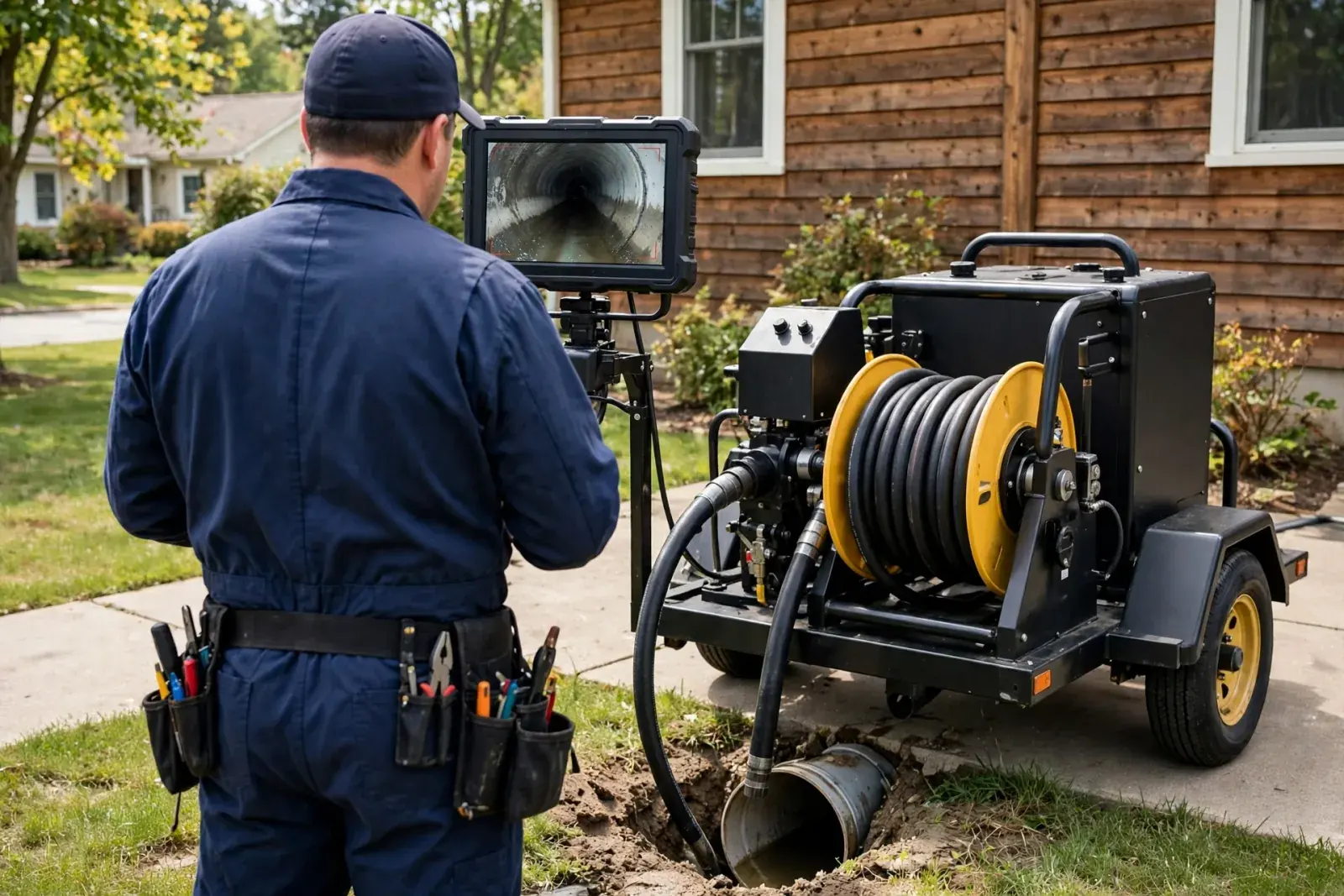
Your house has a story, and the scope reads it. First the walls: on the monitor, a smooth plastic pipe looks clean and dark, while an old iron pipe shows a rough, orange-brown crust.
Then the joints: a clay pipe joint with a root hair poking through looks like a pale thread, and a separated joint shows a dark gap where the pipe has pulled apart. Then the bottom of the pipe: fat sits as a soft, pale layer, crust as a hard, white coat, and a dip as a pool of standing water that never drains.
The crew reads all three before they pick a head. A wide spray head takes on fat and crust.
A spinning cutter takes on a root tangle. A piercing head takes on a hard clog.
Force follows the pipe: gentle for old clay pipe, stronger for sound plastic. After the wash, the scope goes back in, and the three pictures should look different — walls smooth, joints clear, bottom dry.
That second look is the proof. Without it, a clearing is a guess.
Hydro jetting in Milwaukee
The maple over your front yard is drinking from your sewer
Milwaukee's older streets are lined with maples, elms, and oaks, and their roots spread wide in the city's clay soil. A sewer lateral is the most reliable water in the yard, and a root will find the smallest way in: a hairline crack, a loose clay pipe joint, a gap where the pipe meets the house.
Once inside, the root thickens into a tangle that catches paper, grease, and waste until the line slows or backs up. The first sign is often a toilet that flushes weakly after a dry spell, when roots have been growing toward the line for months.
Milwaukee's long, cold winters make the problem worse in a quiet way: roots keep growing slowly underground while the yard above is frozen, and the tangle is at its thickest by spring. A spinning root-cutting head clears the tangle and scours the joint, yet the opening stays — the wash does not seal it — so roots can come back.
Houses with a large maple between the front door and the street should plan on a cleaning every year or two, and should ask the crew to note on camera exactly which joint the roots entered through. Note that spot: it is the one to seal or replace when the time comes.
Hydro jetting in Milwaukee
Lake Michigan water and the crust in your pipes
Milwaukee's drinking water comes from Lake Michigan, and it carries dissolved minerals that settle inside pipes over time. The crust builds slowly — a thin, hard layer that narrows the pipe a little each year and gives grease something to hold onto.
A smooth new plastic pipe sheds grease; a scaled iron pipe keeps it. That is why a kitchen drain in a 1950s Milwaukee house can slow down again weeks after a cable clearing: the cable punched a hole through the middle of the clog while the crust stayed on the walls, and the grease simply rebuilt on the same rough surface.
The wash fixes this because it takes the crust and the grease off together, leaving the pipe as smooth as its age allows. A water softener can slow new crust from forming on fixtures and appliances, but it will not lift the crust that is already in the drain.
When your faucets show white mineral spots and your drains run slow, treat the two as one problem with one cause — and the fix is the same wash. The lake gives Milwaukee good water; it also gives its pipes a slow, steady coating.
Hydro jetting in Milwaukee
Milwaukee Water Works, MMSD, and the pipe you own
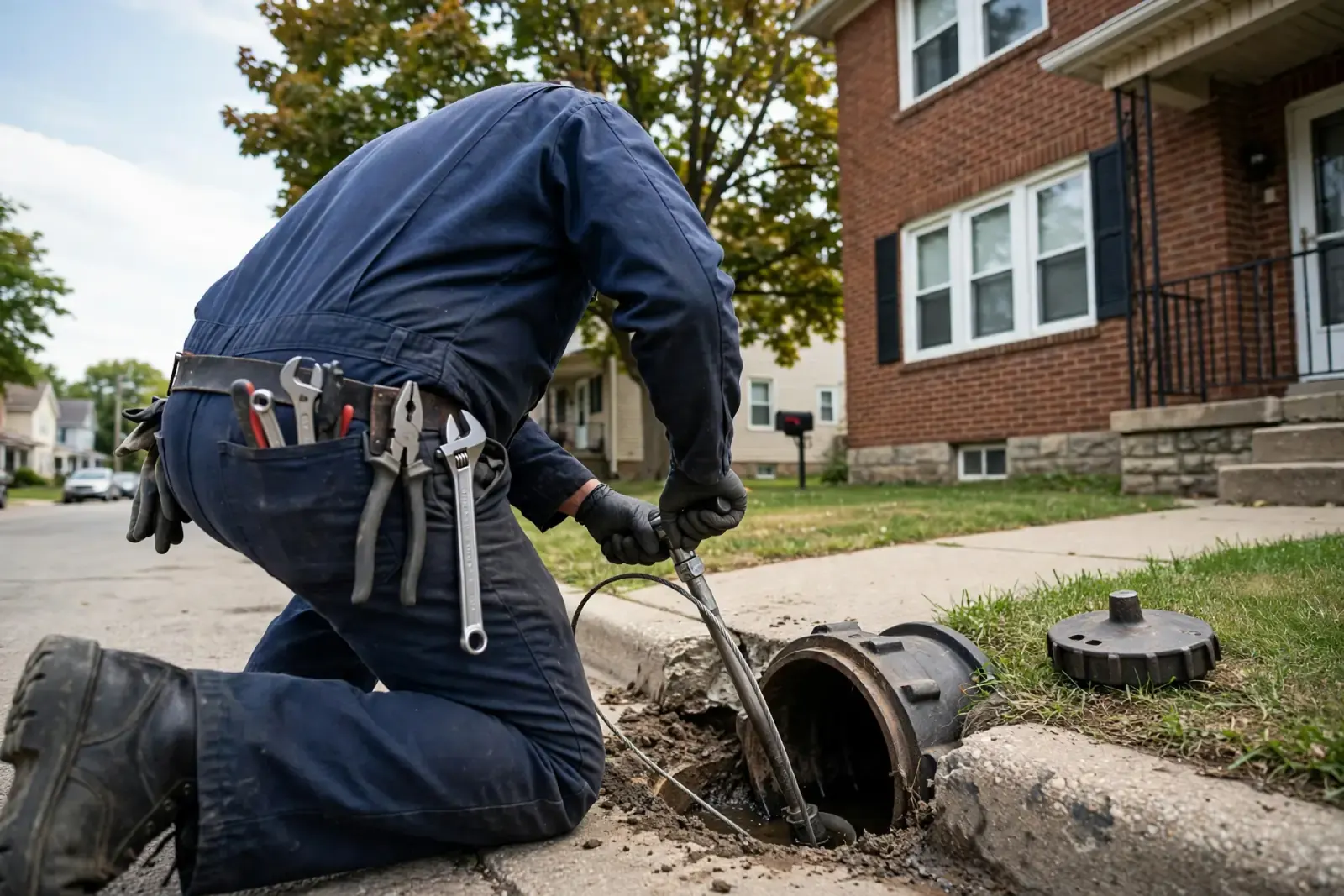
Milwaukee Water Works supplies drinking water to the city from Lake Michigan, and the Milwaukee Metropolitan Sewerage District — MMSD — runs the regional sewer system that carries wastewater to treatment. Your lateral, the pipe that runs from your house to the street main, belongs to you, and the wash cleans that pipe.
The main in the street belongs to the city or the district, so when the scope shows the blockage sitting beyond your property line, the fix is a call to the utility rather than a jetting visit. The footage gives the distance from the cleanout, so the crew can tell which side of the line the trouble sits on.
Milwaukee's combined sewer system in the older neighbourhoods is worth knowing about: in parts of the city, stormwater and sewage share the same pipes, so a heavy rainstorm can push extra water through the system and a partly blocked lateral is the first place a backup shows up. A clean lateral gives storm water somewhere to go.
When you are on a septic system outside the city service area, the rules are different: the wash still works on the house lines, but the tank and drain field need their own care, and the crew should know you are on septic before they start.
Hydro jetting in Milwaukee
The basement floor drain is the canary in a Milwaukee house
Most Milwaukee houses have a basement, and most basements have a floor drain — and that drain is the first place a main-line problem shows up. It sits lower than every other fixture in the house, so when the lateral is restricted, water has nowhere else to go and comes up through the floor drain first.
A gurgle from the floor drain when the washing machine runs, a damp ring around the drain after a shower, or a sewer smell that hangs around the basement are all early warnings. Ignore them and the next step is sewage on the basement floor, usually at the worst possible time — during a holiday, a storm, or a cold snap.
The floor drain also tells you when the problem is the main line rather than one fixture: when a single sink is slow, the trouble is in that branch; when the floor drain burps, the trouble is in the lateral. Keep the drain's trap filled with water — a dry trap lets sewer gas into the basement — and keep the area around it clear so you can see what it is doing.
When the floor drain starts talking, call (833) 878-1592. It is telling you the lateral needs a wash before the next backup.
Hydro jetting in Milwaukee
Bay View's old houses and their drains
Bay View, on Milwaukee's south side along the lake, is one of the city's oldest neighbourhoods, and its drains show that age. The houses are mostly late-1800s to 1930s — brick duplexes, frame cottages, and early bungalows — and most still carry cast iron inside and clay tile outside.
The streets are shaded by mature maples and elms, and the lots sit close together, so a lateral often runs under a neighbour's tree roots as well as your own. Many Bay View houses have also been added onto over the decades, which means the drain layout is not always what the original plans suggest; the camera is the only way to know where the line actually runs.
A duplex in Bay View builds grease faster than a single-family house, because two kitchens share one lateral. The neighbourhood's other quirk is its low elevation near the lake: a heavy rainstorm can raise the water table, and a partly blocked lateral is the first place that water shows up.
When you live in Bay View and your drains have started slowing down, a camera inspection and a jetting visit will tell you more about your house in one morning than years of guessing.
Hydro jetting in Milwaukee
Call now or watch and wait?
Call at once when sewage comes up through any drain, when more than one fixture backs up at the same time, or when a toilet bubbles as the washing machine drains. Those are main-line signs, and waiting turns a cleaning into a cleanup.
Call within a few days when a drain keeps slowing down after a clearing, when you hear gurgling from a fixture nobody is using, or when a sewer smell hangs around a floor drain. Those are coating and root signs, and jetting is the fix.
You can watch and wait when a single sink drains a little slowly and a plunger or a drain screen solves it, or when the slowness started right after a big cooking weekend and then clears on its own. What should never wait is a pattern: the same drain slowing down every few weeks, a backup that returns after a cable clearing, or a floor drain that burps during a rainstorm.
Patterns mean the pipe walls are coated or the joints are full of roots, and no amount of plunging changes the walls. When you are not sure which side of the line you are on, call (833) 878-1592 and describe it — a short conversation costs nothing, and a backup costs plenty.
Hydro jetting in Milwaukee
Milwaukee, Madison, Green Bay — same lake, same drains?
Milwaukee sits on Lake Michigan, and its drain problems look a lot like those in Madison, Green Bay, Kenosha, and Racine — hard water, cold winters, mature maples, and a mix of old clay tile and newer PVC. The differences are in the details.
Milwaukee's housing stock is older than Madison's, so clay tile and cast iron are more common here. The soil is heavy clay that holds moisture in spring and shrinks in summer, which can shift a shallow lateral and open a joint.
Green Bay runs colder in winter, so freeze-related backups show up there earlier in the season. What never changes from city to city is the method: look inside first, wash to match the pipe, and look again to prove the line is clean.
When you own a rental in Milwaukee and another in Madison or Kenosha, the same routine works in both — the footage from the first visit tells you how often each house needs it. A Milwaukee house with a big maple over the lateral needs attention more often than a newer Madison house with PVC and no trees, and the first camera run sets the schedule for each.
Signs you may need hydro jetting
- A kitchen drain that needed a cable last month and needs one again this month has coated walls, not a fresh clog.
- When the toilet flushes weakly after a dry spell, maple roots have been drinking from the lateral.
- A fixture that gurgles while the washer runs is breathing air trapped behind a partial blockage.
- Halfway through a shower, the water starts pooling around your feet because the branch is narrowing.
- White crust on the taps beside a slow drain means the same lake water is coating the pipes.
- A floor drain that smells after its trap is refilled is telling you the main line is restricted.
- Rainwater coming up through a shower or floor drain means the lateral cannot pass the surge.
- Drain flies circling a daily-use sink are feeding on the coating inside the pipe.
- A laundry tub that fills back up as the washer empties shares a restricted line with the washer.
- Toilet paper that drifts instead of flushing shows the pipe has narrowed.
- A glug after the water has gone is air caught behind a partial blockage.
- When every fixture slows on the same day, the trouble is the main line, not one trap.
How it works
- 1
First, the camera goes in
The visit opens with questions: which drains are slow, and how long has it been going on? Then the scope goes in from the cleanout. On the monitor you see the pipe material, the crust, the joints, and the blockage itself. That footage decides the rest of the visit — nozzle, pressure, and passes.
- 2
Then the nozzle and pressure are chosen
Fat and crust call for a wide spray head; a maple root tangle calls for a spinning cutter; a hard clog calls for a piercing head. Pressure follows the pipe: gentle on old clay pipe, stronger on plastic. The scope footage, not a guess, makes the call.
- 3
The line is washed in slow passes
The hose feeds in through the cleanout. The nozzle works its way down, spraying backwards, so loosened debris is carried toward the street main. Heavy stretches get a second pass. The crew watches the flow at the fixtures as they go.
- 4
The camera goes back in to prove it
The scope goes back in to prove it. A second run covers the whole washed length. Crust, fat, and root hairs should be gone, and the pipe should be back to its full width. Every fixture that was slow gets tested, and you can watch the monitor yourself.
- 5
You get a plain-words note on what comes next
Before leaving, the crew tells you the findings in plain words — pipe material, any dip or weak joint, and how soon roots or crust are likely to return — so you know whether this was a one-off clean or the start of a schedule.
Hydro jetting cost in Milwaukee
What does it cost?
The figures in the table are typical 2026 ranges for the country as a whole. What your Milwaukee home pays follows the pipe: its length, its condition, and its access. The camera look before work is what sets the final figure.
| Service | Typical range (estimate) | Notes |
|---|---|---|
| Main sewer jetting | $350 – $650 | Standard home main line |
| Single fixture line clean | $250 – $500 | One branch only |
| Bad blockage and commercial lines | $600 – $1,200 | Roots, thick grease, long pipes |
Prices are estimates only. The local company that does the work sets its own final pricing.
Questions about hydro jetting in Milwaukee