
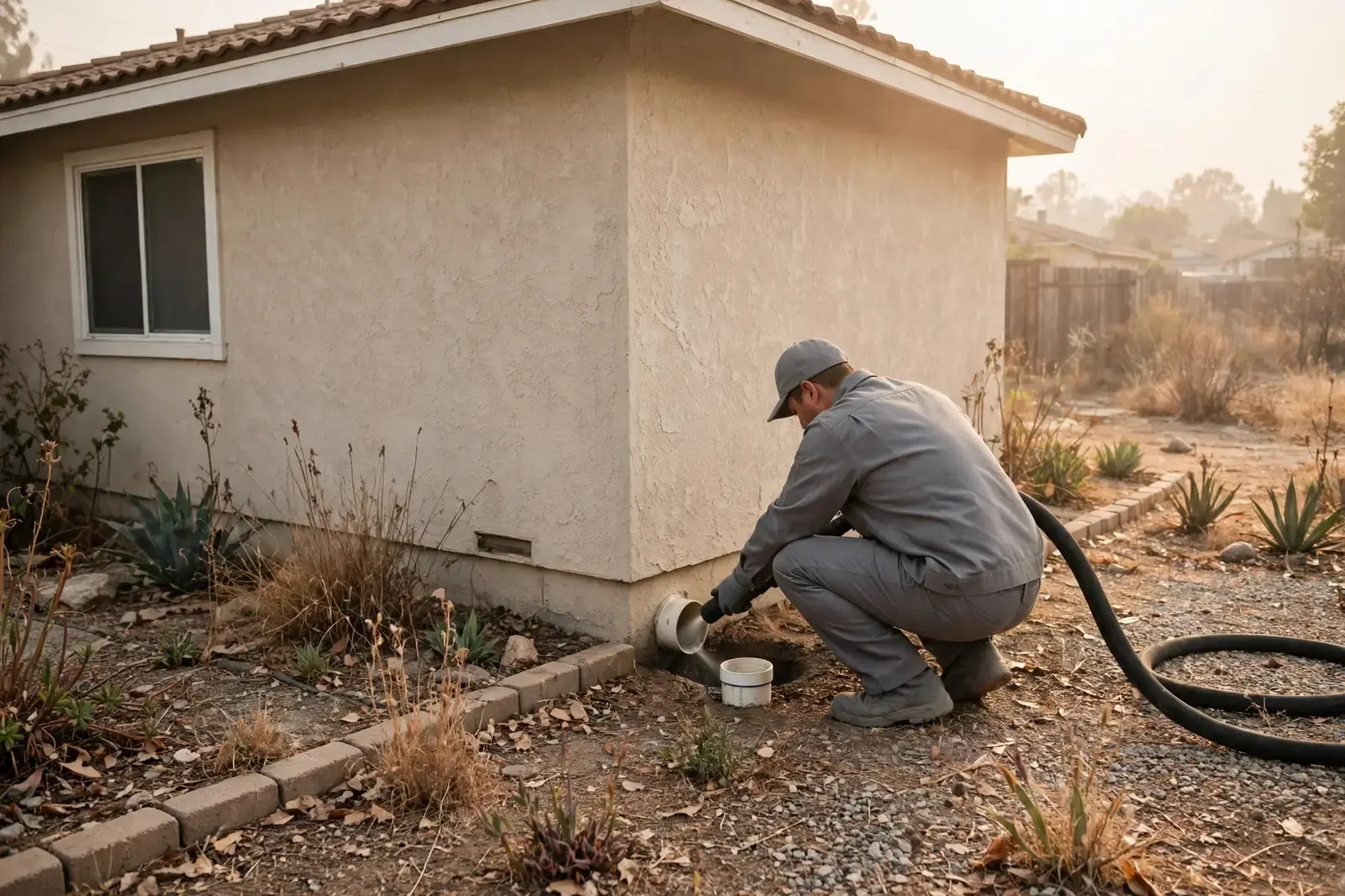
Hydro Jetting in Stockton, CA
Hydro jetting cleans a Stockton drain or sewer line with high-pressure water. The spray strips grease, scale, and small roots from the pipe walls, and the line drains freely again. A camera checks the pipe before and after, so the result is visible on screen. Call (833) 878-1592 to get an estimate.
Updated 2026-11-18. Stockton, CA · San Joaquin County · Population 324,975. Prices shown are estimates only.
- 324,975 Population
- San Joaquin County
- 20 ZIP codes served
- Brookside Neighbourhood
Before & after in Stockton
Before & after
Drag the slider to compare the same pipe before and after jetting.
Hydro jetting in Stockton
Brookside: canals, shade trees, and pipe from another era
Brookside sits in northwest Stockton, a neighborhood built around canals and planted with mature trees, and most of its houses went up between the 1960s and the 1980s. The sewer lines under those houses are the same age as the houses.
Cast iron and clay tile, buried when the streets were new, have spent decades underground, and the inside of a cast iron pipe does not stay smooth. It roughens, and a rough pipe wall catches grease and paper the way a smooth one never does.
The canals add a second problem. The water table runs high beside them, and the soil holds moisture most of the year.
A sewer joint that weeps even slightly draws roots toward it, and a fine root that slips through a gap thickens inside the pipe until it starts snagging waste. A camera tells you which of the two Brookside problems you have: a line that is dirty but sound, or a joint that will keep filling until it is repaired.
Lincoln Village and the streets near downtown share the same mix of old iron and old trees, on narrower lots with shorter runs to the street.
Hydro jetting in Stockton
Reading the pipe: what the camera shows
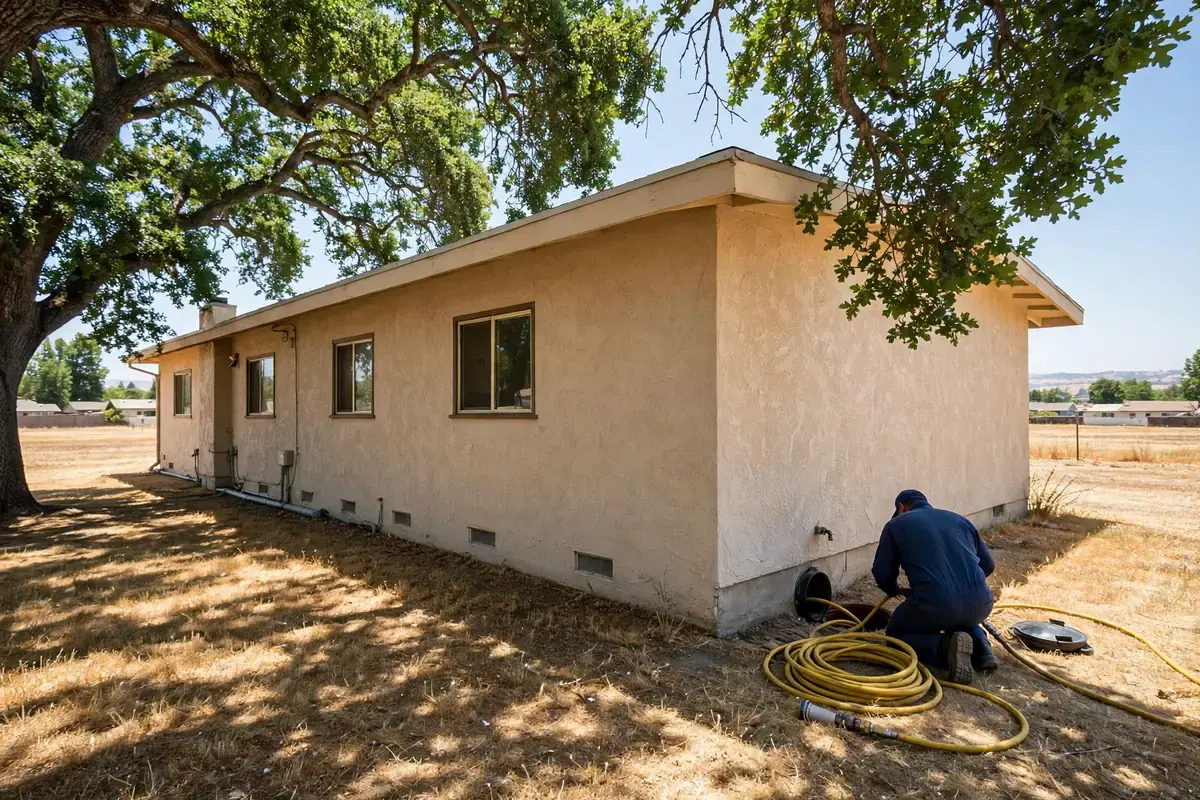
The camera is a small lens on a flexible cable, pushed through the line from the cleanout, and the picture it sends back is the whole basis for the job. In a Stockton house it most often shows a gray-brown coat of grease on the pipe walls, a pale crust of mineral scale, a tangle of fine roots at a joint, or a stretch where water stands instead of flowing.
A locator above ground marks the depth and the spot, so the crew can point at the lawn and say the trouble is here, six feet down, without opening the ground to find out.
Each picture leads somewhere different. Grease and scale come off under the jet, and the bore opens up.
Roots cut away, but the tree is still there, so the question becomes whether a wash every year or two will keep up, or whether the joint itself wants a repair. A dip in the line will hold water again a few weeks after washing, which means cleaning alone cannot fix it.
A split or caved section is a repair, not a wash. The point of looking first is simple: you spend money on washing only when washing is the fix.
Stockton on Wikipedia has background on the city and the Delta.
Hydro jetting in Stockton
Three things set the price in Stockton
The price of a jetting job in Stockton comes down to three things, and the camera inspection is what measures all three. The first is access: a cleanout in the front yard lets the crew set up in minutes, while a line that can only be reached through a roof vent or a pulled toilet adds time, and the clock is what you are paying for.
The second is the pipe itself: cast iron and clay under the older districts is often thin, so the crew works it slowly, with a gentler nozzle, rather than risking a break. The third is length: a run from a back bathroom to the street takes more passes than a short kitchen branch.
The table below shows the usual bands: one slow drain at the bottom, a full main line in the middle, heavy buildup or commercial work at the top. Those are estimates from national ranges, shaped for a Stockton house — not a fixed quote.
Before any hose goes in, ask for the figure in writing, and ask to see the camera picture that supports it. A price that matches the picture is a price you can trust, and a price that does not should make you ask questions.
Hydro jetting in Stockton
What year was your house built?
The houses that clog most in Stockton went up between the 1940s and the 1970s — Brookside, Lincoln Village, the older streets near downtown. Many of them still drain through the original cast iron or clay tile.
Cast iron grows a rough scale coat inside that snags grease and paper. Clay joints creep open over the decades and let fine roots in.
When several rooms in one of those houses slow down on the same day, the main line is the likely culprit, and a full wash is the sensible move — after a camera look, because old iron can hide a thin spot that the jet should not press.
Newer neighborhoods mostly run PVC, which stays smooth inside and keeps roots out. Those houses clog too, but the cause is usually kitchen grease, laundry soap, or lint, and a standard pass handles it.
PVC does not complain about a normal wash; old iron wants a careful nozzle so the spray does not punch through a thin wall. The build year is a clue, not a verdict.
A 1950s house with a replaced line can drain better than a 1970s house where grease has gone down the sink every night for years.
Hydro jetting in Stockton
Look at your faucet: hard water in Stockton
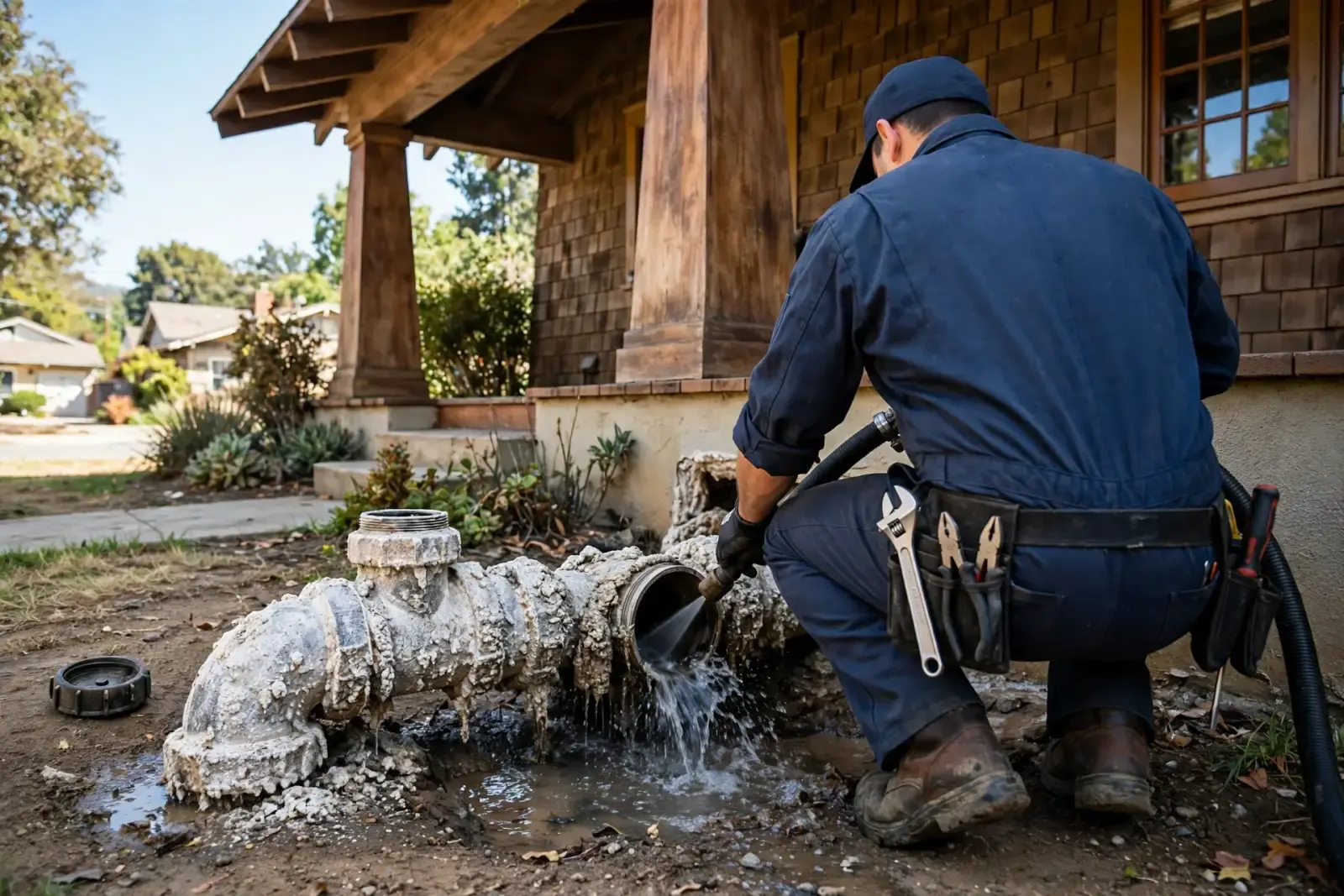
Stockton's water carries a fair load of dissolved minerals, and you can see the evidence on your own fixtures. White crust on a tap or a shower head is mineral scale, and the same crust forms inside your drains.
It settles out whenever water stands in a pipe and dries, laying down in thin layers until the bore narrows and grease and soap find something to grip. Kitchen and laundry lines show it first, because hot water sheds its minerals as it cools.
A cable does nothing for scale. It drills a hole through the blockage and leaves the crust on the walls, so the drain is slow again before the season is out.
The jet strips the wall back to bare pipe. The result lasts longer if the house deals with the cause: a water softener, or a habit of flushing the kitchen line with hot water after dishes.
If the taps show white crust, the drains carry it too — and in an old iron line the scale grips harder, because the iron underneath is already rough.
Hydro jetting in Stockton
The oak in the front yard
Valley oaks, ash, and other shade trees spread wide roots under Stockton yards, hunting for water through the long dry summer. A fine root that finds moisture at a tiny gap in an old clay joint slips inside and thickens, and once it is thick enough it starts catching paper, grease, and waste.
The first sign is often a toilet that gurgles when the washer drains, or a floor drain that backs up after a long shower.
Stockton's Delta soils make the problem worse. The ground stays damp, and a weeping joint is a beacon for roots through the warm months, from late spring into early autumn.
A root-cutting nozzle clears the mass, and the second camera look shows whether the joint still holds water or has opened further. When the same joint fills every year, the lasting answer is to repair that joint, not to wash it again.
Cutting the tree down is rarely the answer. The tree is doing what trees do; the joint is the part that failed.
Hydro jetting in Stockton
July in Stockton: heat and grease
Stockton summers run hot, and heat changes where grease ends up. Cooking grease stays liquid longer in a hot pipe, so it travels further down the line before it sets — often in the main, where it is hardest to reach.
That is why kitchen lines in Stockton clog more in summer than in winter. The long dry season adds a second pressure: the soil pulls moisture from anywhere it can find it, including a weeping sewer joint, which draws roots in while the weather is dry.
Late spring is the time to get ahead of it. A line washed clean in May will carry the house through the hot months without trouble in most cases.
If your kitchen drain slows every summer and eases off in winter, the cause is grease settling further down the line in the heat, and the camera will show you where it sits. A hot-water flush after dishes helps, but it will not shift a coat that has already set on the wall.
Hydro jetting in Stockton
Who runs the water and sewer here
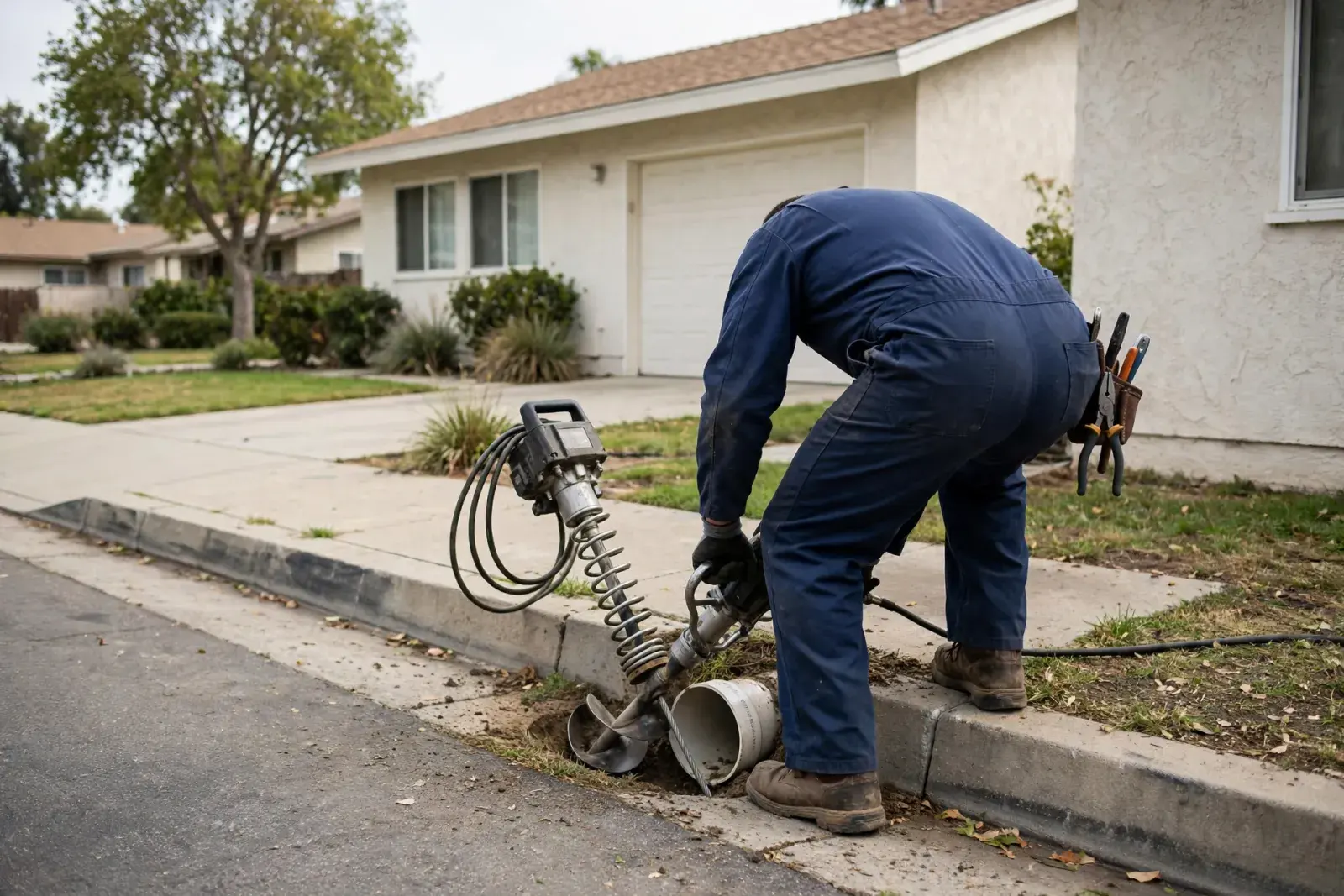
The City of Stockton Municipal Utilities runs the water and sewer system that serves most of the city, and it is worth knowing where the city's responsibility ends and yours begins. The city owns the main in the street and the connection up to your property line.
The lateral — the pipe from your house to that connection — is yours, and so is anything that goes wrong with it. A clog in the lateral is your bill, not the city's, which is why a camera look matters: it shows whether the trouble sits on your side of the line or the city's.
If the camera shows a problem in the street main, the city is the one to call, and a recording of the inspection is useful evidence. If the trouble is in your lateral, jetting is the usual first step.
The utility's own guidance is to keep grease out of drains and to report sewer overflows promptly, because a backup that reaches the street becomes a public health matter. Knowing the boundary saves an argument later: the camera shows the line, the line shows the boundary, and the boundary decides who pays.
Hydro jetting in Stockton
Two lists: call today, watch and wait
Some signs mean call today. Sewage rising through any fixture is one.
Several drains slowing on the same day is another. A toilet that gurgles while another fixture drains is a third.
All three point at the main line, and a main line fault gets worse with every flush. A backup brings wastewater into the house, which is a health problem as well as a plumbing problem.
Stop running water, stop flushing, and call (833) 878-1592 to get an estimate for a camera look and a wash.
One slow fixture is a different matter. When the rest of the house drains fine, the trouble is usually a trap or a short branch, and a plunger may clear it.
Give it a day. Leave chemical drain cleaner on the shelf: it rarely shifts a real blockage, it can damage old pipe, and it leaves the line unsafe for a technician to handle.
If that drain slows again within a few weeks, the cause sits deeper than the trap, and a camera look is the next step.
Hydro jetting in Stockton
An hour and a half in your house
A jetting visit in Stockton takes one to two hours in most cases, and most of that time is the camera, not the washing. The technician starts by asking which fixtures are slow and when it began, then feeds the camera through the cleanout while you watch the screen.
That first look decides the nozzle, the pressure, and how far the hose needs to travel. Nothing gets washed before it has been seen.
The wash itself is quieter than most people expect. The hose slides in, the nozzle sprays backward as it moves forward, and the backward spray both scours the walls and pulls the hose along.
The crew works in stretches, checking the flow at the drains, and giving a second pass to any section the camera flagged. Grease and scale leave through the city sewer, so nothing crosses your floor.
Then the camera goes back in, and the technician shows you the before and after on the screen. The water is ready to use as soon as the crew has tested each fixture.
Hydro jetting in Stockton
The shovel is the line
Nothing from City Hall stands between you and a clean drain. Jetting is maintenance, and the city treats it the way it treats snaking a drain — it doesn't.
You call, the truck comes, the line gets washed, and no inspector ever needs to know. The camera inspection needs no permit either.
The line between 'no permit' and 'permit' is the shovel: the moment a crew has to open the ground, replace a length of pipe, or tie a new connection into the city main, the city wants a permit and an inspection of the finished work.
A small spot repair is a lighter permit than a full line replacement, and the permit cost sits apart from the jetting price. Your plumber should spell out which permits apply before any digging starts, because unpermitted sewer work can come back to bite when you sell the house.
Check first, dig second — and get the permit sorted before the ground is open, not after.
Hydro jetting in Stockton
Stockton against Riverside, Irvine, and the rest
Stockton shares its drain troubles with Riverside and Irvine: the same hard water, the same summer heat, the same grease in kitchen lines, and the same kind of prices for the work. The difference is the ground.
Stockton's Delta soils stay damp and draw roots toward weeping joints, while the southern cities deal with drier ground and different trees, and their root jobs look different on camera.
The contrast is Bakersfield and Oakland. Bakersfield runs hotter and drier, so its grease sets further down the line.
Oakland has older housing and steeper ground, so its lines see more slope trouble and more standing water. Anaheim and Santa Ana sit between the two, with the same hard water and the same kitchen grease.
Inside San Joaquin County, Stockton is the old city, so its plumbers see more mid-century cast iron than their neighbors do — and a camera is the fastest way to find out what yours is made of.
Hydro jetting in Stockton
Garbage disposals and Stockton kitchen drains
A garbage disposal does not make food disappear. It grinds food into small pieces and sends them down the drain, and those pieces settle in the pipe.
In Stockton, where the water is hard and the pipes in older homes are already rough inside, disposal waste builds up faster than most people expect. Grease from cooking, ground-up food, and mineral scale combine into a paste that coats the pipe wall, and the bore narrows a little more every month.
The kitchen sink starts draining slowly. Then it stops draining at all.
A disposal is not a trash can. Coffee grounds, pasta, rice, potato peels, and fibrous vegetables like celery and onion skins are the worst offenders, because they swell with water or tangle into a mat that catches everything behind it.
Bones and fruit pits dull the blades. Grease poured down the drain hardens in the pipe and traps the ground-up food behind it.
The disposal itself rarely breaks. The pipe downstream is what clogs.
If your Stockton kitchen drain slows after years of disposal use, the fix is usually a wash of the kitchen branch, not a new disposal. The spray strips the paste off the walls and returns the pipe to full width.
After the wash, the habits matter more than the machine. Scrape plates into the trash.
Wipe pans before washing them. Run cold water while the disposal runs, and keep it running for a few seconds after the grinding stops, so the pieces flush all the way through.
A disposal used that way can last for years without clogging the line.
A disposal that grinds well and a drain that runs freely go together. When one slows, the other follows.
Signs you may need hydro jetting
- Two or more fixtures slowing on the same day — the main line, not one trap, is the likely cause.
- A toilet that gurgles when the washing machine drains.
- A kitchen sink in Stockton that used to empty fast and now takes its time.
- A laundry drain that spills over mid-spin.
- Downstairs drains slowing while the upstairs still runs fine.
- A sour smell at a floor drain after the house has sat empty for a few days.
- Water climbing in the shower when the toilet flushes.
- A kitchen drain that slows every summer and eases off in winter.
- Damp patches in the yard above the sewer line.
- A cleanout cap that weeps while fixtures run.
- The same drain blocking again a few weeks after a cable cleared it.
How it works
- 1
First, the camera goes in
Before any water flows, the camera travels the line from the cleanout. It maps the grease, the scale, the roots, and the condition of the old iron, and the technician marks the depth and the spot of anything worth noting. You watch the same picture on the screen, so the plan is built on what is actually in the pipe.
- 2
Then the nozzle is chosen for the pipe
The nozzle and the pressure follow the camera picture. Old cast iron gets a gentle pass with a root-cutting head. A grease-coated PVC line takes a wider spray. The hose enters at the cleanout, which keeps the work out of the living space and off your floors.
- 3
The wash works the line in stretches
The hose moves forward a section at a time, the backward spray scouring the walls as it pulls the hose along. The crew checks the flow at the drains as they go, and any stretch the camera flagged gets a second pass before they move on.
- 4
Finally, the camera returns and the fixtures are tested
The camera goes back in to show a clean pipe wall, and each fixture runs to check its flow. The cap goes back on, the area is tidied, and the technician talks through what the camera found and what to watch for next.
Hydro jetting cost in Stockton
What does it cost?
Use these figures as estimates from national ranges, shaped for a typical Stockton house — not a fixed quote. A short branch with light grease sits at the bottom; a long main with roots or heavy scale sits at the top. The camera inspection before work turns the range into a firm number, because it shows the length of the run, the coating on the walls, and the material of the pipe. In Stockton, access, pipe age, and the length of the run to the street move the price most, and a clear cleanout with a short run lands near the low end.
| Service | Typical range (estimate) | Notes |
|---|---|---|
| Main sewer jetting | $350 – $650 | Standard home main line |
| Single fixture line clean | $250 – $500 | A single drain run |
| Severe or commercial jetting | $600 – $1,200 | Severe blockage, long runs |
Prices are estimates only. The local company that does the work sets its own final pricing.
Questions about hydro jetting in Stockton