
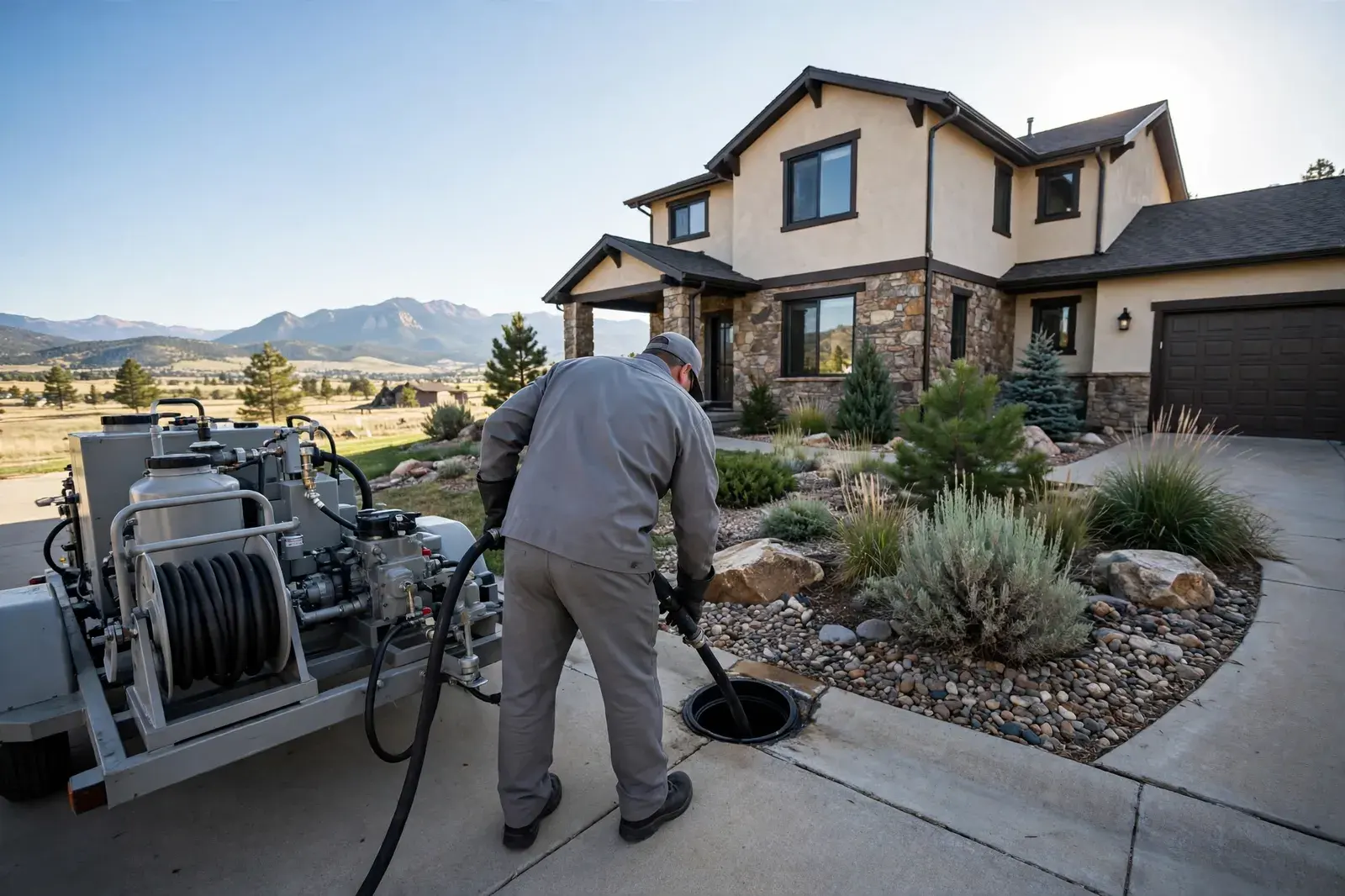
Hydro Jetting in Aurora, CO
Aurora drains clog the way Front Range drains clog: mineral scale from hard water, roots in clay-tile joints, and a winter freeze that shifts the ground. Hydro jetting washes the inside wall of the pipe clean with high-pressure water, so the drain stays open longer than after a cable. Call (833) 878-1592 and start with a camera inspection.
Updated 2026-11-18. Aurora, CO · Arapahoe County · Population 403,130. Prices shown are estimates only.
- 403,130 Population
- Arapahoe County
- 17 ZIP codes served
- Southlands Neighbourhood
Before & after in Aurora
Before & after
Drag the slider to compare the same pipe before and after jetting.
Hydro jetting in Aurora
What you will pay for hydro jetting in Aurora
You can plan around the table below, which lists 2026 national ranges. A branch line is the cheapest job — that is the pipe serving a single kitchen or bathroom.
The main line runs from the house to the street, and it costs more because the hose goes further and the coating is thicker. When roots or a heavy mineral crust fill the pipe, the job lands near the top of the range.
A restaurant line costs more than a home line of the same length.
Your house changes the number in a few concrete ways. If the crew can open a cleanout at ground level in the front yard, setup is quick.
If the only entry is a roof vent or a pulled toilet, the visit takes longer before any washing starts. The pipe material matters too: cast iron from a 1970s home near the old town core needs a gentle jet and several slow passes, while the PVC in a Southlands subdivision takes a stronger jet and finishes sooner.
And a long lateral on a wide southeast lot simply has more pipe to wash than a short one on a tight lot.
Before you book, ask whether the camera inspection is included in the price or billed on its own, and ask for the final figure in writing once the camera has been in the pipe. Nobody can price a pipe they have not seen.
If the camera shows a collapsed section, the work is no longer a cleaning — it is a repair — and you should hear that before any water is turned on. The hydro jetting cost guide explains the ranges in more detail.
Hydro jetting in Aurora
Watching your own pipe on camera
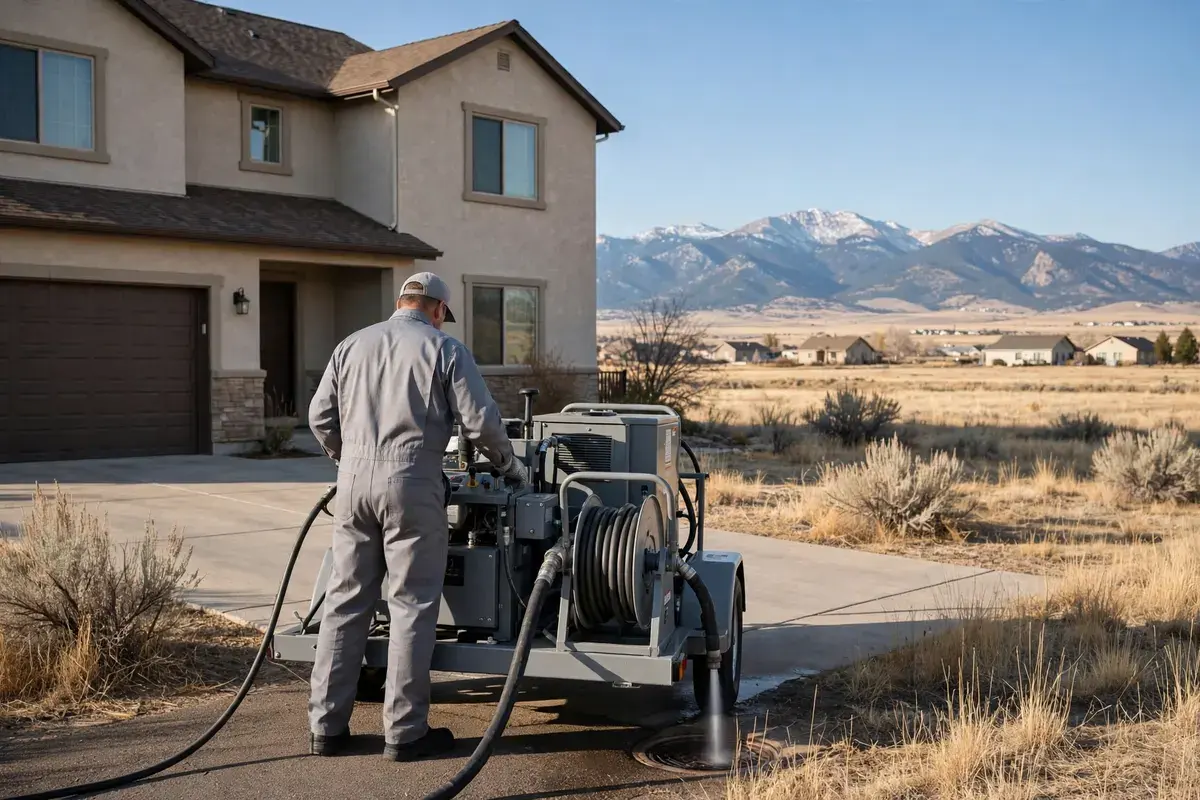
The camera is about the size of a marble, fixed to the end of a flexible cable, and it sends a live picture back to a small screen. In an Aurora kitchen the picture usually shows a pale, waxy film of cooking grease, sometimes with a hard white crust of mineral scale underneath.
In the main line you are more likely to see a dark tangle of roots with paper snagged in it, or a grey shelf of grit sitting where the pipe has sagged.
As the camera travels, the pipe itself comes into view. Cast iron looks rough and rust-brown.
Clay tile shows a joint every few feet. PVC looks smooth and pale.
The technician is watching for three things: a break in the wall, a joint that has shifted open, and a section that holds standing water. A sound PVC line can take a strong jet.
An old cast iron line needs a softer one. A cracked line may need a repair instead of a wash.
The camera head also sends out a signal, so the technician can stand in your yard with a locator and mark the exact spot where the trouble sits. That mark keeps any digging to one hole.
The picture also settles a boundary question: the lateral from your house to the street is yours, and beyond the connection the pipe belongs to the city. Aurora Water handles the water supply.
Keep a copy of the recording — it is the clearest record of your line you will ever have.
Hydro jetting in Aurora
Getting ready for an Aurora winter
January in Aurora is cold enough to freeze a drain. The lines that freeze are the ones nobody thinks about: the pipe through an unheated garage, the shallow lateral under a thin patch of soil, the drain in a crawl space with a vent left open.
Once the water inside turns to ice, the fixture above it stops draining. A plunger will not help.
A cable will not help either, because the blockage is ice, not a clog.
October is the month to prevent it. Wrap the exposed pipes.
Close the crawl-space vents when the cold settles in. Let a faucet on an outside wall drip slowly on the nights the forecast calls for single digits.
And find your main water shutoff now, while the weather is fine — a frozen pipe that splits will pour water the moment it thaws, and the shutoff is the only thing that stops it.
If a line does freeze, hot-water jetting can melt it and wash the pipe at the same time. But a thaw is a rescue, not a fix.
A pipe that froze once will freeze again, and a pipe that froze may have cracked while it was frozen. After the cold snap, run every fixture and watch: a drain that stays slow once the weather warms is sitting over a crack, and a crack is where the roots get in come spring.
The freeze and thaw also heaves the clay under the lateral, loosening joints a little more each winter. A spring camera look, after the ground has settled, will show whether a joint opened.
Hydro jetting in Aurora
The white crust on your showerhead is inside your pipes too
Run a finger over a showerhead in Aurora and you will feel a white, chalky crust that comes back no matter how often you clean it. That crust is mineral scale, left by water carrying dissolved calcium and magnesium.
The same crust forms inside your drains, where you cannot see it — and inside a drain it does more harm than on a showerhead, because it narrows the pipe itself.
Year by year the scale thickens. In an older cast iron line it mixes with rust into a rough, hard lining that can take a visible share of the bore.
Waste catches on that rough surface instead of sliding through, so a scaled line drains slowly even when nothing is blocking it. A cable makes no impression on scale: it bores a hole through the soft clog in the middle and leaves the crust on the walls exactly where it was.
That is why a snaked drain here so often slows down again within a month.
High-pressure water is the tool that actually removes scale. The jet peels the crust off the wall and flushes it out to the city sewer, and the bore comes back to its full width.
A heavily scaled line sometimes needs a second, slower pass. The technician can show you the difference on the camera: before, a grey, narrowed tunnel; after, smooth pipe with the full opening restored.
A water softener will not clean a scaled line, but it will slow the crust from forming again — worth considering once the line is clean.
Hydro jetting in Aurora
Your lateral is riding on moving clay
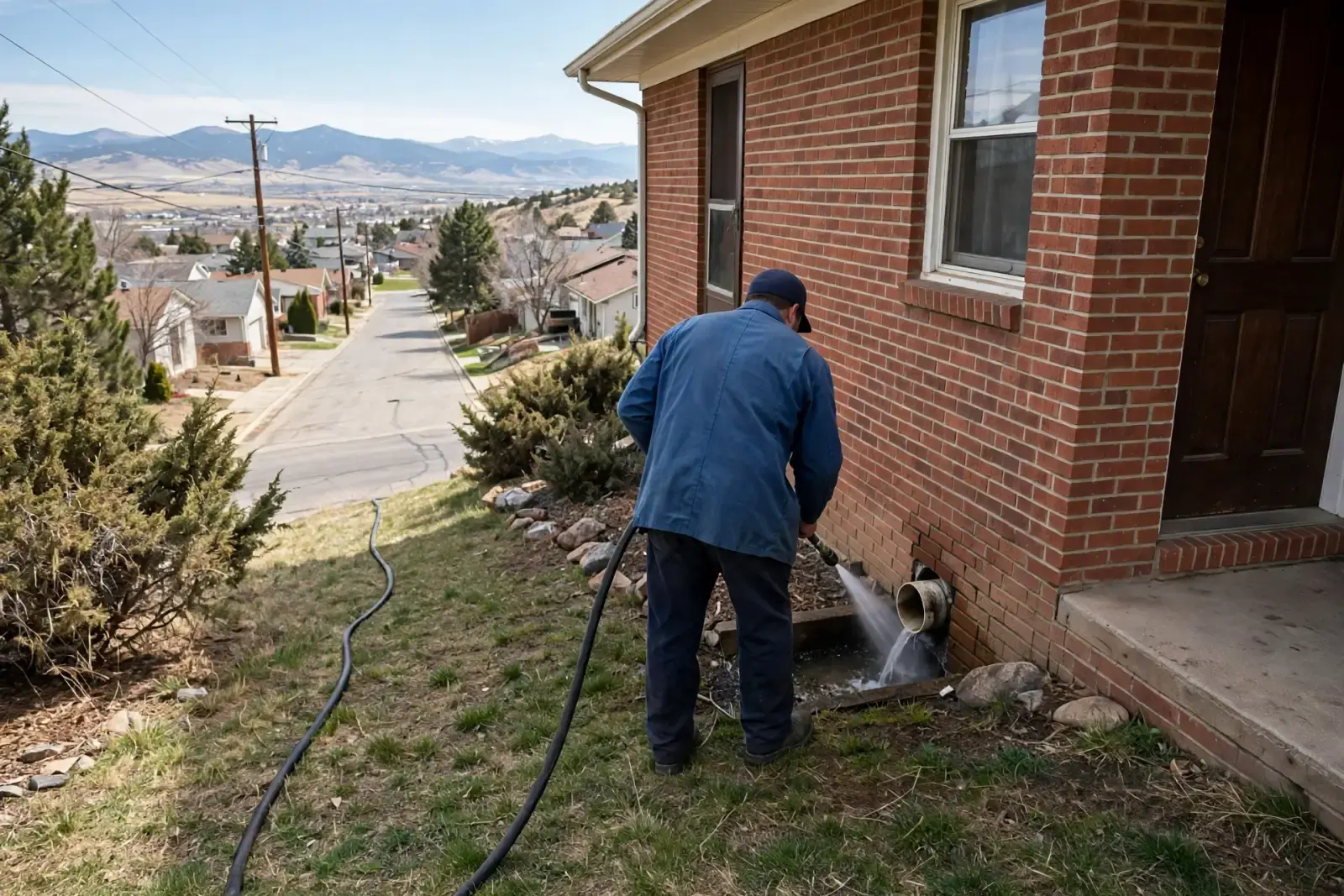
Dig a hole in Aurora and you will find clay — the heavy, sticky kind that swells when it gets wet and shrinks when it dries. A sewer lateral buried in that clay rides the movement: a fraction of an inch with each wet season, a fraction back with each dry one.
The movement is tiny, but it never stops, and over ten or twenty years it does real work on a pipe. Joints in a clay-tile lateral open a hair at a time.
A section settles a little lower than its neighbours and starts holding water instead of passing it along.
That low section is called a belly, and it is where the trouble collects. Water slows as it crosses the belly, and grease and grit fall out of the flow and settle on the bottom.
Over time the deposit grows into a shelf that narrows the pipe from below. A cable punches a hole through the shelf; the shelf stays, and the drain slows again.
Only the jet washes the shelf off the wall — though a deep belly will keep collecting sediment, and sooner or later the honest fix is to dig it up and re-grade that section.
The roots come through the joints. Once a joint opens even slightly, a root tip finds the dampness inside, and the root thickens every year until it is a mat.
The mat catches paper and waste, and the drain slows. A root-cutting nozzle slices the mat and flushes the pieces out, but the joint is still open, so the roots come back.
Plan on a camera look every year or two: catching regrowth while it is thin is a routine wash, while waiting until the drain stops is an emergency call.
Hydro jetting in Aurora
What decade is your Aurora house — and what pipe came with it?
Aurora's building boom ran from the 1960s through the 1990s, and the pipe in the ground follows the decade the house went up. Homes from the 1960s and 1970s usually have cast iron drains inside the house and clay tile outside it, running to the street.
Both materials have had fifty years to age. The cast iron rusts from the inside, which roughens the wall and narrows the bore; the clay tile joints open, which lets roots in.
If your house is from this era and the drains have never been jetted, the camera will almost certainly show a coating worth removing.
Homes from the 1980s onward are a different job. PVC and ABS took over for drains, with glued joints that resist roots and smooth walls that shed grease.
A jetting visit on one of these houses — the kind that fills Southlands and the southeast subdivisions — is usually quick: the camera shows clean plastic, the pressure can run high, and one pass does the work. The troubles in these homes are about use, not age: big households, long laterals on wide lots, and hard-water scale that builds on any material.
Mention the build year when you call. It tells the technician what to expect before the camera goes in, and it sets the pressure before the jet starts.
On an older home, ask to watch the camera screen and ask what pressure is planned — a careful crew will show you the pipe material first and explain the setting. If the camera shows a pipe that is crumbling or flattened, no pressure setting will save it, and a replacement is the right answer.
The recording is your evidence for that decision.
Hydro jetting in Aurora
Should you call now, or can it wait?
Some symptoms can wait a day. A single bathroom sink draining slowly, with every other fixture working fine, is usually a clogged trap — hair and toothpaste at the stopper — and you can clear it by hand.
A kitchen sink that slows after a weekend of heavy cooking may ease with hot water and a strainer in place. In both cases, if the slowness comes back within days, the problem is further down the line, and it is time to call.
Other symptoms should not wait. When two fixtures slow at once — the toilet gurgles while the tub drains, or the shower fills when the washing machine runs — the blockage is in the main line, and a main-line blockage can become a backup into the house with the next load of laundry.
A sewage smell that was not there yesterday, a floor drain holding standing water, or a wet patch in the yard above the lateral are all same-day calls. In Aurora's clay soil, a leaking lateral can wash earth from under a slab or a walk, and the longer it leaks the bigger the repair.
If water is coming up into a tub or a floor drain right now, stop using water, do not flush, and call for emergency hydro jetting. The person who answers will ask which fixtures are affected and whether the trouble started suddenly — those two answers tell them whether a crew needs to come now or whether the visit can wait until morning.
Never pour a chemical cleaner into a line that is backing up: it will not clear a main-line blockage, and it makes the line dangerous for the technician who opens it.
Hydro jetting in Aurora
Your visit, hour by hour
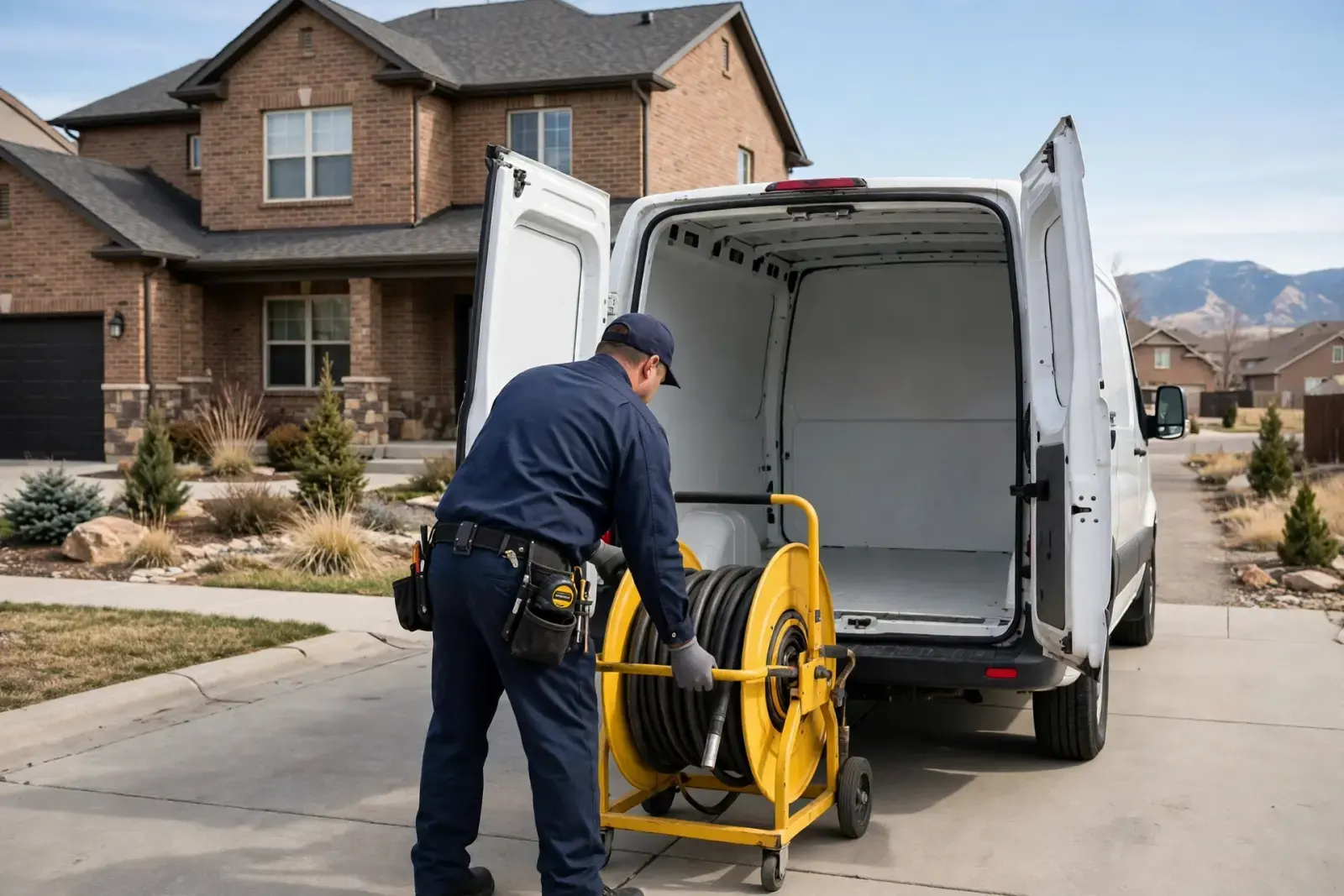
The first half hour belongs to the camera. The technician asks which fixtures are slow and when the trouble began, then feeds the camera in through the cleanout — or, if there is no cleanout, through a roof vent or a removed toilet.
You can watch the screen as the pipe goes by: the coating, the material, the joints, any damage. Then comes a price, given before the jetter is unloaded, based on what the camera actually showed.
The washing itself is the middle of the visit. The jetter is a machine on wheels with a long hose; the nozzle at the end sprays backward as well as forward, so the backward spray pulls the hose along the pipe while it scours the walls.
The technician feeds it in a section at a time and draws it back slowly, watching the drain to see the flow improve with each pass. Pressure is set to the pipe: gentle for old cast iron, stronger for PVC.
The dirty water runs out to the city sewer, and drop cloths keep the floors and the yard tidy.
The last part of the visit is the proof. Water runs through every fixture that was slow, and the camera goes back in so you can see the clean wall on screen — smooth pipe, full bore open, no channel cut through a layer.
The entry point is closed, the area is cleaned up, and the technician tells you what was found and when to look again: roots mean a yearly check, heavy scale means a shorter interval, a belly means watching that one spot. Most Aurora visits take one to three hours from arrival to finish.
Hydro jetting in Aurora
When a cleaning needs a permit in Aurora — and when it does not
A cleaning does not need a permit. Jetting washes a pipe that already exists; nothing is replaced, no new connection is made, and the city does not inspect maintenance work.
If the visit stays a cleaning, there is no paperwork, no waiting, and no inspection.
The permit question comes up when the camera finds damage. Replacing a section of lateral, digging a line up, or tying a new line into the city main is construction, and construction needs a permit from the City of Aurora, with the work done to the city's plumbing code and inspected at the right stage.
Work that crosses a sidewalk or a street needs approval as well, because that ground is public. Be wary of any contractor who offers to replace a lateral and never mentions a permit — unpermitted sewer work can stall a home sale years later, when the buyer's inspector asks for the record.
One more step belongs before any digging: call 811. The utility mark-out is free, and it is required before excavation, because a sewer lateral often crosses gas, electric, water, and telecom lines on its way to the street.
Ask the technician, while the camera is still in the pipe, what happens if the camera finds damage — that way the permit step, the mark-out, and the inspection are all understood before anyone lifts a shovel.
Hydro jetting in Aurora
Keeping the line open after the wash
The cleanest pipe in Aurora will coat again if the habits that coated it do not change, and the kitchen is where most of the coating starts. Wipe pans with a paper towel before they go in the sink, and pour used cooking oil into a sealed container for the trash.
Hot water does not help — it only carries the grease further down the line, where it cools and sticks far from the sink. A mesh strainer catches the food scraps that would otherwise settle in a belly or on a rough cast iron wall.
Outside, the trees are the long-term project. A line that has grown roots once will grow them again, because the joint that let them in is still open.
A camera look every year or two catches the regrowth while it is thin enough for a routine wash. In winter, the job is protection: insulate exposed pipes before the first hard freeze, close the crawl-space vents, and keep a slow drip running on the coldest nights.
A frozen line that splits in January becomes a cracked line by spring, and a cracked line is a root problem by summer.
Skip the chemical cleaners on the store shelf. They cannot dissolve mineral scale, they can eat at old cast iron, and they are a hazard for the technician who opens the line later.
A monthly flush of hot water through each drain, and an enzyme treatment now and then, will do more good. And if a drain slows again within a few months of jetting, call back instead of reaching for a bottle: a fast return usually means a belly or a crack that needs a look, not a chemical.
Signs you may need hydro jetting
- Your Aurora kitchen sink slows down again a few weeks after a cable cleared it — the grease film on the walls is still there.
- Two fixtures slow at once: the toilet gurgles while the washing machine drains, which points at the main line.
- Water climbs into the tub when a toilet is flushed in another room.
- The laundry floor drain holds water after a wash cycle instead of emptying.
- A sewage smell near a drain that gets stronger on hot afternoons.
- A strip of lawn above the lateral stays green and damp while the rest of the yard dries out.
- A previous snaking pulled roots out of the line — the cable cut some and left the mat behind.
- Your house was built before 1980, its cast iron drains have never been jetted, and they run slower every year.
- Drains that act up each spring, after the winter freeze and thaw has shifted the clay soil.
- A shower that stays slow even with a clean trap — scale further down the branch is the likely cause.
- White crust on the showerhead and slow drains in the same house: the same minerals are inside the pipes.
- A basement or lower-level drain that gurgles whenever an upstairs fixture runs.
How it works
- 1
First, the camera goes in
A small waterproof camera travels through the cleanout and shows the blockage, the pipe material, and any damage on a screen. In Aurora this first look sets everything else: the pressure, the nozzle, and whether the pipe can be jetted at all.
- 2
Then the setup matches the pipe
The technician picks a nozzle for the job — one shape for grease, another for roots — and sets the pressure for the material the camera showed. Old cast iron gets a gentle setting; PVC can take more. The hose goes in through the entry point and the work area is covered.
- 3
Then the walls get washed, pass by pass
The hose moves forward a little at a time, and the backward spray scours the wall it just passed. Grease, scale, and root cuttings wash out toward the city main. The technician draws the hose back slowly so no stretch of pipe is skipped.
- 4
Finally, the result is shown, not described
Water runs through the fixtures that were slow, and the camera goes back in so you can see the clean wall yourself. The entry point is closed, the area is tidied, and the technician notes what to watch — a belly, a joint, or roots due for another look.
Hydro jetting cost in Aurora
What does it cost?
Treat these 2026 figures as planning ranges, not a quote. Your Aurora price is set after a camera inspection of the actual line — how long it runs, what it is made of, how thick the buildup is, and how the crew can reach it. A short branch line with a ground-level cleanout sits near the bottom; a long main line with heavy roots or thick mineral scale sits near the top. If the camera shows a collapsed or badly cracked pipe, jetting is not the fix and the conversation changes to a repair. Call (833) 878-1592 after the inspection and the price will be given in writing before any washing starts.
| Service | Typical range (estimate) | Notes |
|---|---|---|
| Full main line wash | $350 – $650 | The usual home job |
| Branch line jetting | $250 – $500 | One sink, tub, or laundry line |
| Severe blockage work | $600 – $1,200 | Heavy coating or commercial use |
Prices are estimates only. The local company that does the work sets its own final pricing.
Questions about hydro jetting in Aurora