
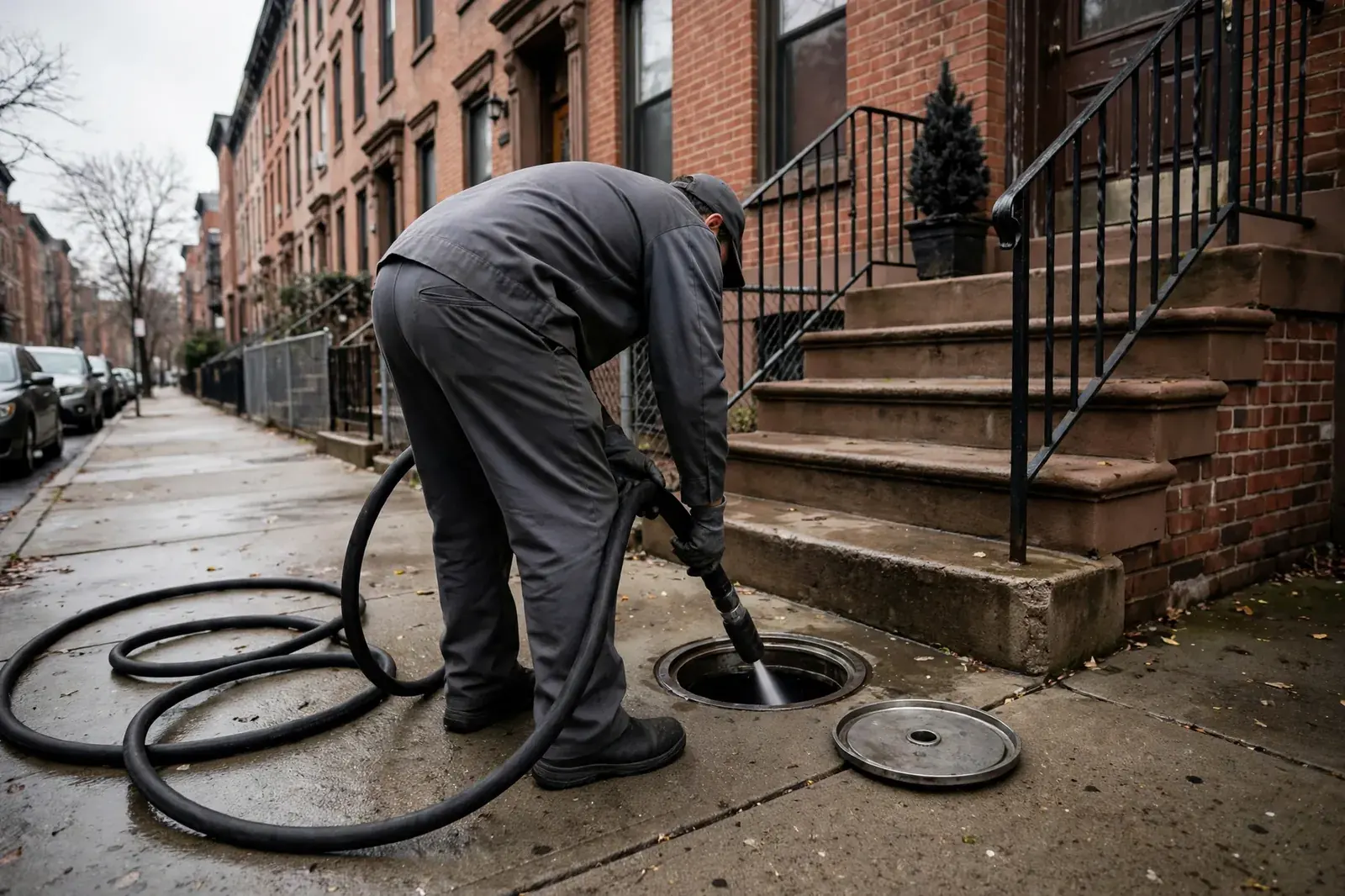
Hydro Jetting in Newark, NJ
In Newark, NJ, hydro jetting uses high-pressure water to scour a drain or sewer pipe clean. Grease, scale, and small roots wash away, and the line drains at full width again. A camera looks at the pipe before and after, so you can see the change. Call (833) 878-1592 to get an estimate.
Updated 2026-11-18. Newark, NJ · Essex County · Population 317,303. Prices shown are estimates only.
- 317,303 Population
- Essex County
- 20 ZIP codes served
- Ironbound Neighbourhood
Before & after in Newark
Before & after
Drag the slider to compare the same pipe before and after jetting.
Hydro jetting in Newark
The basement is where Newark drain trouble starts
Most Newark sewer lines live in the basement. The cleanout is down there, the line runs under the basement floor, and the first sign of a main-line problem often shows up at the basement floor drain — not upstairs.
In a heavy rain, a partly blocked line can push water back up through that drain before any other fixture complains.
That basement position shapes the whole job. The crew works in tight quarters, the hose runs from the basement out to the street, and the camera picture has to cover a line that turns, drops, and runs under concrete.
A basement cleanout also keeps the work contained: the mess leaves through the pipe, not across your living room. When you book, say where the cleanout is and whether the basement is finished — the crew plans around both.
Hydro jetting in Newark
Ironbound rowhouses: a century of iron and grease
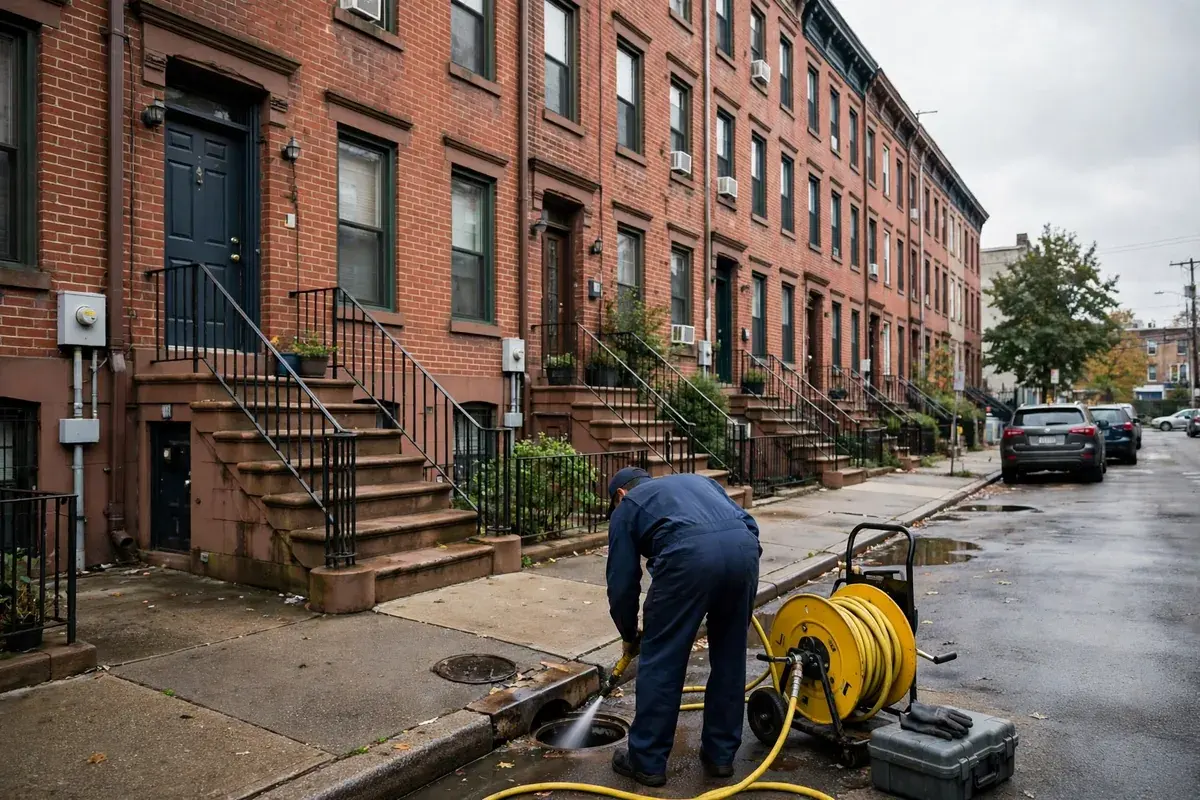
The Ironbound's brick rowhouses date from the early 1900s, and most still drain through original cast iron. After a century, that iron is rough inside.
Rough iron catches grease fast, and the Ironbound's kitchens — where a lot of cooking happens every day — send plenty of grease down the line. A rowhouse with slow drains in several rooms is usually looking at a main line that wants a full wash, not a trap that wants a plunger.
The street adds its own pressure. Narrow streets, parked cars, shared walls.
A sewer problem in one rowhouse can touch the neighbor next door when lines run close together. The camera matters twice over here: it shows whether the blockage sits in your line or further out toward the city main.
Forest Hill faces the same age pattern with larger lots, while the North Ward mixes older rowhouses with newer buildings on PVC lines and simpler grease jobs.
Hydro jetting in Newark
What you pay in a rowhouse
A jetting job in Newark usually falls between $250 and $650. A single slow drain is $250 to $500.
A full main line is $350 to $650. Heavy buildup or commercial work runs $600 to $1,200.
Those are estimates from national ranges, shaped for a Newark rowhouse — not a fixed quote. What turns the range into a firm number for your house is the camera inspection at the start: it shows the length of the run, the coating on the walls, and the material of the pipe.
Rowhouses add their own costs, and they are all about access. A line reached only through a basement cleanout or a pulled toilet takes extra time, and the crew works in tight quarters under a low ceiling.
Iron that has thinned over a century has to be worked slowly, with a gentler nozzle. Narrow streets and scarce parking slow the setup, because the truck cannot always park at the curb.
Before any hose goes in, ask for the price in writing, and ask the technician to show you the camera picture that supports it. A number that matches the picture is a number you can trust.
Hydro jetting in Newark
What the camera sees in a rowhouse
Most Newark sewer lines run under a basement floor and out to a narrow street, and the camera is the only way to see what is happening down there without opening the ground. The lens travels from the basement cleanout, and the picture it sends back usually shows one of four things: a gray-brown coat of grease, a pale crust of scale, a tangle of fine roots at a joint, or a stretch of cast iron gone rough and thin with age.
A locator above ground marks the depth and the spot, so the crew can point at the sidewalk and say the trouble is here, six feet down, without digging in the wrong place.
Each picture leads somewhere different. Grease and scale lift off under the jet, and the bore opens again.
Roots cut away, but the tree keeps growing, so the question is whether a wash every year or two will keep up, or whether that joint wants a repair. A low spot in the line will hold water again a few weeks after washing, which tells you cleaning alone cannot fix it.
A split or caved stretch needs a repair, and in Newark that repair may run under a sidewalk or a street, which changes the job entirely. Looking first means the money goes to washing only when washing is the fix.
Newark on Wikipedia has background on the city's neighborhoods and history.
Hydro jetting in Newark
Rowhouses from another century
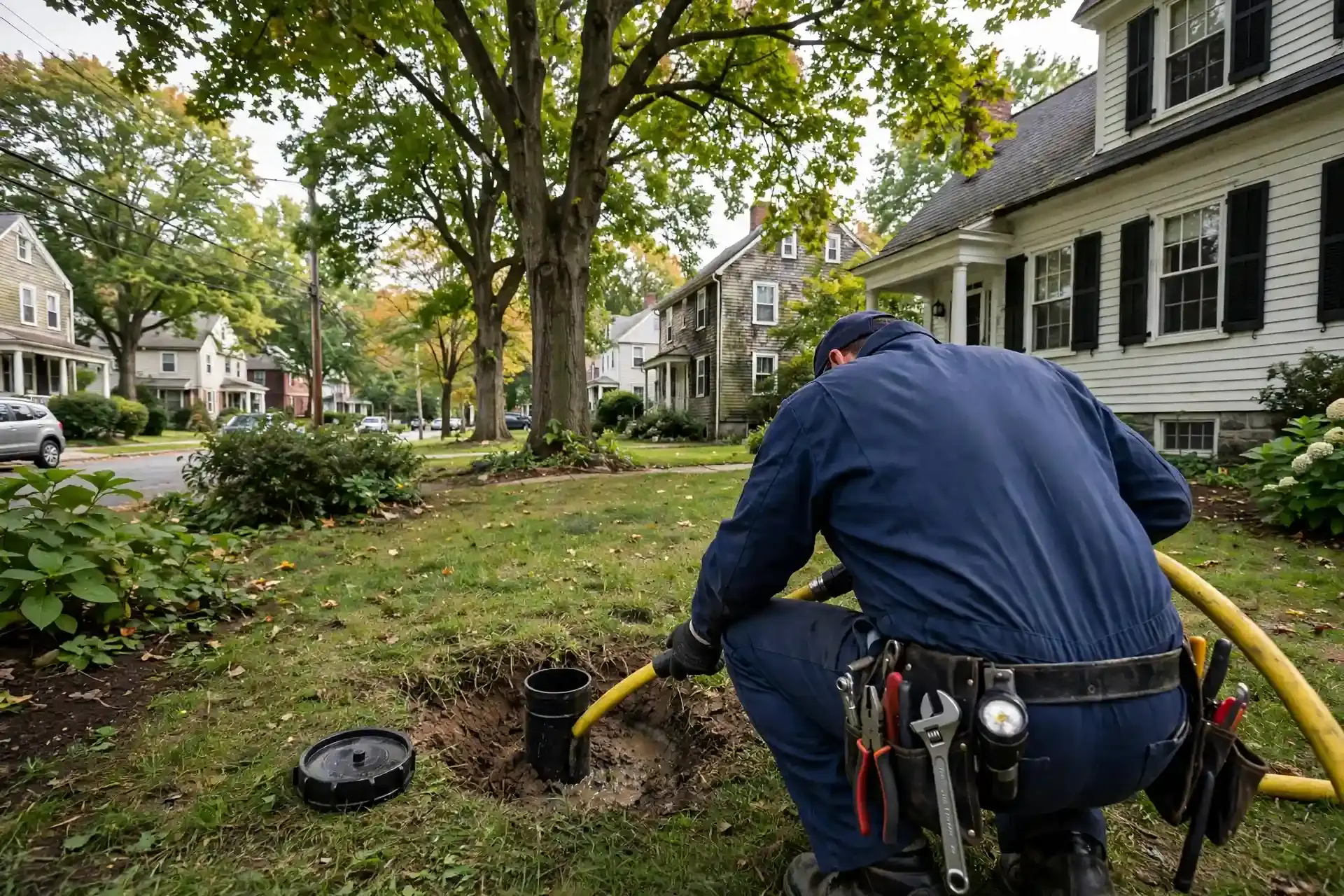
The brick rowhouses built before 1940 clog most — the Ironbound, Forest Hill, the North Ward. Many still drain through the pipe they were built with, cast iron or clay tile.
After eighty-plus years, the bottom of a cast iron pipe can be thin and rough, and a rough wall snags grease and paper far more readily than a smooth one. Clay joints ease open over the years and admit fine roots.
A rowhouse from that era with slow drains in more than one room is a strong candidate for a full wash, and a camera look first is essential, because century-old iron can hide a thin spot.
The outer neighborhoods run newer, mostly PVC, and PVC stays slick inside, so roots cannot get a grip. Those houses clog too, but it is usually grease, soap, or lint, and a standard wash takes care of it.
PVC takes a normal pass without complaint. Old iron needs a softer touch, because a hard spray can break through a wall that has gone thin.
The year on the deed tells you something, but it does not settle the question. A 1920s rowhouse with a replaced line can out-drain a 1970s house where grease has gone down the sink nightly for years.
Hydro jetting in Newark
The water in a brick rowhouse
Newark's water comes from the city's own reservoirs through the Newark Water and Sewer system, and it is moderately hard. You can see it on your own fixtures: a white crust on a tap, a film on a shower head.
That crust is mineral scale, and it forms inside your drains the same way it forms on your taps. It settles out whenever water stands in a pipe and dries, laying down in thin layers until the bore narrows and grease and soap find a grip.
Kitchen and laundry lines show it first, because hot water gives up its minerals as it cools.
A snake is useless against scale. It punches a passage through the clog and the mineral coat stays exactly where it was, so the drain tightens up again within months.
The jet takes the whole wall back to bare pipe. The clean holds longer when the house deals with the cause — a softener, or a regular hot-water flush of the kitchen line.
If your fixtures show white crust, your drains carry it too, and in an old iron line the scale grips harder, because the iron beneath is already rough.
Hydro jetting in Newark
Street trees and Newark sewers
Newark's yards are small, but its street trees are big. Maples, oaks, and other city trees spread roots under sidewalks and front yards hunting for water.
When a fine root finds moisture at a tiny gap in an old clay joint, it thickens inside the pipe and starts catching paper, grease, and waste. A toilet gurgling while the washer drains is often the first clue.
A basement floor drain backing up after a long shower is another.
The risk gathers in the oldest districts, where clay lines have had decades to open at the joints and the street trees are fully grown. Newark's soil — glacial till mixed with urban fill — holds water near a weeping joint and draws roots in.
A root-cutting nozzle clears the mass, and the second camera look shows whether the joint still holds. When the same joint fills every year, the durable answer is a repair of that joint.
Felling the tree is rarely needed, and a street tree usually belongs to the city anyway. The joint is the part you can actually fix.
Hydro jetting in Newark
How long before it comes back
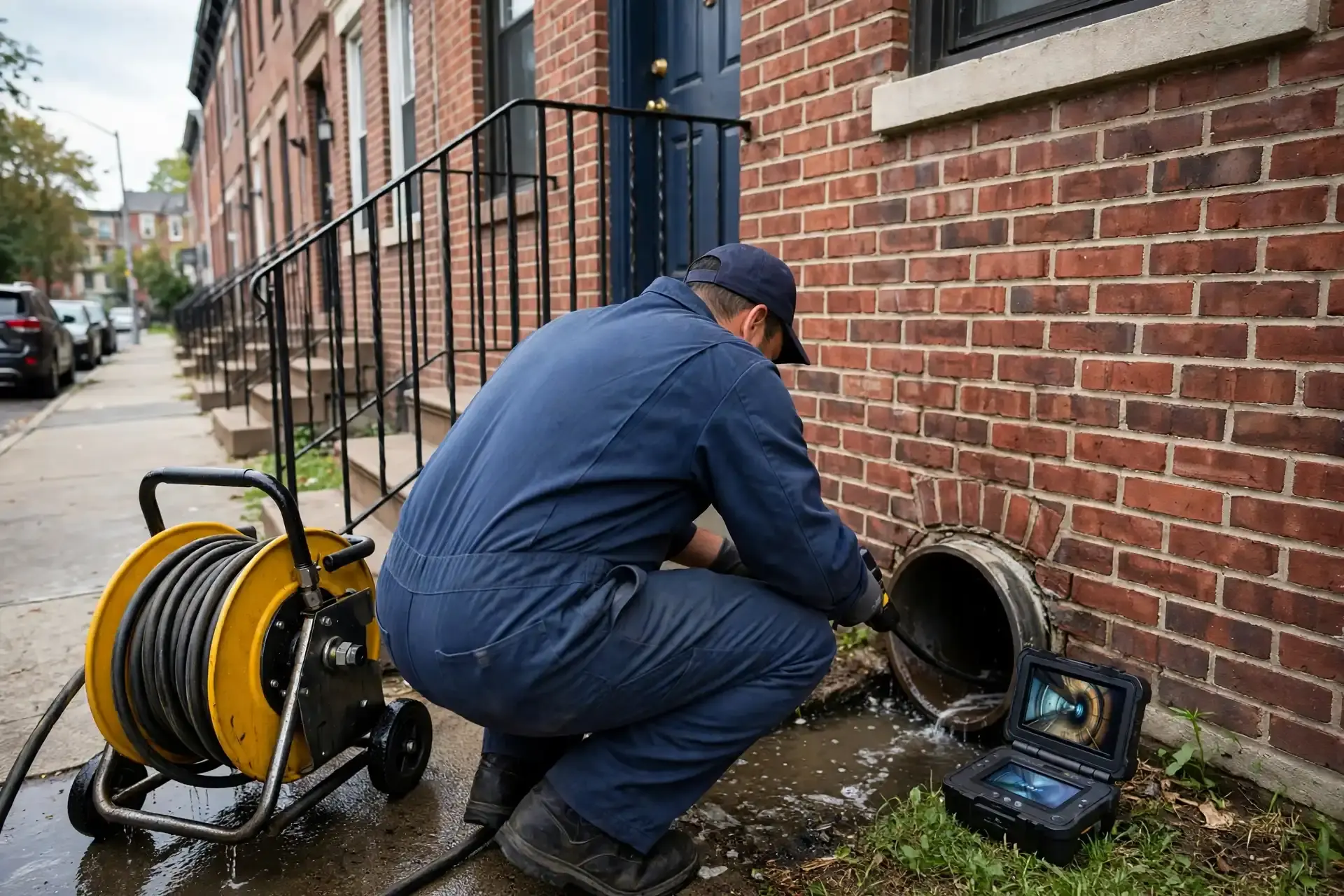
After a wash, a Newark line stays clear for one to three years, and the spread comes down to the pipe and the habits. A grease-coated PVC line in a newer house can stay clear for years once the kitchen changes — wipe the pans, keep grease out of the sink, run hot water after dishes.
An old cast iron line in a rowhouse may want another wash sooner, because the rough iron catches grease again quickly and roots grow back through the same joint. The camera reading after the wash tells you which house you live in.
A line that needs washing twice in one year is telling you something else is wrong. A spot repair or a line replacement usually costs less over time than washing the same stretch again and again.
A short camera check every year or two costs far less than an emergency backup call, and it catches a root mass while it is still small enough to cut out easily.
Hydro jetting in Newark
Newark winters: freezing pipes, thaw backups
Newark winters are cold enough to freeze pipes, and the risk is real for the parts of the system that sit shallow or exposed. Buried sewer lines below the frost line usually keep flowing, because the ground insulates them and wastewater carries warmth.
The danger sits in basement lines, exposed pipes, and cleanouts near the foundation, where cold air reaches the pipe. A line already narrowed by grease or scale freezes faster, because slow water gives up its heat sooner.
Spring brings the second test. Heavy rain and snowmelt send a rush of water through the drains, and a partly blocked line shows its weakness then.
A basement floor drain backing up during a thaw usually points to a main line that wants a wash, not to the snow itself. Autumn is the time to act: a camera look and a wash before the first hard freeze.
A line clean in October usually carries the house through winter and the spring rains without trouble. Insulating exposed basement pipes and keeping the basement warm helps, but a clean line is the real protection.
Hydro jetting in Newark
The basement test
In a Newark rowhouse, the basement floor drain is the test. It sits lower than every other fixture, so when the main line is restricted, wastewater has nowhere to go but up through that drain.
A basement floor drain backing up in heavy rain or a spring thaw is a main line warning, not a floor drain problem. Sewage rising through any fixture is the same warning.
Several drains slowing on the same day is another. All three mean the main line, and the main line does not get better on its own.
Stop the water, stop flushing, and call (833) 878-1592 to get an estimate and a camera look.
One slow fixture is a different matter. When the rest of the house drains fine, the trouble is usually a trap or a short branch, and a plunger may clear it.
Give it a day. Leave chemical drain cleaner on the shelf — it seldom moves a real blockage, it can harm old pipe, and it leaves the line unsafe for a technician to touch.
If that drain slows again within a few weeks, the cause is deeper than the trap, and a camera look is the next move. One slow sink can wait a day.
A basement backup cannot — and never when the floor drain is involved.
Hydro jetting in Newark
A visit to a rowhouse
The crew arrives and heads for the basement, because that is where the cleanout usually is in a Newark rowhouse. The technician asks which fixtures are slow and when it started, then feeds the camera through the cleanout while you watch the screen from the basement stairs.
That first look decides the nozzle, the pressure, and how far the hose needs to travel. Nothing gets washed before it has been seen.
The washing itself makes less noise than most people expect. The hose goes in, the nozzle sprays backward as it moves forward, and that backward spray scours the walls while pulling the hose along.
The crew works in short stretches and checks the flow at the drains, giving a second pass to any section the camera flagged. Grease and scale leave through the city sewer, so nothing crosses your living room floor.
Then the camera goes back in, and you see the before and after on the screen. The water is ready to use as soon as the crew has tested each fixture, and most Newark visits take one to two hours.
Hydro jetting in Newark
The city's say
Washing a drain needs no permit in Newark. It is maintenance, not construction: no pipe is cut, no trench opens, nothing about the system changes.
You book it and have it done the same week, with no paperwork from the city. The camera inspection needs no permit either.
Digging is a different matter. Replacing a section of line, opening a trench, or tying a new line into the city main needs a City of Newark permit and an inspection of the finished work.
Work under a sidewalk or a street may need extra approvals, because the city owns the ground there. A small spot repair is a lighter permit than a full line replacement, and the permit cost sits apart from the jetting price.
Your plumber should spell out which permits apply before any digging starts. Unpermitted sewer work can come back to bite when you sell the house, so check first and dig second.
Hydro jetting in Newark
Newark against Jersey City, Elizabeth, and the rest
Newark shares its drain troubles with Jersey City and Elizabeth: old brick housing, cast iron lines, narrow lots, and the same freeze-thaw winters. The jetting work is the same in all three, at the same kind of prices, though the work often takes a little longer here because basement access is tight and the iron is old.
The contrast is Edison and Woodbridge, where newer suburban housing and more PVC lines mean fewer root and scale jobs and more plain grease washes. Paterson shares Newark's older housing pattern, while Lakewood runs newer on average.
Inside Essex County, Newark's combined sewer system in the older districts means heavy rain can push the system hard, so a partly blocked line shows its weakness during a storm rather than on a dry day. That is one more reason the camera earns its keep here — it finds a blockage before the next big rain does.
Hydro jetting in Newark
Combined sewers: what Newark homeowners need to know
Much of Newark, including the Ironbound, drains through combined sewers — a single pipe that carries both sewage and stormwater. When it rains hard, the combined sewer fills with rainwater as well as sewage, and a line that is already narrowed by fat or roots can back up into the basement.
The basement floor drain is the first place a backup shows up, because it is the lowest point in the house.
A combined sewer means your drain is connected to the street in a way that a separate sewer is not, and it means heavy rain is a test of your line every time it falls. A camera look shows whether the line is clear enough to carry the extra water, and a wash before the rainy season keeps it clear.
If your basement backs up every time it rains hard, the cause may be a clog in your line, or it may be the combined sewer surcharging from the street. The camera tells the two apart, because the fix depends on which one it is.
Signs you may need hydro jetting
- Several fixtures slowing on the same day — that points at the main line, not one trap.
- A toilet that bubbles when the washer drains.
- A kitchen sink in the Ironbound that drains slower every month.
- A basement floor drain that backs up when it rains hard.
- A laundry drain that overflows during the spin cycle.
- Downstairs drains that lag while upstairs runs fine.
- A sour smell rising from a basement floor drain.
- Shower water climbing when the toilet flushes.
- A damp patch in the front yard, right over the sewer line.
- A cleanout cap that drips while water runs elsewhere in the house.
- A drain that slows again a few weeks after a snake cleared it.
How it works
- 1
First look
The camera travels the line from the cleanout, often in the basement, before any water flows. It maps the grease, the scale, the roots, and the condition of the old iron, and the technician marks the depth and the spot of anything worth noting. You watch the same picture on the screen, so the plan is built on what is actually in the pipe.
- 2
Pick the nozzle
The nozzle and the pressure follow the camera picture. Old cast iron gets a gentle pass with a root-cutting head. A grease-coated PVC line takes a wider spray. The hose enters at the cleanout, which keeps the work contained in the basement.
- 3
Wash it through
The hose moves forward a section at a time, the backward spray scouring the walls as it pulls the hose along. The crew checks the flow at the drains as they go, and any stretch the camera flagged gets a second pass before they move on.
- 4
Prove it clean
The camera goes back in to show a clean pipe wall, and each fixture runs to check its flow. The cap goes back on, the area is tidied, and the technician talks through what the camera found and what to watch for next.
Hydro jetting cost in Newark
What does it cost?
Think of these numbers as a starting point, not a quote. They come from national ranges, adjusted for a Newark rowhouse. A short branch with light grease is the cheapest job; a long main with roots or heavy scale is the dearest. The camera inspection is what turns the range into a number you can hold onto, because it shows how long the run is, what coats the walls, and what the pipe is made of. In Newark, the price moves most with basement access, with the age of the pipe, and with whether the work runs under a sidewalk. A cleanout you can reach easily, and a short run, keeps the price near the bottom.
| Service | Typical range (estimate) | Notes |
|---|---|---|
| Main drain jetting | $350 – $650 | Common for homes |
| Single fixture line clean | $250 – $500 | One sink, tub, or laundry line |
| Severe blockage work | $600 – $1,200 | Long runs and heavy buildup |
Prices are estimates only. The local company that does the work sets its own final pricing.
Questions about hydro jetting in Newark