
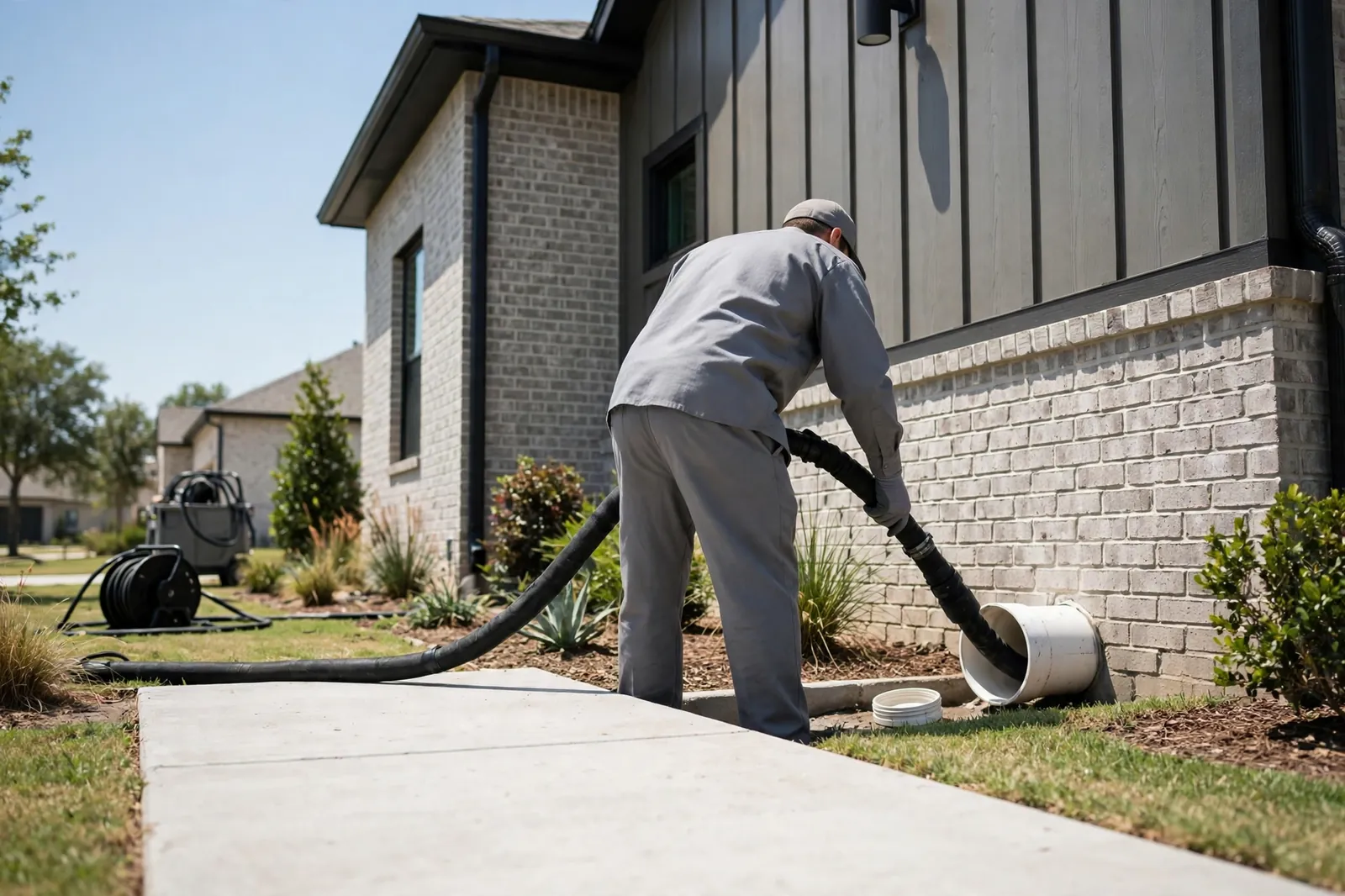
Hydro Jetting in Irving, TX
For a home in Irving, TX, hydro jetting is the fix when several drains slow down together and a cable clearing only helps for a few weeks. A high-pressure water stream scours grease, soap film, and root threads off the whole inside of the pipe, so the line drains at full width again. Call (833) 878-1592 to book a visit in Irving.
Updated 2026-11-18. Irving, TX · Dallas County · Population 258,060. Prices shown are estimates only.
- 258,060 Population
- Dallas County
- 12 ZIP codes served
- Las Colinas Neighbourhood
Before & after in Irving
Before & after
Drag the slider to compare the same pipe before and after jetting.
Hydro jetting in Irving
Expansive clay soil: Irving's quiet pipe problem
The ground under Irving is the city's least visible plumbing problem. North Texas black clay swells when it soaks up rain and shrinks when a dry summer bakes it, and a sewer line buried in that soil rides every cycle.
A joint opens a fraction of an inch here, a straight run settles into a shallow dip there, and over years of wet and dry seasons, a pipe that was laid level ends up with a belly where solids collect.
A belly hides well. The drain keeps working, only slower, and the slowness shifts with the weather: worse after a long dry spell, a little easier after steady rain.
On camera the story is plain, because water stands in the low stretch while the rest of the line runs clear. Jetting empties the belly, but the dip remains, so a deep belly needs a schedule and a plan, not a single cleaning.
Las Colinas shows the clay problem at its largest. The lots are wide, the runs to the street are long, and the trees have had decades to grow.
A long run crosses more joints than a short one, and every joint is a place where clay movement can open a gap and a root can slip in. A camera map that lists each joint and its state is worth more than a guess about which tree is responsible.
Hydro jetting in Irving
What a camera inspection finds in Irving drains
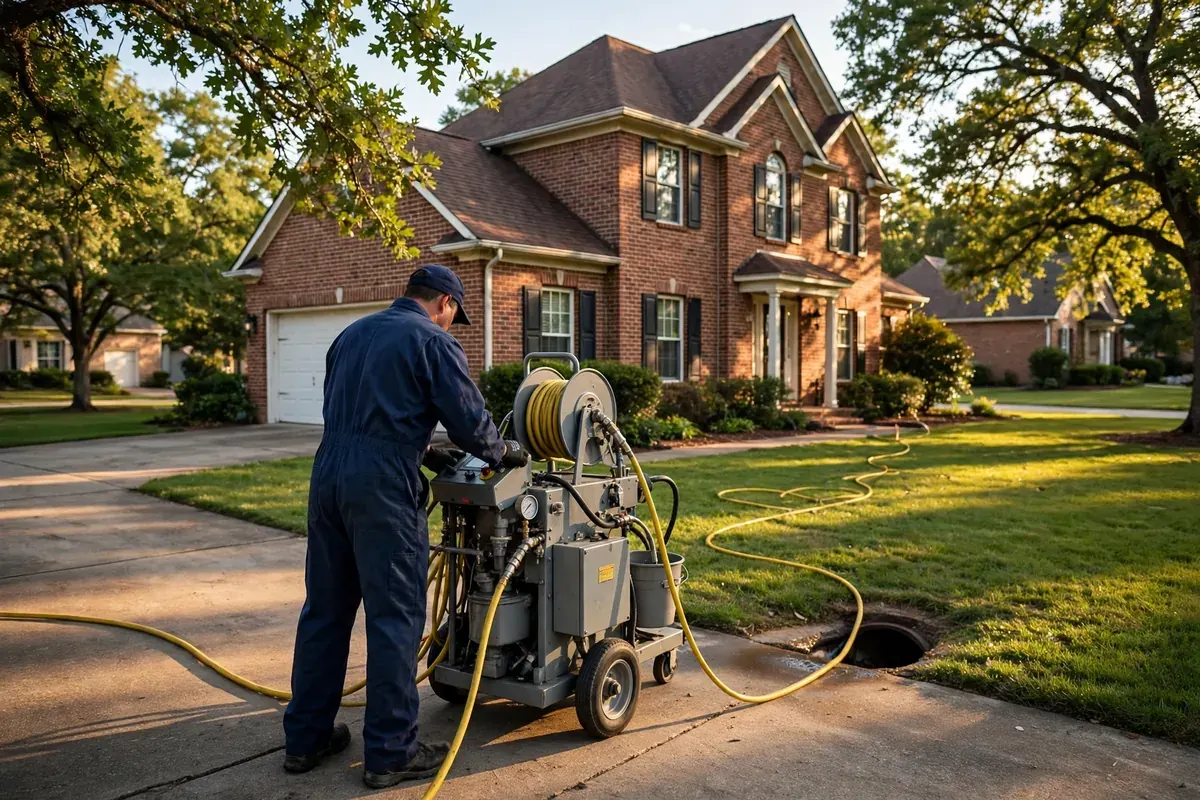
Three things show up on an Irving camera screen, and the order they appear in tells the story. First comes the coating: grease on the kitchen branch, a grey mat of soap and hair in the bathroom branches, or a rough pale crust of scale where hot water runs.
Second comes the shape of the pipe: a belly where water stands, or a small step where one section sits lower than the next because the clay has shifted it. Third comes the material itself: cast iron gone rough and pitted, or PVC that still looks smooth after decades.
The step matters most, because it is the finding jetting cannot fix. Paper catches on that lip every time it passes, and no amount of water pressure will level the pipe.
A homeowner who knows about the step can weigh a spot repair at that one joint instead of booking a cleaning every few months. Without the camera, the same homeowner would keep paying for cleanings that never hold.
The technician reads all three layers on the monitor, notes the distances, and then sets a nozzle and a pressure that fit the pipe in front of them rather than a generic setting. A root mat gets a cutting head first.
Aged iron gets a gentler pressure. Sound PVC gets a firmer one.
The camera is what turns those choices from guesses into decisions, and the recording is worth keeping: a year later, the same distances can be checked again to see how fast things are changing.
Hydro jetting in Irving
How much does hydro jetting cost in Irving, TX?
For an Irving home, the usual numbers are $350 to $650 for a main drain jetting, $250 to $500 for a single branch, and $600 to $1,200 for heavy or commercial work. Those are the ranges in the table below, and they cover the normal job: camera look, cleaning, and a second look to confirm.
A short kitchen branch with a light grease coat sits low; a long main line under a big Las Colinas lot, packed with roots, sits high.
Price moves with access, length, and soil movement above all. A cleanout in the front yard keeps the visit short.
A line that can only be reached by pulling a toilet or going through a roof vent adds time and care, and a line with a shifted joint or a belly needs slower, gentler passes. The camera findings set the rest: a root mat needs a cutting head first, and a heavy scale crust needs more passes than a thin grease coat.
Ask for the figure in writing before work begins, with the camera inspection shown as its own item. When two quotes differ by a lot, ask each plumber what the camera showed and what nozzle and pressure they plan to use.
A quote that skips the camera is guessing, and a quote that skips the after-look leaves you with no proof the line is clean. The written total should cover the visit, the cleaning, and the confirmation look, with no surprise add-on at the end.
Hydro jetting in Irving
Hard water and scale in Irving homes
Start in the kitchen, because that is where Irving scale does its work. The dishwasher and the sink send hot water down the same short branch several times a day, and each pass leaves a little mineral behind.
Irving's supply carries a noticeable load of calcium and magnesium, so the inside of that branch slowly grows a hard, pale crust. The crust is rough, and roughness is the problem: grease that would slide down a smooth wall sticks to a scaled one, and soap film sticks beside it.
Month by month, the bore narrows. The sink drains a little slower, then the dishwasher leaves a little water behind, then the branch starts gurgling.
A cable run through it drills a hole in the middle and leaves the crust on the walls, so the drain narrows again within weeks. It is a temporary fix for a permanent coating.
A jet takes the crust off the whole circumference, leaving a smooth wall that grease cannot grip. After the job, the kitchen drain stays open far longer, and the habit that keeps it that way is a camera look once a year with a jetting while the coat is still thin.
Shorter visit, smaller bill, and no emergency call. The U.S. Geological Survey explains water hardness in plain terms for readers who want the background on mineral content.
Hydro jetting in Irving
When Irving drains need help now, and when they can wait
Think in three timeframes. Today: water coming back into a tub, a shower, or a floor drain; a toilet that will not flush while the other fixtures are slow; a sewage smell that is strong and getting stronger.
Those mean the main line is close to fully blocked, and every flush adds water with nowhere to go. Stop using water, do not keep flushing to test it, and call (833) 878-1592 the same day.
This week: one slow fixture with no smell and no backup. A bathroom sink that drains slowly on its own is often hair and soap near the trap, and a plunger or a careful hand cleaning may sort it out.
Watch the rest of the house while you wait: if the tub starts slowing too, or the toilet gurgles when the washer drains, the trouble has moved from one fixture to the main line, and the booking moves from this week to today.
This month: the drain that was cleared a month or two ago and is slow again. That repeat pattern is the clearest sign of a coating or a root mass that a cable only partly removed.
It deserves a booking even though nothing has backed up yet, because waiting turns a planned cleaning into an emergency visit. A camera look plus a jetting now is the cheaper path, and it leaves a record of what the line holds.
Hydro jetting in Irving
Las Colinas and Irving's older streets: two different drain stories
Las Colinas grew up around offices, apartments, and planned single-family streets, and its homes often sit on larger lots with long sewer runs and mature landscaping. A long run means more joints, and each joint is a place where Irving's clay can shift and a root can enter.
The trees there have had decades to grow, and their roots have had the same decades to find the lines. A homeowner in Las Colinas gains the most from a camera map that lists every joint and its condition, so a cleaning can be scheduled before a root mat blocks the line.
The older parts of Irving, closer to the historic downtown and the early subdivisions, tell a different story. Homes there were often built in the 1950s through the 1970s, and many still have cast iron drains that have corroded from the inside for half a century.
The bore narrows, the wall thins, and a camera shows a rough, flaking surface. Jetting can still help when the iron is sound, but the pressure must be set low and the nozzle chosen with care, and a badly thinned section needs a repair rather than a cleaning.
Between those two poles are the 1980s and 1990s subdivisions, mostly PVC, where the usual trouble is grease and scale rather than a failing pipe. The lesson is the same in every part of town: the age of the house and the material of the pipe decide what the camera should look for, and the camera decides what the jet should do.
A quote that ignores the house's age is a quote built on a guess.
Las Colinas is the newer half of the story. Its streets are lined with office towers, apartment blocks, and homes built in the last few decades, so the laterals are usually PVC, the cleanouts are easy to find, and the runs are straight.
The drains there clog from grease, soap, and fast-growing trees, the same as anywhere, but the pipe itself is young. The older streets tell the other half: homes built in the 1960s and 1970s with cast iron inside and clay tile outside, joints that have opened over decades, and oaks that have had fifty years to spread their roots.
A camera reads both stories the same way, and the technician sets the pressure from what it shows, gentler for aged iron, firmer for sound plastic.
Hydro jetting in Irving
What happens during an Irving jetting visit
Here is the visit in order. First, questions at the door: which fixtures are slow, how long it has been going on, and whether anything has backed up.
Second, the cleanout: the technician locates the capped pipe, most often in the front yard or near the foundation, and sends a camera in toward the street. You can watch the monitor as the camera passes each joint, and the technician points out grease, scale, roots, or a shifted joint as they appear.
Third, the choice: nozzle and pressure, set from the camera map. A root head goes first when a root mat blocks the way, and a wide spray head follows to wash the walls clean.
The hose enters through the cleanout, and each pass carries it a little further down the line, with the loosened coating flushed out by the same water that lifted it. Splash protection goes down at the cleanout, and the work area is left tidy.
Fourth, the proof: a second camera run and a test of every fixture that was slow. The after-look should show clean walls along the full jetted length, and each sink, tub, toilet, and laundry drain should run at full speed.
Before leaving, the technician explains what was found, what the line looks like now, and when to have it checked again. If a shifted joint or a sag appeared on the camera, you will hear about it in plain words, with the distance from the cleanout noted so any repair quote can be exact.
Hydro jetting in Irving
Do Irving jetting jobs need a permit?
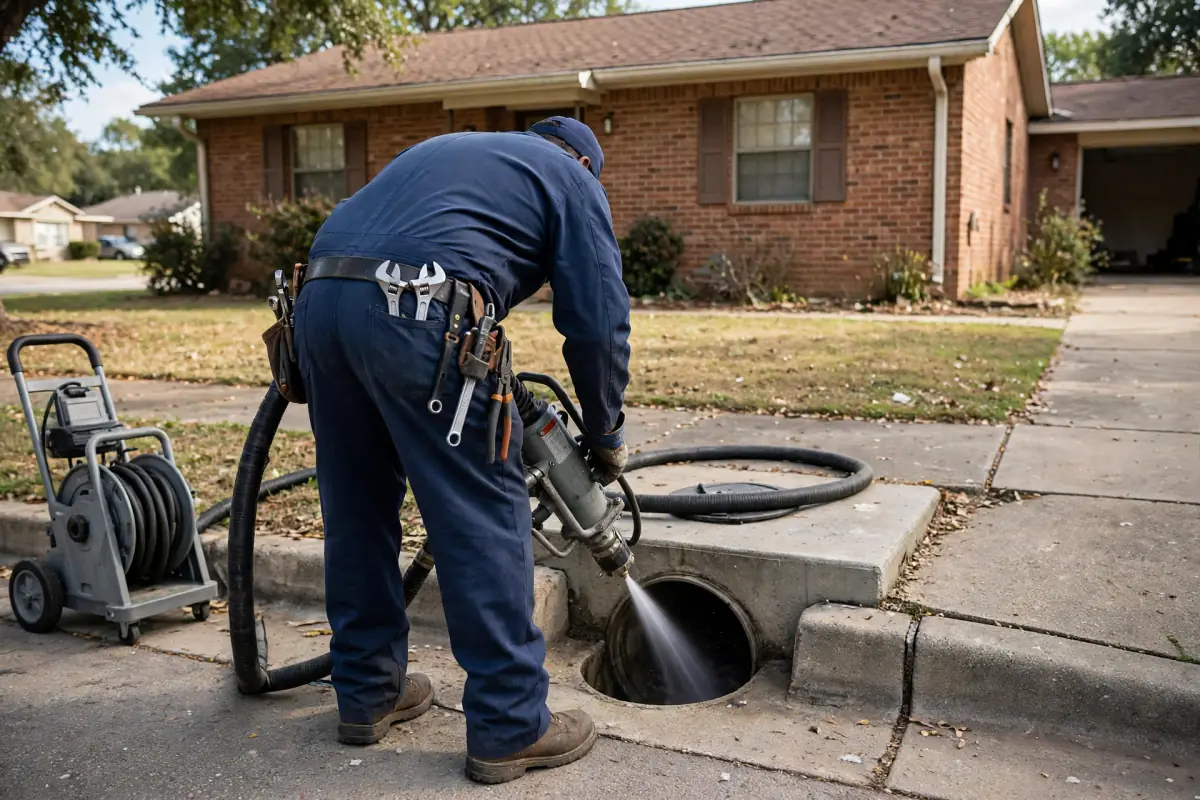
Short answer: a cleaning does not, a repair might. Jetting uses water and a cleanout that already exists, changes nothing about the pipe or the house, and makes no new connection to the city sewer.
The City of Irving treats that as maintenance, so most visits are a single appointment with the invoice as the only paperwork.
The permit question belongs to the plumber, not the homeowner, when a repair is needed. Replacing a section of sewer line, digging in a yard to reach a broken joint, or changing the connection at the street is construction work, and the city generally requires a permit for it.
In practice the plumber pulls the permit: the application, the description of the work, and the inspection once the work is finished are part of the job, and the homeowner's part is to make sure the permit is named on the quote.
Why does that matter? A repair done without a permit that was required can cause trouble later, especially at sale time when a buyer asks for records.
Ask for the permit to be listed on the quote and for the inspection to be part of the job. Jetting itself never reaches that question: no permit, no digging, and no change to the line.
Hydro jetting in Irving
Cold snaps and Irving drains: a short freeze can still hurt
Irving winters are mild most of the time, but a cold snap can drop temperatures below freezing for a night or two, and that is enough to matter for exposed pipes. A line that runs through an unheated garage, a crawl space, or an exterior wall can freeze at a low spot, and the ice narrows the pipe until a drain slows or stops.
The risk is highest where a pipe is already partly coated, because the ice has less room to form before it blocks the flow.
The practical steps are simple and cheap: insulate exposed runs before winter, keep a garage door closed on the coldest nights, and let a tap drip slightly when a hard freeze is forecast. If a drain stops during a freeze, do not force it with a plunger or a chemical drain cleaner; the blockage may be ice, and pressure can damage a joint.
A technician can tell ice from a clog with a camera and advise whether to wait for a thaw or to act.
After a freeze, watch for a new leak or a new slow spot. A joint that was already shifted by the clay can open a little more when the ground freezes and thaws, and a root that was a thin thread in autumn can be a mat by spring.
A camera look in early spring, after the coldest weeks have passed, is a good habit for an Irving home with an older line.
Hydro jetting in Irving
Irving next to Garland, Frisco, and Plano
Irving, Garland, Frisco, and Plano share the same North Texas clay and the same regional water, so their drain problems rhyme. Garland has more older homes than Frisco, and its lines show more cast iron corrosion and more shifted joints.
Frisco is newer on average, with subdivisions built in the last twenty years, so its lines are mostly PVC and its troubles are usually grease, scale, and construction debris rather than a failing pipe. Plano sits between the two, with a wide spread of ages.
The practical difference is what the camera is likely to find. In Garland, expect to hear about an old line; in Frisco, expect to hear about a long new run with a low spot or a heavy grease coat from a busy kitchen.
Irving has both stories in one city, because Las Colinas and the older streets are so different in age. A plumber who quotes without a camera look is treating those two stories as one job, and they are not.
For a homeowner choosing between quotes, the comparison to make is not the total alone but the findings behind it. Ask what the camera showed, how long the line is, and what the after-look will confirm.
A quote built on a real camera map is worth more than a cheaper quote built on a guess, in Irving or in any of its neighbours. You can also see how the same service is described for the wider area on the hydro jetting page.
Signs you may need hydro jetting
- A kitchen sink that holds water after washing up, even with a clean trap.
- A toilet that gurgles when the washing machine drains.
- Two bathrooms slowing down on the same day.
- A drain cleared two months ago and sluggish again already.
- A sour smell coming from a floor drain after rain.
- Water rising in the shower when the toilet flushes.
- A laundry drain that spills over during the spin cycle.
- Paper needing a second flush where one used to do.
- A wet patch in the yard above the sewer line.
- A tub that gurgles after every shower in the house.
- One bathroom sink draining slowly, then the other one joining it.
How it works
- 1
Camera first, cleaning second
The technician opens the cleanout and runs a camera toward the street, marking grease, scale, roots, and any shifted joint or sag by distance. You watch the monitor, so the diagnosis is visible and specific before any water is turned on.
- 2
Match the nozzle and pressure to the pipe
A root-cutting head leads when a root mat blocks the way, and a wide spray head follows to wash the walls. Pressure is set from the camera findings, gentler for aged cast iron or clay, firmer for sound PVC, so the line is cleaned without being stressed.
- 3
Wash through in steady passes
The hose moves a little further on each pass, and the water lifts the coating off the full wall and carries it downstream. The technician watches the return flow and repeats any stretch that still runs dirty.
- 4
Confirm with a second look and a full test
The camera goes back in to show clean walls along the jetted length, and every fixture that was slow is run and timed. You leave with a tested line, not a hope, and a note of when to check it again.
Hydro jetting cost in Irving
What does it cost?
The ranges in the table below are the ones set for Irving homes. A main line wash is the usual job; a single branch costs less because the run is shorter; heavy work costs more because it can need a root head first and several passes. The camera look before work is what fixes the final figure, since it shows the length, the material, and how thick the coating is. What changes the price most in Irving is access, length, and clay movement: a cleanout in the yard keeps the visit short, a roof-vent or toilet entry adds time, a long Las Colinas run costs more than a short one, and a shifted joint or a belly needs slower, gentler passes. Ask for the total in writing before the hose goes in, and check that the after-look is part of the price.
| Service | Typical range (estimate) | Notes |
|---|---|---|
| Main drain jetting | $350 – $650 | Common for homes |
| Small line jetting | $250 – $500 | Just one branch line |
| Heavy roots and grease work | $600 – $1,200 | Heavy coating or commercial use |
Prices are estimates only. The local company that does the work sets its own final pricing.
Questions about hydro jetting in Irving