
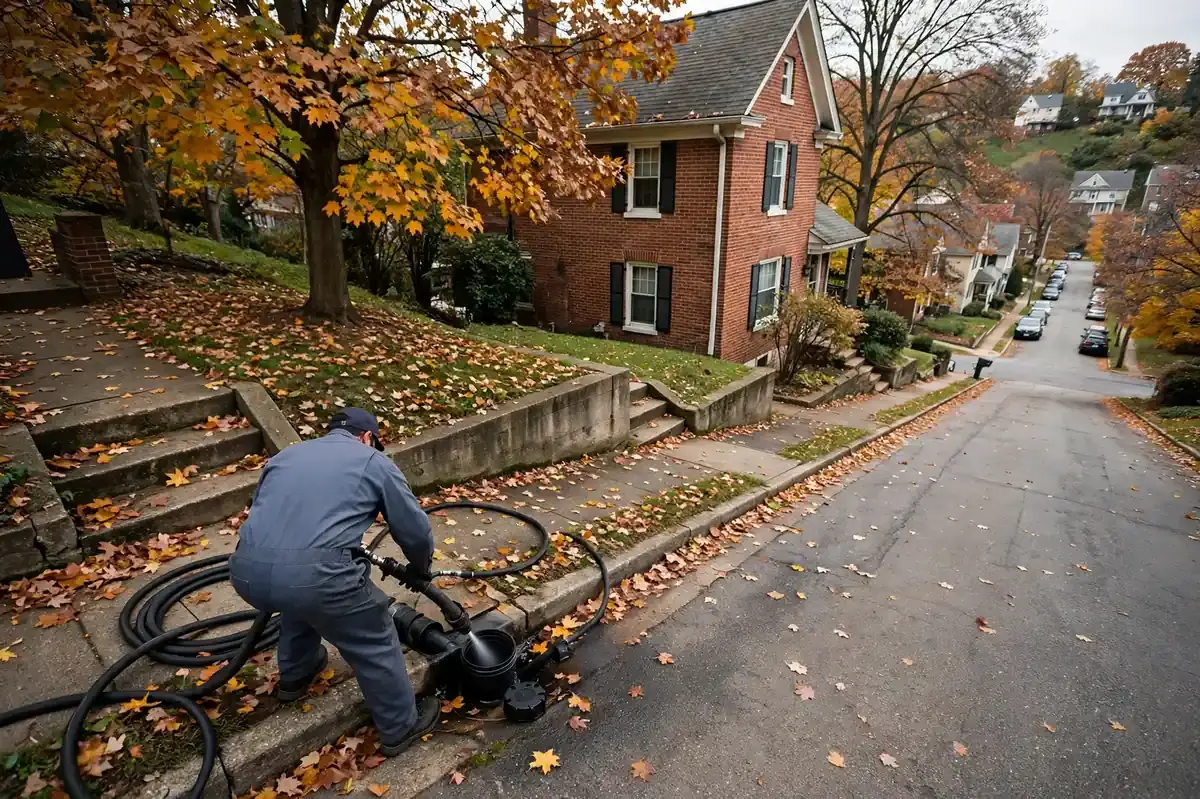
Hydro Jetting in Cincinnati, OH
In Cincinnati, a drain or sewer line gets cleaned with high-pressure water — that is hydro jetting. The spray takes grease, scale, and small roots off the walls, and the line drains freely again. A camera checks the pipe before and after the wash. Call (833) 878-1592 to get an estimate.
Updated 2026-11-18. Cincinnati, OH · Hamilton County · Population 314,915. Prices shown are estimates only.
- 314,915 Population
- Hamilton County
- 71 ZIP codes served
- Hyde Park Neighbourhood
Before & after in Cincinnati
Before & after
Drag the slider to compare the same pipe before and after jetting.
Hydro jetting in Cincinnati
Hills are the Cincinnati drain problem
Cincinnati is a city of hills, and hills decide how sewers behave. A line that runs down a slope can develop a low spot where the grade flattens out.
That low spot holds water, drops its solids, and builds a layer that narrows the pipe a little more each year. A line that runs under a retaining wall is hard to reach if it ever needs a repair, and the wall itself can shift the ground around the pipe.
The camera is the tool that reads a hillside line. It shows the grade changes, the dips, and the spots where water stands.
A dip reads on camera as a pool the lens has to push through — a picture no symptom inside the house can give you. Washing clears the layer out of a dip, and flow improves at once, but the low spot stays, so the buildup returns faster than it would in a line with proper fall.
A line that clogs in the same place again and again is usually talking about its slope, not about what went down the drain.
Hydro jetting in Cincinnati
Hyde Park: old brick on a slope
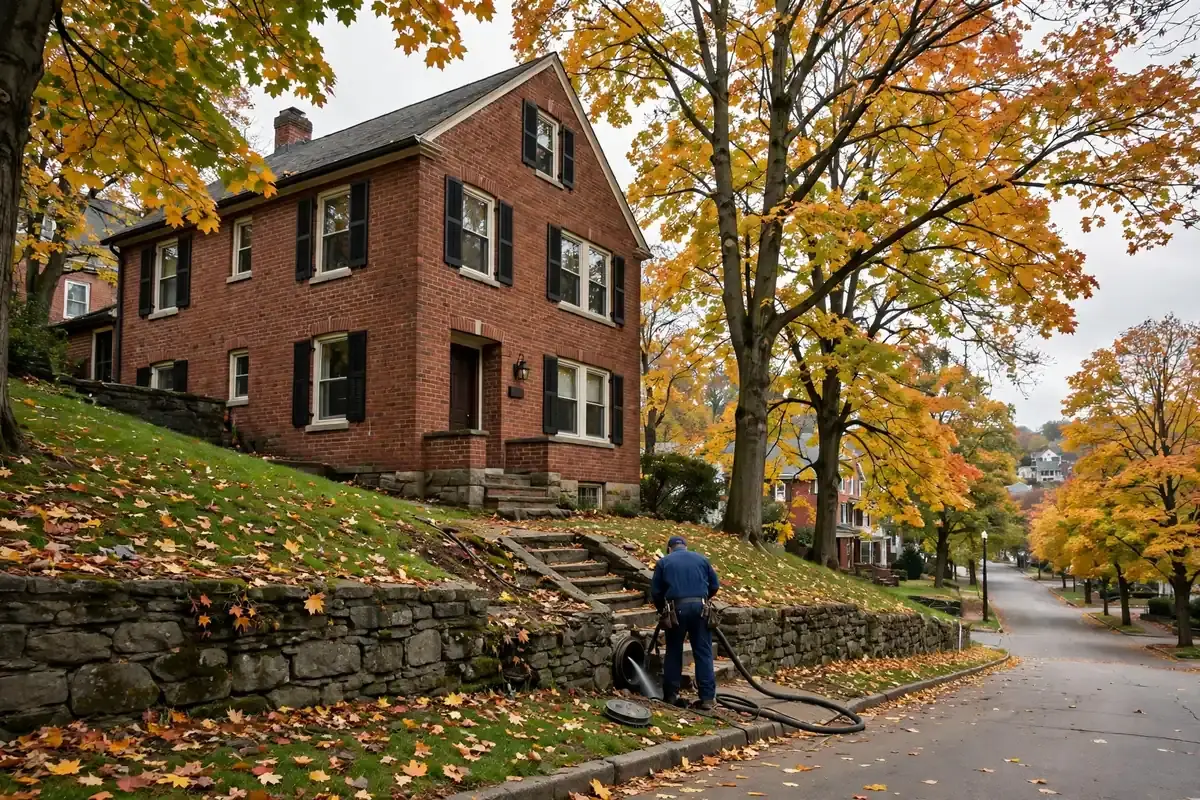
Hyde Park is one of Cincinnati's older streetcar neighborhoods, a grid of brick homes and tree-lined streets east of downtown, and its drains carry the age of the housing. Most Hyde Park homes date from the early 1900s, with cast iron or clay sewer lines running from a basement cleanout out to the street.
After a century, that iron is rough inside, and the roughness catches grease and paper faster than a smooth new pipe would.
The hill is the second Hyde Park factor. Many lots slope down toward the street, and a sewer line following that slope can develop a low spot where the grade flattens.
The camera matters twice over here: it shows whether the line is sound and only dirty, or whether a low stretch will keep causing trouble until it is regraded. Oakley faces the same iron and root pattern, while Mount Adams adds steeper grades and tighter lots.
Watch the basement floor drain after the first hard rain of spring, too — a drain that gurgles or weeps in a storm is warning you the main is narrowed, even if the upstairs fixtures still seem fine.
Hydro jetting in Cincinnati
The hills add to the bill
Picture a Hyde Park house on a slope. The sewer line runs steeply from the house, then levels off near the street, and that flat stretch is where the trouble gathers.
Finding it takes a camera, and cleaning it takes a wash — and both are priced by the job, not by the hour. For a Cincinnati house, the bands run $250 to $500 for a single slow drain, $350 to $650 for a full main line, and $600 to $1,200 for heavy buildup or commercial work.
Those figures are estimates from national ranges, not a fixed quote. The camera look at the start sets the price for your house — it shows the run's length, the coating, and the material.
Three things push the number up or down. The slope is the first: a line that flattens near the street takes longer to map than a line that falls steadily.
The pipe is the second: iron and clay that have spent decades underground are often thin, so the crew works them gently. The distance is the third: a back bathroom far from the street needs more passes than a kitchen branch near the cleanout.
Ask for the price in writing before any water flows, and ask the technician to show you the camera picture. A price that matches the picture is one you can trust.
Hydro jetting in Cincinnati
Reading a hillside pipe
A hillside sewer line in Cincinnati does not run flat, and only a camera can show you its grade. The lens goes in at the cleanout and sends back a live picture — most often a gray-brown grease coat, a pale mineral crust, a root tangle at a joint, or a stretch where water stands because the grade has flattened.
A locator marks the spot and the depth from above ground, so the crew knows where the trouble sits without opening the yard.
The picture decides the fix. Grease and scale come off under the jet, and the bore opens up.
Roots cut away, but the tree is still growing, so the question becomes whether a yearly wash will keep up or whether the joint itself wants a repair. A flat stretch fills with water again a few weeks after washing, which means cleaning alone will not hold it.
A split or caved section is a repair, not a wash. The camera earns its keep by showing you which one you have.
Cincinnati on Wikipedia has background on the city and the Ohio River.
Hydro jetting in Cincinnati
The hill houses
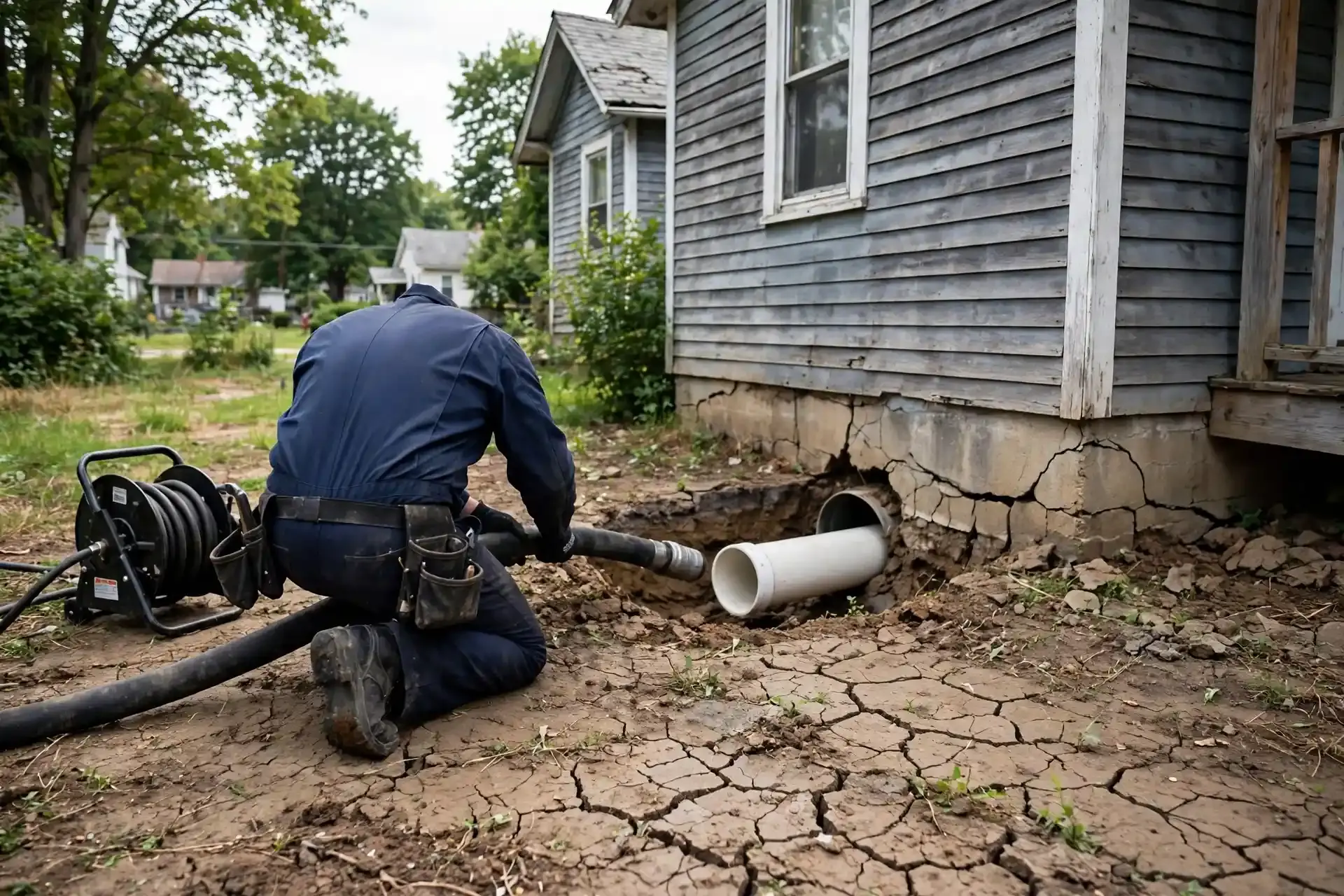
The brick houses on Cincinnati's hills clog most — Hyde Park, the older streets on the slopes, the historic districts. Many of them still use the pipe they were built with.
Cast iron and clay tile, buried when the streets were new, have spent decades underground. Iron roughens with age, and a rough wall catches grease and paper far faster than a smooth one.
Clay joints shift a fraction over the decades and let fine roots in. When the whole house slows down on the same day, the main is the likely culprit, and a full wash is the sensible move — after a camera look, because old iron can hide a thin spot the jet should not press.
The flatter neighborhoods mostly have PVC, which stays smooth inside and keeps roots out. Those houses clog too, but the cause is usually kitchen grease, laundry soap, or lint, and a standard pass handles it.
PVC does not complain about a normal wash. Old iron wants a careful nozzle, so the spray does not punch through a thin wall.
The build year is a clue, not a verdict. A 1920s brick house on a hill with a replaced line can out-drain a 1970s house where grease has gone down the sink nightly for years.
Hydro jetting in Cincinnati
Ohio River water and your drains
Greater Cincinnati Water Works draws on the Ohio River, and the water it delivers carries a fair load of dissolved minerals. Look at your own taps: the white crust on a faucet, the film on a shower head — that is mineral scale, and your drains carry the same crust.
It settles out whenever water stands in a pipe and dries, laying down in thin layers until the bore narrows and grease and soap gain a hold. Kitchen and laundry lines feel it first, because hot water gives up its minerals as it cools.
A snake cannot touch scale. It bores a hole through the blockage and leaves the crust on the walls, so the drain slows again within months.
The jet strips the wall back to bare pipe. The result lasts longer if the house tackles the cause: a softener, or a habit of flushing the kitchen line with hot water after dishes.
White crust on the taps means scale in the drains, and in an old iron line it grips harder, because the iron underneath is already rough.
Hydro jetting in Cincinnati
Maples, oaks, and the joints they find
The maples and oaks that shade a Cincinnati yard spread wide roots hunting for water, and a fine root that finds a weeping joint slips inside and thickens. Once it is thick enough it starts snagging paper, grease, and waste, and your drains slow down a little more every month.
The first sign is often a toilet that gurgles when the washer drains, or a floor drain that backs up after a long shower.
Cincinnati's hills make the problem sharper. A line that follows a slope can develop a low spot where the grade flattens, and that low spot holds water, drops its solids, and draws roots in.
The crew slices the root mass out with a cutting nozzle, then runs the camera again to see the joint with the roots gone. When the same joint fills every year, the lasting answer is a repair of that joint, not another wash.
The tree is not the problem. The joint is.
Hydro jetting in Cincinnati
How long a hillside wash holds
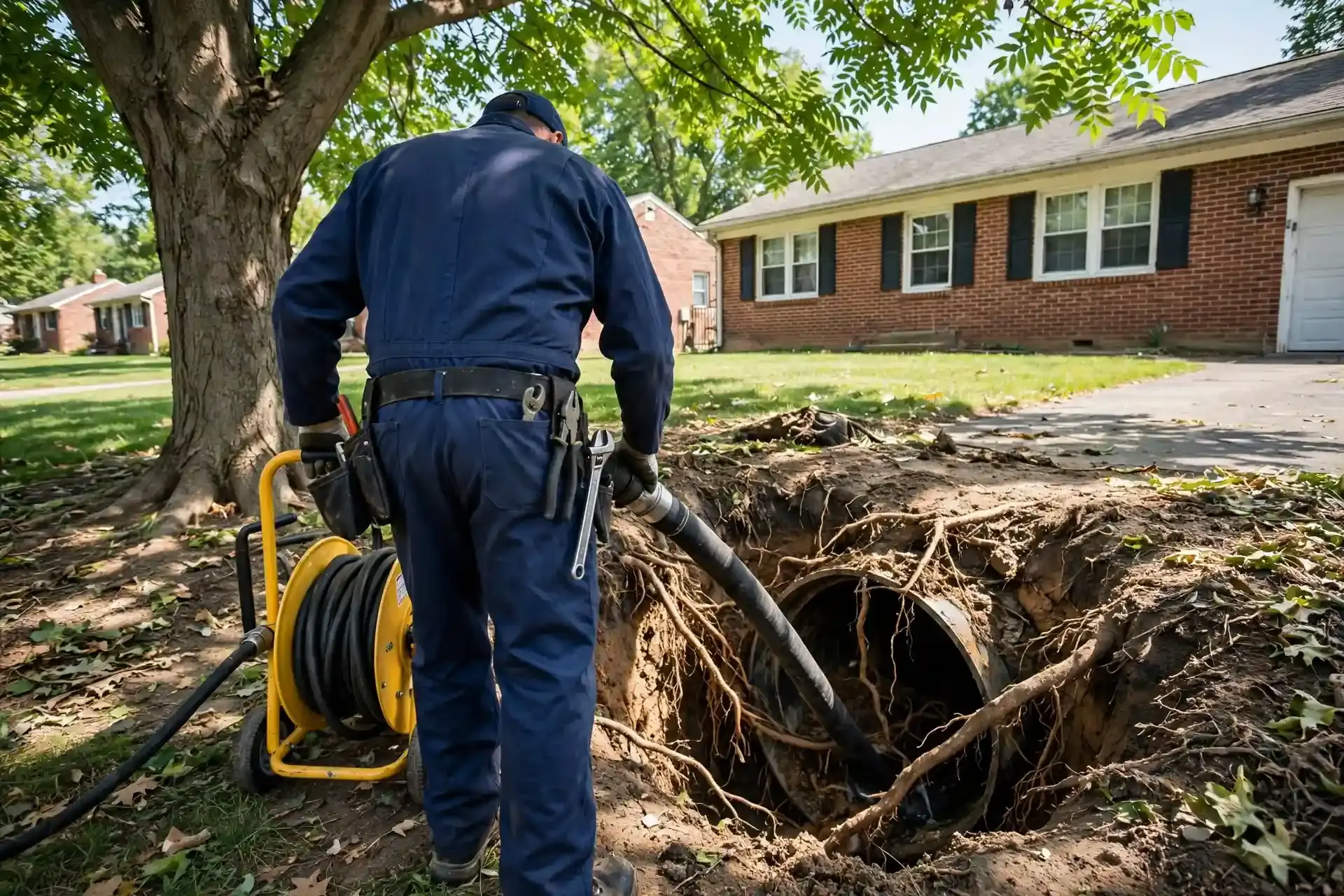
A Cincinnati wash holds for one to three years, and the spread comes down to the pipe and the habits. A PVC line in a newer house, coated in grease, can stay clear for years once the kitchen changes: wipe the pans, keep grease out of the sink, run hot water after dishes.
An old iron line on a hillside may want another wash sooner, because the rough iron catches grease again fast and roots grow back through the same joint. What the camera shows after the wash tells you which house you live in.
Two washes in one year means something else is wrong. A spot repair, or a line replacement, usually costs less over time than washing the same stretch again and again.
A short camera check every year or two costs far less than an emergency backup call, and it catches a root mass while it is still small.
Hydro jetting in Cincinnati
Winter on a hillside
A Cincinnati winter can freeze a pipe, and the risk is real where the line sits shallow or exposed. A buried sewer line below the frost line usually keeps flowing — the ground insulates it, and wastewater carries warmth.
The trouble spots are basement lines, exposed pipes, and cleanouts near the foundation, where cold air reaches the pipe. A line already narrowed by grease or scale freezes faster, because slow water gives up its heat sooner.
Spring brings the second test. Heavy rain and snowmelt send a rush of water through the drains, and a partly blocked line shows its weakness then.
A basement floor drain backing up during a thaw usually means the main line wants a wash, not that the snow is to blame. Autumn is the time to act: a camera look and a wash before the first hard freeze.
A line clean in October usually carries the house through winter and the spring rains without trouble. Insulating exposed basement pipes and keeping the basement warm helps, but a clean line is the real protection.
Hydro jetting in Cincinnati
The hill test
On a Cincinnati hillside, the test is simple: start the washing machine and watch the nearest toilet. If the bowl water rises or bubbles, the main is restricted.
Flush a toilet and put your ear near the shower drain — a gurgle there means air is trapped behind a blockage in the shared pipe. Sewage coming back up through any fixture is the same warning, and so is every drain in the house slowing on the same day.
All of them point at the main line, and the main line does not get better on its own. Stop the water, stop flushing, and call (833) 878-1592 for a camera look and a wash.
A single slow fixture is a different matter. When the rest of the house drains fine, the trouble is usually a trap or a short branch, and a plunger may clear it.
Give it a day. Chemical drain cleaner is not the answer — it rarely shifts a real blockage, it can damage old pipe, and it leaves the line unsafe for a technician to handle.
If that drain slows again within a few weeks, the cause sits deeper than the trap, and a camera look is the next step.
Hydro jetting in Cincinnati
Ninety minutes, start to finish
The visit runs one to two hours in most Cincinnati homes, and the camera takes most of that. The technician starts by asking what is slow and when it began, then sends the camera through the cleanout while you watch the screen.
What that first look shows decides the nozzle, the pressure, and the distance. No washing happens until the camera has had its look.
It is quieter than you would think. The hose feeds in slowly while the nozzle fires backward, and the backward spray does two jobs at once: it strips the walls and it pulls the hose deeper.
The crew cleans one stretch, checks the drains, then moves to the next, and any stretch the camera marked gets cleaned twice. Everything the jet strips off leaves through the city sewer, so nothing crosses your floor.
Then the camera makes a second trip, and you see how the pipe looks now against how it looked before. The water is ready to use once the crew has run each fixture.
Hydro jetting in Cincinnati
What the city wants to see
The city does not ask for a permit to clean a drain. Jetting is maintenance — no pipe is cut, no trench opens, nothing about the system changes — so you book it and have it done the same week.
The camera inspection is the same: no permit, no paperwork.
The paperwork starts when the ground opens. A replaced section of pipe, a dug trench, or a new tie-in to the city main all need a City of Cincinnati permit, with an inspection once the work is done.
A spot repair is a lighter matter than a full line replacement, and work on a steep hillside may need extra care with grading and drainage. The permit cost is separate from the jetting price.
Ask your plumber which permits apply before any digging starts — unpermitted sewer work can cause trouble when you sell the house.
Hydro jetting in Cincinnati
Cincinnati beside the Ohio cities
Cincinnati shares its drain troubles with Cleveland and Dayton: the same hard river water, the same freeze-thaw winters, the same brick housing, and the same kind of prices for the work. The difference is the ground.
Cincinnati's hills mean its lines run on slopes and flat spots that the flatter cities do not see, and a camera is how you find where the grade gives out.
Columbus sits flatter, with more newer housing and more PVC lines. Toledo shares the river water and the winters but runs flatter.
Akron rounds out the picture, with the same mid-century housing and the same cast iron. Inside Hamilton County, Cincinnati is the hill city, so its plumbers see more slope trouble than their neighbors — and a camera is the fastest way to find out what yours is made of.
Hydro jetting in Cincinnati
The Ohio River, the water table, and Cincinnati drains
Cincinnati sits on the Ohio River, and the river sets the water table for the whole city. In Hyde Park and the other hillside neighborhoods, the water table is lower, and the sewer lines drain well.
In the low-lying areas near the river, the water table is higher, and a sewer line with a cracked joint takes in groundwater that adds to the flow. A line already narrowed by fat or roots shows its weakness when the water table rises, because the extra water has nowhere to go.
The Ohio River also brings humidity and heavy rain, and the hillsides that give Cincinnati its views also give its sewer lines a steep run to the street. A steep run helps the line drain, but it also means a long run, and a long run needs more passes to wash clean.
The camera shows the length of the run and the condition of the pipe, and the wash clears it from a single opening.
If your drains slow every time the river rises or the rain falls hard, the cause may be groundwater entering the line from outside, not a clog inside it. The camera tells the two apart, because the fix depends on which one it is.
A clog needs a wash. Groundwater needs a repair of the joint that is letting it in.
Signs you may need hydro jetting
- The whole house slowing down on the same day.
- A toilet bowl that rises when the washer runs.
- A Hyde Park kitchen sink that takes longer to empty than it did last year.
- A washing machine drain that spills over mid-cycle.
- The downstairs drains lagging while the upstairs runs clear.
- A musty smell from a floor drain that was not there last month.
- Water backing up into the shower when a toilet flushes.
- A hillside drain that gets slower a little more each year.
- A wet patch in the yard, directly above the sewer line.
- A cleanout cap that leaks when fixtures run.
- A drain that clogs again a month after a cable cleared it.
How it works
- 1
The camera first
The camera goes through the line from the cleanout before any water flows. It shows the grease, the scale, the roots, the grade, and the state of the old iron. The technician notes the depth and the spot of anything worth marking, and you see the same picture on the screen.
- 2
The nozzle next
What the camera showed decides the nozzle and the pressure. Old iron gets a gentle pass with a root-cutting head. A grease-coated PVC line takes a wider spray. The hose goes in at the cleanout, which keeps the work out of the living space.
- 3
The wash
The hose moves forward a section at a time, the backward spray scouring the walls as it pulls the hose along. Flow gets checked at the drains as the crew goes, and any stretch the camera flagged gets cleaned twice before they move on.
- 4
The check
The camera makes a second trip to confirm the walls are clean, then every fixture gets run to prove the flow. The cleanout cap goes back on, the work area is left tidy, and the technician walks you through the findings and what to keep an eye on.
Hydro jetting cost in Cincinnati
What does it cost?
Use these figures as a starting point, not a quote. They come from national ranges, shaped for a Cincinnati house. A short branch with light grease sits at the bottom; a long main with roots or heavy scale sits at the top. What turns the range into a firm number is the camera inspection first: it shows the run's length, its coating, and its material. In Cincinnati, hillside access, pipe age, and run length move the price most, and a clear cleanout with a short run usually lands near the low end.
| Service | Typical range (estimate) | Notes |
|---|---|---|
| Main line jetting | $350 – $650 | What most houses need |
| Branch drain jetting | $250 – $500 | One sink, tub, or laundry line |
| Severe blockage work | $600 – $1,200 | Heavy roots, grease, or long runs |
Prices are estimates only. The local company that does the work sets its own final pricing.
Questions about hydro jetting in Cincinnati