
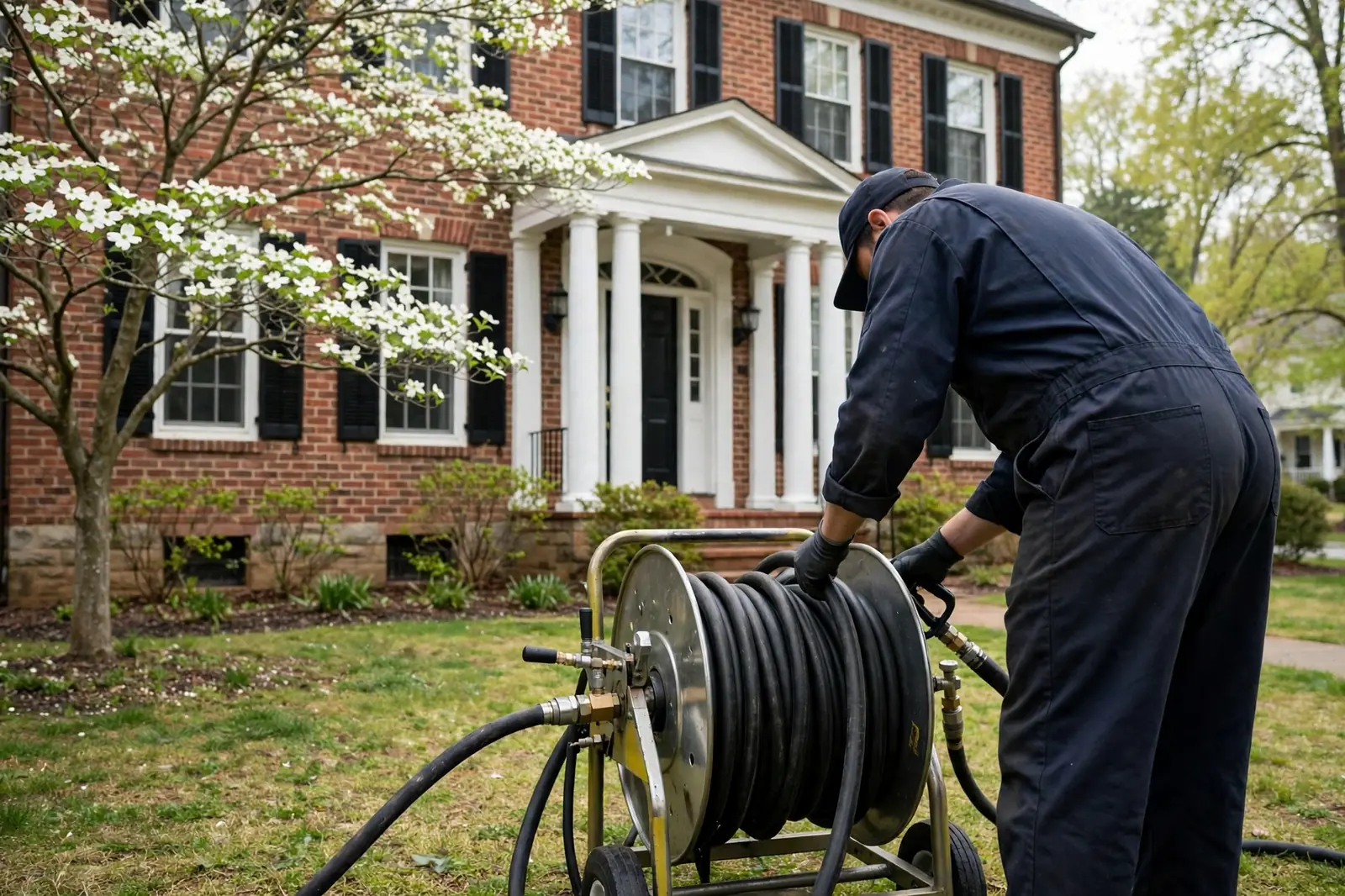
Hydro Jetting in Charlotte, NC
Hydro jetting in Charlotte, NC runs a high-pressure water nozzle through a drain or sewer line, scouring grease, scale, and root growth off the walls and flushing it out to the city sewer. It is the fix for a main line that keeps slowing down after a cable clearing. Call (833) 878-1592 to get an estimate for a Mecklenburg County home.
Updated 2026-11-18. Charlotte, NC · Mecklenburg County · Population 943,476. Prices shown are estimates only.
- 943,476 Population
- Mecklenburg County
- 75 ZIP codes served
- NoDa Neighbourhood
Before & after in Charlotte
Before & after
Drag the slider to compare the same pipe before and after jetting.
Hydro jetting in Charlotte
Red clay: the soil under Charlotte
The clay under Charlotte is old. It formed as the Piedmont hills weathered over millions of years, and it is dense, red, and stubborn.
It holds water after rain and dries hard in a hot summer, and that cycle moves pipe joints a little each year. Clay tile sewers, common in the city's older homes, are built from short sections joined with mortar, and the joints shift as the soil swells and shrinks, opening small gaps.
A tree root only needs a hairline gap to get in. It grows toward the damp leaking out of the sewer, slips inside, and thickens in the warm pipe.
The red clay causes a second problem. When a joint opens, the fine clay washes into the line and settles in low spots, building a sludge that a cable pushes through but never removes.
The camera shows both problems clearly: red-tinted sediment in a dip, and white root hairs at a joint. Jetting answers both, because the water cuts the roots back to the wall and flushes the clay sediment downstream.
After the cleaning, the camera pass shows whether the joint that let the roots in is still open. If it is, the lasting fix is a spot repair or a liner on that section, not another cleaning.
Anyone buying an older Charlotte home should ask for a camera look before closing, since the red clay hides joint trouble that no surface check can see. And anyone planting a new tree should keep big species well back from the sewer path, because in this soil, a root and a joint will find each other.
Hydro jetting in Charlotte
The quote, line by line
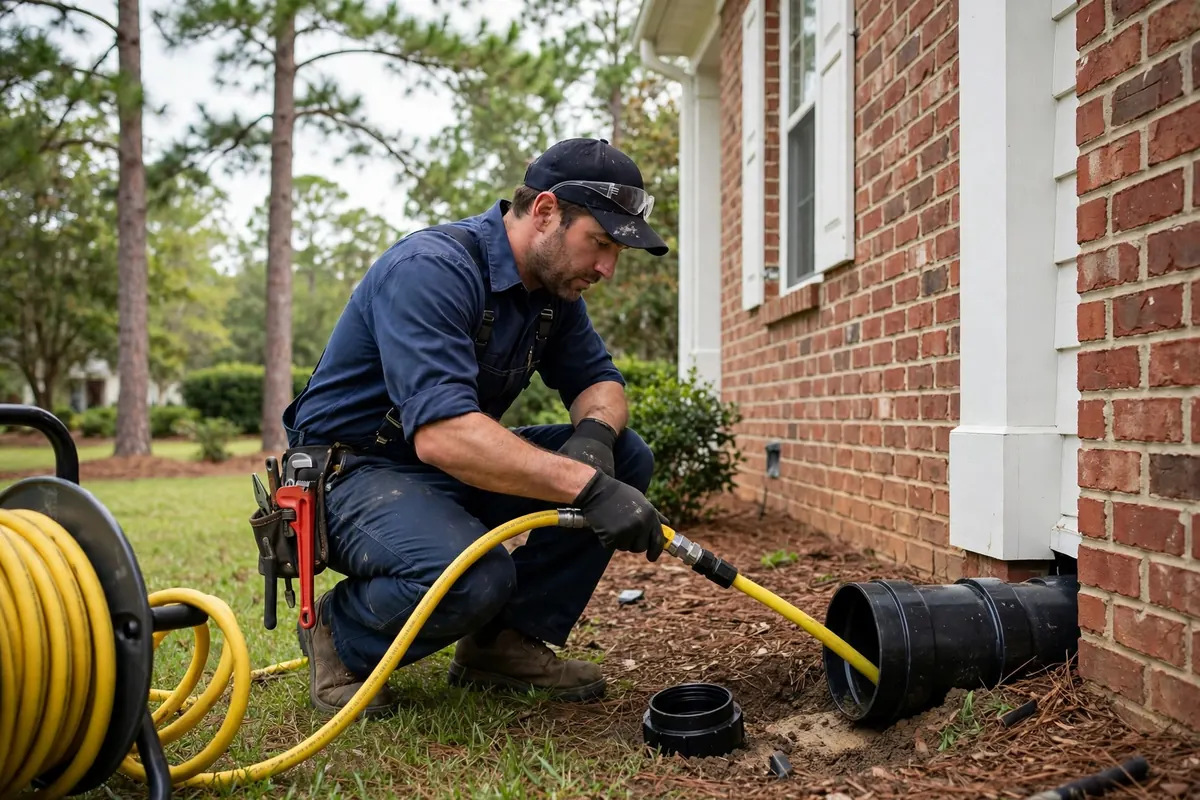
A Charlotte quote for jetting has a few lines, and each one means something. The first line is the camera look.
It is the inspection that turns a range into a figure for your line, because it shows the run length, the blockage type, and the pipe's state. The second line is the cleaning itself.
A short branch with a soft fat clog is the cheapest job: one access point, one head, one pass. A long main packed with roots, scale, or clay sediment is the dearest, because the head has to travel the whole run and make repeat passes.
The third line is access. A cleanout in open grass is the easy way in, while a line that needs the crew to pull a toilet or work down a roof vent takes longer and costs more.
The fourth line is the pipe. Smooth plastic cleans fast.
Old cast iron, rough with scale, needs slow passes and a descaling head. Clay tile needs a light hand so the jet does not open a crack wider.
The fifth line is timing. A booked weekday visit is the standard price.
A backup at two in the morning is not. Charlotte work lands near the middle of the national ranges in the table below.
Before you book, note three things: which fixtures are slow, whether the trouble came back after a cable clearing, and roughly how old the house is. Hand those to the crew at (833) 878-1592 and the figure you get will be built on your house, not on a guess.
Ask whether the price covers a second pass if the first leaves scale on the walls, and whether the camera look is part of the price.
Hydro jetting in Charlotte
NoDa's mill houses and their pipes
NoDa grew up around the textile mills, and the houses there were built for mill workers in the early 1900s through the forties. They were solid houses, and their pipes were the best of their day: cast iron drains and clay tile sewers.
A century later, those pipes are still in the ground, and they fail the way old pipes fail. Cast iron rusts from the inside, building a rough scale that narrows the pipe and gives debris something to grip.
The bottom of an old cast iron line can thin until it weeps. Clay tile comes in short sections, and the mortar joints shift as the red clay soil moves through wet and dry seasons, letting roots in and soil wash out.
The lots in NoDa are modest and the streets are lined with mature trees, so root pressure on short sewer runs is high. Many houses have had additions and remodels over the decades, which means the drain layout is rarely what the original plans show.
A camera run often turns up a junction or a rerouted branch that nobody remembered. South toward uptown, commercial lines carrying heavy grease sit next to older residential ones, while the newer suburbs to the south and east have younger plastic lines and longer runs to the street.
Across the city, the rule holds: the age of the house and the trees near the line predict the trouble better than the street name. A NoDa homeowner with a 1920s house and a large oak in the front yard should think about a camera look sooner than a homeowner in a new subdivision with no trees near the sewer path.
Hydro jetting in Charlotte
Storms, humidity, and Charlotte drains
Charlotte summers are hot and humid, and the storm season puts a real load on the city's drains. A heavy thunderstorm can drop an inch of rain in an hour, and the water runs into the yard, the gutters, and the ground around the sewer line.
A sound line handles the extra water without trouble. A line that is already half-blocked with grease, scale, or roots has no spare capacity, and the storm is often what turns a slow drain into a backup.
The rain also swells the red clay soil, which shifts pipe joints and can widen the gaps that roots enter through. Hurricane remnants reach Charlotte some years, bringing days of steady rain that keep the soil saturated and the ground moving.
The kitchen is the other summer story. Warm weather means more cooking, more grilling, and more grease down the sink, and the fat coats the pipe walls faster in summer than in winter.
A line that was marginal in spring can become a problem by August. The practical answer is timing.
A camera look and a jetting visit in late spring, before the storm season, clears the winter buildup and gives the line its full capacity for the summer rain. If a backup happens during a storm, stop using water, avoid flushing, and call (833) 878-1592, because running more water into a blocked line only pushes sewage further into the house.
After the storm, the camera can show whether the rain washed soil into the line or the blockage was already there.
Hydro jetting in Charlotte
The crew's notebook: what the camera finds
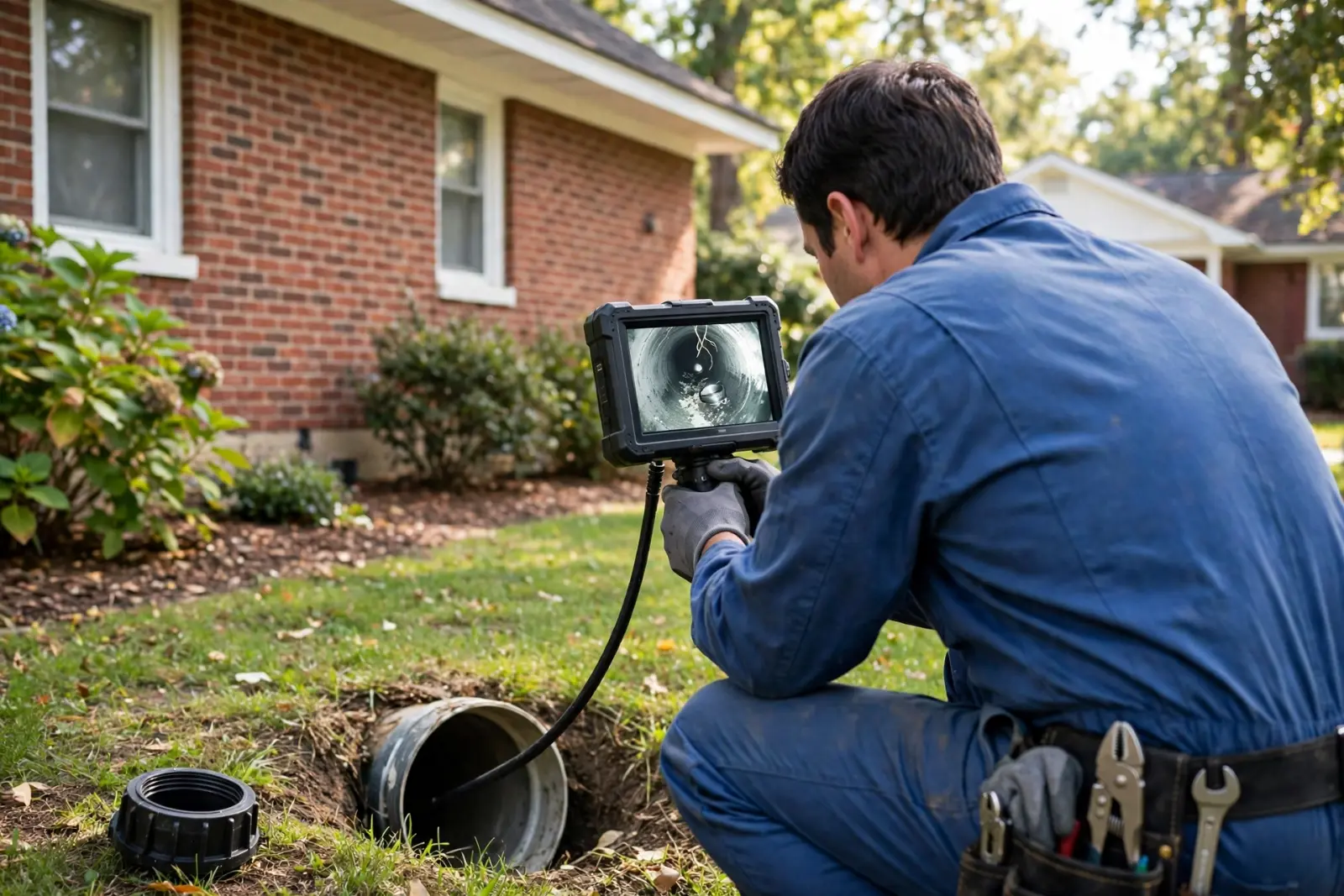
Open the crew's notebook after a Charlotte camera run and you will find one of a short list of entries. Grease: a smooth yellow-brown coating in the kitchen branch, where cooled cooking fat has narrowed the opening a little more each year.
Scale: a grey-white crust in older cast iron, rough and uneven, catching everything that passes. Roots: fine white hairs at first, then a thick mat that acts like a net for paper and waste, where a pine or oak grows near the sewer path.
Red clay sediment: a rust-coloured sludge in a dip, where a settled section holds standing water and the fine soil drops out. Then the entries that change the plan.
A clay joint shifted sideways. A section settled into a dip.
A crack with soil washing in. A pipe gone oval or flat, which is what old Orangeburg does.
Each entry points somewhere different. Grease and scale point to the jet.
Roots point to the jet plus a repair on the joint. A dip or a collapse points to repair only, and jetting a collapsed line is money wasted.
The notebook also records the simplest fact: what the pipe is made of. Cast iron, clay, Orangeburg, and plastic each take a different pressure and a different head.
Keep the recording. A year from now, a new recording next to the old one shows whether the trouble is fresh growth or the same spot giving way again.
That comparison is worth more than any guess.
Hydro jetting in Charlotte
The glass test
Fill a glass with tap water and leave it on the counter overnight. In the morning, look at the inside of the glass.
If a faint white film has formed, that is the story of Charlotte drains. Charlotte Water supplies the city from surface sources, and the water is moderately hard, which means it carries enough dissolved minerals to leave scale inside pipes over time.
The effect is slower than in the hardest-water cities, but it is real, and it shows up first around the house: white crust on the aerator, spots on the glassware, soap that never quite rinses clean. Inside the pipe, the same minerals build a crust that roughens the wall, and a rough wall catches grease, paper, and debris that would slide through a smooth pipe.
In a cast iron line, the trouble doubles, because the iron rusts into a rough surface of its own and the scale adds a second coat on top. Over decades, the crust can narrow a main line enough that the fixtures slow down even when no single clog exists.
A cable is the wrong tool for this. It bores a channel down the middle and leaves the crust on the walls, so the line narrows again within months.
The jet is the right tool. Its sprays chip the crust off and carry the pieces downstream, and the pipe comes back close to its original width.
The scale will return, because the water does not change, so the sensible move is a camera look once a year. Charlotte Water publishes the city's water quality reports, and they are worth a read if you want to know what is reaching your home.
Hydro jetting in Charlotte
The crew's ranking: five price drivers
Ask a Charlotte crew what moves the price and they will rank it the same way every time. First, the blockage.
Soft grease washes out in one pass. Hard scale, thick root mats, and packed red clay need slow repeat passes and a special head, which is more time on site.
Second, the length. Charlotte lots range from small NoDa plots to deep suburban ones, and a main that runs a long way to the street takes more hose, more water, and more passes than a short one.
Third, access. An open cleanout is the cheap way in.
No cleanout means a toilet pulled or a vent used, and both add setup time. Fourth, the pipe itself.
A sound line takes full pressure. A cracked or sagging line needs a gentle hand, and a collapsed section cannot be jetted at all until it is fixed.
Fifth, timing. A booked daytime visit is the standard price.
A backup at night is not. The camera shows four of the five before a drop of water flows: the blockage, the length, the access, and the condition.
Only timing is yours to control, and the way to control it is to book before the trouble becomes an emergency. If the number looks high, ask which of the five is driving it.
Sometimes a new cleanout, a repair on one joint, or a weekday booking brings the next visit down. A crew that can explain the price in those terms is a crew you can trust with the pipe.
Hydro jetting in Charlotte
One January night
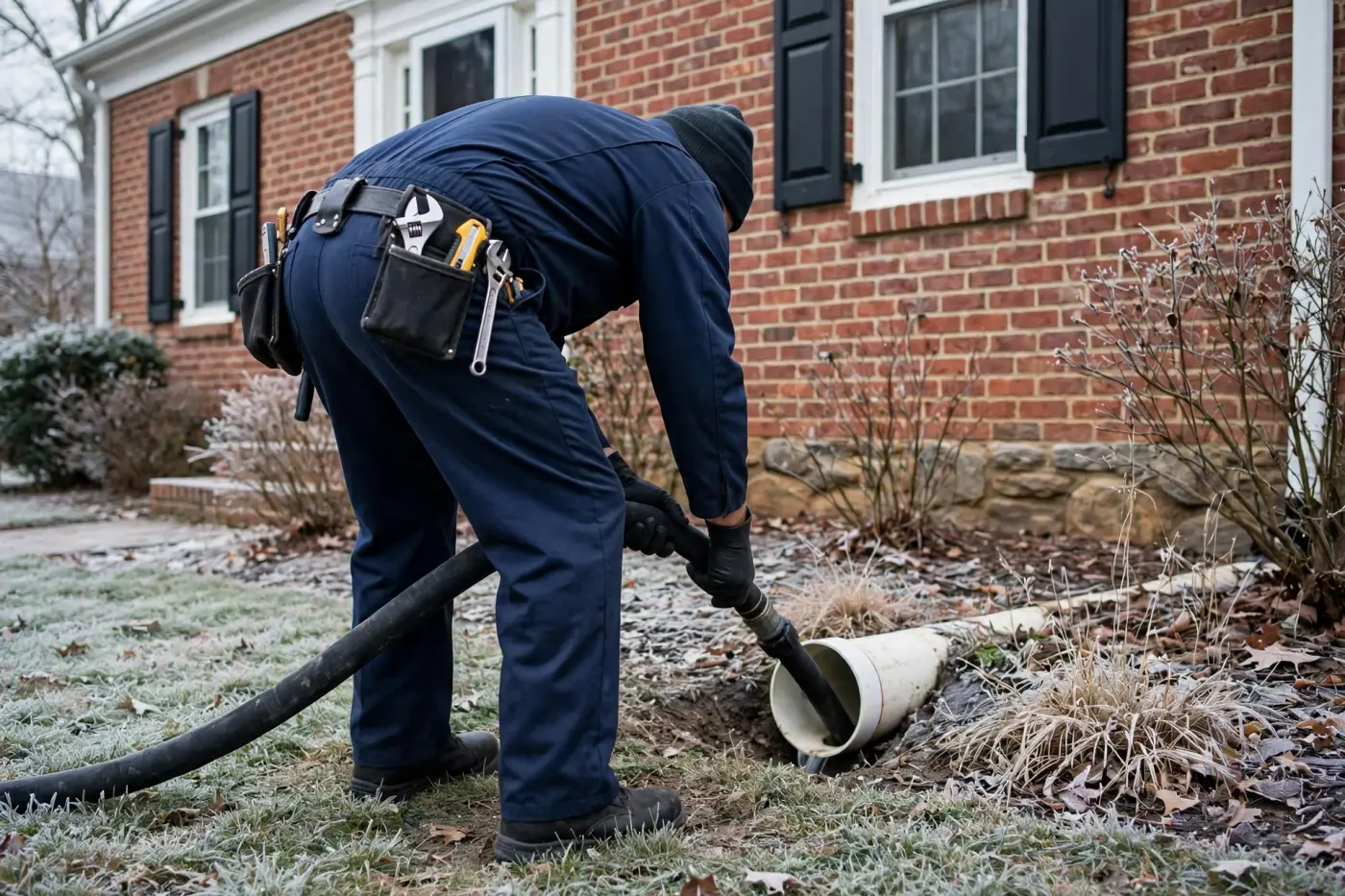
Picture a January night in Charlotte. The forecast calls for the teens, and the wind finds every gap in the house.
Pipes run through unheated crawl spaces, attics, and exterior walls with thin insulation, because the building style assumes the cold will not last. By midnight, water in an exposed line has frozen, swelled, and split the pipe.
The split stays hidden until the thaw, when water starts running into a wall or under a floor. Drain lines freeze differently.
A clear line has little standing water in it, so there is nothing to freeze. A half-blocked line is another story: a sagging section full of slow water can freeze solid, and the drain stops completely until the weather warms.
Charlotte winters are usually mild, but the city gets cold snaps most years, and a short freeze can cause trouble in houses built for mild weather. The fix is mostly preparation, and it is cheap.
Wrap exposed pipes before the first cold night. Seal the gaps where wind reaches a pipe run.
Let a tap drip when the forecast calls for the teens. Learn where the main shutoff is now, not while water is running across the floor.
For the drains, the best freeze defence is a clean line, and autumn is the time to get one. A jetting visit in October or November clears the grease and scale that would otherwise sit and freeze.
If a drain does lock up in a freeze, leave it alone and call (833) 878-1592 after the thaw.
Hydro jetting in Charlotte
What you will see on the day
You will see the truck park outside, and you will notice the loud equipment stays in it. The crew walks a hose to the cleanout, not a machine through the living room.
You will see the camera go in first, and you will watch the picture on the monitor with them. They point at what they see and say what it means in plain words.
You will see the crew pick the head for the job: a pointed head to open a path through a heavy clog, a spinning head to scour the walls, a cutting head to chew through roots. You will hear the hose move through the line in slow passes, and you will hear the sound change when the line opens up.
The flow at the fixture tells the rest of the story. Then you will see the camera go back in.
That second look is the proof: clean walls along the run, water moving fast, every slow fixture tested one by one. A home main line usually takes a couple of hours.
A long run or a heavy root job takes longer, and the crew will say so before they start. Before they leave, they tell you what they found, what the pipe looks like now, and how soon to look again.
The paperwork is done on the spot. What you keep is a clean line and a recording of what it looks like inside, which is more useful than a receipt when the next problem shows up.
Hydro jetting in Charlotte
Red flags and yellow flags
Red flags mean call now. Sewage coming up in a tub, a shower, or a floor drain is a red flag.
A toilet that overflows after a normal flush is a red flag. Gurgling in one fixture every time another one runs is a red flag, because it means the main line is close to full.
A drain that was cleared a few months ago and is slow again is a red flag too, because a repeat clog means the cable only opened a hole and the real coating is still on the walls. Yellow flags mean book a visit soon.
A house with known roots or heavy scale deserves a camera look once a year, even when everything drains well, because small growth is cheap to clear and big growth is not. Drains that get a little worse each month are a yellow flag.
Gurgling that shows up more often is a yellow flag. A cable visit twice in one year is a yellow flag.
All three mean the walls need scouring, not another hole punched through the middle. Green flags mean watch and wait.
A single sink that drains slowly while everything else runs fine is usually a local clog, and a plunger may sort it. A one-off slow drain after a big cooking session, which then recovers fully and stays fast for days, is worth watching rather than rushing.
The trap is letting a yellow flag turn red. Jetting is the fix for a pattern.
Book it while the flag is still yellow, not after it becomes a backup at midnight.
Hydro jetting in Charlotte
Charlotte against Raleigh
Charlotte and Raleigh sit in the same Piedmont region, so their drain trouble looks alike at first glance. Both cities sit on red clay that swells and shrinks with the seasons, both have moderate-to-hard water that builds scale, and both have older central neighbourhoods with cast iron and clay tile lines.
The differences are smaller but real. Charlotte is the larger city, with more commercial lines carrying heavy grease in and around uptown, while Raleigh has a bigger share of mid-century houses with Orangeburg and early plastic sewers.
Charlotte's housing leans older in the central districts like NoDa, while Raleigh's growth has spread further into newer suburbs with younger lines. The storm risk is the same, since both cities catch summer thunderstorms and the occasional hurricane remnant, and the freeze risk is the same too, with short cold snaps most winters.
The work itself barely changes. The same camera, the same heads, the same pressures, set by the pipe rather than the postcode.
What changes is what the camera tends to find: more commercial grease and root pressure on the Charlotte side, more mid-century pipe on the Raleigh side. Prices track each other closely.
The hydro jetting service covers both cities, and hydro jetting in Raleigh, NC and hydro jetting in Durham, NC describe the same work in those cities.
Signs you may need hydro jetting
- Your Charlotte kitchen sink runs fine at breakfast and crawls by dinner, even with a clear strainer.
- The toilet gurgles as the washer drains, a sign of air trapped behind a main-line blockage.
- The tub in a NoDa house holds water long after the shower is off.
- The downstairs drains run slow while the upstairs ones still run fine.
- A sewer smell comes back to a floor drain days after a cable visit, because the coating is still on the walls.
- The same main line clogs twice in a year, which means the walls were never properly scoured.
- White crust on the faucet aerators shows up alongside slow drains, a sign mineral scale is growing inside the pipes.
- A pine or oak stands in the front yard and the sewer keeps slowing down.
- A drain backs up during a heavy summer thunderstorm, when the line has no spare capacity.
- The floor drain fills when the dishwasher runs, pointing to a shared branch line.
- Red-tinted sludge shows in a floor drain, a sign clay soil is washing into a low spot in the line.
How it works
- 1
Survey the line on camera
The crew sends a camera down from the cleanout and you watch the picture together. It maps the blockage, the pipe material, and any cracks or dips, so the pressure fits the weakest section and nothing is jetted blind.
- 2
Set the rig outside
The jetter stays in the truck and only a hose comes to the access point. The crew fits the head the picture calls for: pointed to open a heavy clog, spinning to scour scale, or cutting to chew through roots.
- 3
Flush it clean in slow passes
The head works the line in slow, steady passes, spraying forward and back. Grease melts, scale chips away, roots are cut to the wall, and the debris rides the flow out to the street sewer.
- 4
Confirm the flow on camera
The camera goes back in to show clean walls down the whole run, and each slow fixture is run to check the flow. The crew explains what they found and how soon the line should be looked at again.
Hydro jetting cost in Charlotte
What does it cost?
The figures below are estimates from national ranges, not a quote for your home. Your number comes from the camera look before work, which shows the blockage, the run length, and the pipe's state. A short branch with soft grease costs far less than a long main full of roots or scale, and a night-time backup costs more than a weekday visit you planned. Call (833) 878-1592 with the age of the house and which fixtures are slow for a realistic figure.
| Service | Typical range (estimate) | Notes |
|---|---|---|
| Main sewer jetting | $350 – $650 | What most houses need |
| One-line jetting | $250 – $500 | One branch only |
| Severe or commercial jetting | $600 – $1,200 | Roots, thick grease, long pipes |
Prices are estimates only. The local company that does the work sets its own final pricing.
Questions about hydro jetting in Charlotte