
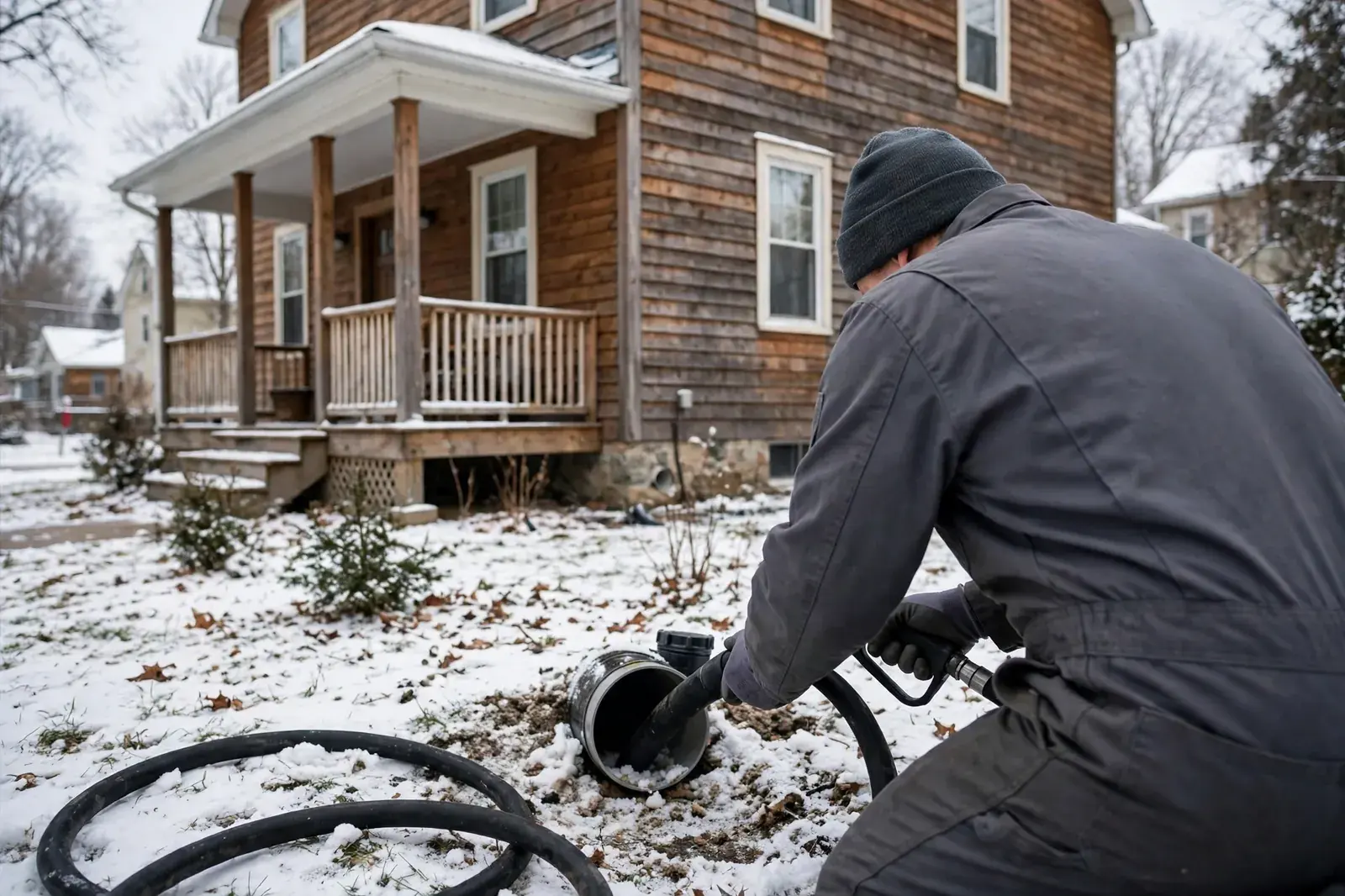
Hydro Jetting in Buffalo, NY
Buffalo drains suffer most in winter, when grease sets fast in cold pipe and freeze-thaw opens joints for roots. Hydro jetting sends water at high pressure through the line and strips grease, scale, soap film and roots from the full inner wall. Call (833) 878-1592 to book a visit.
Updated 2026-11-18. Buffalo, NY · Erie County · Population 276,617. Prices shown are estimates only.
- 276,617 Population
- Erie County
- 12 ZIP codes served
- Elmwood Village Neighbourhood
Before & after in Buffalo
Before & after
Drag the slider to compare the same pipe before and after jetting.
Hydro jetting in Buffalo
Lake-effect snow, spring melt, and the Buffalo drain
Buffalo sits at the eastern end of Lake Erie, and lake-effect snow can bury the city in a day. When that snow melts, the ground around a sewer line takes in a great deal of water at once.
The soil soaks, shifts, and a joint that was tight in January opens a little by April. A root that was thin in winter thickens across the spring.
The first slow drain of the year often arrives in April or May, and people blame the melt, when the trouble is really a line that was already narrowed by grease and scale and could not carry the extra load.
The melt loads the house as well. Winter clothes, blankets and towels all go through the laundry at once, and the extra hot water exposes a line that was already slow.
Basements feel it first, because the floor drain sits lower than every other fixture. A camera pass in the autumn, before the snow season, is the best defence: a clean line carries the melt the way a coated one cannot.
If the drains slow after the thaw, the ground has moved, and the line deserves a look before the next storm adds its own weight.
Hydro jetting in Buffalo
The bill has three parts
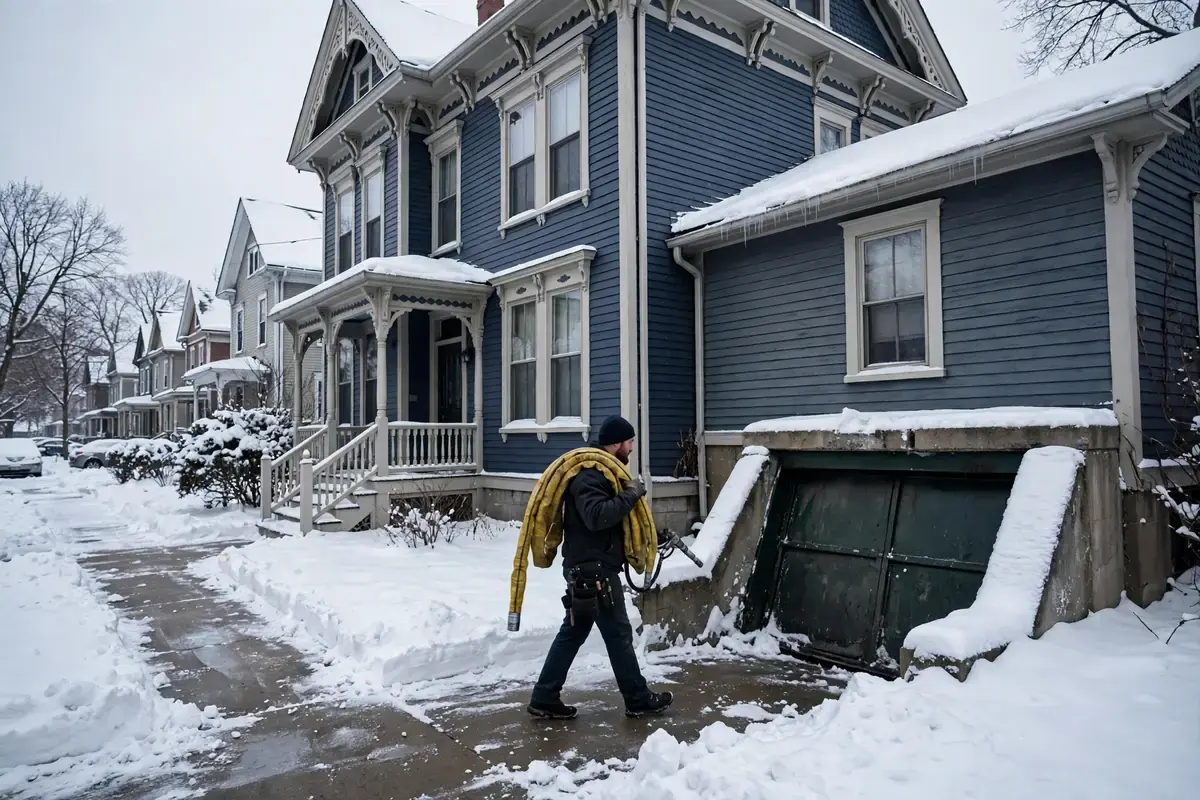
A jetting bill in Buffalo is really three charges added together, and understanding them helps you read the figure you are given. The first part is the camera pass, the survey that maps the line before anything is washed.
The second is the wash itself, priced by the length of the run and the thickness of the coating, because a long main with a root tangle takes more time and more water than a short branch. The third is the flow test and the second camera pass at the end, which proves the work.
Winter changes the second part most. Old iron wants slow, gentle passes at lower pressure, and gentle takes longer.
A basement cleanout reached through a tight utility room takes more setup than a clear yard cleanout, and in January the crew may spend time clearing snow before the work begins. A restaurant line, thick with fat, takes the longest session of all.
Ask for the figure on paper after the camera pass, with the three parts written out separately. That sheet is the only fair way to compare two visits, because a price quoted over the phone cannot see the line, and two houses on the same street can carry different figures when one has roots and the other does not.
Hydro jetting in Buffalo
Reading your Buffalo house: how old is the pipe?
You can guess a great deal about your sewer line from the house itself, before anyone opens a cleanout. A Buffalo home built before 1960 almost certainly has cast iron or clay pipe, and a home built after 1990 almost certainly has PVC.
Between those dates, it depends on the street and the builder. The cleanout tells you more: a cast iron cap in the basement points to an older line, while a white plastic cap in the yard points to a newer one.
The fixtures tell you something too. A house that still has its original tubs and toilets has usually kept its original pipe as well.
Why does the age matter? Because it decides how the wash is done.
Old iron wants a camera pass first, low pressure, and slow, gentle passes. PVC takes a standard wash without fuss.
A crew that asks the age of the house before starting is doing the job properly. A homeowner who knows the age, and can tell the crew, saves time and gets a better result.
If you are unsure, the year the house was built is on the county records, and the camera pass will settle the question in minutes. The pipe does not lie on a screen.
Hydro jetting in Buffalo
Snowmelt, gutters, and the ground around your line
A Buffalo yard in April is a wet place. Snowmelt soaks the ground, gutters run full, and the soil around the sewer line shifts as it soaks and drains.
A joint that was tight in January can open a little by April, and a root that was thin in winter thickens across the spring. The first slow drain of the year often arrives with the melt, and people blame the water, when the trouble is really a line that was already narrowed by grease and scale and could not carry the extra load.
Gutters and grading matter more than most homeowners think. A downspout that dumps water beside the foundation keeps the soil around the line wet, and wet soil moves.
In older Buffalo homes, some downspouts were tied straight into the sewer, which loads the line every time it rains. A camera pass shows whether your downspouts are part of the problem.
The fix is simple: carry gutter water away from the house, keep the yard graded so water runs off, and wash the line in the autumn so it goes into winter clean. A line that is clean before the snow season carries the melt the way a coated one cannot.
Hydro jetting in Buffalo
Downspouts tied into the sewer: a Buffalo habit worth checking
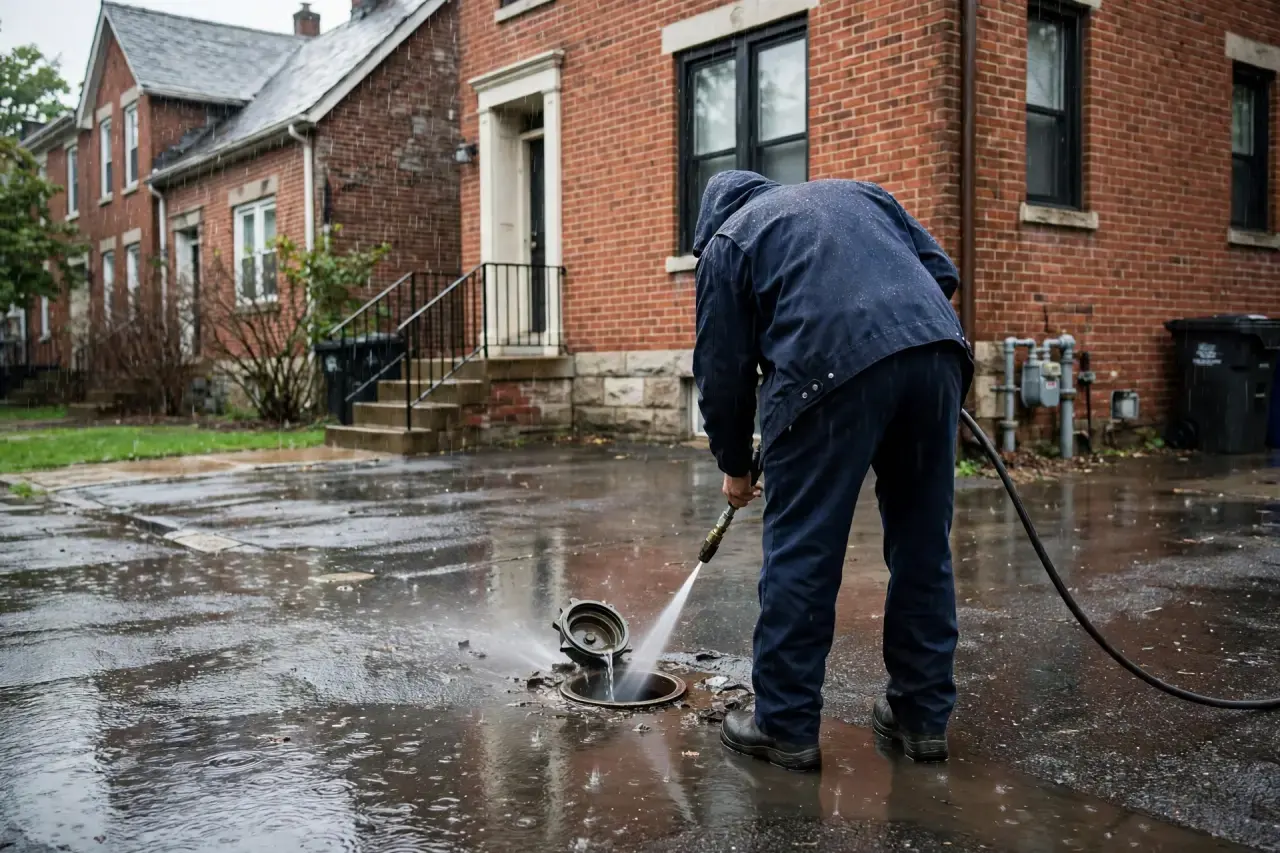
In many older Buffalo homes, the downspouts run straight into the sewer line. It was common practice when the houses were built, and it seemed sensible at the time: rainwater had to go somewhere.
The problem is that every storm then loads the sewer with water it was never meant to carry. A line that is already narrowed by grease or scale cannot take a storm surge on top of the household flow, and the result is a backup through the lowest fixture in the house, usually the basement floor drain.
A camera pass shows whether your downspouts join the sewer, and where. The remedy is to disconnect them and carry the water away from the foundation with extensions or a dry well, which also keeps the soil around the line drier and more stable.
That one change can turn a house that backs up every spring into a house that does not. It is worth asking the technician about during the visit, because the camera is already in the line and the answer is on the screen.
A sewer that only carries household water is a sewer with room to spare when the household needs it most.
Hydro jetting in Buffalo
Maples: leaves above, roots below
Buffalo streets are lined with maples, and every autumn their leaves fill the gutters. The roots do their work out of sight, in the soil below, and they are the bigger problem for a sewer line.
A maple root follows moisture, and a sewer line is the steadiest moisture in the yard. A hairline gap at a clay or iron joint is an open door, and one fine root slips in, thickens, and becomes a tangle that snags paper and waste.
The drain that ran fine in spring starts to gurgle by late summer.
A root tangle does not mean the pipe is finished. A cutting head on the jetter shears the tangle away and flushes it downstream, and the camera then shows the joint itself.
A sound joint means the line goes back to work, with a camera pass on the calendar for next year, because the roots will return. A cracked or separated joint means the tangle will grow back quickly, and the honest next step is a repair at that one spot.
Any home with a large maple within twenty feet of the sewer should have the line looked at as routine upkeep, not as an emergency. The leaves in the gutter are a reminder to look below as well as above.
Hydro jetting in Buffalo
The disposal: what it can and cannot eat
A garbage disposal feels like a solution to kitchen waste, and in a Buffalo home it is often the start of the problem. The disposal grinds food into small pieces, but those pieces still have to travel the line, and grease travels with them.
In a cold pipe, grease sets fast, and the ground-up food sticks to the grease layer. Over a winter of cooking, the line builds a coating of fat and food that a snake can only bore a tunnel through.
Water flows for a while, the tunnel closes, and the sink slows again.
The disposal is fine for small scraps rinsed with plenty of hot water. It is not a bin for potato peels, coffee grounds, rice, pasta or bones, and it is never a place for cooking oil.
Those belong in the bin or in a sealed container. Scrape plates before rinsing, run cold water while the disposal runs and hot water for half a minute afterwards, and keep oil out of the sink entirely.
Those habits slow the coating, but they cannot remove what is already stuck there. If your kitchen sink has needed a snake more than once since the holidays, the line is asking for a wash, not another tunnel.
Hydro jetting in Buffalo
A winter visit: snow, salt, and a frozen cleanout
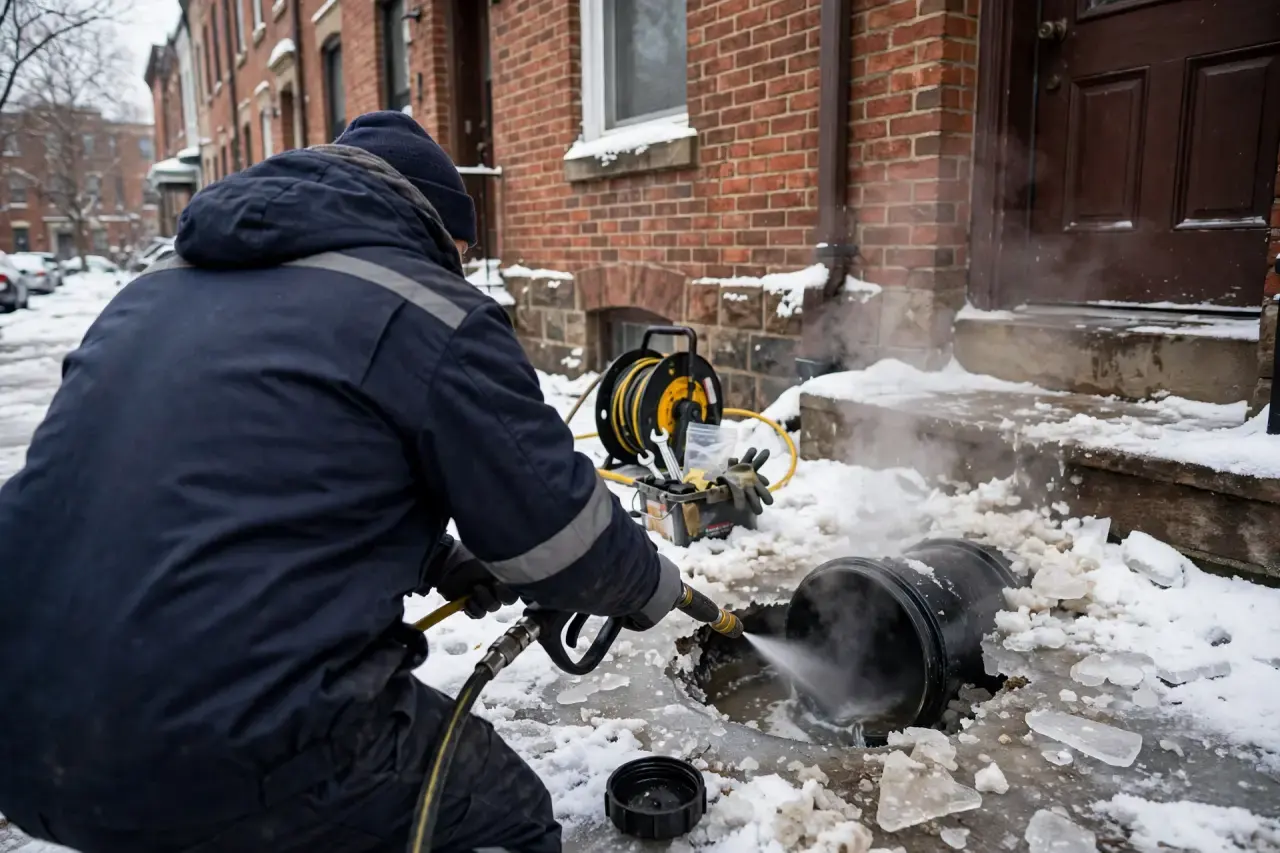
A jetting visit in a Buffalo winter starts before the crew reaches the pipe. The outside cleanout may be under snow, and the crew clears it first.
The machine runs outside, about as loud as a lawn mower, and the hose runs to the cleanout while the house stays warm inside. Salt from the sidewalk can find its way into a damaged cleanout cap, so the technician checks the cap as well as the line.
Inside, the camera goes first, always. It travels the line from the cleanout, and the technician watches for crust, grease, roots and damage, noting the distance to each problem.
That picture decides which head to use and what pressure to set. A wash that starts without a camera pass is a gamble with your pipe.
Then the jetter works in slow passes, jets facing forward to break the coating and backward to flush the debris downstream. The technician watches the water coming back until it runs clear, then puts the camera in once more.
You should see a bare pipe wall on the screen and watch every slow fixture drain at full speed before the crew packs up. Most home visits take one to three hours, and a winter visit may take a little longer for the setup.
Hydro jetting in Buffalo
After the wash: keeping the line clean through a Buffalo winter
A freshly washed line is a clean slate, and a few habits keep it that way through the cold months. The first is heat: run hot water for half a minute after washing greasy pans, so fat stays liquid until it reaches the sewer instead of setting in your own pipe.
The second is the bin: scrape plates into the rubbish before rinsing, and keep coffee grounds, rice and potato peels out of the disposal. The third is the trap: pour a bucket of water into any floor drain that rarely gets used, so the seal stays full and sewer gas stays out of the basement.
The fourth habit is the calendar. Put a camera pass on it for next autumn, before the snow season, so the line goes into winter clean again.
A line that is washed on a regular cycle never builds the coating that causes a January backup, and the visit is a planned one rather than an urgent one. The fifth habit is the simplest: listen.
A gurgle from a toilet, a bubble in a shower drain, a sink that drains a little slower than it did last month — all of those are early warnings, and early warnings are cheap. A Buffalo winter is long enough without a drain problem in the middle of it.
Hydro jetting in Buffalo
The 3 a.m. test: emergency or morning?
Some drain problems can wait until morning and some cannot, and the test is simple: is water rising, or is it only slow? If water is rising into a tub, a shower or a basement floor drain, call now, whatever the hour.
A backup spreads fast, and the water is not clean. Stop using water, avoid flushing, and keep people away from the affected fixtures until the crew arrives.
If the drain is only slow, and nothing is rising, the morning will do. One slow sink can wait a day while you clear the trap by hand and pull out any hair near the surface.
Two slow fixtures at once is a bigger problem, because it means the trouble is in a shared line or the main, and that deserves a call the same day. A drain that has slowed three times in a season, even though it clears each time, is telling you the wall is coated.
Every clearing only bores a channel through the coating. The coating is the trouble, and a wash is what removes it.
In Buffalo the riskiest wait is through a freeze, when a coated line holding water can crack at a weak joint.
Hydro jetting in Buffalo
The price is set by the house, not the map
People ask whether jetting costs more in Rochester or Yonkers than in Buffalo, and the answer is that the map has little to do with it. The crew, the machine and the hours are the same across New York.
What changes the figure is the house: how long the run is, how the cleanout is reached, how old the pipe is, and what the camera finds inside it. A Rochester home with a long run and a buried cleanout can cost more than a Buffalo home with a clear basement cleanout, and a newer home with PVC can cost less than either when the line is short and the coating is light.
The only fair comparison is a written figure after a camera pass. A phone quote cannot see the line, and two houses on the same street can carry different prices when one has roots and the other does not.
The same service is available nearby — see hydro jetting in Rochester and hydro jetting in Yonkers — and the cost table below applies across New York with the same ranges. If a crew is already working near your street, ask whether the visit can be grouped, but do not expect a price to be promised before the line has been seen.
What the camera finds decides the figure, here and in every city around it.
Hydro jetting in Buffalo
Who to call: the city, the water provider, or a plumber?
A Buffalo homeowner with a drain problem faces a simple question: whose pipe is it? The line from your house to the street connection is yours, and a blockage there is yours to fix.
The main in the street belongs to the city, and trouble there is the city's to fix. Water comes from Buffalo Water, and the sewer system carries waste away to treatment.
If every drain in the house is slow at once, the trouble is probably in your line. If the neighbours have the same problem at the same time, the trouble is probably in the street main, and the city is the right call.
Washing a drain is a cleaning, so it does not usually need a permit. A permit enters the picture when the camera pass finds damage that needs digging, such as a broken section or a new cleanout, and whoever does that digging should explain the city's steps and inspection before work starts.
Never let anyone open a sewer line without checking that first. Before any visit, find your main water shutoff and make sure it turns.
In older Buffalo homes it often sits near the front wall of the basement, and in a city where winter can freeze a pipe, a shutoff you can find in the dark is worth more than any tool. For general guidance on saving water at home, see WaterSense from the EPA.
Signs you may need hydro jetting
- Every fixture in your Buffalo home runs slow on the same morning, which usually means the main line.
- The hall toilet makes a bubbling sound when someone runs a sink elsewhere in the house.
- Washing machine water comes back up through the basement floor drain.
- A drain cleared in the autumn is slow again before the snow has melted.
- The tub fills with water when a toilet down the hall is flushed.
- The basement smells of sewer gas even though the floor drain trap holds water.
- After a holiday meal, the kitchen sink drains slowly, and the trouble is back within weeks.
- Each April, as the snow melt soaks the ground, the drains run slower than they did in March.
- The basement cleanout cap feels damp, or the concrete around it has stained.
- On the spin cycle, the laundry tub overflows because the pump pushes water faster than the line can take.
- A shower drain keeps collecting hair and soap a month after it was cleared.
- The maple that has shaded the street for decades keeps growing, and the drains have slowed a little more each year.
How it works
- 1
Find the cleanout and run the camera
The crew clears snow from the outside cleanout, or opens the basement cleanout, and runs a camera through the pipe. Crust, grease, roots, joints and any crack or sag show on the screen, with a distance marker for each one. That picture fixes the head and the pressure, and it protects old iron from being washed at a force it cannot take.
- 2
Choose the head the blockage needs
The jetter stays outside or at the basement door, the hose runs to the cleanout, and the head is chosen for what the camera found: a spinning head to scour scale and grease, a cutting head for a root tangle. Pressure stays low for old iron and higher for sound PVC. The house stays dry because the work runs through the cleanout.
- 3
Wash until the returning water runs clear
The jetter works the line in slow passes, and the technician watches the water coming back. When it runs clear, the coating is gone. When it still carries grit, another pass follows. The wash ends only when the water runs clear and the camera shows a bare wall.
- 4
Test every slow fixture, then look once more
Every fixture that was slow is run at full flow, and the camera goes back in so you can see the clean wall on the screen. The flow test and the after picture are the proof the job worked. If the camera still shows a crack or a sag, the crew talks through repair options plainly instead of pretending the wash fixed it.
Hydro jetting cost in Buffalo
What does it cost?
The table below lists countrywide estimates for 2026. In Buffalo, a short branch in a newer home usually lands at the low end, while a long main with a root tangle or thick scale lands at the high end. A restaurant line costs more still. Three local facts move the figure: the age of the pipe, how the cleanout is reached, and what the camera finds inside — old iron wants slow, gentle passes, winter work takes longer, and roots in the lake-plain soil take extra time. Get the amount in writing after the camera pass, with the pass, the washes and the final flow test listed separately, before any work begins.
| Service | Typical range (estimate) | Notes |
|---|---|---|
| Full main line wash | $350 – $650 | Most homes |
| Branch line jetting | $250 – $500 | One branch only |
| Bad blockage and commercial lines | $600 – $1,200 | Heavy coating or commercial use |
Prices are estimates only. The local company that does the work sets its own final pricing.
Questions about hydro jetting in Buffalo