
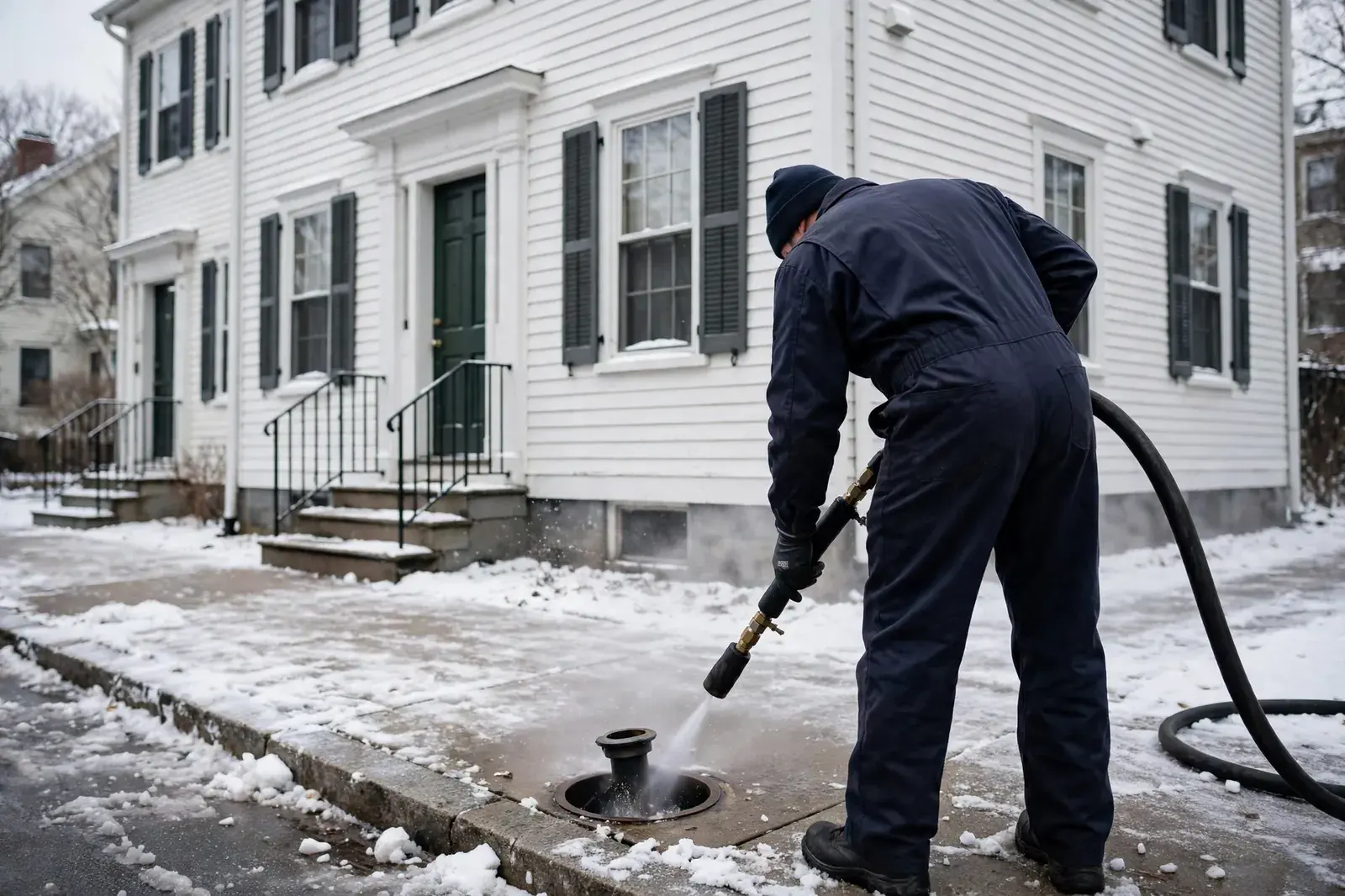
Hydro Jetting in Boston, MA
Hydro jetting in Boston clears a drain with high-pressure water, scouring grease, scale and root hair off the pipe walls and flushing it out to the sewer. It suits the city's old brownstones and triple-deckers, where a cable pass often leaves the coating behind. Call (833) 878-1592 to arrange a visit in Boston.
Updated 2026-11-18. Boston, MA · Suffolk County · Population 673,458. Prices shown are estimates only.
- 673,458 Population
- Suffolk County
- 37 ZIP codes served
- Back Bay Neighbourhood
Before & after in Boston
Before & after
Drag the slider to compare the same pipe before and after jetting.
Hydro jetting in Boston
What kind of pipes do Boston brownstones and triple-deckers have?
Boston's housing spans two centuries, and the drains show every era of it. Brownstones in Back Bay and the South End, raised in the 1800s, generally carry cast iron indoors and clay tile outdoors, running from the house to the street main.
Cast iron serves for decades, but its inner face roughens with age and gathers scale in rings, and that rough face grabs grease. Clay tile holds up well below ground, yet the mortar in its joints crumbles over the decades and leaves gaps where roots slip in.
Triple-deckers, the three-family wood houses that fill Dorchester, Roxbury and Jamaica Plain, were mostly built from the 1890s through the 1920s with the same cast iron and clay tile mix, plus long shared stacks serving three kitchens and three baths. A coating in the shared main slows every floor at once, which is why a triple-decker drain call often involves more than one flat.
Later homes, from the 1950s onward in the outer neighbourhoods, add early plastic and then PVC, which wash quickly at full pressure.
The camera, not the year on the deed, sets the pressure. A 1900s cast iron line that has stayed dry and sound can take a firm wash, while a 1970s line that has sat in wet ground may hide a weak spot the crew must work around.
That is why the call opens with a lens look rather than a hose. If the footage shows a split or a collapse, the honest answer is a repair, and jetting alone will not fix it.
Hydro jetting in Boston
Do Boston winters freeze drain pipes?
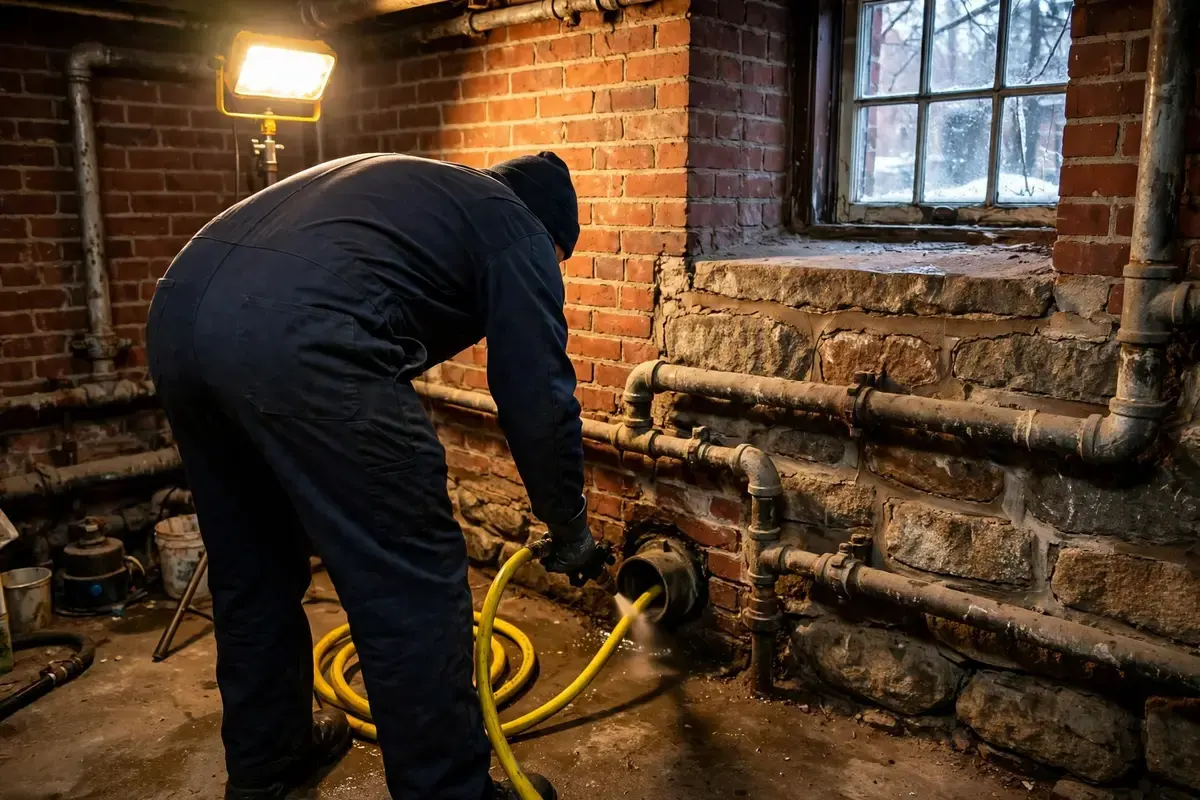
Boston winters are long and cold, and freezing is one of the main drain risks in the city. Weeks of sub-freezing weather can freeze a shallow lateral or an exposed pipe in a basement, crawl space or unheated porch.
The freeze itself rarely breaks the pipe; the thaw does the damage, when a cracked section starts leaking and the ice dam that held back water suddenly releases a backup into the lowest fixture.
Old houses carry the most risk. Pipes often run along an outside wall, through a cold cellar, or under a front stoop, and a draft through an old window or a gap in the foundation can freeze a line that would otherwise be safe.
A drain that slows sharply during a cold week, then returns to normal when the weather warms, is a sign ice was forming inside. That pattern is worth a camera look, because repeated freezing leaves rough spots that catch grease all year.
Hydro jetting helps after a freeze by clearing the debris that collected behind the ice and washing the rough spots smooth again. It does not keep a pipe from freezing, so the visit should end with plain advice on the exposed runs: insulate them, seal the drafts, and let a tap drip on the coldest nights.
Spring is the best time to book the wash, once the ground has thawed and the camera can see the full run, and autumn is the second-best window, clearing the line before the first freeze arrives.
Hydro jetting in Boston
How much does hydro jetting cost in Boston?
A brownstone quote looks different from a suburban one, and the reasons are in the building. The lateral is short, running straight from the front of the house to the street, which holds the price down.
But the pipe is old, cast iron or clay tile, and the cleanout is usually in the basement rather than the yard, which pushes the price back up: old pipe wants gentler pressure and slower passes, and a basement entry means more setup and floor protection.
A triple-decker adds its own arithmetic. One shared main serves three flats, so a wash of that main helps every floor at once, and the visit covers the whole stack in a single trip.
A single branch line, one kitchen or one bathroom drain, sits at the low end of the table below, while a full main with heavy buildup sits higher. The camera look is what places your house inside the range.
Ask for the amount in writing once the line has been seen. A fair visit puts the camera first and the figure second, and the figure should cover the wash, the second camera pass and the cleanup.
The table below shows the usual 2026 ranges for Boston. The full process is set out at how hydro jetting works.
Hydro jetting in Boston
What can a camera inspection find in a Boston home?
Think of the camera as a surveyor's tool, not just a peek inside the pipe. It measures the run as it travels: where the grease shelf sits, how far the root mat reaches, where the pipe dips into a belly and holds standing water.
In Boston the usual survey returns a grease shelf in the kitchen branch, a mat of fine roots at a clay tile joint, and a belly where filled ground has let a section sag. Each finding calls for its own nozzle and pressure.
The survey matters most when it finds trouble jetting cannot fix. A collapsed section under a sidewalk, a pipe crushed by a street tree root, or a joint pulled apart by frost heave will still block flow after the wash.
Catching that on screen before any water goes in means you do not pay for a clean that was never going to hold, and it leaves a clear record of what the pipe actually needs next.
The closing pass is the proof. Bare walls, clear running water and each fitting draining quickly are what you should spot.
Watch it with the crew. It costs nothing more, and keeping the footage with the home logs means the next call starts from a known starting point rather than from scratch.
Hydro jetting in Boston
Your basement backs up on a Sunday: who do you call?
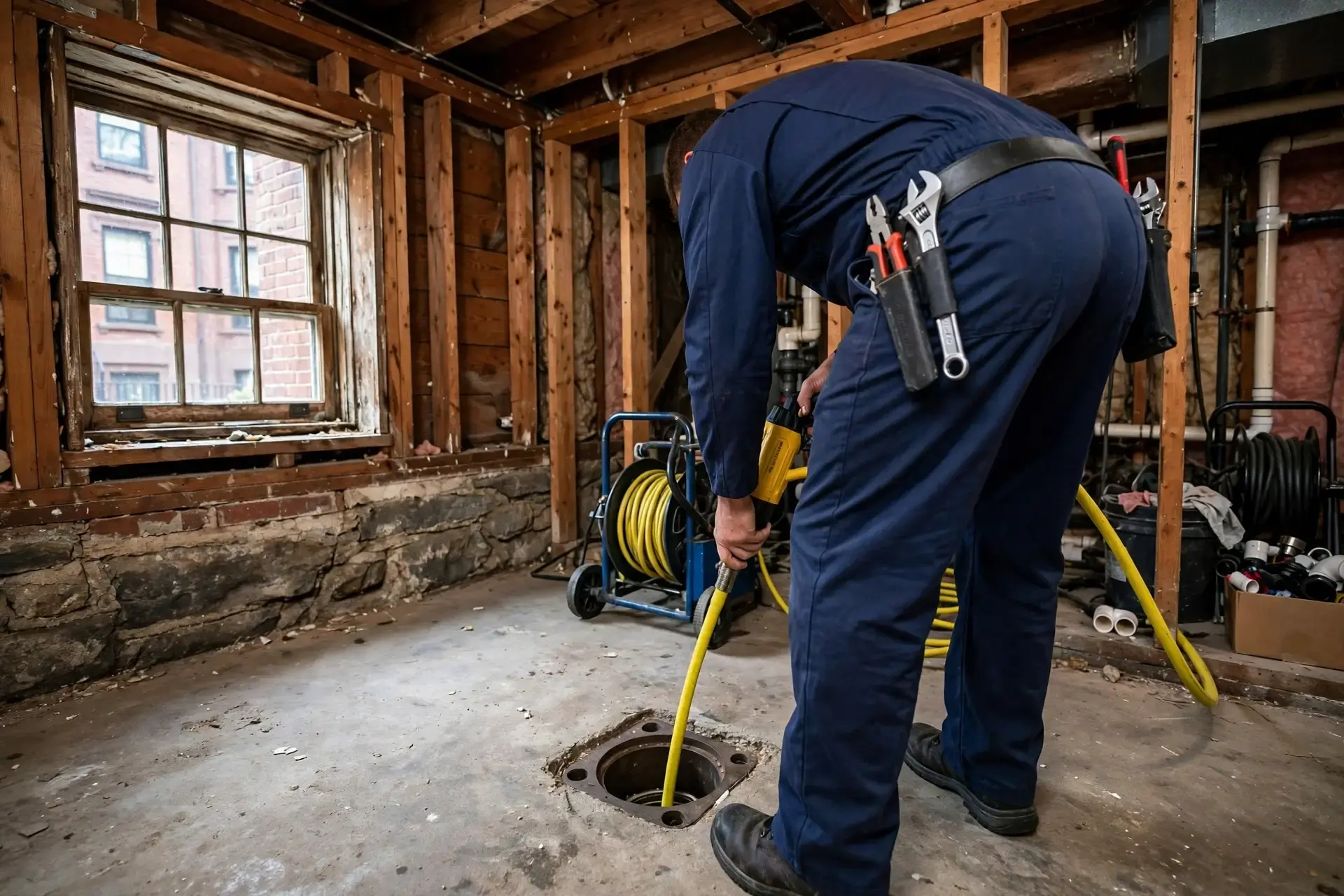
Your basement backs up on a Sunday, and the first question is who to call. The answer depends on the pattern, not the day.
If several houses on the street are backing up at once, or water is rising out of a manhole, the trouble is in the main, and that belongs to the Boston Water and Sewer Commission, which runs the mains beneath the streets. If only your house is slow, with the lowest fixture backing up first, the trouble is in the lateral, and that is the work hydro jetting is built for.
The lateral is the pipe running from your building to the public main, and a blockage in that stretch is yours to fix. That split catches people off guard: the pipe ends at a public main a few feet from the front door, yet the run to it belongs to the homeowner.
The Commission does not own it, and it will not clear it for you.
Two things are worth knowing before the crew arrives: where the cleanout sits, and whether the house has a backwater valve. The crew can track both down on their own, but a homeowner who can point at the cleanout saves real time on site.
Some older Boston houses have no cleanout at all, and the camera stage is where that comes out, with the crew laying out the entry options before any water moves.
Hydro jetting in Boston
The Back Bay fill: what the ground under a brownstone does to the pipe
Back Bay was built on filled land. In the 1800s the city filled in a tidal bay with gravel and sand, and the brownstones went up on top of it.
That fill is the ground a Back Bay lateral runs through, and it behaves differently from the solid ground under the rest of Boston. It settles slowly over the decades, a fraction of an inch at a time, and a sewer lateral that was laid straight a century ago can sag into a belly where a section has dropped.
A belly is a low spot where water and grit sit instead of flowing away. The camera shows it plainly: a pool of standing water in the middle of an otherwise clear run, with grit settled at the bottom.
The jets can clear the grit and wash the walls, but they cannot lift the pipe back up, so a belly that keeps filling is a repair, not a wash, and the camera is what tells the two apart.
For a Back Bay house, the sensible order is a camera look first, a wash matched to the pipe, and a second camera pass to prove the result. That footage becomes the baseline, and a year later the same run shows whether the belly is holding steady or deepening, which decides whether the next appointment is a wash or a repair at that one low spot.
A line that holds its shape for a year will usually hold it for many more.
Hydro jetting in Boston
Hydro jetting in Back Bay and the older Boston streets
Back Bay holds some of the most recognisable housing in Boston, brick brownstones built on filled land in the 1800s. Those lines have served for well over a century, and the camera usually shows the same picture: a rough, scaled wall, joints that have opened a little, and root hair where the street trees have reached the lateral.
The filled ground underneath can settle over time, which adds bellies where a section of pipe sags and holds water. A careful wash at matched pressure brings those lines back to full flow without disturbing a front garden or a brownstone stoop.
The South End and Beacon Hill share that mix of age and trees, with narrow passages where a large machine cannot easily reach the back of a house. A compact jetter and a hose from the front access point take care of most of those jobs, leaving brickwork and iron railings untouched.
Triple-deckers in Dorchester and Jamaica Plain add a shared main serving three flats, so a coating there slows every floor at once and the wash covers the whole stack in one visit.
For an older Back Bay house, the sensible order is a camera look first, a wash matched to the pipe, and a second camera pass to prove the result. That footage becomes the baseline, and a year later the same run shows whether roots are coming back fast or the line is holding, which decides whether the next visit is a wash or a repair at a single joint.
Hydro jetting in Boston
Salt, snow and the street: what winter road salt does to drains
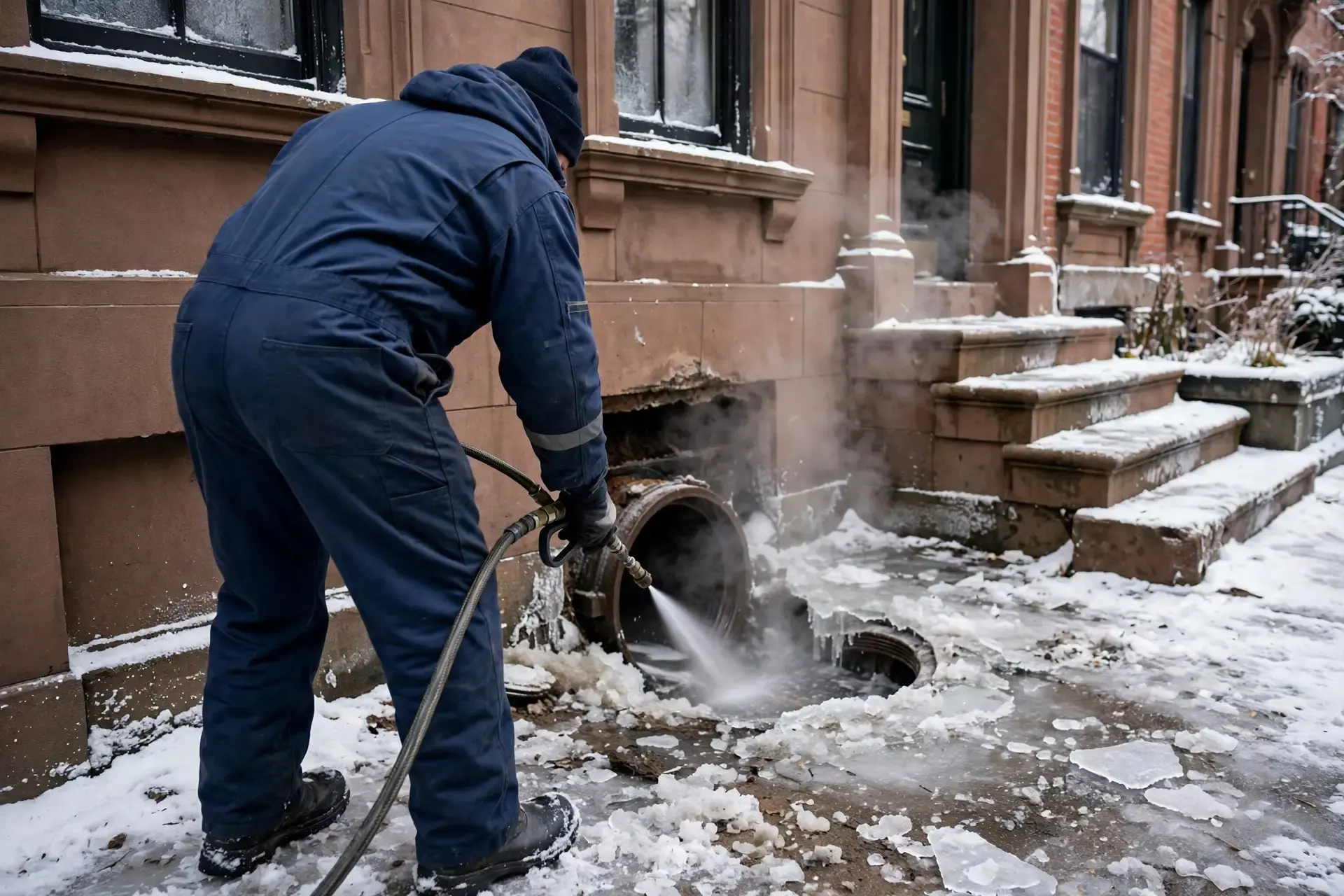
Boston winters bring snow, and snow brings road salt, and road salt ends up in the drains. The salt itself does not clog a pipe, but the meltwater that carries it does two things: it swells the clay soil around the lateral, tugging at pipe joints a little at a time, and it washes grit and sand from the street into the system, where the grit settles in any low spot and narrows the run.
The salt also works on the metal. Cast iron pipe that has carried salty meltwater for decades shows a rougher inner face than the same pipe in a salt-free city, and that rough face grabs grease more readily than a smooth one does.
The camera usually shows the result plainly: a scaled wall with a grit shelf in the lowest section, and root hair where the street trees have reached the lateral through joints the soil has worked open.
The fix is a wash in spring, once the snow has gone and the ground has thawed. The jets strip the scale and the grit shelf off the walls, and the second camera pass shows whether the joints have opened enough to need a repair.
After the wash, the habits matter more than ever: scrape fat into the bin, keep a strainer in every drain, and watch for the early warnings, a sink emptying a touch slower each week or a toilet asking for a second flush, while the job is still small.
Hydro jetting in Boston
What does a hydro jetting visit look like in Boston?
A Boston visit in winter starts in the basement. The crew asks which fixtures are slow and how long it has lasted, then finds the cleanout, often in the cellar of a brownstone or triple-decker, and sends the camera in.
You observe the screen as it moves. Grease reads as a pale shelf, roots as a fine white mat, a belly as a pool of standing water, and from that picture the nozzle, the pressure and the plan all follow.
Then the jetter comes out. The hose reel parks close to the entry, the floors by the cleanout get covered with drop cloths, and the hose works the pipe in slow passes, moving from the house toward the street so the waste leaves the system.
A spinning head clears mineral scale and fat; a cutting head shears any root tangles the lens spotted. A typical home call takes one to three hours, with the unit outside making most of the noise, about as loud as other plumbing work.
At the end you should spot the result for yourself, not just take the technician's word for it. Water runs through each slow fitting while the lens returns to show stripped walls and fast flow.
The technician should walk you through the footage, point out frail places worth watching, and leave the place tidy. Before they go, ask for the written amount and the camera record, so the next call starts from what this one found.
Hydro jetting in Boston
What a Boston home inspector looks for in the drains
A home inspector in Boston looks at the drains with a buyer's eyes, and the things they flag are the things a seller should fix first. The first is speed: every fixture should drain fast, and a sink that takes minutes to empty will be written up.
The second is the camera record: an inspector who can see footage of a clean line with bare walls will pass it without a second thought, while a line with no record at all invites a closer look.
The third is the cleanout. An inspector wants to see one, in the basement, accessible and in good order.
A house with no cleanout at all is a flag, because it means any future drain work will need an entry cut in, and that costs money. The fourth is the backwater valve: an inspector will ask whether the house has one, and whether it works, because a basement without one is a flood risk in a storm.
For a seller, the sensible order is a camera look, a wash, and a second camera pass, with the footage kept with the house records. That pair of visits costs less than a price cut after an inspection, and it leaves a record that answers the inspector's questions before they are asked.
For a buyer, the same footage is the best guide to what the drains will cost in the first year.
Hydro jetting in Boston
Triple-deckers: one shared main, three flats, one wash
A Boston triple-decker runs three kitchens and three baths into a single shared main, and that shared pipe shapes every drain problem in the building. When the main coats over, every flat slows at the same time, which is confusing at first: three households, three sets of fixtures, one cause.
The clue is the pattern. If only the top flat is slow, the trouble is usually in that flat's branch.
If all three slow together, the shared main is the culprit.
Jetting suits a shared main because the wash covers the whole stack in one visit. The camera travels from the cleanout up through the shared run, the spinning nozzle strips the coating off the full length, and the second camera pass proves the result for every flat at once.
A snake, by contrast, opens a hole in one spot and leaves the rest of the coating behind, so the building slows again within months.
For a landlord, the camera footage doubles as a record. It shows the condition of the shared line, the state of each branch, and whether the coating is grease, scale or roots.
That record settles the question of whose habits caused the problem and what the building needs next, whether that is a wash, a repair at one joint, or simply a reminder to every flat about what goes down the sink.
A second wash a year after the first is worth booking on its own. The first year after a cleaning is when the habits settle in across all three flats, and the camera at that visit shows whether the shared routine is kind to the old main or whether the coating is already building again.
Catching it early keeps the job short, and it costs far less than the emergency call that follows a backup.
Signs you may need hydro jetting
- Week by week, the kitchen sink takes longer to clear out.
- The toilet gurgles when the washer drains into the same shared main.
- Two fixtures go slow together.
- A musty smell rises from a basement floor drain after a hot, humid spell.
- The shower still holds water after the taps are off, trap already clean.
- The camera finds fine root hair at a clay tile joint beneath a street maple.
- A basement drain backs up after a heavy winter thaw or a spring rainstorm.
- A kitchen line that once cleared in seconds now drains at a crawl.
- A drain cleared by cable a few months back that is slow again already.
- The bathroom sink gurgles when the toilet is flushed.
- Dark, gritty water rises into the laundry tub after a wash.
- A drain that slows in a cold snap and picks up when the weather warms.
How it works
- 1
What happens first: the camera
From the cleanout, often in the basement, a small camera travels the line while you watch the screen. Blockage, pipe material and weak spots all show up plainly, and the wash approach comes from that picture instead of a guess.
- 2
What happens next: the rig is set up
The hose reel parks beside the cleanout and the nozzle is chosen for the job, a spinning head for grease and scale, a cutting head where the camera found roots. Floor covers go down by the entry before the pump starts.
- 3
What happens then: water does the work
The hose advances section by section and the jets scrub the walls clean while the water carries the debris out to the sewer. Working from the home toward the road keeps the waste moving out, not settling further down the line.
- 4
What happens last: the proof on screen
Water runs through each fitting that was slow to confirm fast drainage, and the lens comes back to show a clean line. Bare walls and clear water on the monitor show the job is finished, and the technician tidies up before leaving.
Hydro jetting cost in Boston
What does it cost?
Treat the figures below as the usual 2026 spread for Boston, not a price for your house. Short branches with a light film sit low; long mains with roots or a heavy mineral scale shelf sit high. In a brownstone the short run helps the figure, while the old pipe and the basement entry push it back up. The lens look before work settles it, so request the amount in writing once the line has been seen.
| Service | Typical range (estimate) | Notes |
|---|---|---|
| Main line clean-out | $350 – $650 | Typical for a house |
| Single fixture line clean | $250 – $500 | One branch only |
| Commercial and severe jobs | $600 – $1,200 | Heavy coating or commercial use |
Prices are estimates only. The local company that does the work sets its own final pricing.
Questions about hydro jetting in Boston