

Hydro Jetting in Austin, TX
Hydro jetting in Austin, TX scours a drain or sewer line with a spinning, high-pressure water nozzle, cutting through grease, limestone scale, and roots and carrying the debris out to the city sewer. It suits a main line that keeps slowing down after a cable job. Call (833) 878-1592 to get an estimate for a Travis County home.
Updated 2026-11-18. Austin, TX · Travis County · Population 993,588. Prices shown are estimates only.
- 993,588 Population
- Travis County
- 75 ZIP codes served
- Zilker Neighbourhood
Before & after in Austin
Before & after
Drag the slider to compare the same pipe before and after jetting.
Hydro jetting in Austin
Austin Water and the limestone in your pipes
Take a kettle in an Austin kitchen. Fill it, boil it, and after a month the inside is furred white.
That fur is the story of Austin drains. The city's water runs over limestone on its way to your tap, and it arrives carrying dissolved calcium.
Hard water, in other words. The minerals settle inside the pipe as a crust, a thin layer at a time, and the crust is rough.
Grease slides off smooth plastic and sticks to rough scale. Paper sticks too.
In a cast iron line the trouble doubles, because the iron rusts into a rough surface of its own and the crust adds a second coat on top. After twenty or thirty years the opening narrows enough that the fixtures slow down even when no single clog exists.
You can read the signs around the house: white crust on the aerator, spots on the shower door, a kettle that furs up fast. For this job, a cable will not do.
It bores a channel down the middle and leaves the crust on the walls, so the line narrows again in a few months. The jet is the proper tool.
Its sprays chip the crust off and carry the pieces downstream, and the pipe returns close to its original width. The scale will return, because the water does not change, so a camera look once a year is the sensible move.
The picture shows how thick the crust has grown, and the next cleaning can be booked before the line narrows enough to back up. Austin Water publishes the city's water quality reports, and they are worth a read if you want to know what is reaching your home.
Hydro jetting in Austin
What an Austin jetting job costs
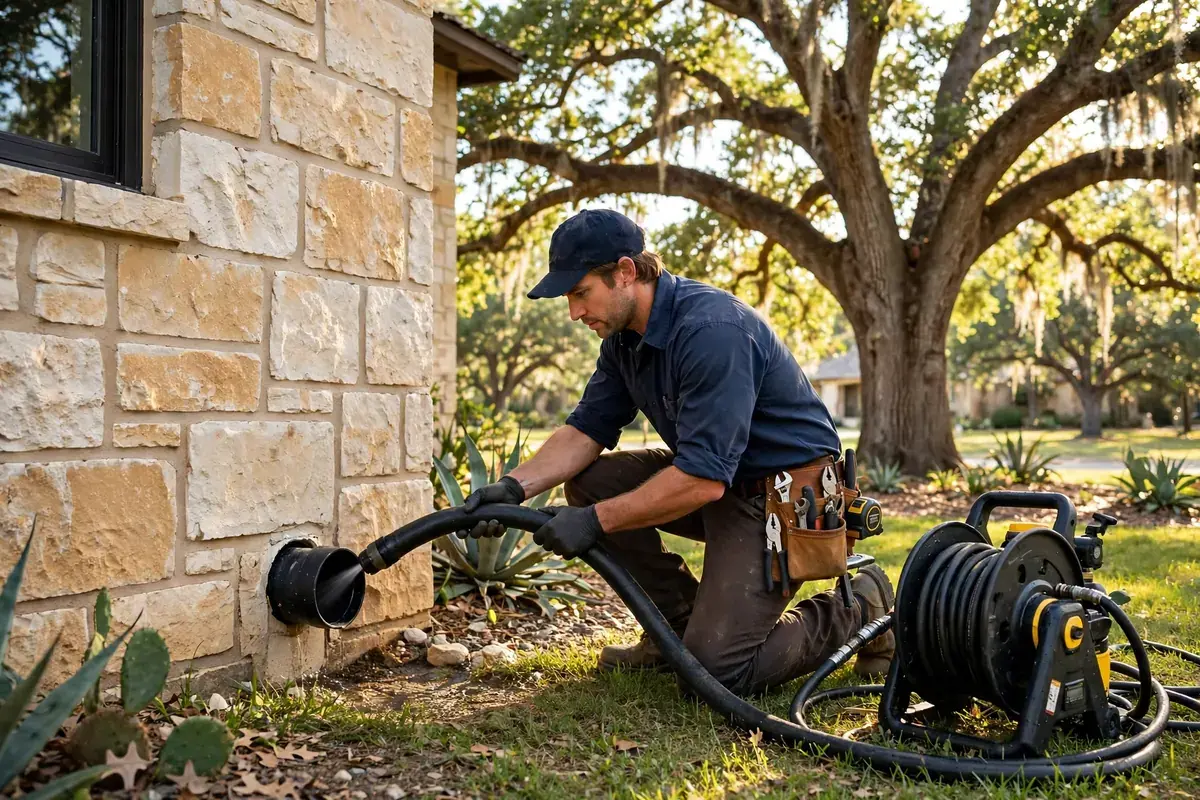
Take a house in Zilker, built in 1946, with a live oak out front. The kitchen sink drains slowly every evening.
The tub holds water after a shower. A cable cleared it in spring, and by autumn it is slow again.
The crew starts with a camera look. In this house the picture shows two things: a grey crust of limestone scale in the cast iron, and root hairs at a clay joint near the street.
The run is short, the cleanout sits in open grass by the porch, and the job lands in the middle of the table below. Now change one fact.
Move the same house to a deep lot in the northern suburbs, where the sewer runs a hundred feet to the street, and the price climbs, because the nozzle travels further and makes more passes. Bury the cleanout under a new patio, and it climbs again, because the crew has to pull a toilet instead.
Make it two in the morning with sewage in the tub, and it climbs again, because that is an emergency call. Austin work lands near the middle of the national ranges, and the camera look is what turns a range into a figure for your line, because it shows the run length, the blockage type, and the pipe's state.
Before booking, jot down three things: the slow fixtures, whether the trouble came back after a cable clearing, and the rough age of the house. Hand those notes to the crew at (833) 878-1592.
Find out if the price covers a second pass when the first leaves scale behind, and whether the camera look is included.
Hydro jetting in Austin
Clay, live oaks, and the root cycle
Walk a Zilker street in August and you will see the clay at work. The soil has shrunk in the dry heat, and cracks run through the bare earth in front gardens.
Much of Austin sits on clay that shrinks in a dry summer and swells when the rain returns, and that movement is where most root trouble starts. The soil shift opens small gaps at pipe joints, and a root only needs a hairline gap to get in.
It grows toward the damp and the nutrients leaking out of the sewer, slips inside, and thickens in the warm dark pipe. Live oaks and pecans are the usual offenders in Austin yards.
A big tree within about twenty feet of the sewer path is worth watching. A tree planted right over the line is a problem waiting to happen.
The warning signs arrive slowly. A toilet may gurgle while the washer drains.
Month by month, a tub empties a little more slowly. The line clogs, a cable clears it, and three months later it clogs again, sooner than before.
That shrinking gap between clogs is the signature of roots. A cable punches a hole through the mat, and the roots grow back thicker around the hole.
Jetting with a cutting head works differently. It strips the growth back to the wall and washes it out, so the pipe runs near full width again.
After the cleaning, the camera pass shows how much is left and whether the joint is still open. If it is, plan a repair for that section.
No cleaning closes a gap in a pipe, and in Austin clay, an open joint will keep inviting roots back every season.
Hydro jetting in Austin
Zilker's houses and their pipes
Cross Lady Bird Lake into Zilker and you are in a neighbourhood of houses from the thirties through the fifties, and their drains carry that history. The earliest are cast iron inside and clay tile outside.
Cast iron fails from the inside out: it rusts, it scales, and the bottom of the line thins until it weeps. Clay tile fails at the joints: short sections, old mortar, soil that moves every summer and winter.
A house from the forties or fifties might have Orangeburg instead, a pipe made of fibre and tar that was cheap after the war and is now softening and flattening under the soil. None of these materials is a cause for worry, but all of them change how a cleaning is done.
A setting meant for plastic pipe can harm thin, old cast iron. A pressure that cast iron handles can still split a clay joint that has moved.
That is why the camera goes in first in an old Zilker house, every time, without exception. The picture sets the pressure for the weakest section, and if the pipe is too far gone, an honest crew will say so and talk about a repair rather than a cleaning.
The trees that shade Zilker streets are part of the story too. A large live oak near the sewer path sends roots toward the moisture leaking from an old joint.
North of the lake, downtown mixes commercial lines carrying heavy grease with older residential ones, while the newer suburbs hold younger plastic lines and longer runs. Across Austin, one rule holds: the age of the house and the trees near the line predict trouble better than the street name.
Hydro jetting in Austin
The February freeze, and the next one
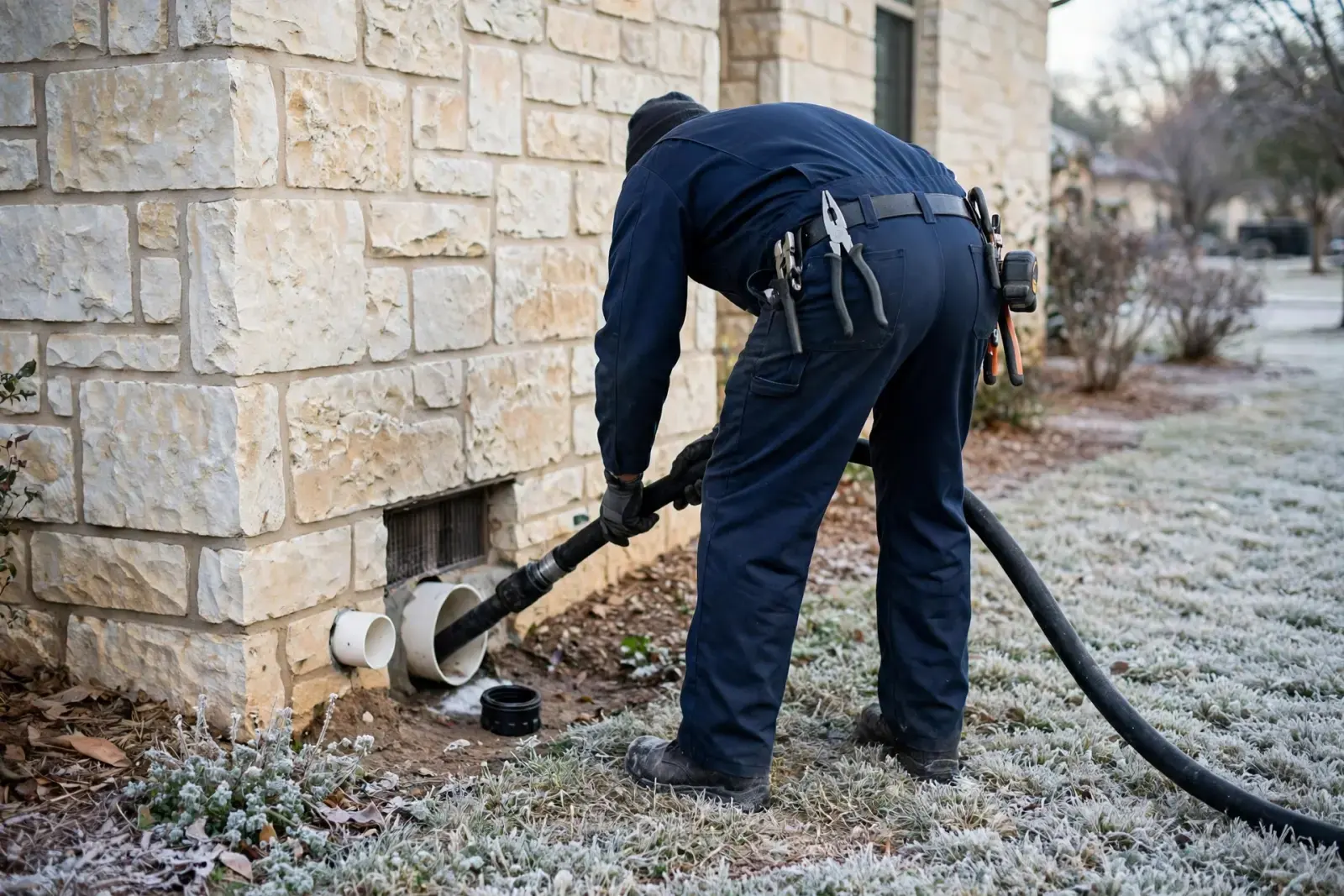
Austin is built for heat, not for hard freezes, and February 2021 showed the whole city what that means. Pipes run through attics and crawl spaces with thin insulation, because most winters never test them.
Then a front drops the temperature into the teens and parks there. Water in an exposed line freezes, swells, and splits the pipe.
The split often stays hidden until the thaw, when water starts running into a wall or under a slab. Drain lines freeze differently.
With the line clear, almost no water stands in it, so freezing has nothing to work on. A half-blocked line is a different matter.
Slow water in a sagging section can freeze solid, and the drain stops until the weather warms. The fix is mostly preparation, and it costs little.
Wrap exposed pipes before the first cold night arrives. Seal the gaps where cold air reaches a pipe run.
Let a tap drip when the forecast calls for freezing temperatures. Learn where the main shutoff is now, not while water runs across the floor.
For the drains, a clean line is the best freeze defence, and autumn is the time to get one. Book a jetting visit in October or November and the grease and scale that would sit and freeze are gone.
If a drain locks up in a freeze, leave it alone and call (833) 878-1592 after the thaw comes. Boiling water and a blind cable can both worsen a stressed pipe.
Hydro jetting in Austin
Reading the camera picture
Sit with the crew at the monitor and the picture tells its own story. First comes the kitchen branch, where a smooth yellow-brown coating narrows the pipe a little more each year.
That is grease, cooking fat that has cooled. Then the main line in old cast iron, where a grey-white crust, rough and uneven, covers the walls.
That is limestone scale, and it is why the fixtures slow down even when no single clog exists. Then a joint, where fine white hairs wave in the flow, or a thick brown mat where the growth is old.
Those are roots, and they show the joint is open. The camera also finds the things jetting cannot fix, and those matter just as much.
A clay joint that has shifted sideways. A section that has settled into a dip, holding a pool of standing water.
A crack, with soil washing through it. A pipe that has gone oval or flat, which is what old Orangeburg does.
Each finding points in a different direction. Grease and scale are a job for the jet.
Roots need the jet plus a repair on the joint. A dip or a collapse means repair, full stop.
Jetting a collapsed line wastes your money. The camera also answers the simplest question: what is this pipe made of?
Cast iron, clay, Orangeburg, and plastic each need their own pressure and their own head. Keep the recording.
A year from now, when the line slows again, a new recording next to the old one shows whether the trouble is fresh growth or the same spot giving way again. That comparison beats any guess.
Hydro jetting in Austin
Five things that move the price in Austin
Start with the blockage. Soft grease washes out in a single pass.
Hard limestone scale and thick root mats need slow repeat passes and a special head, which is more time on site. Then the length.
Austin lots range from small central plots near Zilker to deep suburban ones, and a main that runs a long way to the street takes more hose, more water, and more passes than a short one. Then access.
An open cleanout gives the crew the cheapest way in. With no cleanout, the crew pulls a toilet or uses a vent, and both add time to the job.
Then the pipe itself. A sound line handles full pressure.
Cracked or sagging pipe calls for a light touch. A collapsed stretch cannot be jetted until someone repairs it.
Then timing. Book on a weekday and you pay the standard rate.
Night-time backups cost more. Before a drop of water flows, the camera shows four of the five: the blockage, the length, the access, and the state of the pipe.
Only timing is yours to control, and you control it by booking before the trouble turns into an emergency. If the number looks high, ask which of the five pushes it up.
Sometimes a new cleanout, a fix on one joint, or a weekday booking brings the next visit down. If a crew can explain the price that way, you can trust them with your pipe.
Hydro jetting in Austin
The day of the visit
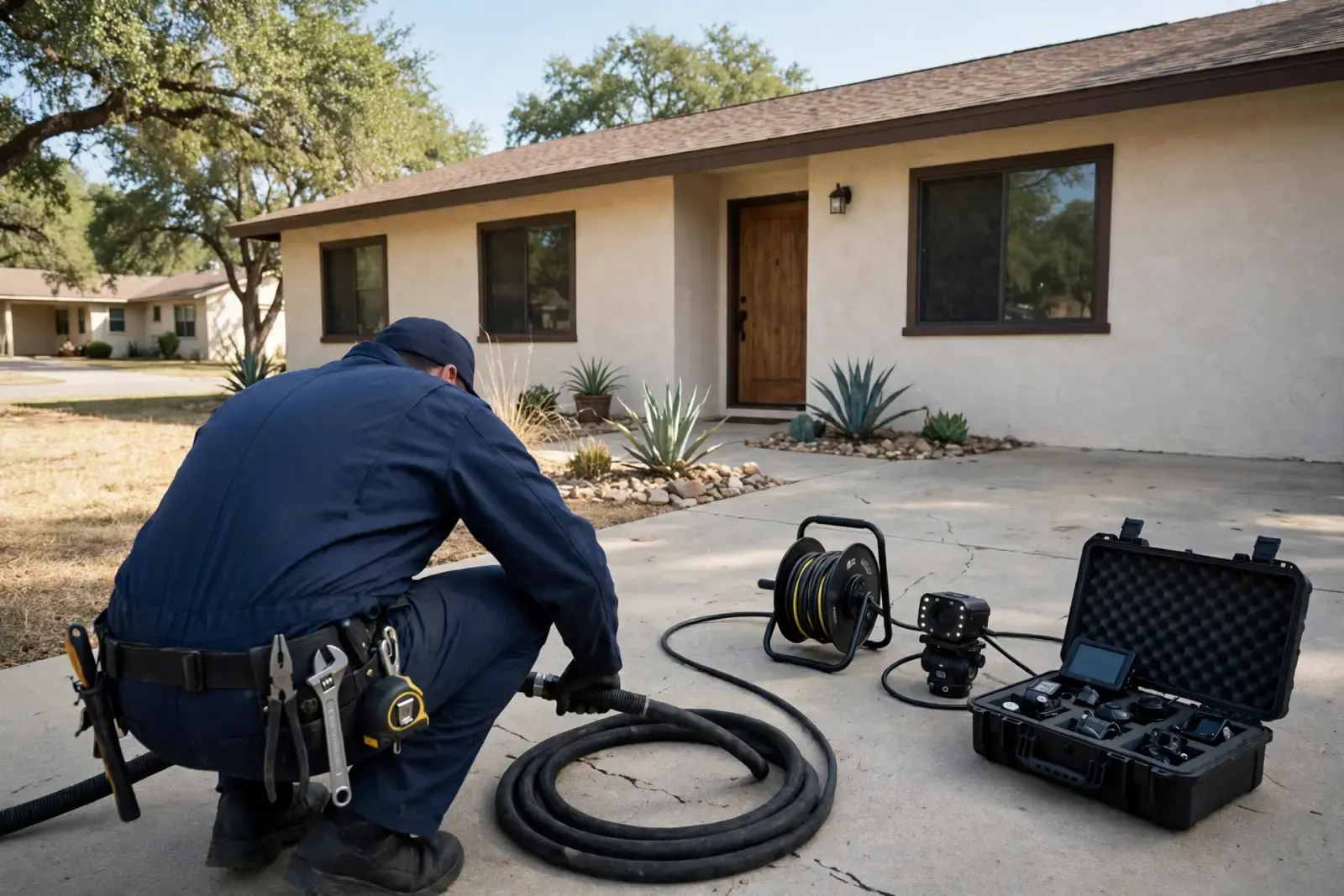
The truck parks outside and the loud equipment stays in it. The crew carries a hose to the cleanout, not a machine through the living room.
The camera goes in first, and you watch the picture with them. They point at what they see and explain what it means in plain words.
Then they pick the head for the job. A pointed head opens a path through a heavy clog.
A spinning head scours the walls. A cutting head chews through roots.
The hose moves through the line in slow passes, and the crew watches the drain and listens for the change. The sound changes as the line opens up, and the flow at the fixture tells the rest of the story.
Then the camera goes back in. That second look is the proof: clean walls along the run, fast-moving water, every slow fixture tested one by one.
A home main line usually takes about two hours. Long runs and heavy root jobs take more time, and the crew will tell you that before they start.
Before leaving, the crew tells you what they found, how the pipe looks now, and when to look again. The paperwork is finished on the spot.
What you keep is a clean line and a recording of what it looks like inside, which beats a receipt when the next problem shows up.
Hydro jetting in Austin
Call now, call today, or watch and wait?
Sewage coming up in a tub, a shower, or a floor drain means call now, not tomorrow. A toilet that overflows after a normal flush means the same.
Gurgling in one fixture every time another one runs means the main line is close to full, and that is a call today. A drain that was cleared a few months ago and is slow again deserves a call the same day, because a repeat clog means the cable only opened a hole and the real coating is still on the walls.
A yearly camera look is the right pace for a house with known roots or heavy scale, even when everything drains well, because small growth is cheap to clear and big growth is not. What can wait?
When one sink drains slowly and everything else runs fine, the clog is usually local, and a plunger may sort it. After a big cooking session, a drain may slow once and then recover fully, staying fast for days.
Watch it rather than rushing. The pattern is the trap.
Drains that worsen a little each month. Gurgling that turns up more often.
Two cable visits inside a single year. A pattern means the walls need scouring, not another hole punched through the middle.
Jetting is the answer for a pattern. Book it while it is still a pattern, not after it turns into a backup at midnight.
Hydro jetting in Austin
Austin against San Antonio
Austin and San Antonio share the same limestone country and the same swelling clay, so their drain trouble looks alike at first glance. Both cities have hard water that builds scale inside cast iron, both have live oaks and pecans that push roots into old joints, and both have central neighbourhoods with houses from the early and middle 1900s.
The differences are small, but they are real. Austin has more houses on the steep slopes at the Hill Country edge, where a sewer can run downhill fast and a settled section can hold water, while San Antonio has a bigger share of flat lots where a line runs level for a long way.
Austin's growth has been faster in recent decades, so its suburbs hold a bigger share of newer plastic lines, while San Antonio's older districts hold more of the original cast iron and clay tile. The water hardness is high in both, and the freeze risk is the same, since both cities learned the same lesson in February 2021.
The work itself changes little. The same camera, the same heads, the same pressures, set by the pipe rather than the city.
What changes is what the camera tends to find: more slope-related dips on the Austin side, more long flat runs on the San Antonio side. Prices follow each other closely.
The hydro jetting service covers both cities, and hydro jetting in San Antonio, TX and hydro jetting in Houston, TX describe the same work in those cities.
Signs you may need hydro jetting
- The Austin kitchen sink runs fine at breakfast and crawls by dinner, even with a clear strainer.
- A toilet gurgles when the washer drains, which means air is trapped behind a main-line blockage.
- The tub in a Zilker house holds water long after the shower is off.
- Downstairs drains run slowly while the upstairs ones still run fine.
- A few days after a cable visit, a sewer smell can return to a floor drain. The coating is still on the walls.
- The same main line clogs twice in a year, which means the walls were never cleaned properly.
- White crust on the faucet aerators shows up alongside slow drains, a sign limestone scale is growing inside the pipes.
- A big live oak or pecan stands in the front yard and the sewer keeps slowing down.
- In a hard freeze a drain can lock solid and stay blocked even after the thaw.
- The floor drain fills when the dishwasher runs, which points to a shared branch line.
- Water pools around a ground-floor drain after a heavy Central Texas thunderstorm.
How it works
- 1
Look first: the camera run
The crew sends a camera down from the cleanout and you watch the picture together. It maps the blockage, the pipe material, and any cracks or dips, so the pressure is set for the weakest section and nothing is jetted blind.
- 2
Rig up: hose in, machine out
The jetter stays in the truck and only a hose comes to the access point. The crew fits the head the picture calls for: pointed to open a heavy clog, spinning to scour scale, or cutting to chew through the roots.
- 3
Scour: slow passes down the line
The head works the line in slow, steady passes, spraying forward and back. Grease melts, limestone scale chips away, roots are cut to the wall, and the debris washes downstream to the street sewer.
- 4
Prove it: the second camera run
The camera goes back in to show clean walls down the whole run, and each slow fixture is run to check the flow. The crew will explain what they found and how soon the line should be looked at again.
Hydro jetting cost in Austin
What does it cost?
Use the figures below as estimates from national ranges, not as a quote for your house. The camera look before work is what sets your number, because it shows the blockage, the run length, and the pipe's state. A short branch with soft grease costs far less than a long main full of roots or limestone scale, and a night-time backup costs more than a planned weekday visit. Ring (833) 878-1592 with the age of the house and which fixtures are slow, and the crew can give you a realistic figure before they arrive.
| Service | Typical range (estimate) | Notes |
|---|---|---|
| Main drain jetting | $350 – $650 | The usual home job |
| Branch line jetting | $250 – $500 | One branch only |
| Severe or commercial jetting | $600 – $1,200 | Heavy coating or commercial use |
Prices are estimates only. The local company that does the work sets its own final pricing.
Questions about hydro jetting in Austin